
- Catalogs
- Dantec Dynamics A/S
- Wind Turbine Optimization

Wind Turbine Optimization

Wind Turbine Optimization
Wind power is increasingly recognized as a viable and cost-effective renewable energy source. The demand for efficient wind turbines has led to continuous improvements in design, placement, and performance. Modern turbines, producing over 2.5MW, require longer and lighter blades, necessitating the use of new composite materials. Optimal placement of wind farms is crucial for maximizing efficiency.
Dantec Dynamics provides state-of-the-art instrumentation for testing, inspecting, and maintaining wind turbines. Their solutions include deformation and strain measurements, non-destructive testing (NDT), air flow measurements, and validation of computational models. These tools help mitigate challenges in turbine design, manufacture, and maintenance.
Wind turbine blades are subject to various factors that can cause damage and fatigue, such as operational loads, gust loading, icing, and erosion. Non-contact measurement systems are used to optimize blade design and inspect for defects, reducing the risk of failure. Shearography is highlighted as a rapid NDT method for inspecting large composite surfaces.
In-field inspections using portable shearography systems can detect defects like wrinkles, impact damage, and delamination. These systems can inspect large areas quickly without surface preparation. Digital Image Correlation (DIC) is used for measuring 3D deformation and surface strain, aiding in various testing applications.
Blade design is crucial for optimizing aerodynamic efficiency and withstanding operational loads. Particle Image Velocimetry (PIV) is used for aerodynamic modeling, providing detailed flow field information. Understanding flow-structure interaction and flow separation is essential for improving turbine performance.
Flow separation affects aerodynamic efficiency and noise. Constant Temperature Anemometers (CTA) help determine separation points. Proper placement of turbines considers wind conditions, mean velocity, and turbulence. Laser Doppler Anemometer (LDA) and CTA are used for accurate airflow measurements.
Off-shore wind farm placement requires consideration of ocean currents, topography, and sediment transport. Techniques like PIV, LDA, and Phase Doppler Anemometry (PDA) provide insights into flow structures and sediment distribution, aiding in environmental impact mitigation.
Dantec Dynamics is a leading provider of laser optical measurement systems and sensors, offering solutions for optimizing component testing and product efficiency. With offices worldwide, they provide tailored solutions to improve efficiency, safety, and quality of life.
Catalog excerpts

WIND TURBINE OPTIMIZATION Testing, Inspection and Maintenance
Open the catalog to page 1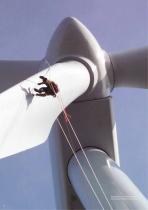
Inspection of a wind turbine. Courtesy of Rope Partner, USA.
Open the catalog to page 2
As environmental concerns escalate and the limits of fossil fuel are approached, wind power has gained momentum as a viable and cost-effective renewable energy source for the future. Maximizing Performance and Minimizing Maintenance Cost of Wind Turbines As environmental concerns escalate and the limits of fossil fuel are approached, wind power has gained momentum as a viable and cost-effective renewable energy source for the future. Greater demands on efficiency of wind turbines result in continuous improvement of design, placement and performance. Given that modern wind turbines produce in...
Open the catalog to page 3
Ensuring Wind Turbine Blade Longevity Over the course of its lifetime, a blade is exposed to many factors that can lead to damage and fatigue. These include cyclic operational loads and gust loading, as well as icing and erosion. Ultimately, any of these factors may result in blade failure. Defects incurred during the manufacturing process, as well as damage inflicted during blade transportation, may lead to the failure or loss of turbine operation, if left undetected. Non-contact measurement systems are employed in the design, manufacture and quality assurance processes to reduce the risk of...
Open the catalog to page 4
In-field NDT test. Courtesy of Rope Partner, USA. In-field inspection can be carried out using a portable shearography system with an integrated vacuum hood for attachment to the blade. Each measurement takes 15 seconds. Materials that shearography can inspect include glass-fiberreinforced plastic (GFRP) and carbon-fiber-reinforced plastic (CFRP). Defects including wrinkles, impact damage, delamination, dry-spots, cracks, voids, kissing bonds and much more can be detected. Shearography can inspect areas at a rate of 15 m2 per hour (160 sq ft/hr) and requires no surface preparation. An automated...
Open the catalog to page 5
Maximizing Power Output of Wind Turbine Farms Air flow measurements around a wind turbine installation can be important for the following applications: • Blade design and aerodynamic modeling • Flow-structure interaction and flow separation • Placement of wind turbines • Impact on and effects of submerged wind turbine towers Optimizing Blade Design by Aerodynamic Modeling Blade design is critical for optimizing the aerodynamic efficiency of the turbine during light wind conditions. The design, however, must also be strong enough to withstand operational loads including gust loads. Dantec Dynamics...
Open the catalog to page 6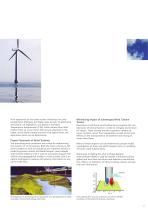
Flow separation at the blade surface influences not only aerodynamic efficiency but blade noise as well. To determine the location of separation, you deploy a Constant Temperature Anemometer (CTA), which derives flow information from an array of thin film sensors attached to the blade. As the blade rotates and the wind speed varies, the separation point can be determined. Proper Placement of Wind Turbines Minimizing Impact of Submerged Wind Turbine Towers Placement of off-shore wind turbine farms requires the consideration of several factors in order to mitigate environmental impact. These include...
Open the catalog to page 7
About Dantec Dynamics Dantec Dynamics is the leading provider of laser optical measurement systems and sensors. Since 1947 we have provided solutions for customers to optimize their component testing and products. Our large number of customers benefit from our quality solutions within: Fluid Mechanics Thermal Comfort Strain, Stress & Vibration Particle Characterization Non-destructive Testing Combustion Diagnostics Process Control Disatac Tachometers Worldwide representation From our six offices and more than 30 representatives worldwide we approach our customers individually. We examine the...
Open the catalog to page 8All Dantec Dynamics A/S catalogs and technical brochures
 F-Q-480
2 Pages
 F-Q-400TCT
2 Pages
 Q-400 μDICTM
2 Pages
 5 Beam 112mm probe
2 Pages
 LabVIEW Toolbox for CTA
2 Pages
 Least Squares Matching (LSM)
3 Pages
 DynamicStudio Base Package
5 Pages
 Flow Field
8 Pages
 HiSense 600 series
2 Pages
 FlowSense EO
4 Pages
 HiSense Zyla
2 Pages
 ComfortSense Mini
4 Pages
 DISATAC Tachometers
56 Pages
 Laser Doppler Anemometry
8 Pages
 Probes for hot-wire anemometry
25 Pages
 FlowExplorer compact LDA
2 Pages
 DynamicStudio
8 Pages
 Spray Diagnostics Solutions
8 Pages
 Laser shearography (Q-800)
2 Pages
 Q-501 Real Time Mode Monitor
2 Pages
 PDA systems
8 Pages


- Digital imager
- Visible imager
- Measuring device
- CMOS camera module
- Management software solution
- Monitoring analyzer
- Analysis software solution
- Measuring machine
- Full-color camera system
- Windows software
- Calibration system
- Cloud-based software
- Benchtop analyser
- Image processing camera module
- 3D software solution
- Inspection system
- Measurement software
- GigE Vision camera
- HD camera module
- Visualization software solution