

- Company
- Products
- Catalogs
- News & Trends
- Exhibitions
RCM Smart
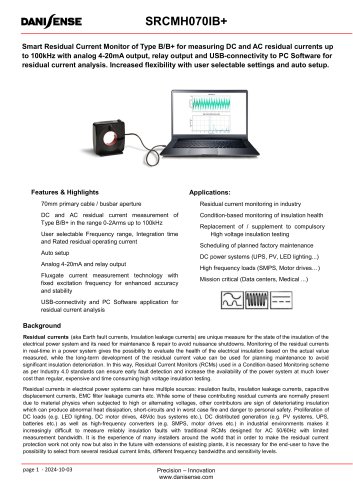
RCM Smart
The SRCMH070IB+ is a Smart Residual Current Monitor (RCM) capable of measuring both DC and AC residual currents up to 100kHz. It includes a 70mm aperture for primary cables or busbars, and offers user-selectable frequency ranges, integration times, and rated residual operating currents. Outputs include analog 4-20mA and relay outputs, with USB connectivity for PC software analysis. It is suitable for industrial applications such as residual current monitoring, insulation health monitoring, and high-frequency load management.
Background
Residual currents are indicators of electrical insulation health and maintenance needs. Real-time monitoring of these currents aids in evaluating insulation health and planning maintenance, offering cost savings over traditional high-voltage insulation testing. The increase in DC loads and high-frequency converters requires RCMs with wider measurement bandwidths.
General Description
The RCM measures DC and AC residual currents up to 100kHz, suitable for various industrial applications. It provides an analog 4-20mA output for real-time TRMS value interfacing and a relay output for system warnings or shutdowns. It operates on a 24Vdc power supply and is compatible with both single-phase and three-phase systems.
Integration Time, Frequency Range, and Rated RC Limit
Integration time affects sensitivity to short peaks, while frequency range determines measurement bandwidth. The rated RC limit sets the TRMS value that triggers the relay output. The user interface includes a test button and status LED for visual indication.
Functional Description
The RCM employs a balanced Flux-gate detector for real-time residual current measurement. It features user-selectable parameters that affect TRMS value, relay output, and status LED. The relay output is managed by a comparator with hysteresis to prevent frequent toggling.
Smart-RCM PC Software
The software facilitates residual current analysis via USB connectivity, offering features such as device information access, FFT analysis, and residual current logging.
Auto Setup
The RCM can automatically configure settings based on baseline measurements, ensuring a comfortable margin for future residual current increases.
Electrical Specifications
The RCM supports a rated voltage of 690Vrms and a frequency range of 0-400Hz. It offers various user-selectable residual current limits and frequency ranges, with specific relay output characteristics and integration times.
Supply Voltage: Rated at 24Vdc with a tolerance of +10%/-15%. Overvoltage category is OVCe III, with a rated impulse withstand voltage of 1.5kV and rated insulation voltage of 30V. Internal consumption is less than 4W.
Relay Output: Features NO+NC contact output with a rated voltage of 30Vac/dc and a rated current of 1Aac/dc. Maximum actuating times are specified for different current thresholds.
Analog Current Interface: Current output ranges from 4-20mAdc with a resolution of 0.01mA. Short-circuit current is less than 25mAdc, and the maximum total load resistance is 900Ω.
Environmental and Mechanical Characteristics
Operating Temperature: Ranges from -20°C to 55°C.
Storage Temperature: Ranges from -40°C to 85°C.
Relative Humidity: Between 20% and 80%, non-condensing.
Mass: 0.9 kg.
Connector: Phoenix Contact DFMC 1.5-3.5 2x5way PN: 1790519, or compatible.
Mounting Instructions
- Base plate mounting with screws in the four holes.
- Free-hanging on the cable using cable strips through the hooks on the backside for fixation.
Standards and Compliance
- Conforms to EN / IEC 62020-1:2020.
- Declaration of conformity with EC Directives 2014/30/EU and 2014/35/EU.
- Harmonized standards applied include EN 61010-1, EN 61010-2-030, and EN 61326-1.
- Manufactured in accordance with RoHS directive 2011/65/EU, with amendments from directive 2015/863.
Declaration of Conformity
Issued by Danisense A/S, Taastrup, Denmark, confirming compliance with relevant EC Directives and standards.
Catalog excerpts
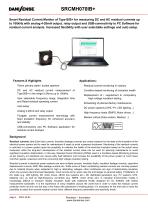
SRCMH070IB+ Smart Residual Current Monitor of Type B/B+ for measuring DC and AC residual currents up to 100kHz with analog 4-20mA output, relay output and USB-connectivity to PC Software for residual current analysis. Increased flexibility with user selectable settings and auto setup. Features & Highlights 70mm primary cable / busbar aperture Residual current monitoring in industry DC and AC residual current measurement of Type B/B+ in the range 0-2Arms up to 100kHz Condition-based monitoring of insulation health User selectable Frequency range, Integration time and Rated residual operating current Auto setup Replacement of / supplement to compulsory High voltage insulation testing Scheduling of planned factory maintenance DC power systems (UPS, PV, LED lighting...) Analog 4-20mA and relay output High frequency loads (SMPS, Motor drives…) Fluxgate current measurement technology with fixed excitation frequency for enhanced accuracy and stability Mission critical (Data centers, Medical ...) USB-connectivity and PC Software application for residual current analysis Background Residual currents (aka Earth fault currents, Insulation leakage currents) are unique measure for the state of the insulation of the electrical power system and its need for maintenance & repair to avoid nuissance shutdowns. Monitoring of the residual currents in real-time in a power system gives the possibility to evaluate the health of the electrical insulation based on the actual value measured, while the long-term development of the residual current value can be used for planning maintenance to avoid significant insulation deterioriation. In this way, Residual Current Monitors (RCMs) used in a Condition-based Monitoring scheme as per Industry 4.0 standards can ensure early fault detection and increase the availability of the power system at much lower cost than regular, expensive and time consuming high voltage insulation testing. Residual currents in electrical power systems can have multiple sources: insulation faults, insulation leakage currents, capacitive displacement currents, EMC filter leakage currents etc. While some of these contributing residual currents are normally present due to material physics when subjected to high or alternating voltages, other contributors are sign of deterioriating insulation which can produce abnormal heat dissipation, short-circuits and in worst case fire and danger to personal safety. Proliferation of DC loads (e.g. LED lighting, DC motor drives, 48Vdc bus systems etc.), DC distributed generation (e.g. PV systems, UPS, batteries etc.) as well as high-frequency converters (e.g. SMPS, motor drives etc.) in industrial environments makes it increasingly difficult to measure reliably insulation faults with traditional RCMs designed for AC 50/60Hz with limited measurement bandwidth. It is the experience of many installers around the world that in order to make the residual current protection work not only now but also in the future with extensions of existing plants, it is necessary for the end-user to have the possibility to select from several residual current limits, different frequency bandwidths and sensitivity levels. Precision – Innovation www.danisense.co
Open the catalog to page 1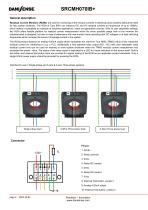
dani/ense General description Residual Current Monitors (RCMs) are used for monitoring of the residual currents in electrical power systems without the need for fast system shutdown. The RCM of Type B/B+ can measure DC and AC residual currents at frequencies of up to 100kHz, which makes it compatible to multitude of industrial applications, loads and generation sources. With its user selectable settings, this RCM offers flexible platform for residual current measurement which fits every possible usage both at the moment the industrial plant is designed, but also in case of extensions with new...
Open the catalog to page 2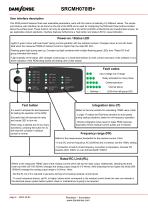
SRCMH070IB+ User interface description This RCM product features three user selectable parameters, each with the choice of selecting 3-5 different values. The simple and intuitive user interface can be found on the top of the RCM and is used for configuring the RCM with three buttons located below the surface level. These buttons can only be operated with a tool which prohibits unintentional and unauthorized access, as per applicable product standards. Interface features furthermore a Test button and status LED for visual indication. Power-on / Status LED Lights in green colour with heart-beat*...
Open the catalog to page 3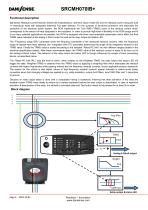
SRCMH070IB+ Functional description Danisense Residual Current Monitor senses the instantaneous, real-time value of both DC and AC residual current using the built -in transducer head with integrated balanced Flux-gate detector. For the purpose of functional protection and especially fire protection of the electrical power system, the RCM implements the True RMS (TRMS) value of the residual current which corresponds to the amount of heat dissipated in the insulation. In order to provide high level of flexibility in the RCM usage and fit to as many potential applications as possible, this RCM is...
Open the catalog to page 4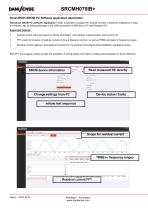
SRCMH070IB+ Smart-RCM (SRCM) PC Software application description Danisense SRCM PC Software application makes it possible to analyze the residual currents in electrical installations in easy and intuitive way by taking advantage of the USB-connectivity of SRCM to a PC with Windows OS. Supported features: General screen with easy access to device information, user settings, measurements, test function etc. FFT screen for analysis of residual currents in time & frequency domain, as well as TRMS calculated in frequency ranges Residual current logging in prolonged time periods for the purpose of...
Open the catalog to page 5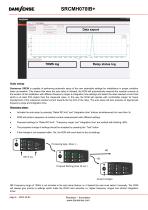
Data export Auto setup Danisense SRCM is capable of performing automatic setup of the user selectable settings for installations in proper condition taken as baseline. This means that when the auto setup is initiated, the RCM will automatically measure the residual currents at the location of the installation with different frequency ranges & integration time settings and select the rated residual current limit which is at least 50% higher than the measured value. In this way the RCM will operate with comfortable margin for future development of the measured residual current towards the trip...
Open the catalog to page 6All Danisense catalogs and technical brochures
 DS600ID
9 Pages
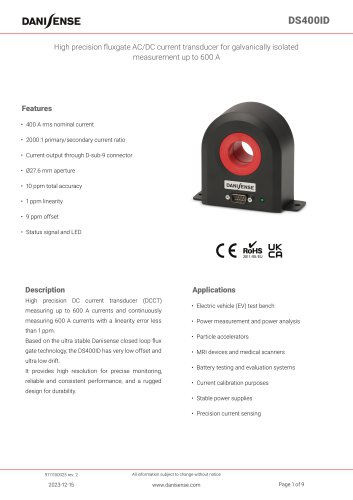 DS400ID
9 Pages
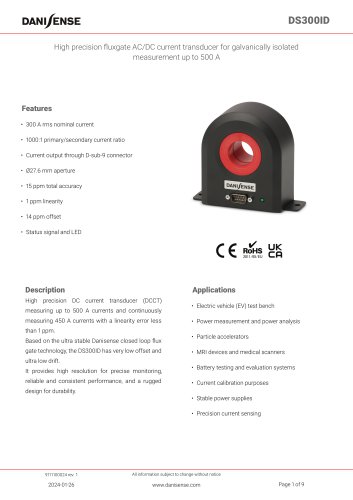 DS300ID
9 Pages
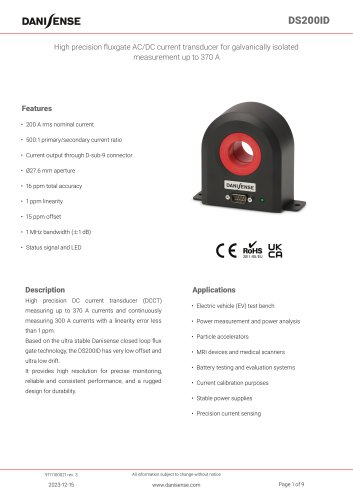 DS200ID
9 Pages
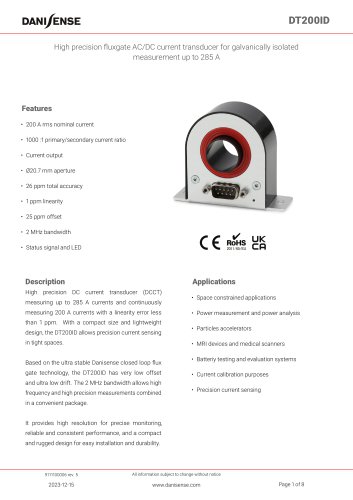 DT200ID
8 Pages
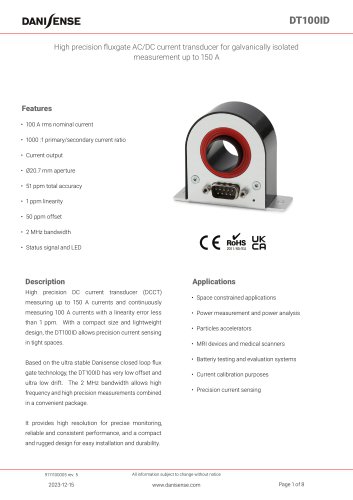 DT100ID
8 Pages
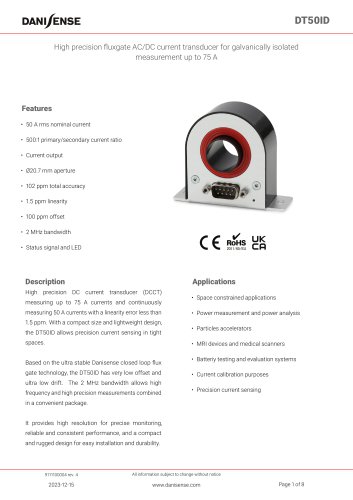 DT50ID
8 Pages
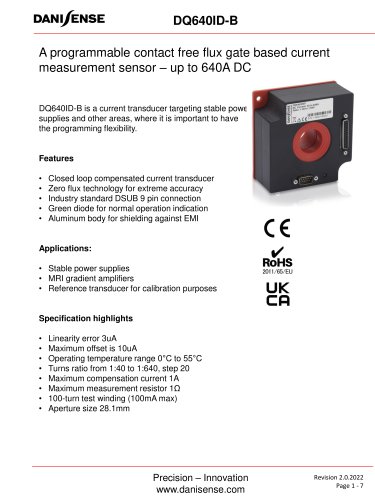 DQ640ID-B
7 Pages
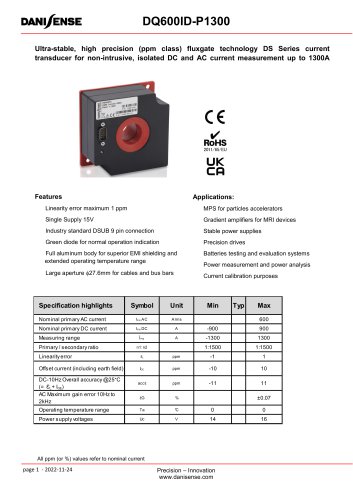 DQ600ID-P1300
7 Pages
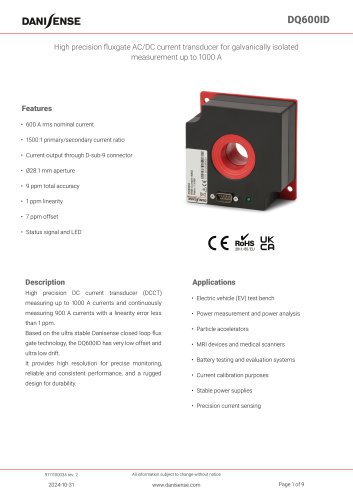 DQ600ID
9 Pages
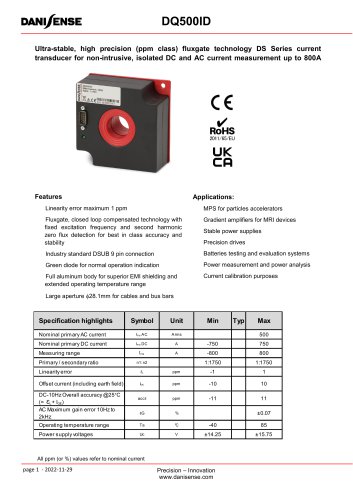 DQ500ID
7 Pages
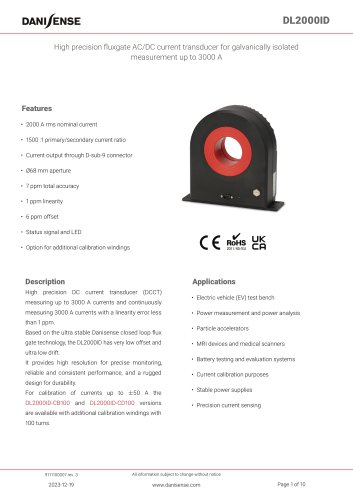 DL2000ID
10 Pages
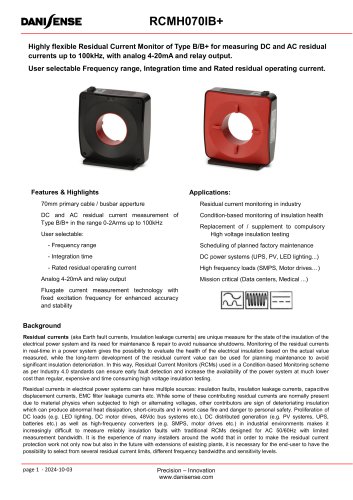 RCM Standard
9 Pages
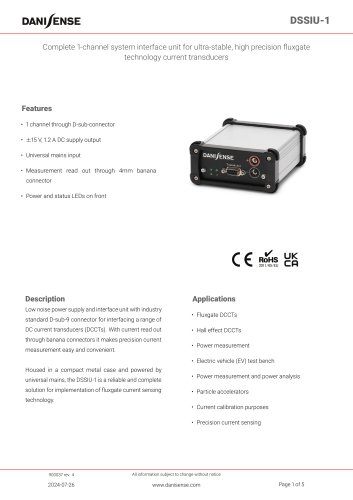 DSSIU-1
5 Pages
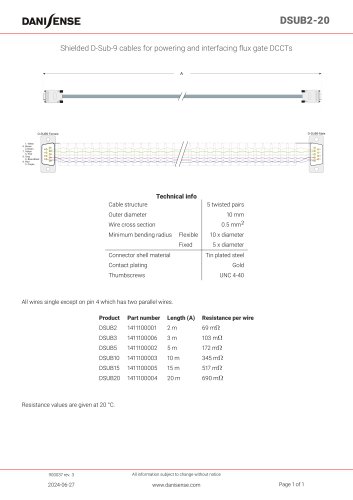 DSUB2-20
1 Page
 DSSIU-6-1U-V
8 Pages
 DSSIU-4-1U
6 Pages
 DS50ID
9 Pages
 DL2000UB-10V
9 Pages
 DL2000UB-1V
9 Pages
 DS300UB-1V
8 Pages
 DS300UB-10V
8 Pages
 DM1200ID-CD3000
7 Pages
 DN1000ID
9 Pages
 DW500UB-2V
9 Pages
 DM1200ID
8 Pages
 DSSIU-6-1U
7 Pages
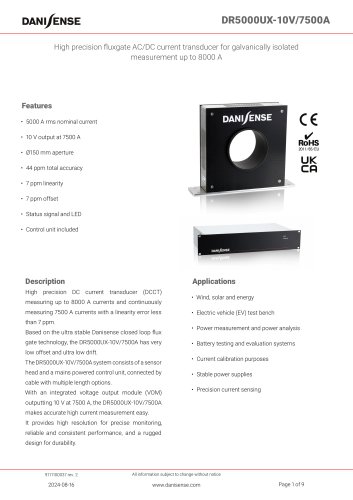 DR5000UX-10V/7500A
9 Pages
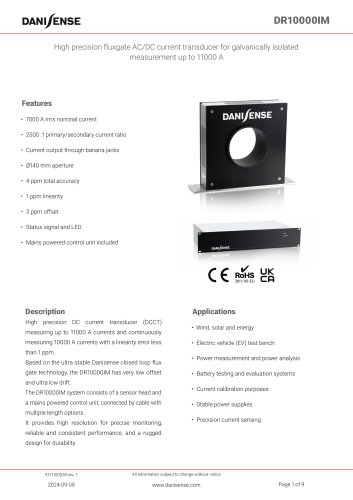 DR10000IM
9 Pages
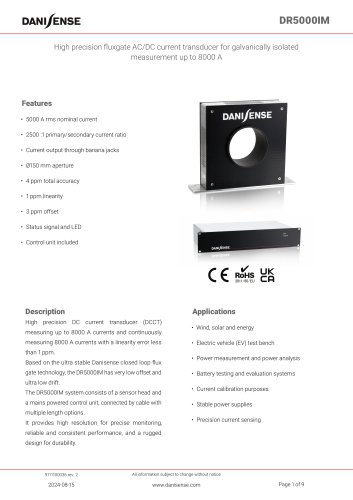 DR5000IM
9 Pages
 Product Selection Guide
24 Pages
 DP50IP-B
4 Pages
 VOM1333-10
1 Page
 DS400UB-10V
6 Pages
 DS200ID-CD1000
6 Pages
 DC200IF
4 Pages
- Optical cable
- Armored cable
- Current transducer
- Twisted pair cable
- Interface module
- AC current transducer
- DC current transducer
- Precision current transducer
- Armored optical cable
- Fixed current transducer
- Monitoring current transducer
- Solid-core current transducer
- High-accuracy current transducer
- Through-hole current transducer
- Fluxgate current transducer
- Power optical cable
- Converter module
- Current output current transducer
- Voltage output current transducer
- Compact current transducer