1. Catalogs
  2. DANFOSS Refrigeration & Air Conditioning
  3. Inverter scroll compressors VZH088-117-170 single and manifold serie

Inverter scroll compressors VZH088-117-170 single and manifold serie

Inverter scroll compressors VZH088-117-170 single and manifold serie
1 / 90 PagesView full catalog

Inverter scroll compressors VZH088-117-170 single and manifold serie

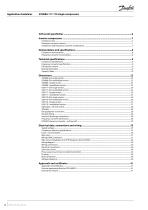
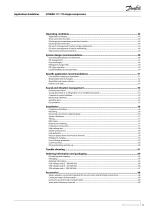
Product catalog summary
Overview: This document provides guidelines for the application of VZH088-117-170 inverter scroll compressors using R410A refrigerant. It includes specifications, installation, and operational recommendations for both single and manifold configurations.
Compressor Specifications: Details on nomenclature, technical specifications, oil injection control, bearings lubrication, and capacity tables for compressors and frequency converters are provided.
Dimensions and Configurations: Dimensions for VZH088, VZH117, and VZH170 compressors, including single and manifold versions, are outlined. Information on sight glass, oil level switch, and connections is included.
Electrical Data: Covers supply voltage, electrical specifications, fuses, circuit breakers, wire sizes, and wiring diagrams. EMC protection and motor protection features are also discussed.
Approvals and Certificates: The compressors comply with the Pressure Equipment Directive 2014/68/EU and other relevant certifications.
Operating Conditions: Guidelines for application envelopes, discharge gas temperature protection, and oil return management are provided. High and low-pressure protection measures are discussed.
System Design Recommendations: Essential piping design considerations, oil management, and heat exchanger recommendations are outlined. Refrigerant charge limits and liquid floodback during operation are addressed.
Specific Application Recommendations: Recommendations for low ambient operations, brazed plate heat exchangers, and reversible heat pump systems are included. Defrost cycle logic and sound/vibration management are discussed.
Installation: Instructions for compressor handling, mounting, and system cleanliness are provided to ensure proper installation and operation.
Technical Specifications and Procedures Overview:
1. Tubing and Connections: Guidelines for tubing, filter driers, brazing, soldering, and compressor connections are provided to ensure system integrity and performance.
2. Testing and Detection: Details high voltage tests, system pressure tests, and leak detection methods to ensure system safety and efficiency.
3. System Preparation: Describes vacuum pump down and moisture removal processes, refrigerant charging, and loss of charge protection to prepare the system for operation.
4. Commissioning and Maintenance: Covers commissioning procedures, oil level checking, and troubleshooting to maintain optimal system performance.
5. Ordering and Packaging: Provides information on ordering kits, packaging, and voltage codes for different compressor models.
6. Accessories: Lists available accessories such as valves, adapters, connectors, crankcase heaters, thermostats, lubricants, and spare parts.
7. Application Guidelines for Compressors: Discusses the specificities of VZH scroll compressors, including oil circulation, motor efficiency, and inverter technology for flexible compressor selection.
8. Nomenclature and Specifications: Explains compressor and frequency converter nomenclature, including details on motor protection, equipment versions, and voltage codes.
9. Technical Specifications: Provides detailed specifications for compressor models, including swept volume, displacement, oil charge, and net weight. Also covers frequency converter specifications such as supply voltage, frequency, and protection functions.
10. Performance Data: Includes performance tables for different compressor models at various speeds and conditions, highlighting cooling capacity and power input.
Specifications and Connections: The CDS303 frequency converter is designed for open loop control with a preset input of 0-10 V on terminal 53. It can also be configured for process loop control with 4-20 mA on terminal 54. Electrical connections require specific torque and grounding measures to ensure safety and performance.
Electrical and Motor Protection: The CDS303 provides a soft start for compressors, limiting inrush current to slightly above nominal levels. Motor protection is integrated, with factory settings to prevent overload and locked rotor conditions.
Operating Conditions: The operating envelope for VZH compressors is defined by specific condensing and evaporating temperatures. The CDS303 manages short cycle control and oil return management to ensure compressor reliability.
Approvals and Certificates: VZH compressors comply with various directives, including the Pressure Equipment Directive 2014/68/EU and Low Voltage Directive 2014/35/EU. They are also UL certified and meet EMC standards.
High and Low Pressure Protection: High-pressure and low-pressure safety switches are required to prevent compressor damage. The settings for these switches depend on the application and must be connected to specific inputs on the CDS303.
Additional Features: The CDS303 includes features like crankcase heating and electronic expansion valve control to optimize compressor performance.
Conclusion: The CDS303 frequency converter is a comprehensive solution for controlling VZH compressors, offering extensive protection and control features to ensure efficient and reliable operation.
Pressure Specifications: High side working pressure: 13.5 - 44.5 bar (g), Low side working pressure: 2.3 - 11.6 bar (g), Maximum high pressure safety switch: 45 bar (g), Minimum low pressure safety switch: 1.5 bar (g), Minimum low pressure pump-down switch: 2.3 bar (g).
Crankcase Heating: Models: VZH088-J, VZH117-J, VZH170-J, VZH088-G, VZH117-G, VZH170-G, VZH088-H, VZH117-H, VZH170-H, Power consumption: 470-500 W, Heating DC current: 26-44%, Delay: 5 seconds.
System Design Recommendations: R410A systems require components designed for higher pressure levels compared to R22/R407C. Proper piping practices are essential for oil return and to prevent refrigerant migration.
Oil Management: Use of oil separators is mandatory for systems with long piping or complex configurations. Chiyoda oil separators are recommended and have been tested by Danfoss.
Heat Exchangers: Optimized R410A heat exchangers are necessary for system efficiency. Adequate liquid sub-cooling is crucial to prevent flash gas formation.
Off-Cycle Migration and Liquid Floodback: Implement crankcase heating or pump-down cycles to prevent refrigerant migration. Liquid floodback can be detected by monitoring oil sump and discharge gas temperatures.
Additional Recommendations: Use of liquid line solenoid valves and pump-down cycles to manage refrigerant charge. Ensure proper system design to prevent excessive liquid refrigerant in compressors.
Compressor Operation and Pressure Control: The document outlines the importance of maintaining proper pressure settings to prevent compressor failure. It emphasizes that compressors should not operate under vacuum and highlights the need for low-pressure control settings.
Solutions for Low Ambient Conditions: To prevent compressors from drawing a vacuum during startup in low ambient conditions, solutions include cycling fans with a head pressure controller in air-cooled machines and using a water regulator valve in water-cooled units.
System Efficiency and Crankcase Heating: Condensing pressure control is recommended for system efficiency, with a target of 12 K above ambient temperature for air-cooled condensers. Crankcase heating minimizes refrigerant migration.
Low Ambient and Load Operations: The VZH compressor requires a minimum pressure differential of 6 to 7 bar to prevent metal-to-metal contact. During low ambient operations, head pressure control may be necessary.
Heat Pumps and Discharge Temperature Monitoring: Heat pumps often operate at high condensing temperatures and low evaporating pressures, necessitating discharge gas safety control to prevent excessive temperatures.
Brazed Plate Heat Exchangers and Reversible Heat Pump Systems: These systems require careful management of refrigerant flow and pressure differentials. A suction line accumulator is recommended to handle liquid refrigerant during cycle changes.
Sound and Vibration Management: The VZH scroll compressor is designed for minimal sound and vibration. Sound insulation and vibration isolation methods are recommended.
Defrost and Reverse Cycle Logic: Defrost cycle logic involves stopping the compressor before moving the 4-way valve to limit liquid refrigerant handling.
Sound and Vibration Sources in Refrigeration and Air Conditioning Systems: Refrigeration and air conditioning systems generate sound and vibrations from three main sources: sound radiation, mechanical vibrations, and gas pulsation. The document discusses causes and mitigation methods for each source.
Sound Generation in Refrigeration Systems: The document provides noise level data for VZH models at different frequencies and voltages, with and without acoustic hoods.
Installation Guidelines for Single Compressors: Compressors must not exceed a 3-degree inclination. They come with rubber grommets and metal sleeve liners to isolate vibrations.
System Cleanliness and Contamination Prevention: Maintaining system cleanliness is crucial for efficiency and reliability. Contaminants like metal shavings and moisture can damage the system.
High Voltage Testing: Instructions for conducting high voltage tests on frequency converters and compressors are provided, emphasizing safety and proper procedures to avoid damage.
Leak Detection and Refrigerant Charging: Leak detection should use nitrogen with refrigerant or helium. Proper vacuum pump-down and moisture removal are essential before refrigerant charging.
Pressure Testing and Oil Management: Use inert gases like nitrogen for pressure testing, adhering to specified pressure limits. Additional oil may be needed for installations with line runs over 20 meters.
Oil Level and Management: The document outlines the importance of maintaining the correct oil level in the compressor sight glass. Foam presence indicates a high concentration of refrigerant in the oil or liquid return to the compressor.
Commissioning and Monitoring: After startup, the system should be monitored for at least 60 minutes to ensure proper operation, including metering device function, pressure levels, oil return, and compressor cycling rates.
Troubleshooting: The document provides a troubleshooting guide for VZH compressors, addressing issues such as power output, alarms, torque limits, and compatibility checks.
Ordering Information and Packaging: Details are provided for ordering VZH compressors and CDS303 frequency converters, including model specifications, packaging dimensions, and weight.
Accessories and Spare Parts: The document lists accessories like valves, adapters, connectors, and gaskets for compressor connections.
Application Guidelines Overview: The document provides comprehensive guidelines for the application of Danfoss SH fixed speed compressors and VZH Inverter compressors in air conditioning and heat pump systems.
Oil Management Concept: The oil management system is crucial for the efficient operation of manifold compressors. It involves interconnected compressor sumps and low-pressure shells to ensure oil balancing.
Oil Separator: An oil separator is recommended to enhance oil management. The document suggests using a Chiyoda oil separator, which has been tested by Danfoss.
System Design Recommendations: The guidelines provide detailed recommendations for system design, including electronic expansion valve settings, pressure switch settings, and essential piping design considerations.
Installation and Service: Instructions for handling, compressor mounting, and wiring are provided to ensure proper installation and service.
Approved Configurations: Various configurations of hybrid tandems are possible, with all VZH models capable of being manifolded with fixed speed compressors.
Specifications and Performance: The document provides performance data for various compressor models, detailing their power output in kW and TR at 100Hz.
System Design Recommendations: Key recommendations for system design include the use of electronic expansion valves (EXV) to manage refrigerant flow variations.
Piping Design Considerations: Proper piping practices are essential for adequate oil return and to prevent refrigerant migration.
Defrost Cycle Logic: The document outlines two defrost cycle logics to manage liquid refrigerant during defrost sequences.
Installation and Service Procedures: Installation procedures for parallel systems are similar to basic systems, with additional components selected according to common rules.
Failure Analysis and Oil Equalization: In case of compressor failure, a quick failure analysis is necessary to prevent contamination of other compressors.
Ordering Information: Guidelines for ordering components for tandem systems are provided, including the necessary kits and components based on compressor models and oil level switch voltage.
Conclusion: The document provides comprehensive guidelines for the design, installation, and maintenance of manifold compressor systems, emphasizing the importance of proper component selection and system configuration to ensure efficient and reliable operation.
Specifications and Components: The document outlines the installation and configuration of various compressor models, specifically VZH088, VZH117, and VZH170, in tandem setups with fixed-speed compressors.
Installation Procedures: For VZH088 and SH120, a 7mm rigid spacer is required under the VZH088 feet to align the oil equalization connection.
Oil Equalization and Balance: The oil level is balanced using a 1"1/8 or 1"3/8 oil equalization line, depending on the model.
Updates and Revisions: The document includes updates to various sections such as frequency converter dimensions, approvals, crankcase heating function, packaging, accessories, and hybrid tandem configurations.
Company Overview: Danfoss Commercial Compressors is a global leader in manufacturing compressors and condensing units for HVAC and refrigeration applications.
See more

Catalog excerpts

Inverter scroll compressors VZH088-117-170 single and manifold serie-1

ENGINEERING ^/J-nrJfjW^ Application guidelines Inverter scroll compressors

 Open the catalog to page 1

Inverter scroll compressors VZH088-117-170 single and manifold serie-3

Application Guidelines

 Open the catalog to page 3
Inverter scroll compressors VZH088-117-170 single and manifold serie-4

Application Guidelines

 Open the catalog to page 4
Inverter scroll compressors VZH088-117-170 single and manifold serie-5

Application Guidelines

 Open the catalog to page 5
Inverter scroll compressors VZH088-117-170 single and manifold serie-6

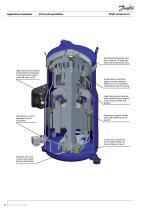
Application Guidelines Single compressors Reinforced high grade cast iron scroll set. 2 ranges for high and low pressure ratio High speed oil circulation minimized by separating oil and gas flows with a sump oil return tube A patented oil injection system ensures optimal efficiency at low speed by improving scroll set sealing Lead free polymer bearing with excellent performance under diverse loads and speeds Oil injection control optimizes the oil circulation Permanent magnet motor with high efficiency at all speeds Oil strainer controls the risk of system debris in the oil injection circuit...

 Open the catalog to page 6
Inverter scroll compressors VZH088-117-170 single and manifold serie-7

Application Guidelines Inverter compressors Compressor size Inverter technology offers more flexibility in compressor selection than fixed speed compressors. Selection of the right inverter compressor size can be done by different methods: 1. Maximum cooling capacity: Select a compressor size which achieves the peak load system cooling capacity demand at its maximum speed. 2. Nominal cooling capacity: Select a compressor size which achieves the nominal system cooling capacity at a rotational speed of 3600 - 4500 rpm (60-75 rps). Single compressors 3. Best Seasonal Efficiency Ratio: Select a compressor...

 Open the catalog to page 7
Inverter scroll compressors VZH088-117-170 single and manifold serie-8

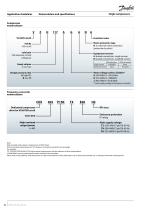
Application Guidelines Single compressors Compressor nomenclature Variable speed A Evolution index Motor protection type N: no internal motor protection (protection by drive) Family VZH scroll Lubricant POE lubricant, R410A refrigerant Equipement version A: brazed connections, single version B: brazed connections, manifold version Swept volume in cm³/rev Single version Manifold version Oil sight glass Threaded None Oil level switch None Threaded Motor voltage code to CDS303 * G: 380-480V/3~/50 & 60Hz H: 525-600V/3~/50&60Hz J: 200-240V/3~/50 & 60Hz Design pressure ratio A: high PR, B: low PR *...

 Open the catalog to page 8
Inverter scroll compressors VZH088-117-170 single and manifold serie-9

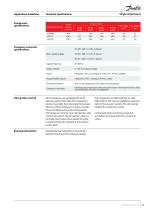
Application Guidelines Compressor specifications Single compressors Technical specifications Compressor model Swept volume (cm³/rev) Frequency converter specifications Supply frequency Output voltage Programmable outputs Protection functions Over-current protection, low / high current handling Compressor functions Bearings lubrication Discharge gas temperature protection, pressostat / thermostat function, short cycle protection, oil return management VZH compressors are equipped with an oil injection system that makes the compression pockets more tight thus improving the isotropic efficiency...

 Open the catalog to page 9
Inverter scroll compressors VZH088-117-170 single and manifold serie-10

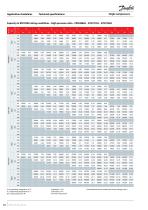
Application Guidelines Single compressors Technical specifications Capacity at EN12900 rating conditions - High pressure ratio - VZH088AJ - VZH117AJ - VZH170AJ Te To: Evaporating temperature in °C Tc: Condensing temperature in °C Qo: Cooling capacity in W Superheat = 10 K Subcooling = 0 K Pe: Power input in kW Presented data are for models with motor voltage code J

 Open the catalog to page 10
Inverter scroll compressors VZH088-117-170 single and manifold serie-11

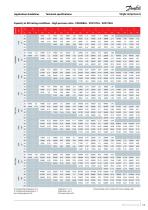
Application Guidelines Single compressors Technical specifications Capacity at ARI rating conditions - High pressure ratio - VZH088AJ - VZH117AJ - VZH170AJ Te To: Evaporating temperature in °C Tc: Condensing temperature in °C Qo: Cooling capacity in W Superheat = 11.1 K Subcooling = 8.3 K Pe: Power input in kW Presented data are for models with motor voltage code J

 Open the catalog to page 11
Inverter scroll compressors VZH088-117-170 single and manifold serie-12

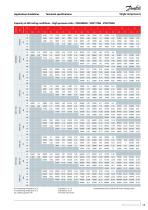
Application Guidelines Single compressors Technical specifications Capacity at EN12900 rating conditions - High pressure ratio - VZH088AG - VZH117AG - VZH170AG To Tc To: Evaporating temperature in °C Tc: Condensing temperature in °C Qo: Cooling capacity in W Superheat = 10 K Subcooling = 0 K Pe: Power input in kW Presented data are for models with motor voltage code G

 Open the catalog to page 12
Inverter scroll compressors VZH088-117-170 single and manifold serie-13

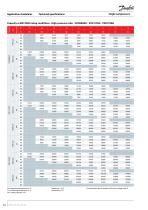
Application Guidelines Single compressors Technical specifications Capacity at ARI rating conditions - High pressure ratio - VZH088AG - VZH117AG - VZH170AG To Tc To: Evaporating temperature in °C Tc: Condensing temperature in °C Qo: Cooling capacity in W Superheat = 11.1 K Subcooling = 8.3 K Pe: Power input in kW Presented data are for models with motor voltage code G

 Open the catalog to page 13
Inverter scroll compressors VZH088-117-170 single and manifold serie-14

Application Guidelines Single compressors Technical specifications Capacity at EN12900 rating conditions - High pressure ratio - VZH088AH - VZH117AH - VZH170AH To To: Evaporating temperature in °C Tc: Condensing temperature in °C Qo: Cooling capacity in W Presented data are for models with motor voltage code H

 Open the catalog to page 14
Inverter scroll compressors VZH088-117-170 single and manifold serie-15

Application Guidelines Single compressors Technical specifications Capacity at ARI rating conditions - High pressure ratio - VZH088AH - VZH117AH - VZH170AH To To: Evaporating temperature in °C Tc: Condensing temperature in °C Qo: Cooling capacity in W Presented data are for models with motor voltage code H

 Open the catalog to page 15
Inverter scroll compressors VZH088-117-170 single and manifold serie-16

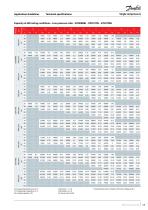
Application Guidelines Single compressors Technical specifications Capacity at EN12900 rating conditions - Low pressure ratio - VZH088BJ - VZH117BJ - VZH170BJ Te To: Evaporating temperature in °C Tc: Condensing temperature in °C Qo: Cooling capacity in W Superheat = 10 K Subcooling = 0 K Pe: Power input in kW Presented data are for models with motor voltage code J

 Open the catalog to page 16
Inverter scroll compressors VZH088-117-170 single and manifold serie-17

Application Guidelines Single compressors Technical specifications Capacity at ARI rating conditions - Low pressure ratio - VZH088BJ - VZH117BJ - VZH170BJ To To: Evaporating temperature in °C Tc: Condensing temperature in °C Qo: Cooling capacity in W Superheat = 11.1 K Subcooling = 8.3 K Pe: Power input in kW Presented data are for models with motor voltage code J

 Open the catalog to page 17
Inverter scroll compressors VZH088-117-170 single and manifold serie-18

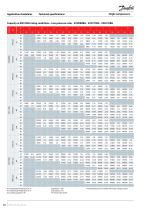
Application Guidelines Single compressors Technical specifications Capacity at EN12900 rating conditions - Low pressure ratio - VZH088BG - VZH117BG - VZH170BG To Tc To: Evaporating temperature in °C Tc: Condensing temperature in °C Qo: Cooling capacity in W Superheat = 10 K Subcooling = 0 K Pe: Power input in kW Presented data are for models with motor voltage code G

 Open the catalog to page 18
Inverter scroll compressors VZH088-117-170 single and manifold serie-19

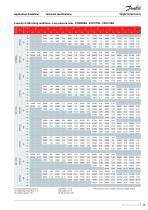
Application Guidelines Single compressors Technical specifications Capacity at ARI rating conditions - Low pressure ratio - VZH088BG - VZH117BG - VZH170BG To To: Evaporating temperature in °C Tc: Condensing temperature in °C Qo: Cooling capacity in W Superheat = 11.1 K Subcooling = 8.3 K Pe: Power input in kW Presented data are for models with motor voltage code G

 Open the catalog to page 19
*Prices are pre-tax. They exclude delivery charges and customs duties and do not include additional charges for installation or activation options. Prices are indicative only and may vary by country, with changes to the cost of raw materials and exchange rates.