
- Catalogs
- Danfoss Power Solutions
- Steering General, Steering Components


- Products
- Catalogs
- News & Trends
- Exhibitions
Steering General, Steering Components

Steering General, Steering Components
Overview: This document provides comprehensive technical information on Danfoss steering components, focusing on both hydrostatic and electrohydraulic steering systems. It includes details on various steering units, flow amplifiers, priority valves, and steering valves.
Steering Concepts: The document outlines the different steering concepts, including hydrostatic steering and electrohydraulic steering systems. It describes the specific steering units such as OSPM, OSPB, OSPC, OSPR, OSPF, and OSPL, and their characteristic features.
Steering Components: Detailed descriptions of steering units are provided, including those with rotary meters and amplifier valves. The document also covers priority valves (OLSA and OLS) and flow amplifiers (OSQA and OSQB), highlighting their main data and features.
Product Overview: A product overview section explains the variants of steering components, including mini steering units and load sensing steering units. It provides main data and features for each type, such as OSPB, OSPC, OSPD, and OSPU.
Hydrostatic Steering Systems: The document discusses open center and load sensing steering systems, detailing the features of static and dynamic steering systems with Danfoss LS steering units.
Choice of Steering Concept: Guidance is provided on selecting the appropriate steering concept and components, considering legislative requirements for steering systems.
This document provides comprehensive technical data and specifications for Danfoss steering components used in hydrostatic steering systems for off-road vehicles. It covers both component and system-level solutions, including a wide range of steering units and priority valves.
Technical Specifications
The document details various steering units with displacements ranging from 32 to 1200 cm3/rev, capable of handling flows up to 100 l/min and pressures up to 240 bar. It also describes priority valves and pilot-operated flow amplifiers with specific amplification factors and rated oil flows.
Steering System Calculations
Several calculation examples are provided for different steering system components, including steering cylinders, units, and pumps. The document also discusses the Ackermann steering principle and its application in articulated vehicles.
Hydraulic Fluids and Maintenance
Information on suitable oil types, sealing materials, and oil temperature management is included. The document emphasizes the importance of particle content control and filtering to maintain system integrity.
Installation and Maintenance
Guidelines for installation, including tightening torques and startup procedures, are provided. Maintenance recommendations ensure the longevity and reliability of the steering systems.
Steering System Examples
Various configurations of steering systems are illustrated, including those with emergency steering capabilities and integrated priority valves. The document also covers electrohydraulic steering systems with features like GPS integration and joystick control.
Characteristic Features
Key features of the steering units include low steering torque, low noise levels, and multiple built-in valve functions. The electrohydraulic systems offer advanced functionalities such as variable steering ratios and manual steering capabilities for heavy vehicles.
Conversion Factors
Conversion factors for units of measurement are provided to assist in understanding the technical data.
Conclusion
Danfoss offers a diverse range of steering components suitable for various applications, ensuring reliable and efficient steering solutions for off-road vehicles.
The document provides detailed technical information on various steering units and components used in vehicles. The primary focus is on the functionality and specifications of different steering units such as OSPM, OSPB, OSPC, OSPR, OSPF, and OSPL. These units consist of a rotary valve and a rotary meter, which direct oil flow to the steering cylinder based on the steering wheel's rotation.
Steering Units with Specific Features:
- OSPD: Features two rotary meters for enhanced steering control, with a shift valve to activate one or both meters.
- OSPU: Includes an amplifier valve for flow amplification, ensuring constant amplification even in emergency steering situations.
Priority Valves:
Priority valves like OLSA and OLS ensure that steering has the first priority in oil flow distribution, with excess flow directed to other hydraulics.
Flow-Amplifiers:
OSQA and OSQB flow-amplifiers enhance oil flow to the steering cylinders, with amplification factors ranging from 4 to 20. They include various valves for pressure relief and shock absorption.
Steering Valve EHPS:
The EHPS is a pilot-operated directional valve that can be actuated by oil flow or an electrical signal. It includes components like a priority valve and pilot pressure control valve.
OSPE Steering Valve:
Equipped with an electrical programmable module, the OSPE valve supports features like GPS-steering and variable steering ratios.
Type Variants and Features:
The document lists various steering unit types and their specific features, such as open center non-reaction (ON), load sensing (LS), and closed center non-reaction (CN). Each type is designed for specific vehicle sizes and steering requirements.
Technical Specifications:
Each steering unit type is detailed with specifications such as displacement, recommended flow, maximum steering pressure, and back pressure. These specifications are crucial for selecting the appropriate steering unit for different vehicle applications.
Conclusion:
The document serves as a comprehensive guide for understanding the different steering components and their applications in various vehicle types. It highlights the importance of selecting the right steering unit based on vehicle size, steering requirements, and system configurations.
- Available in two versions: Load Sensing non-reaction (LS) dynamic and Load Sensing Reaction (LSR) dynamic.
- Displacement ranges from 60 to 125 cm3/rev during manual steering and up to 440 cm3/rev at full oil supply.
- Maximum steering pressure is 210 bar, with a maximum back pressure of 40 bar.
- Features include manual steering capability for heavy vehicles without an emergency pump.
- Offers amplification function with displacement from 60 to 500 cm3/rev.
- Flow ranges from 8 to 50 l/min, with a maximum steering pressure of 210 bar.
- Includes features like "Fast Steer" with progressive amplification.
- Designed for larger vehicles with displacement from 520 to 1200 cm3/rev.
- Flow ranges from 52 to 100 l/min, with a maximum steering pressure of 240 bar.
- Features low steering torque, low noise, and low pressure drop at high flow.
- Available in static and dynamic versions, with flow rates up to 320 l/min.
- Maximum system pressure is 250 bar, with some models supporting up to 350 bar.
- Features low noise and optional pilot pressure relief valve.
- Designed for very heavy vehicles, offering amplification factors from 4 to 20.
- Flow capacity up to 400 l/min, with a maximum steering pressure of 210 bar.
- Includes built-in valve functions and emergency steering circuit options.
- Available in three versions, combining hydrostatic and electro-hydraulic systems.
- Flow for steering up to 100 l/min, with a maximum steering pressure of 250 bar.
- Features include low pilot pressure, emergency steering capability, and CAN-bus interface.
- Available in four versions, with displacement from 100 to 500 cm3/rev.
- Flow ranges from 10 to 50 l/min for steering wheel steering.
- Features integrated EH valve and selectable steering modes.
- OVPL offers flow up to 100 l/min with built-in valve functions.
- OVR is designed for limited space applications without valve functions.
- Open Center systems provide immediate wheel reaction and high comfort.
- Load Sensing systems offer energy efficiency and improved steering performance.
- Dynamic systems provide better performance than static systems, with OSPF units offering the best characteristics.
1. Dynamic Flow Requirement: Minimum 1.1 l/min from the priority valve.
2. Steering Unit Options: Reaction and Non-reaction. Reaction units allow external forces to move the steering wheel when not actively steering, while non-reaction units do not.
3. Recommendations: Non-reaction units are recommended for rear-wheel and articulated steering or when displacement exceeds 250 cm3/rev.
Technical Data:
1. Temperature: Ambient: -30°C to +60°C; Oil: -30°C to 90°C; Recommended oil temperature: 30°C to 60°C.
2. Viscosity: Oil viscosity range: 10 mm2/s to 1000 mm2/s; Recommended: 12 mm2/s to 80 mm2/s.
3. Filtration: Maximum contamination levels specified by ISO 4406.
Steering Torque and Pressure:
1. Normal Steering Torque: Varies by unit type, e.g., OSPM: 0.5 - 1.5 N•m.
2. Manual Steering: Maximum torque for OSPM is 80 N•m; for other OSP units, 120 N•m.
3. Manual Steering Pressure: Nominal pressures provided for different unit sizes.
Steering Column Requirements:
1. Design: Must not exert axial or radial forces on the steering unit's input shaft.
2. Spline Data: Specific dimensions and standards for spline shafts provided.
Steering System Calculations:
1. Steering Force and Pressure: Formulas provided for calculating steering force and pressure for different cylinder types.
2. Empirical Rule: Add 50 bar to theoretical pressure for adequate performance.
3. Steering Unit and Pump Calculations: Formulas for determining displacement and oil flow requirements.
Legislation and Standards:
1. Compliance: Adherence to EU directive 2009/66/EC and ISO 5010 is necessary.
Oil Types:
1. Recommendations: Use mineral oils with anti-wear additives; suitable types include HM, HV, and ATF A oils.
Additional Notes:
1. Articulated Vehicles: Danfoss offers calculation services for steering systems in articulated vehicles.
2. Flow-Amplifier Systems: Calculations for systems using flow-amplifiers are provided.
Danfoss steering components are increasingly used with non-flammable or biodegradable hydraulic fluids. These fluids are categorized under ISO 12922 into four groups: HFA, HFB, HFC, and HFD-U. For specific applications, contact the Danfoss Sales Organisation.
Sealing Materials
Steering components use nitrile rubber (NBR) and teflon (PTFE) seals. For synthetic fluids, consult Danfoss for appropriate sealing materials.
Oil Temperature and Life
Operating temperatures above 60°C can significantly reduce oil life due to oxidation. Oil life is halved for every 8°C increase above 80°C. Impurities like particles or water further reduce oil life.
Contamination and Filtering
Oil must be filtered to maintain acceptable contamination levels. The maximum ISO contamination levels are specified for different steering components. Filtering requirements depend on system conditions and may require multiple filters in dusty environments.
Installation Guidelines
Key installation practices include avoiding painting on steering surfaces, ensuring accessibility, and proper alignment of components. Use appropriate sealing materials and follow specific installation instructions.
Tightening Torques
Recommended tightening torques for various connections are provided. It is advised to follow the torque levels specified by the fitting supplier.
Starting Up and Running In
Initial system checks include verifying pump rotation, bleeding air from the system, and ensuring all lines are filled with oil. The system should be fully bled before loading.
Maintenance
Regular maintenance is crucial for system reliability. This includes changing oil and filters as per supplier instructions and checking oil condition and system tightness.
Label Information
Steering components are labeled with the Danfoss logo, type designation, code number, serial number, and bar codes.
Examples of Steering Systems
Various steering systems are described, including OSPC ON, OSPC OR, OSPC LS + OLSA, OSPF + OLS, OSPD LS, OSPU LS, OSPBX LS and OSQA, and others. Each system has specific valve functions and configurations for different applications.
Conclusion
Danfoss Power Solutions provides high-quality hydraulic and electronic components for off-highway vehicles, offering global support and service through an extensive network of partners.
Danfoss Power Solutions has multiple locations worldwide, including Germany, Denmark, the USA, and China. Each location has its own contact phone number.
Disclaimer:
Danfoss disclaims responsibility for errors in printed materials and reserves the right to alter products without notice, even for products already ordered, as long as specifications remain unchanged.
Trademarks:
All trademarks mentioned are owned by their respective companies. Danfoss and its logotype are trademarks of Danfoss A/S.
Product Offerings:
Danfoss offers a wide range of products including Bent Axis Motors, Closed Circuit Axial Piston Pumps and Motors, Displays, Electrohydraulic Power Steering, Electrohydraulics, Hydraulic Power Steering, Integrated Systems, Joysticks and Control Handles, Microcontrollers and Software, Open Circuit Axial Piston Pumps, Orbital Motors, PLUS+1® GUIDE, Proportional Valves, Sensors, Steering, and Transit Mixer Drives.
Associated Brands:
Comatrol, Schwarzmüller-Inverter, Turolla, Valmova, Hydro-Gear, and Daikin-Sauer-Danfoss are associated brands with their respective websites provided for more information.
Catalog excerpts

MAKING MODERN LIVING POSSIBLE Technical Information Steering General, Steering Components
Open the catalog to page 1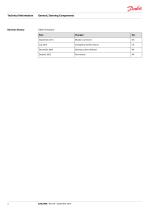
Technical Information General, Steering Components Revision history Table of revisions Date Mistakes corrected Changed to Danfoss layout Steering column deleted First version
Open the catalog to page 2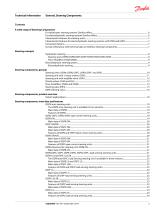
Technical Information General, Steering Components
Open the catalog to page 3
Technical Information General, Steering Components
Open the catalog to page 4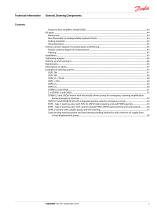
Technical Information General, Steering Components
Open the catalog to page 5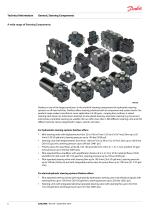
Technical Information General, Steering Components A wide range of Steering Components Danfoss is one of the largest producers in the world of steering components for hydrostatic steering systems on off-road vehicles. Danfoss offers steering solutions both at component and system levels. Our product range makes it possible to cover applications of all types - ranging from ordinary 2-wheel steering (also known as Ackermann steering) to articulated steering, automatic steering (e.g. by sensor) and remote controlled steering via satellite. We can offer more than 1,800 different steering units and...
Open the catalog to page 6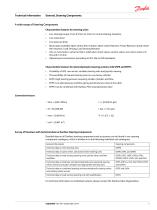
Technical Information General, Steering Components A wide range of Steering Components Characteristic features for steering units: Low steering torque: From 0.5 N•m to 3 N•m in normal steering situations Low noise level Low pressure drop Many types available: Open center Non-reaction, Open center Reaction, Power Beyond, Closed center Non-reaction, Load Sensing, Load Sensing Reaction One or more built-in valve functions: relief valve, shock valves, suction valves, non-return valve in Pline and in LS-line Optional port connections (according to ISO, SAE or DIN standards) Characteristic features...
Open the catalog to page 7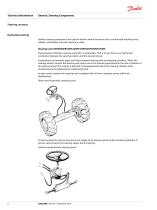
Technical Information General, Steering Components Steering concepts Hydrostatic steering Danfoss steering components are used in vehicles where the driver has to control high steering forces, reliably, comfortably and with maximum safety. Steering units OSPM/OSPB/OSPC/OSPF/OSPR/OSPD/OSPU/OSPL The operation of Danfoss steering units OSP- is hydrostatic. That is to say, there is no mechanical connection between the steering column and the steered wheels. Instead there are hydraulic pipes and hoses between steering unit and steering cylinder(s). When the steering wheel is turned, the steering unit...
Open the catalog to page 8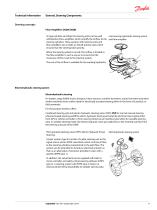
Technical Information General, Steering Components Steering concepts Flow-Amplifiers OSQA/OSQB In large vehicles and ships the steering units can be used Load sensing hydrostatic steering system withDanfoss Flow-amplifiers which amplify the oil flow to the with flow amplifier steering cylinders. These systems with steering units and flow-amplifiers also include an inbuilt priority valve which ensures that the steering takes priority. When the steering wheel is turned, the oil flow is divided in the flow-amplifier in such a way as to ensure that the necessary oil flow is led to the steering system....
Open the catalog to page 9
Technical Information General, Steering Components Steering components, general Steering Units: OSPM, OSPB, OSPC, OSPR, OSPF, and OSPL The steering unit consists of a rotary valve and a rotary meter. Via a steering column the steering unit is connected to the steering wheel of the vehicle. When the steering wheel is turned, oil is directed from the steering system pump via the rotary valve (spool and sleeve) and rotary meter (gear wheel set) to the cylinder ports L or R, depending on the direction of turn. The rotary meter meters the oil flow to the steering cylinder in proportion to the angular...
Open the catalog to page 10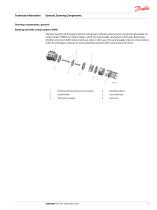
Technical Information General, Steering Components Steering components, general Steering unit with 2 rotary meters: OSPD The basic function of this type is like the main group of Danfoss steering units, except the gearwheel set (rotary meter). OSPD has 2 rotary meters, which are mechanically connected. A shift valve determines whether only one or both rotary meters are active. In the case of no pump supply only one rotary meter is active for emergency steering. In normal steering situations both rotary meters are active. 1 Housing with spool/sleeve set and valves 4 Distributor plates 2 Cardan...
Open the catalog to page 11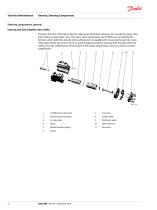
Technical Information General, Steering Components Steering components, general Steering unit with amplifier valve: OSPU The basic function of this type is like the main group of Danfoss steering units, except the rotary valve and a torque compensator valve. The rotary valve (spool/sleeve set) of OSPU has an amplification function, which adds flow directly to the cylinder ports in parallel with oil passing through the rotary meter (gear wheel set). In the case of no pump supply (emergency steering) only the gear wheel set meters oil to the cylinder ports. The function of the torque compensator...
Open the catalog to page 12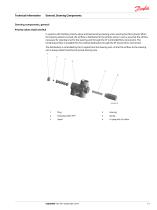
Technical Information General, Steering Components Steering components, general Priority valves: OLSA and OLS In systems with Danfoss priority valves and load sensing steering units, steering has first priority. When the steering wheel is turned, the oil flow is distributed in the priority valve in such a way that the oil flow necessary for steering is led to the steering unit through the CF (controlled flow) connection. The remaining oil flow is available for the working hydraulics through the EF (excess flow) connection. The distribution is controlled by the LS signal from the steering unit,...
Open the catalog to page 13
Technical Information General, Steering Components Steering components, general Flow-Amplifiers: OSQA and OSQB The flow-amplifiers OSQA and OSQB contain a directional valve, an amplification valve, a priority valve, a pilot pressure relief valve, shock and suction valves. In addition OSQB contains a back pressure valve. The flow-amplifier amplifies the oil flow from the steering unit cylinder ports L or R by an amplification factor of 4, 5, 8, 10 or 20. The amplified oil flow is directed from the flow-amplifier ports CL or CR to the steering cylinder(s). The amplified flow is proportional to...
Open the catalog to page 14
Technical Information General, Steering Components Steering components, general Steering valve EHPS The EHPS is a pilot operated directional valve. Oil from a pilot steering unit or an electrical signal can actuate the steering valve. Basicly the EHPS valve contains a directional valve, a priority valve, a pilot relief valve, a pilot pressure control valve, and shock- and suction valves. An electric actuation module, PVE, can be fitted onto the EHPS valve. In the type 1 system the controller is operated by an analog signal and the type 2 system the signal is digital with Canbus interface and...
Open the catalog to page 15All Danfoss Power Solutions catalogs and technical brochures
 PVG 16
2 Pages
 PLUS1 Toolbox
16 Pages
 WS403
WS4032 Pages
 WS403-J
2 Pages
 WS503 / WS503-BP
2 Pages
 WS103
WS1032 Pages
 Product Range
4 Pages
 Orbital Motors General
36 Pages
 TMT new hydraulic motor
4 Pages
 Fan Drive Gear Motors
8 Pages
 Hydraulic Fluids and Lubricants
20 Pages
 PLUS+1 I/O Modules
38 Pages
 PVG Product Brochure
8 Pages
 H1 Family Brochure
8 Pages






Archived catalogs
 Sauer Danfoss - All Products
30 Pages
 D Series Gear Pumps
36 Pages

- Industrial pump
- Pump with electric motor
- Stationary pump
- Electromotor
- Seawater pump
- Self-priming pump
- Compact pump
- Automation software solution
- Directional control valve
- Control software
- Compact electromotor
- High-pressure pump
- High-efficiency electromotor
- Valve actuator
- Measurement software
- DC-DC converter
- High-efficiency pump
- Hydraulic directional control valve