
- Catalogs
- Danfoss Power Solutions
- Hydraulic Fluids and Lubricants


- Products
- Catalogs
- News & Trends
- Exhibitions
Hydraulic Fluids and Lubricants
Hydraulic Fluids and Lubricants
This document provides guidance on selecting hydraulic fluids, emphasizing adherence to manufacturer specifications for longevity, safety, and efficiency of hydraulic components.
Operators should avoid prolonged skin contact with lubricants, prevent eye contact, and follow storage regulations. Spills must be cleaned promptly, and fluids should not contaminate the environment. The flash point should be at least 20°C above the maximum working temperature.
Key features include viscosity, viscosity index (VI), pour point, and shear stability. Viscosity affects flow and lubrication, with temperature changes impacting levels. A high VI indicates minimal viscosity change with temperature fluctuations.
Hydraulic fluids must meet requirements for viscosity, wear protection, corrosion resistance, and seal compatibility. Cleanliness levels are defined per ISO 4406, with specified fluid change intervals.
Options include mineral-based, fire-resistant, and biodegradable fluids, each with specific applications and benefits.
Proper selection and maintenance of hydraulic fluids are vital for efficient hydraulic system operation. Operators should consult technical literature for specific ratings and adhere to recommended practices.
Air release prevents a spongy system and poor controllability. Air release time is tested according to DIN 51 381, while foaming characteristics are tested by DIN 51 566.
Bulk modulus measures fluid resistance to compression, important in systems with pressure fluctuations. Compressibility is the reciprocal of bulk modulus.
Defined by ISO 4406-1999, cleanliness levels are determined by particle count per ml. New standards include ISO 11 171-1999 for calibration and ISO 16 889-1999 for filter testing.
Water content should not exceed 0.1%. Fluid change intervals are recommended at 500 hours after start-up and every 2000 hours thereafter.
Monitoring metal concentration is crucial to prevent damage. Fluid change is recommended if silicium levels exceed 10-15 mg/kg.
Operating temperatures should be between 30°C to 60°C. High temperatures can reduce fluid life and affect seal integrity.
Fluids must include rust, foam, and corrosion inhibitors, and possess good thermal and hydrolytic stability. Mixing different fluids is not recommended without manufacturer approval.
TurollaOCG gear pumps and motors are not compatible with fire-resistant fluids.
While environmentally friendly, they are not a complete replacement for mineral-based fluids. Thorough field testing is recommended.
A viscosity-temperature diagram according to DIN 51 524-2 HLP is included.
TurollaOCG offers aluminum and cast iron gear pumps and motors, emphasizing experience, technical support, and fast response times.
Catalog excerpts
Hydraulic Fluids and Lubricants Technical Information OpenCircuitGear MEMBER OF THE SAUER-DANFOSS GROUP
Open the catalog to page 1
OpenCircuitGear MEMBER OF THE SAUER-DANFOSS GROUP Hydraulic Fluids and Lubricants Technical Information Introduction The purpose of this manual is to aid the machine operator in the selection of suitable hydraulic fluid. The specifications of the lubricant manufacturer and the recommendations of the machine manufacturer are the basis for selection and are subject to change without advance advice. The choice of suitable hydraulic fluids or lubricants is critical for the lifetime, operational safety and efficiency of hydraulic components. If there are any fire hazards, see Safety instructions....
Open the catalog to page 2
OpenCircuitGear MEMBER OF THE SAUER-DANFOSS GROUP Hydraulic Fluids and Lubricants Technical Information Contents Safety Instructions General Information Requirements for Hydraulic Fluids
Open the catalog to page 3
OpenCircuitGear MEMBER OF THE SAUER-DANFOSS GROUP Health, accident and environmental measures Hydraulic Fluids and Lubricants Technical Information Safety Instructions When operating units, which are filled with hydraulic fluids (hereafter referred to as lubricants) the operator must consider, among other things, the following precautionary measures: • • Skin contact with fluid or with heated unit parts is to be avoided, especially at temperatures over 60 °C [140 °F]. Should lubricant get into your eyes, rinse them thoroughly with drinking water and see a doctor if necessary. Official regulations...
Open the catalog to page 4
OpenCircuitGear MEMBER OF THE SAUER-DANFOSS GROUP Hydraulic Fluid Features Hydraulic Fluids and Lubricants Technical Information General Information Hydraulic fluids have the primary purpose of transferring potential or kinetic energy (pressure and movements), create volume flow between pump and hydrostatic motor, and reduce the wear of parts that rub against each other. In addition, they protect the system from corrosion and help carry away the heat produced during energy transformation. The following table gives an outline of the necessary requirements for hydraulic fluids. Necessary characteristics...
Open the catalog to page 5
OpenCircuitGear MEMBER OF THE SAUER-DANFOSS GROUP Hydraulic Fluid Features (continued) Hydraulic Fluids and Lubricants Technical Information General Information Hydraulic fluid has to perform the following tasks: • Energy transmission • Lubrication • Heat removal When choosing a hydraulic fluid the following features are most important for consideration: • Viscosity • Viscosity Index (VI) and/or Viscosity Grade (VG) viscosity at 40 °C [104 °F]. • Pour point • Shear stability, when polymer VI-improvers are used For any application the features of the hydraulic fluid must be appropriate to the...
Open the catalog to page 6
OpenCircuitGear MEMBER OF THE SAUER-DANFOSS GROUP Hydraulic Fluid Features (continued) Hydraulic Fluids and Lubricants Technical Information General Information Viscosity index (VI) The viscosity index is a calculated number, according to DIN ISO 2909 which describes the viscosity change of a mineral oil based or a synthetic fluid versus temperature. • a high viscosity index means a small viscosity change when the temperature changes • a low index means a large viscosity change when the temperature changes Viscosity – temperature diagram according to Ubbelohde representing the temperature operating...
Open the catalog to page 7
OpenCircuitGear MEMBER OF THE SAUER-DANFOSS GROUP Hydraulic Fluid Features (continued) Hydraulic Fluids and Lubricants Technical Information General Information The high durability of a hydraulic fluid with a high viscosity index avoids damage and machine breakdown, lowers the operating cost and increases the life of hydrostatic transmissions and units. Shear stability Fluids using polymer viscosity index improver may noticeably shear down (> 20 %) in service. This will lower the viscosity at higher temperatures below the originally specified value. The lowest expected viscosity must be used...
Open the catalog to page 8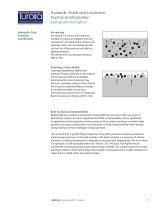
OpenCircuitGear MEMBER OF THE SAUER-DANFOSS GROUP Hydraulic Fluid Features (continued) Hydraulic Fluids and Lubricants Technical Information General Information Air release Air release is a measure for the time needed to release air bubbles (free air) contained in the fluid to the surfaces. Air typically enters the circuit through the suction line if the seals are not tight as explained above. Air release time is tested according to DIN 51 381. Foaming characteristic Foaming characteristic defines the amount of foam collected on the surface in the reservoir and the air bubble decomposition time....
Open the catalog to page 9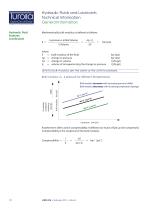
OpenCircuitGear MEMBER OF THE SAUER-DANFOSS GROUP Hydraulic Fluid Features (continued) Hydraulic Fluids and Lubricants Technical Information General Information Mathematically, bulk modulus is defined as follows: ∆ pressure x initial Volume ∆p • Vo E = = ∆ Volume ∆V where: E = ∆p = ∆V = Vo = bulk modulus of the fluid change in pressure change in volume volume of oil experiencing the change in pressure Units for bulk modulus are the same as the units for pressure. Bulk modulus vs. ∆ pressure for different temperatures Bulk modulus bar [psi] increasing oscillation tendency, Spongy Bulk modulus...
Open the catalog to page 10
OpenCircuitGear MEMBER OF THE SAUER-DANFOSS GROUP Hydraulic Fluid Features (continued) Hydraulic Fluids and Lubricants Technical Information General Information Examples for bulk modulus and compressibility at 22 °C [71.6 °F] and 140 bar [2031 psi] and 300 bar [4351 psi] Bulk Modulus bar-1 [psi-1] Water Mineral based hydraulic fluids Fluid compressibility becomes a concern for a hydrostatic system which has large volumes of oil under pressure, such as long or large system lines, and experiences high system pressure spikes during operation. To understand the nature of the problem that can be associated...
Open the catalog to page 11
OpenCircuitGear MEMBER OF THE SAUER-DANFOSS GROUP Cleanliness Features Hydraulic Fluids and Lubricants Technical Information General Information Definition of cleanliness levels per ISO 4406 The cleanliness level of a hydraulic fluid is determined by counting number and size of particles in the fluid. The number of particles is defined as a cleanliness level according to ISO 4406. Definition of cleanliness levels per ISO 4406 Number of particles per 100 ml 1-2 2-4 4-8 8-16 16-32 32-64 etc. 4 x 10³ - 8 x 10³ 8 x 10³ - 16 x 103 16 x 103 - 32 x 103 32 x 103 - 64 x 103 64 x 103 - 130 x 103 130 x...
Open the catalog to page 12All Danfoss Power Solutions catalogs and technical brochures
 PVG 16
2 Pages
 PLUS1 Toolbox
16 Pages
 WS403
WS4032 Pages
 WS403-J
2 Pages
 WS503 / WS503-BP
2 Pages
 WS103
WS1032 Pages
 Product Range
4 Pages
 Orbital Motors General
36 Pages
 TMT new hydraulic motor
4 Pages
 Fan Drive Gear Motors
8 Pages
 PLUS+1 I/O Modules
38 Pages
 PVG Product Brochure
8 Pages
 H1 Family Brochure
8 Pages







Archived catalogs
 Sauer Danfoss - All Products
30 Pages
 D Series Gear Pumps
36 Pages

- Industrial pump
- Pump with electric motor
- Stationary pump
- Electromotor
- Seawater pump
- Self-priming pump
- Compact pump
- Automation software solution
- Directional control valve
- Piston pump
- Control software
- Compact electromotor
- High-pressure pump
- High-efficiency electromotor
- Valve actuator
- Measurement software
- DC-DC converter
- High-efficiency pump
- Hydraulic directional control valve