
- Catalogs
- DAMON Industrial Europe Srl
- DamonIndustryConveyorRollerCatalogue(Eur-en)Feb.,2018


DamonIndustryConveyorRollerCatalogue(Eur-en)Feb.,2018

DamonIndustryConveyorRollerCatalogue(Eur-en)Feb.,2018
The document provides an overview of conveyor rollers, emphasizing the importance of selecting the appropriate roller type based on environmental conditions and product characteristics. It highlights that plastic components are fragile at low temperatures and that polyurethane may not be suitable for transporting colored packages. Products with hard, flat surfaces are ideal for roller conveyors, while those with soft or irregular bottoms are not.
Conveyor rollers are categorized into different conveying modes: gravity conveying, driven conveying, and accumulating conveying. Each mode is associated with specific roller series, such as the 1200 series for polymer bearing housing and the 1100 and 1800 series for steel bearing housing. The document emphasizes selecting the correct roller pitch to ensure steady conveying, recommending a minimum of three rollers to support goods at any moment.
The load capacity of each roller must not exceed its maximum static loading. Guidelines for roller pitch selection suggest using a pitch of 1/4 to 1/5 of the product length for steady conveying. It also advises on the deflection of flexible products and the pitch calculation for double sprocket conveyors.
Damon Industry is a global leader in conveyor roller manufacturing, with bases in Asia, America, Australia, and Europe. The company serves various industries, including food distribution, pharmacy, and logistics, providing over 40 different products to meet diverse requirements. Damon Industry is committed to quality and innovation, offering services such as ERP management systems and online roller dimensional drawing systems.
Damon Industry aims to create value for customers' logistics systems and strives to be a leading supplier in the global materials handling industry. The company provides millions of rollers annually, supporting efficient logistics for global companies.
Nitrile Butadiene Rubber (NBR) is noted for its excellent resistance to oil, good abrasion and heat resistance, but has low elasticity, poor cold and ozone resistance, and low electrical insulation properties.
To improve conveying efficiency and eliminate slip, friction between contact surfaces can be increased using rubber lagging, which also protects the conveyed surface and reduces noise. Alternatively, PVC sleeving can be used, offering similar benefits with a shorter lead time and cost-effectiveness.
Thick chrome plating enhances component performance by improving hardness, abrasion, temperature, and corrosion resistance.
Various installation methods are discussed, including spring-loaded and bolt-fastened methods. The choice of method affects assembly complexity and load capacity. High-quality carbon structural steel is recommended for shafts, with antirust oil as the standard surface treatment.
Bearings are crucial for roller reliability and lifespan. The C3 clearance is recommended for optimal dynamic performance. The RZ sealing method is advised for its low friction and effective dustproof performance.
Considerations for conveying goods include reducing roller pitch for stability, avoiding sudden movements, and ensuring anti-static designs. For humid environments, stainless steel or anti-corrosion materials are recommended.
Gravity conveyors are simple, non-powered systems where goods are moved by gravity or human force, typically arranged horizontally.
- Polymer Bearing Housing: Strong, durable, available in various diameters, and has a high load capacity.
- Series and Diameters: The document lists different series (1100, 1200, 1800) with corresponding diameters and end components.
- Gravity Conveying: Utilizes non-powered rollers to move goods by gravity or human force, suitable for horizontal or declined arrangements.
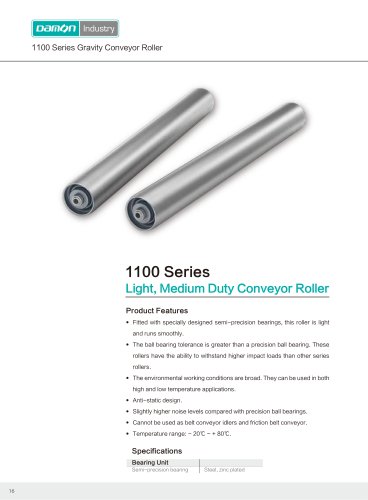
- 1100 Series: Features semi-precision bearings, suitable for light to medium duty, with a temperature range of -20℃ to +80℃. Not suitable for belt conveyor idlers.
- 1200 Series: Popular for carton conveying, features precision ball bearings, and is suitable for high-speed applications up to 120m/min. Temperature range: -5℃ to +40℃.
- 1800 Series: Features precision ball bearings secured in steel housing, suitable for high load capacity and broad environmental conditions. Temperature range: -20℃ to +80℃.
- Load Capacity: The document provides static load capacity data for various roller configurations, indicating the maximum load they can handle based on length and diameter.
- Available Configurations: Various configurations are available for each series, including different tube and shaft diameters, materials, and additional features like PVC sleeves.
The document describes two types of driven conveying: belt-driven and chain-driven. Belt-driven systems are noted for low noise and high speed, while chain-driven systems are suitable for high load capacities but are prone to wear in dusty environments.
The document outlines the installation and maintenance requirements for single and double grooved drive layouts. It emphasizes the importance of proper preloading of O-belts and the limitations on the weight of items conveyed.
The rollers are suitable for various conveying applications, including light/medium duty carton conveying and heavy-duty environments. The document highlights the adaptability of the rollers to different working conditions and their customizable features.
The rollers are available in materials such as steel (zinc plated), steel with a PVC sleeve, stainless steel, and aluminum. The shaft diameters and tube diameters vary across different series, with specifications like Φ50x1.5 and Φ60x2.0.
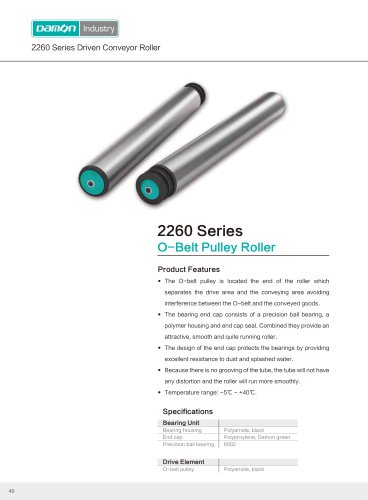
Each series features a bearing unit with a precision ball bearing, polymer housing, and end cap seal, providing smooth and quiet operation. The design ensures resistance to dust and water, enhancing durability.
The O-belt and poly-vee systems are used for driving the rollers, with specific configurations for different load capacities and applications. The 2260 series features a double grooved pulley drive layout, while the 2280 series uses a timing belt pulley for stable and efficient conveying.
The load capacity is a critical factor, with single items not exceeding 30kg for certain series. The 2250 series can handle up to 100kg with a 3-groove poly-vee belt. The 2280 series is suitable for medium load conveying and is designed for environments like clean rooms.
Installation requires appropriate methods and tools to ensure correct setup, especially for poly-vee rollers. Maintenance is simplified due to the design of the drive elements.
The document outlines the versatility and adaptability of the conveyor rollers for various industrial applications, emphasizing their robust construction, efficient design, and suitability for different operational environments.
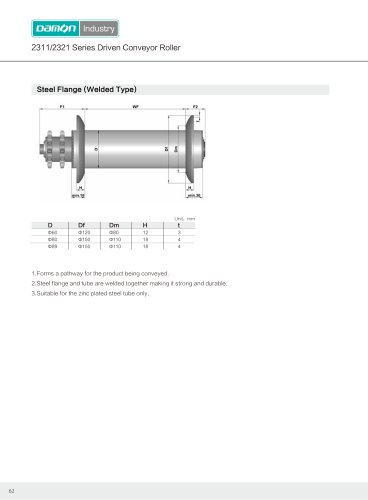
The rollers are available in different diameters (Φ50, Φ60, Φ80, Φ89) and shaft diameters (Φ12, Φ15, Φ20). They can be fitted with PVC sleeves and are designed to handle high torque and heavy-duty transportation. The temperature range for operation is -20℃ to +80℃.
The rollers feature precision ball bearings pressed into steel bearing housings for durability. They are protected against dust and water, making them suitable for various environmental conditions. The sprockets are made of steel, with options for zinc plating or black steel for stainless steel tubes.
The document includes tables showing the static load capacity for different tube and shaft configurations, emphasizing the importance of considering chain tension and motor power in calculations.
The 3214/3224 series is designed for medium-duty accumulation, featuring adjustable accumulation force and low running noise. The rollers use polymer sprockets and polyamide bearing housings, suitable for conveying weights between 10-30 kg, with a temperature range of 0 to +40℃.
Factors affecting roller operation include product weight, friction factor, environmental conditions, accumulation time, and load position. The document highlights the importance of these factors in determining the roller's performance and lifespan.
- Material and Construction: The rollers are constructed using steel, zinc-plated tubes, and stainless steel options. They feature precision ball bearings housed in polymer or steel housings.
- Temperature Range: The operating temperature range for these rollers is typically between -5℃ to +80℃, depending on the series.
- Load Capacity: The rollers are suitable for conveying weights ranging from 10kg to 80kg.
- Accumulating Conveyor Rollers: These rollers feature adjustable accumulation force, durable steel sprockets, and are designed for smooth and quiet operation. They are available in single and double sprocket configurations.
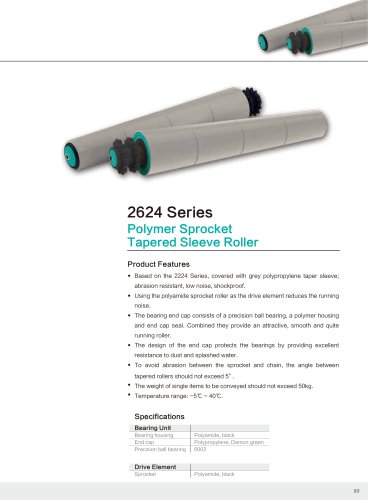
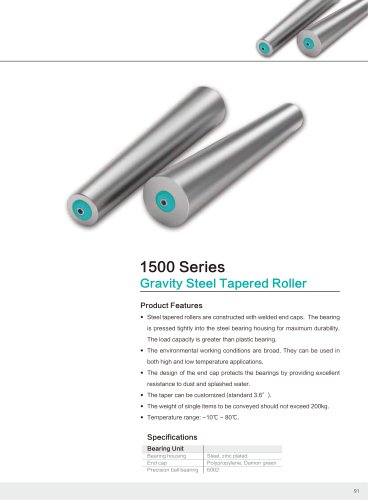
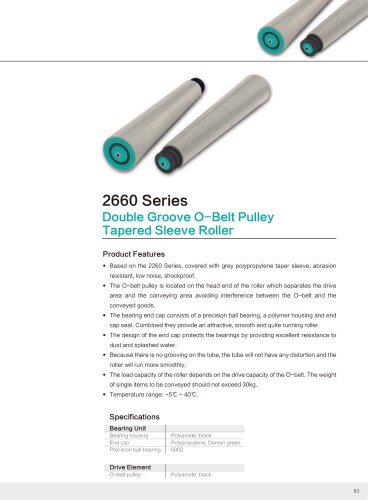
- Curve Conveyor Rollers: Designed with tapered sleeves to ensure smooth conveying around curves. They feature low noise, abrasion resistance, and customizable groove positions.
- Roller Length Calculation: The document provides formulas for calculating roller length and taper sleeve length based on the width of goods and curve radius.
- Roller Pitch: The design principle suggests a minimum of three rollers should support the goods at any moment, with specific pitch recommendations for different series.
- 3211/3221 Series: Features internal thread and adjustable accumulating rollers suitable for weights up to 80kg.
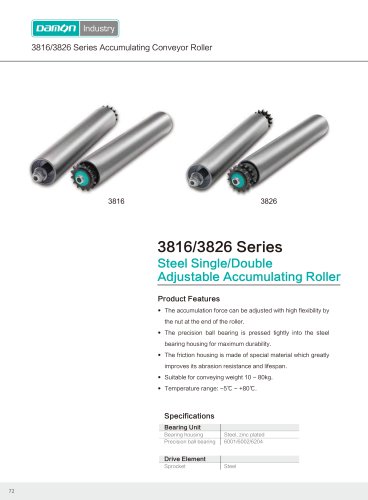
- 3816/3826 Series: Offers adjustable accumulating rollers with a focus on durability and flexibility in accumulation force adjustment.
- 1600 Series: Curve conveyor rollers with tapered sleeves, designed for low noise and smooth operation.
- 2640 Series: Double grooved tapered sleeve rollers, emphasizing abrasion resistance and customizable groove positions.
Catalog excerpts

DAMON INDUSTRIAL EUROPE SRL Adress:Apahida,Libertatii Str.,No.21,407035,Cluj,Romania Tel: 0040-364130050 Email: [email protected] Web: www.damonroller.com ZHEJIANG DAMON INDUSTRIAL EQUIPMENT Address: Blk 22, Woodlands Link, #04-70, Singapore 738734 Address: Shangqiang Industrial Park, Daixi, Huzhou, Email: [email protected] Email: [email protected] Web: www.damonroller.com Australia Indonesia PT. Rollflex Manufacturing Indonesia Address: Taman Tekno BSD, Sektor XI Blok H-11 No. 7 DAMON Australia Address:30 Grasslands Avenue Craigieburn VIC Email: [email protected] Email: [email protected] Malaysia Rollflex (M) Sdn.Bhd. Address: Lot58908, No.3399, Jalan Pekeliling Tanjung 27/2 Kawasan Perindustrian Indahpura, 81000 Kulai, Johor, Address: 11310 Rockfield Ct, Cincinnati, OH 45241, Email: [email protected] Email: [email protected] Conveyor Roller Japan Kyowa Manufacturing Co., Ltd. Address: 570-10 Kubota-cho, Kasai-city, Hyogo pref. 675-2364 JAPAN Tel : 0081-790420601 Fax: 0081-790424895 Email: [email protected] Web: www.pulseroller.com
Open the catalog to page 1
About Damon Industry CONTENTS 02-13 2411/2421 series steel single/double ………… 54 sprocket roller with polymer bearing housing Conveyor Roller Selection ……………………… 02 2311/2321 series steel single/double ………… 58 sprocket roller with steel bearing housing Roller Overview Load Capacity …………………………………… 04 Run Out Tube ………………………………………… 04 Accumulating Conveyor Roller Series 64-73 GLOBAL LEADING MANUFACTURER OF CONVEYOR ROLLERS ——Providing European local manufacturing, sales and services Damon Industry provides millions pieces of rollers all over the world every year for many industries.� Roller Part...
Open the catalog to page 2
About Damon Industry CONTENTS 02-13 2411/2421 series steel single/double ………… 54 sprocket roller with polymer bearing housing Conveyor Roller Selection ……………………… 02 2311/2321 series steel single/double ………… 58 sprocket roller with steel bearing housing Roller Overview Load Capacity …………………………………… 04 Run Out Tube ………………………………………… 04 Accumulating Conveyor Roller Series 64-73 GLOBAL LEADING MANUFACTURER OF CONVEYOR ROLLERS ——Providing European local manufacturing, sales and services Damon Industry provides millions pieces of rollers all over the world every year for many industries.� Roller Part...
Open the catalog to page 3
Roller Overview Conveyor Roller Selection Is the product suitable for a roller conveyor? Roller Length: Roller Pitch Selection: The suitable length of the roller should be selected Different Conveying Modes: To ensure the steady conveying of goods, the principles of 1.Gravity conveying: Manual pushing or declined roller according to the width of the product (length of roller selecting the correct roller pitch (roller centre distance, A Product with a hard and flat bottom surface such as surface, indicated by W). For straight conveying, calculate indicated by T) is a minimum 3 rollers to support...
Open the catalog to page 4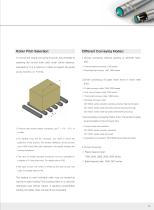
Roller Overview Conveyor Roller Selection Is the product suitable for a roller conveyor? Roller Length: Roller Pitch Selection: The suitable length of the roller should be selected Different Conveying Modes: To ensure the steady conveying of goods, the principles of 1.Gravity conveying: Manual pushing or declined roller according to the width of the product (length of roller selecting the correct roller pitch (roller centre distance, A Product with a hard and flat bottom surface such as surface, indicated by W). For straight conveying, calculate indicated by T) is a minimum 3 rollers to support...
Open the catalog to page 5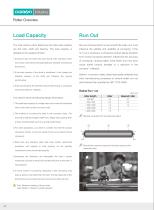
Roller Overview Load Capacity Tube Material The main factors which determine the roller load capacity Run out is the key factor in how smooth the roller runs. It will are the tube, shaft and bearing. The load capacity is influence the stability and reliability of conveying. If the dictated by the weakest of them: run-out is excessive, it will lead to product jolting, deviation 1.Excessive load will distort the tube during roller operation which may result in permanent damage leading to unstable conveying of the product. 2.If the load capacity of the shaft is insufficient, it will change the adaptive...
Open the catalog to page 6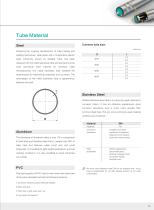
Roller Overview Load Capacity Tube Material The main factors which determine the roller load capacity Run out is the key factor in how smooth the roller runs. It will are the tube, shaft and bearing. The load capacity is influence the stability and reliability of conveying. If the dictated by the weakest of them: run-out is excessive, it will lead to product jolting, deviation 1.Excessive load will distort the tube during roller operation which may result in permanent damage leading to unstable conveying of the product. 2.If the load capacity of the shaft is insufficient, it will change the adaptive...
Open the catalog to page 7
Roller Overview Tube Surface Treatment Zinc Plated Rubber Lagging Forms a homogeneous, compact, well combined zinc coating through electrolysis. Compared with other metal, zinc is economic For effectively improving conveying efficiency, eliminating slip such as specified area acceleration, small inclines, etc., we need and easy to be coated. Corrosion prevention plating allows zinc to be used widely in the area of steel parts protection, especially to add friction between the contact surfaces. Rubber lagging is the most commonly used method. It may also provide protection in preventing oxide...
Open the catalog to page 8
Roller Overview Tube Surface Treatment Zinc Plated Rubber Lagging Forms a homogeneous, compact, well combined zinc coating through electrolysis. Compared with other metal, zinc is economic For effectively improving conveying efficiency, eliminating slip such as specified area acceleration, small inclines, etc., we need and easy to be coated. Corrosion prevention plating allows zinc to be used widely in the area of steel parts protection, especially to add friction between the contact surfaces. Rubber lagging is the most commonly used method. It may also provide protection in preventing oxide...
Open the catalog to page 9All DAMON Industrial Europe Srl catalogs and technical brochures
 Belt Conveyor Pulley
8 Pages
 Gravity Conveyor Roller Series
18 Pages
![COMPREHENSIVE PRODUCTS OVERVIEW[201905V1(2)]](https://img.directindustry.com/pdf/repository_di/189845/comprehensive-products-overview-201905v1-2-838629_1mg.jpg)











Archived catalogs
 Driven Conveyor Roller Series
32 Pages
 Taper Conveyor Roller Series
22 Pages

- Transport rail conveyor
- Work conveyor
- Stainless steel conveyor
- Curved conveyor
- Metal conveyor roller
- Steel conveyor roller
- Slip-on conveyor roller
- Logistic conveyor
- Assembly line conveyor
- Plastic conveyor roller
- Motorized roller
- Small load conveyor
- Stainless steel conveyor roller
- Packaging line conveyor
- Driven roller conveyor
- Conveyor drum motor