
- Catalogs
- Daikin Applied
- CAT 1610-2 - Daikin Classroom Unit Ventilators- Model AH Ceiling Units

CAT 1610-2 - Daikin Classroom Unit Ventilators- Model AH Ceiling Units

CAT 1610-2 - Daikin Classroom Unit Ventilators- Model AH Ceiling Units
Daikin Classroom Unit Ventilators have been used in educational settings for nearly a century, offering quiet and efficient climate control. They are designed for cost-effectiveness, ease of installation, and maintenance, ensuring long-term reliability and comfort in classrooms.
- Quiet Operation: The GentleFlo air moving system minimizes noise while maintaining comfort.
- Fresh Air and Cooling: Economizer Operation and Demand Control Ventilation ensure optimal air quality and temperature.
- Temperature and Dehumidification Control: Precise control mechanisms reduce operating costs by utilizing outdoor air for cooling.
- Low Installation and Operating Costs: Designed to fit existing spaces and use minimal electricity, these units are economical to run.
- Durability: Built with a sturdy chassis and tamper-resistant features, these units are designed to last.
The units are rated according to AHRI Standard 840-98, ensuring reliable performance metrics such as airflow, cooling capacity, and power input.
The Model AH is a versatile, ceiling-mounted unit suitable for spaces with limited floor area. It supports various heating and cooling configurations, making it ideal for both new constructions and retrofits.
These controls offer superior performance and easy integration with building automation systems, supporting multiple communication protocols for seamless operation.
Detailed guidelines are provided for selecting the appropriate unit based on specific heating and cooling needs, including chilled water and steam heating options.
The units are designed for easy installation and maintenance, with modular components that simplify service tasks.
Daikin's unit ventilators offer flexibility in controls with options like MicroTech II, which supports BACnet, LonTalk, or Metasys N2 communications. These units can be integrated into building automation systems or operated individually. They are designed for low operating costs, particularly in school environments, by providing individual classroom control and utilizing outdoor air for cooling.
The units are designed to reduce energy consumption by cycling on only when rooms are occupied and using outdoor air for cooling. Features like Economizer Operation and Demand Control Ventilation further enhance energy savings by adjusting air intake based on occupancy and outdoor conditions.
Daikin unit ventilators are built for easy maintenance with features like a modular fan deck and single-filter design. The units are constructed with a heavy-duty frame and durable exterior finish to withstand classroom environments. Tamper-resistant fasteners and easy access panels facilitate maintenance while preventing unauthorized access.
The document outlines various model types such as AHF (Face & Bypass) and AHV (Valve Control), each with specific configurations for airflow and temperature control. Options include different coil configurations, heating options, and control features to suit various applications.
Daikin's unit ventilators are designed to provide efficient, reliable, and low-maintenance solutions for heating and cooling, particularly in educational settings. Their robust construction and advanced control options make them a versatile choice for modern building requirements.
The document outlines the construction and features of louvers and grilles made from AQ 5005 aluminum, which is suitable for color anodizing. Both components can be painted or unpainted, with a special environmentally friendly urethane powder paint applied for durability and corrosion resistance. Louvers are available in horizontal and vertical blade configurations, each designed to manage moisture effectively.
The document describes the installation options for louvers, which can be flanged or unflanged depending on the wall type. It also details the use of a bird screen to prevent small animals from entering through the louvers.
The VentiMatic shutter is recommended for room exhaust ventilation, offering a silent, energy-efficient solution that responds to static air pressure. It is designed to operate without power, using gravity to manage airflow.
The document provides detailed specifications for various unit sizes, including fan data, filter sizes, shipping weights, and coil water volumes. It includes tables with nominal airflow rates and dimensions for different unit configurations.
Several figures illustrate the dimensions and arrangements of unit ventilators, including front and bottom discharge options with different grille and duct collar configurations. The document also provides detailed descriptions of component locations and piping entries.
The document explains the coil connection configurations for heat/cool, reheat, and heating-only units. It includes notes on steam coil connections, condensate drain pan adjustments, and electric heating coil power connections.
The document provides detailed specifications and dimensions for various unit ventilators, including direct expansion, steam, electric heating, and cooling units. It includes figures and dimensions for different configurations, such as hot water heating, steam heating, and chilled water cooling units. Condensate drain connections and face & bypass end of cycle valves are also detailed with specific dimensions and connection types.
The document outlines specifications for 2-way and 3-way modulating valves, including connection sizes, static pressure, close-off pressure, and temperature ranges. Actuator specifications are provided, detailing control types, electrical requirements, and operating temperatures.
Louvers are available in horizontal and vertical blade configurations, designed to manage moisture and prevent animal entry. Specifications for louver dimensions and recommended wall openings are provided, along with details on optional grilles and VentiMatic shutter assemblies.
The document outlines a quick selection procedure for determining unit capacity for heating and cooling based on coil rows. It includes steps for determining design conditions, heating and cooling loads, air quantity requirements, and unit size selection. Tables provide capacities for chilled water cooling, hot water heating, steam heating, and electric heating.
Recommendations for freeze protection include constant pump operation below 35°F, using antifreeze, and proper valve selection to ensure adequate water flow. Specific steps for chilled and hot water systems are provided.
The document discusses the impact of ethylene glycol and propylene glycol on heating and cooling capacities, including capacity correction factors and pressure drop correction factors. It provides guidance on calculating unit capacity and water pressure drop when using antifreeze solutions.
Instructions for determining entering wet bulb temperature and enthalpy calculations are included, providing a comprehensive approach to system design and performance evaluation.
Proper sizing of condensing units is crucial for optimal performance. Oversized units can lead to issues such as compressor short cycling, poor temperature and humidity control, and low discharge air temperatures. It is recommended to determine the cooling load based on May and September conditions at 1 pm when the classroom is occupied. If the load falls between two sizes, select the smaller unit to avoid problems associated with oversized units.
Figure 80 illustrates the relationship between the total capacity of the unit ventilator and the saturated evaporator temperature. The condensing unit's capacity can be cross-plotted on this chart, considering suction line loss, to determine the total system capacity and saturated suction temperature. Sensible capacity is calculated using the sensible heat factor from Table 32.
The document provides detailed electrical data for various unit types, including indoor fan motor horsepower, electric heat elements, and maximum fuse size or circuit breaker requirements. This information is crucial for ensuring proper electrical setup and safety compliance.
Several wiring diagrams are provided, including typical MicroTech II wiring, wall sensor wiring, and external input/output wiring. These diagrams are essential for correct installation and integration of unit ventilators with external devices and systems.
Economizer operation is facilitated by the outdoor air damper, which adjusts to provide free cooling when outdoor conditions are suitable. Three levels of economizer control are available: Basic, Expanded, and Leading-Edge, each offering varying degrees of control based on temperature and humidity measurements.
MicroTech II controllers offer various modes based on room occupancy and other factors. Modes include Occupied, Night Purge, and Freeze Prevention, each designed to optimize energy use and maintain comfort and safety in different scenarios.
- Unoccupied Mode: The unit maintains a new room set point with the fan operating only when heating or cooling is needed. The outdoor air damper remains closed.
- Stand By Mode: Maintains occupied mode set point temperature with the outdoor air damper closed. The fan runs continuously unless configured to cycle based on load.
- Bypass Mode: Overrides to Occupied Mode for a set time, defaulting to 120 minutes, adjustable via ServiceTools™.
- Valve Control Units: Protects against freezing by adjusting the air damper and hot water valve, with fan speed adjustments to prevent overheating.
- Emergency Heat Mode: Activates heating if room temperature falls below 55°F, even in modes that typically do not allow heating.
- External Input Functions: Includes signals for occupancy mode, dehumidification, shutdown, ventilation lockout, and exhaust interlock.
- External Output Functions: Provides signals for lights, fault conditions, exhaust fan operation, and auxiliary heat.
- Part Load Variable Air Control: Adjusts fan speed based on room load for efficient operation.
- Demand-Controlled Ventilation (DCV): Uses CO2 sensors to adjust ventilation based on actual occupancy, aligning with ASHRAE standards.
- Active and Passive Dehumidification Control: Manages humidity levels using sensors and fan speed adjustments.
- DX Split System Control: Manages compressor operation based on economizer availability and outdoor temperature conditions.
- MicroTech II System: Includes the Unit Ventilator Controller (UVC), Local User Interface (LUI), and optional network communication modules, with factory-mounted sensors and actuators for control and feedback.
The MicroTech II Control Board is equipped with a Local User Interface (LUI) featuring a touch pad and digital LED display. This interface provides information on room set point temperature, current room temperature, and fault codes for diagnostics.
- MicroTech II Unit Ventilator Controller
- Optional Communication Module
- Local User Interface (LUI)
- Optional Time Clock for standalone units
- Various sensors including temperature, humidity, and CO2 sensors
- Actuators for damper and valve control
The User Interface includes touch-sensitive buttons and a menu structure for changing operating variables. Four operating modes are available: Heat, Cool, Fan Only, and Auto. Additionally, four fan states are provided: high, medium, low, and Auto speed modulation.
Optional features include a time clock for scheduling, various remote wall-mounted temperature sensors, humidity sensors, and CO2 sensors for demand-controlled ventilation.
The system includes actuators for face & bypass dampers, outdoor air dampers, and modulating valves. These actuators are configured for precise control and positioning.
A wide variety of input, output, and alarm data points are available, providing detailed information on unit operation and conditions.
ServiceTools software is available for operation on PCs, offering enhanced capabilities for monitoring, configuring, and diagnosing unit operations.
Optional communication modules support protocols like BACnet, LonTalk, and Metasys N2 Open, facilitating integration with building automation systems.
Special considerations are necessary for school environments due to variable occupancy and usage patterns. Overheating issues should be addressed during the design phase to avoid costly renovations.
This document discusses the complexities of maintaining optimal classroom temperatures due to uncontrolled heat sources such as students, lighting, and solar gain. It highlights the need for cooling systems even in cold weather conditions.
- Body Heat from Students: In a typical classroom of 30 students, body heat contributes approximately 7,800 BTUs per hour.
- Heat from Lighting: Classroom lighting adds about 8,500 BTUs per hour.
- Solar Heat Gain: Solar radiation can add up to 10,000 BTUs per hour, depending on window size and exposure.
The total uncontrolled heat gain in a classroom can reach 26,300 BTUs per hour. Cooling is required when outdoor temperatures exceed certain thresholds, which vary based on room heat loss characteristics.
The Daikin Unit Ventilator is recommended for its ability to provide both heating and cooling. It uses outdoor air to cool classrooms, maintaining optimal temperatures and addressing the issue of overheating.
Good IAQ is crucial in schools. Tightly sealed buildings can lead to poor ventilation and health issues. Daikin unit ventilators and Ventimatic shutters help maintain IAQ by introducing fresh air and managing exhaust effectively.
This control cycle is economical, using minimal outdoor air for heating and natural cooling to offset internal heat gains. It involves modulating outdoor air dampers and heating coils to maintain desired temperatures.
Key components include outdoor air damper actuators, discharge airstream sensors, and temperature modulation devices. These components ensure precise control of classroom temperatures.
Effective classroom temperature management requires a balance of heating and cooling, with a focus on maintaining IAQ. The Daikin Unit Ventilator system provides a comprehensive solution to these challenges.
The Daikin Applied unit ventilators are certified per AHRI Standard 840, requiring a minimum of 80% rated standard airflow for ventilation. They must also provide humidity control, circulation, heating or cooling, and air filtering.
Face & Bypass Temperature Control: Available for 2-pipe or 4-pipe systems, these units automatically switch between heating and cooling based on room temperature. They can bring in up to 100% fresh outdoor air for ventilation cooling, with the bypass damper allowing for precise temperature and humidity control.
These units maintain constant air volume while modulating water flow to control temperature. However, they may result in higher indoor humidity levels compared to face and bypass control.
Ensuring constant water flow is crucial to prevent coil freeze. If not possible, an antifreeze solution should be used.
Daikin offers a variety of coil options to meet different room conditions, ensuring maximum heat transfer efficiency.
Advanced heat transfer technology provides extra cooling capacity, with manual air vents and drain plugs for maintenance.
Electric coils are designed for even air distribution, prolonging their life.
These coils ensure even steam distribution and discharge air temperatures, with vacuum breakers to prevent coil freeze-up.
Available with direct expansion cooling coils, these systems are suitable for classrooms with high outdoor air ventilation requirements.
The document outlines various configurations for unit ventilators, including fully recessed, completely exposed, partially exposed (soffit), and concealed arrangements. Each configuration specifies the air intake and discharge locations, such as room air from bottom grille and outdoor air from top or rear duct collars, with discharge air from front or bottom double-deflection grilles.
Ceiling unit ventilators are typically used in schools to bring outside air to interior spaces like computer rooms, auditoriums, and libraries. They can operate against external static pressures up to 0.45 inches w.g. Proper duct design is crucial for quiet operation and effective air distribution.
Good duct design is essential for noise control and efficient operation. Recommendations include using flexible duct connections, maintaining low duct velocity, and ensuring ducts are acoustically lined and supported independently of the unit. The design should accommodate 100% of the total CFM for economizer or morning warm-up operations.
Installation details for recessed and flanged wall louvers are provided, emphasizing the importance of proper sealing to prevent leaks and ensuring drainage holes are not blocked.
The interior wall behind the unit must be smooth and level to prevent air leakage. Exhaust systems should match the amount of outdoor air introduced to maintain balanced pressure. The VentiMatic Shutter is recommended for efficient room exhaust ventilation.
End-of-cycle (EOC) valves are required for hydronic coils, with specific recommendations for 3-way and 2-way valves based on the system type. Proper installation is crucial for the MicroTech control sequence to function correctly.
The document provides detailed specifications and selection criteria for various types of valves used in HVAC systems, specifically focusing on hot water, chilled water, and steam applications. It includes information on 2-way and 3-way End-Of-Cycle (EOC) valves and modulating valves, highlighting their operational states (normally open or closed) and the impact of energizing the valves on water or steam flow.
Illustrations and descriptions of piping configurations for both 2-way and 3-way valves are provided. These configurations include the use of unions, shutoff valves, and balancing valves to ensure proper flow and maintenance access. The document emphasizes the importance of correct installation to prevent issues such as oversized or undersized valve selection, which can lead to inefficiencies and potential damage.
The document outlines the process for selecting modulating valves, emphasizing the need to match the valve size (Cv) with the system's pressure drop requirements. It provides guidelines for ensuring that the pressure drop across the valve is appropriate to maintain control over the flow rate, avoiding issues like hunting or excessive pressure drops.
For steam applications, the document details the selection process for both end-of-cycle and modulating steam valves. It includes tables with capacity ranges based on pressure drops, ensuring that the selected valve can handle the required steam flow for heating applications.
The document also includes guide specifications for Daikin Applied Unit Ventilators, covering aspects such as unit construction, cabinet design, fan and motor assembly, and damper configurations. It specifies materials, construction methods, and design features to ensure durability, efficiency, and ease of maintenance.
- Ensure proper valve sizing to match system requirements.
- Follow specified piping configurations for optimal performance.
- Use factory-installed components and adhere to installation guidelines to prevent operational issues.
- Regular maintenance and correct installation are crucial for the longevity and efficiency of the system.
The document outlines the specifications for unit ventilators, including the construction of outdoor and room air dampers, which are designed to minimize heat pickup. The room air damper is made of aluminum and counterbalanced against back pressure, while the outdoor air damper features a double-wall construction with fiberglass insulation.
Units come with an insulated galvanized steel drain pan, which can be sloped for proper condensate removal. An option for a stainless steel drain pan is available.
Unit ventilators are UL listed for the US and Canada, and certified per AHRI standard 840. Motors conform to NEMA, IEEE, ANSI, and NEC standards.
Hydronic coils are constructed with copper tubes and aluminum fins. Steam coils are freeze-resistant with a pressure equalizing device. DX coils include a thermal expansion valve.
Filters are designed for even dust loading and balanced airflow. Options include throwaway, wire mesh, or renewable filters.
Condensing units are matched to the ventilator size and include features like brass service valves and high-pressure control.
Each unit includes a microprocessor-based DDC Unit Ventilator Controller (UVC) for standalone or network operation, supporting various communication protocols.
The control system performs diagnostics and safeties, with options for network communication via LonMark, BACnet, or Metasys N2 Open.
Units come with a factory-mounted room temperature sensor and tenant override switch, with options for wall-mounted sensors.
Options for night set-back/set-up control include a digital time clock or network DDC control system.
Units have pre-wired external signal connection plugs for various inputs and outputs.
Options include outdoor air intake louvers, horizontal and vertical blade aluminum louvers, and decorative intake grilles.
Daikin offers training for its HVAC products and provides a limited product warranty. For more information, visit their website or contact their training department.
Information on local parts and service offices is available on the Daikin website.
Catalog excerpts
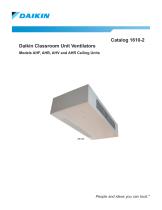
Daikin Classroom Unit Ventilators Models AHF, AHB, AHV and AHR Ceiling Units People and ideas you can trust.™
Open the catalog to page 1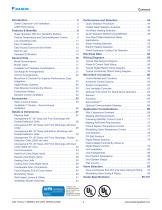
Daikin Classroom Unit Ventilators . . . . . . . . . . . . . . . . . . . . 3 AHRI Performance . . . . . . . . . . . . . . . . . . . . . . . . . . . . . . . . 4 Quick Selection Procedure . . . . . . . . . . . . . . . . . . . . . . . . Chilled Water Selection Example . . . . . . . . . . . . . . . . . . . . Hot Water Heating Selection . . . . . . . . . . . . . . . . . . . . . . . Quick Selection Method Using MBH/ΔT . . . . . . . . . . . . . . Two-Pipe Chilled-Water/Hot-Water Applications . . . . . . . . . . . . . . . . . . . . . . . . . . . . . . . . . . . . Steam Heating Selection . . . . . . ....
Open the catalog to page 2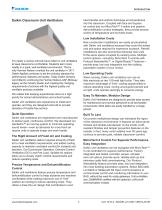
heat transfer and uniform discharge air temperatures into the classroom. Coupled with face and bypass air control and our MicroTech™ II active and passive dehumidification control strategies, they provide precise control of temperature and humidity levels. Daikin Classroom Unit Ventilators Low Installation Costs New construction installations are easily accomplished with Daikin unit ventilators because they avoid the added cost and space required for expensive ductwork. Retrofit installations are also economical because new units fit the same space occupied by existing ones. Multiple control...
Open the catalog to page 3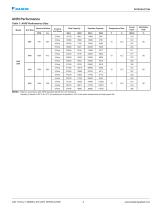
AHRI Performance Table 1: AHRI Performance Data Model Unit Size Cooling Coil Rows Total Capacity Btuh Sensible Capacity Power Input Ventilation Rate Notes: Rated in accordance with AHRI Standard 840-98 for Unit Ventilators Capacity is based on 80°F db, 67°F wb entering air temperature, 45°F enter water temperature and high-speed fan. CAT 1610-2 • MODEL AH UNIT VENTILATOR
Open the catalog to page 4
Model AH Ceiling Unit Features Our Model AH is a horizontal, ceiling-mounted unit that is designed for rooms where floor space is at a premium. It utilizes remotely-supplied chilled water or refrigerant for cooling, and hot water, steam or electric heat for heating. It also can be supplied as a cooling/ventilating unit only or as a heating/ventilating unit only with the option of adding cooling at a later date. exposures, including completely exposed, partially or fully recessed, or completely concealed. Older buildings with baseboard radiant heat or other hydronic heating systems can be easily...
Open the catalog to page 5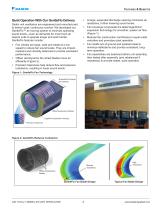
Features & Benefits Quiet Operation With Our GentleFlo Delivery Daikin unit ventilators are engineered and manufactured to deliver quiet, continuous comfort. We developed our GentleFlo™ air moving system to minimize operating sound levels—even as demands for more fresh air require units to operate longer and work harder. GentleFlo features include: • Fan wheels are large, wide and rotate at a low speed to reduce fan sound levels. They are impactresistant and carefully balanced to provide consistent performance. • Offset, aerodynamic fan wheel blades move air efficiently (Figure 2). • Precision...
Open the catalog to page 6
Features & Benefits The Right Amount of Fresh Air and Cooling Part-Load Variable Air Control Daikin unit ventilators deliver required amounts of fresh air to meet ventilation requirements and added cooling capacity to maintain consistent comfort for students and teachers. Our Economizer Operation, Part Load Variable Air control can be used in conjunction with face and bypass damper temperature control to automatically adjust the unit ventilator fan speed based upon the room load and the room temperature. This MicroTech II control option provides higher latent cooling capabilities and quieter...
Open the catalog to page 7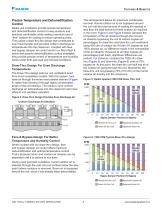
Features & Benefits Precise Temperature and Dehumidification Control Daikin unit ventilators provide precise temperature and dehumidification control to keep students and teachers comfortable while making maximum use of “free” outdoor-air cooling to reduce operating costs. They utilize a draw-thru fan design that contributes to even heat transfer and provides uniform discharge air temperatures into the classroom. Coupled with face and bypass damper air control and/or our MicroTech II active and passive dehumidification control strategies, they provide precise control of temperature and humidity...
Open the catalog to page 8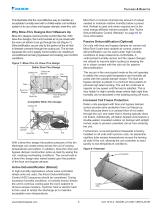
Features & Benefits This illustrates that the most effective way to maintain an acceptable humidity level with a chilled-water unit ventilator system is to use a face and bypass damper, draw-thru unit. MicroTech II controls minimize the amount of reheat needed to maintain relative humidity below a preset limit. Reheat is used only when required and in the most energy-efficient manner possible. See "Active Dehumidification Control (Reheat)" on page 63 for more information. Why Blow-Thru Designs Don’t Measure Up Blow-thru designs cannot provide comfort like this. With blow-thru designs, the humid...
Open the catalog to page 9
Features & Benefits • Built-In Wire Race: A built-in metal wire race runs Daikin unit ventilators have many features that make them economical to purchase and to install in both new construction and retrofit applications. It is this attention to detail and understanding of school applications that make them the system of choice. from one end of the unit to the other to provide extra protection for wires and protect them from unit air. • Adjustable, Double-Deflection Discharge Grille Units with front and bottom discharge come standard with four-way, double-deflection discharge grilles (Figure...
Open the catalog to page 10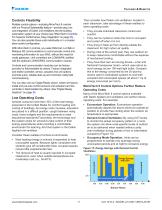
Features & Benefits With MicroTech II controls, you select BACnet, LonTalk or Metasys N2 communications to communicate control and monitoring information to your BAS, without the need for costly gateways. Unit controllers are LONMARK certified with the optional LONWORKS communication module. Controls and communication modules can be factory provided or field-installed by others. Factory integrated and tested controller, sensor, actuator and unit options promote quick, reliable start-up and minimize costly field commissioning. You can also use our Digital Ready option, where we factoryinstall...
Open the catalog to page 11All Daikin Applied catalogs and technical brochures
 Maverick® II systems
2 Pages
 Destiny® Indoor Air Handler
28 Pages
 PreciseLine®
4 Pages
 OptiLine™
2 Pages
 CAT 413-4 Steam Coils
23 Pages
 CAT 412-6 Water Heating Coils
32 Pages
 CAT 903 Air Terminal Units
106 Pages
 Daikin Applied 2014
247 Pages
 CAT 610-1 (AGSD 140-200 tons)
88 Pages


- Filter air purifier
- Air heater unit
- Mobile air purifier
- Daikin refrigeration unit
- Daikin stationary refrigeration unit
- HEPA filter air purifier
- Industrial air conditioner
- Air handling unit
- Ventilation unit
- Electric air heater unit
- Compact air conditioner
- Industrial air heater unit
- Outdoor air conditioner
- Inverter heat pump
- Wall-mounted air heater unit
- Commercial air conditioner
- Floor-standing air purifier
- Air purifier for commercial buildings
- Rooftop air conditioner