
- Catalogs
- Daheng New Epoch Technology, Inc(CDHC)
- Machine vision catalog


- Company
- Products
- Catalogs
- News & Trends
- Exhibitions
Machine vision catalog
1 /42Pages

Machine vision catalog
1 /42Pages
Catalog excerpts
Prompt Response, Good Quality, On time Delivery High Precision, Stable, Customization
Open the catalog to page 2
ADHC Daheng Optics Image Lenses • GCO-23 Higher Resolution 5M Series • GCO-23 High Resolution Series GCO-232 Bi- Telecentric Lenses(lntegrated, Iris adjustment) • GCO-232 Higher Resolution 5M Series • GCO-232 High Resolution Series • GCO-2606/2607 Object-Telecentric Micro-vision Series • GCO-2605 Zoom Object-Telecentric Micro-vision Series Other Lenses GCO-2390 Series of LED Pattren Projectors GCO-400101 Beam Shaping Lens Split Image Lens GCC-1021 Enhanced Aluminum Mirrors GCC-10220 Protected Silver Mirrors GCC-1023 Protected Gold Mirrors GCC-2030 Broadband Interference Filters GCC-3010 Neutral...
Open the catalog to page 3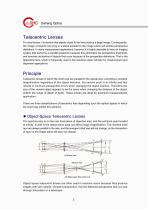
ADHC Daheng Optics Telecentric Lenses For most lenses, it is obvious that objects closer to the lens produce a larger image. Consequently, the image of objects not lying in a plane parallel to the image plane will exhibit perspective distortions. In many measurement applications, however, it is highly desirable to have an imaging system that performs a parallel projection because this eliminates the perspective distortions and removes occlusions of objects that occur because of the perspective distortions. That is the telecentric lens, which is frequently used in the machine vision industry for...
Open the catalog to page 4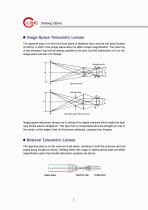
ADHC Daheng Optics Image-Space Telecentric Lenses The aperture stop is on the front foca! plane of objective lens, and the exit pupil located at infinity. A shift in the image plane does not affect image magnification. The chief ray of the emergent rays will be always parallel to the axis, and the intersection of it on the image plane will also not change. Image-space telecentric lenses are in demand for digital cameras which make the light rays hit the sensor straight-on. The rays from a conventional lens are straight-on only in the center, at the edges, they hit the sensor obliquely, causing...
Open the catalog to page 5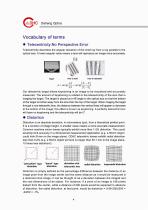
ADHC Daheng Optics • Telecentricity:No Perspective Error Telecentricity describes the angular deviation of the chief ray from a ray parallel to the optical axis. A lower angular value means a lens will reproduce an image more accurately. Our telecentric target allows keystoning in an image to be visualized and accurately measured. The amount of keystoning is related to the telecentricity of the lens that is imaging the target. The target is placed at a 45°angle to the optical axis so that the bottom of the target is further away from the lens than the top of the target. When imaging the target...
Open the catalog to page 6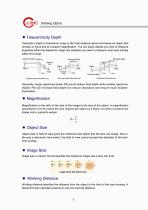
ADHC Daheng Optics • Telecentricity Depth Telecentric depth or telecentric range is the total distance above and below an object that remains in focus and at constant magnification. You can place objects you wish to measure anywhere within the telecentric range. But whatever you want to measure must exist entirely within this range. Telecentric depth chief ray (a) Object-space telecentric lens Telecentric depth (b) Image-space telecentric lens Telecentric depth Tetecentric depth {c) Bilateral telecentric lens Generally, larger apertures (lower F#) would reduce field depth while smaller apertures...
Open the catalog to page 7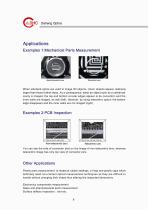
ADHC Daheng Optics Examples 1:Mechanical Parts Measurement Non-telecentric Lens Telecetric Lens When standard optics are used to image 3D objects, closer objects appear relatively larger than those further away. As a consequence, when an object such as a cylindrical cavity is imaged, the top and bottom circular edges appear to be concentric and the inner walls are imaged, as well (left). However, by using telecentric optics, the bottom edge disappears and the inner walls are not imaged (right). Non-telecentric Lens Telecentric Lens You can see the side of connector pins on the image of non-telecentric...
Open the catalog to page 8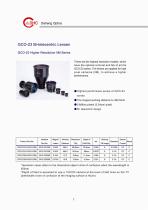
ADHC Daheng Optics GCO-23 Higher Resolution 5M Series These are the highest resolution models, which have the optimal contrast and NA of all the GCO-23 series. The lenses are applied for high pixel cameras (5M), to achieve a higher i Highest performace series of GCO-23 I The longest working distance to 494.5mm i5 Million pixels (3.34um/ pixel) Resolution value refers to the theoretical object circle of confusion when the wavelength is *Depth of field is assumed to use a 1/2CCD camera at the level of 240 lines on the TV (admissible circle of confusion of the imaging surface is 40um)
Open the catalog to page 9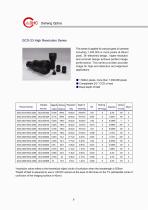
ADHC Daheng Optics GCO-23 High Resolution Series This series is applied for various types of cameras including 1,300,000 or more pixels (4.65um/ pixel). Bi- telecentric design, higher resolution and contrast design achieve perfect image performance. This series provides accurate image for high-end detection and alignment 1 Million pixels, more than 1,300,000 pixels Deep depth of field "resolution value refers to the theoretical object circle of confusion when the wavelength is 550nm *Depth of field is assumed to use a 1/2CCD camera at the level of 240 lines on the TV (admissible circle of confusion...
Open the catalog to page 11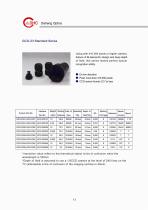
Using with 410,000 pixels or higher camera, feature of Bi-telecentric design and deep depth of field, this series realize perfect optical recognition ability. Ex-low distortion Pixel: more than 410,000 pixels CCD sensor format: 2/3 "or less Resolution value refers to the theoretical object circle of confusion when the *Depth of field is assumed to use a 1/2CCD camera at the level of 240 lines on the TV (admissible circle of confusion of the imaging surface is 40um)
Open the catalog to page 15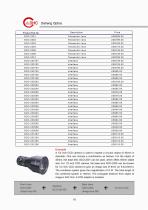
ADHC Daheng Optics A 1/2 inch CCD camera is used to inspest a circular object of 45mm in diameter. One can choose a combination as follows. For the object of 45mm, the base lens GCO-2301 can be used, which offers 50mm object size. For 1/2 inch CCD camera, the base lens GCO-2305 can be chosen for 1/2 inch CCD camera to give an image size of 8mm (or 6.4x4.8mm). The combined system gives the magnification of 0.16. The total length of the combined system is 146mm. The conjugate distance from object to image is 304.7mm. A CCD adaptor is included. Front Lens Back Lens
Open the catalog to page 18All Daheng New Epoch Technology, Inc(CDHC) catalogs and technical brochures
 Catalog V.15
298 Pages
 New Products
4 Pages
 Filters
13 Pages
 Daheng Catalog 2016
360 Pages




- Actuator
- Linear actuator
- Electric actuator
- DAHENG OPTICS positioning stage
- Clamping device
- DAHENG OPTICS linear positioning stage
- Motorized positioning table
- Compact actuator
- DAHENG OPTICS precision positioning stage
- Motor controller
- Clamping device
- Metal stand
- DC actuator
- DAHENG OPTICS technology positioning stage
- DAHENG OPTICS 1-axis positioning stage
- DAHENG OPTICS camera objective
- Manually-operated positioning stage
- 2-axis positioning table
- Precision actuator
- Compact positioning table