
- Catalogs
- CURTISS-WRIGHT
- SCM100

- Company
- Products
- Catalogs
- News & Trends
- Exhibitions
SCM100

SCM100
- Supply Voltage: 18 - 30 Vdc (regulated) or ±15 Vdc (regulated)
- Supply Current: Maximum 100 mA
- LVDT Excitation Voltage: 3 Vrms (nominal)
- LVDT Excitation Frequency: 2.5k Hz (nominal)
- Output Ripple: <5 mVrms
- Output Load: Minimum 1k Ω (resistive)
- Frequency Response: 300 Hz (-3dB)
- Non-linearity: ±0.05% max over 1% to 99% of stroke
- Line Regulation: <0.01% output span/Volt
- Load Regulation: <0.05% output span
- Output Adjustment Range: Null adjustment ±25%, Gain adjustment ±10%
- Operational Temperature: 0 to +70 ºC
- Storage Temperature: -20 to +85 ºC
- Temperature Coefficient of Output: <0.01% of span volts/ºC
- Transducer Types: 5 wire ratiometric LVDT only
- Mechanical Housing: Entrelec 11000 series
- Weight: Maximum 100 g
- Output options include ±2.5Vdc, ±5Vdc, ±10Vdc, 0-5Vdc, 0-10Vdc, and 4-20mA (SCM100/I only).
- Power supply options are 18 - 30Vdc or ±15Vdc.
- The module is user-configurable for input and output options. A set-up guide is provided for full instructions.
- Electrical connections are made via screw terminals, and the module fits DIN EN50022 or DIN EN50035 rails.
- Misconnection of the power supply may cause permanent damage.
Catalog excerpts

dc/dc LVDT DRIVER SCM1 00 PERFORMANCE Supply voltage Vdc LVDT excitation voltage Vrms LVDT excitation frequency Hz Output voltage1 (SCM100/V) Output current (SCM100/I) Output ripple mVrms Non-linearity Line regulation Load regulation Output adjustment range -null adjustment -gain adjustment Operational temperature °C Temp. coefficient of output Transducer types Mechanical housing Weight maximum g The LVDT Signal Conditioning Module SCM100 has been specifically designed to operate with the AF111 and AF145 range of LVDT's, and to make using an LVDT as simple as using a linear potentiometer. This module incorporates a high performance circuit which drives the LVDT in a ratiometric configuration, thereby maximising system accuracy by eliminating effects caused by temperature and supply current variations. 18 - 30 (regulated) or ±15 (regulated) 100 maximum 3 (nominal) 2.5k (nominal) See output options on page 9 for full details See output options on page 9 for full details <5 1k minimum (resistive) - voltage and current output 300 (-3dB) ±0.05% max (over 1% to 99% of stroke when used with AF111 or AF145 LVDT's) <0.01% output span/Volt <0.05% output span (minimum to maximum load) ±25% ±10% 0 to +70 -20 to +85 <0.01% of span volts/°C 5 wire ratiometric LVDT only Entrelec 11000 series (to suit DIN EN50022/EN50035 rails) 100 Note: This module is user configurable for input and output options. See set-up guide supplied with module for full instructions. When powered with a single rail supply, the output may not quite reach 0 Vdc For this reason, linearity is specified for 1% to 99% of LVDT stroke.
Open the catalog to page 1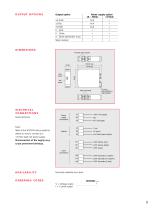
Output option DIMENSIONS ELECTRICAL CONNECTIONS Screw terminals Note: Refer to the SCM100 set-up guide for details on how to connect to a ±15Vdc (split rail) power supply. Misconnection of the supply may cause permanent damage. AVAILABILITY Power supply connections LVDT connections Normally available from stock V out 0V return 4 to 20mA output (option) LVDT primary (red) LVDT primary (black) LVDT screen LVDT secondary 1 (yellow) LVDT secondary C/T (green) LVDT secondary 2 (blue) ORDERING CODES SCM100/ V = Voltage output I = Current output
Open the catalog to page 2
Penny+GHes A Curtiss-Wright Company Penny & Giles Position sensors and joysticks for commercial and industrial applications. / CURTISS WRIGHT- Controls Integrated Sensing The information contained in this brochure on product applications should be used by customers for guidance only. Penny & Giles Controls Ltd makes no warranty or representation in respect of product fitness or suitability for any particular design application, environment, or otherwise, except as may subsequently be agreed in a contract for the sale and purchase of products. Customer's should therefore satisfy themselves of...
Open the catalog to page 3All CURTISS-WRIGHT catalogs and technical brochures
 S-Drive
2 Pages
 AES-350
18 Pages
 AES-349
25 Pages
 Industrial Division
8 Pages
 Transmission Shifter
2 Pages
 SBW
SBW3 Pages
 newVSI Brochure
2 Pages
 Multi-Function Grip
2 Pages
 wm-67
wm-672 Pages
 wm-672
2 Pages
 wm-674
1 Page
 wm-68a
2 Pages
 wm-762
2 Pages
 wm-763
2 Pages
 wm-764
2 Pages
 WM-777
2 Pages
 WM-782
3 Pages
 WM-783
3 Pages
 WM 784
2 Pages
 wm-80
wm-802 Pages
 WCS-133284
5 Pages
 WM 81
WM 812 Pages
 WCS-134143
5 Pages
 Tilt Position Sensor
4 Pages
 Industrial Group
4 Pages
 Sealed Tilt Sensor STT280
2 Pages
 Sealed Tilt Sensor STT500
2 Pages
 Aerial Work Platforms
4 Pages
 AES-204
13 Pages
 ML1951
1 Page
 ML1441 AC
1 Page
 Diagnostic Test Tool
2 Pages
 WM526
WM5262 Pages
 CW-IG-Overview Brochure
8 Pages
 JC050
JC0502 Pages
 JC040
JC0402 Pages
 WM547 Rotary hand control
2 Pages
 WM535 Lever hand control
2 Pages
 C7 Hydraulic Lever
2 Pages
 C6 Hydraulic Lever
2 Pages
 RF15 Series
2 Pages
 RF11 Series
2 Pages
 PGFM3000 Series
3 Pages
 PGF8000 Series
4 Pages
 PGF7000
1 Page
 PGF3000 Series
4 Pages
 CW-IG-Overview
8 Pages
 CW-IG-On-Highway
4 Pages
 CW-IG-Medical Mobility
4 Pages
 CW-IG-Industrial
4 Pages
 CW-IG-Construction
4 Pages
 PGFX3000 Series
2 Pages
 PGFM8000 SERIES
4 Pages
 On-Highway
4 Pages
 GK1037
1 Page
 GK0730
1 Page
 Permanent Magnet
1 Page
 GD1444
1 Page
 D-Frame Solenoid
1 Page
 CW-IG-Agriculture
4 Pages
 SRH220DR
2 Pages
 STT280
2 Pages
 CW-IG-Material Handling
4 Pages
 C3-CE AC Motor Controller
2 Pages
 C3-36V - AC Motor Controller
2 Pages
 WM531 Remote sensor control
2 Pages
 WM526 Electronic floor pedal
2 Pages
 WM537 Electronic floor pedal
2 Pages
 WM558 Electronic floor pedal
2 Pages
 SRS Sealed Rotary Sensors
8 Pages
 STT series Sealed Tilt Sensors
12 Pages
 Holding Magnets
2 Pages
 Digital Panel Indicators
8 Pages


Archived catalogs
 ICS100 IN-CYLINDER SENSORS
8 Pages
- Technology switch
- Motor controller
- Linear position transmitter
- Control pedal
- Displacement transducer
- Single pedal pedal
- Rotary electric switch
- Solenoid
- Linear displacement sensor
- Electronic pedal
- Analog position transducer
- IP67 switch
- DC motor controller
- No-contact position sensor
- Magnetic position sensor
- Analog displacement transducer
- Manual potentiometer
- Industrial position sensor