
- Catalogs
- Cummins Inc.
- Choosing the Right Technology For Tier 4


Choosing the Right Technology For Tier 4

Choosing the Right Technology For Tier 4
Cummins engines are designed for reliability and performance while meeting global emissions standards. The document highlights Cummins' technological advancements to comply with off-highway emissions requirements, focusing on collaboration with OEMs for integrated solutions.
Emissions standards have become stricter since Tier 1 regulations in 1996, targeting reductions in particulate matter (PM) and nitrogen oxides (NOx). By 2014, Tier 4 Final and EU Stage IV regulations demanded over 90% reduction in PM and NOx, requiring advanced engine technology and exhaust aftertreatment.
Cummins uses technologies like electronic fuel systems, charge air temperature control, cooled EGR, and VGT to meet emissions standards. These technologies, initially for on-highway use, are optimized for off-highway applications.
Cummins offers certified off-highway diesel engines. Engines between 49-750 hp must meet Tier 3 standards, while larger engines comply with Tier 2 standards. Despite regional differences, similarities in standards allow for common product sales across major markets.
Starting in 2011, these regulations required significant PM and NOx reductions for engines in the 174-750 hp range, necessitating PM exhaust aftertreatment and enhanced engine technology.
By 2014, these regulations further reduced NOx emissions by 45% for engines above 174 hp, aligning closely with Japanese regulations and pushing emissions to near-zero levels.
From 2011, regulations require certification of engine and aftertreatment systems as a unit. The NRTC test cycle adds rigor to certification, reflecting real-world engine operation more accurately.
ULSD is critical for effective aftertreatment operation. The transition to 15 ppm sulfur content diesel fuel is underway in North America and Europe, with Japan already using ULSD for certain applications. Biodiesel is also gaining traction, supported by Cummins.
Cummins is committed to meeting Tier 4/Stage IV emissions standards through technology advancements, ensuring compliance while maintaining engine performance and reliability.
Cummins has developed technologies to meet Tier 4 Interim/Stage IIIB standards, focusing on minimizing installation impact and operational costs. Key technologies include Cooled EGR, VGT, HPCR fuel systems, and advanced electronic controls.
Cummins uses aftertreatment technologies like DPF, DOC, SCR, and NOx adsorbers, integrated with engine systems to optimize performance and emissions control.
Cooled EGR controls NOx emissions by recirculating cooled exhaust gases back into the combustion chamber, reducing flame temperatures and NOx production.
VGTs precisely meter exhaust gas and air into the engine, improving performance and fuel economy. Cummins' VGT features a patented sliding-nozzle design for optimal airflow control.
HPCR systems offer precise control over fuel injection parameters, enhancing engine performance and meeting emissions standards.
Advanced electronic controls manage fuel injection, air handling, and aftertreatment systems. Cummins' ECMs are designed for robust performance in harsh environments and are compatible with CANbus networks.
Tier 4 engines require advanced filtration systems for air intake, lube oil, and fuel. Cummins Filtration provides solutions like the Direct Flow air filtration system and coalescing filters.
The Cummins Particulate Filter uses a wall-flow design to capture particulate matter, with passive and active regeneration processes to oxidize PM.
Cummins' integrated approach to engine and aftertreatment system design ensures compliance with emissions standards while optimizing performance and efficiency.
Cummins plans to integrate cooled EGR, VGT, and HPCR fuel systems with a Cummins Particulate Filter and Direct Flow air filtration for engines in the 174-751 hp range, simplifying the transition to Tier 4 Final/Stage IV standards by 2014.
Cummins focuses on advanced combustion engineering and potential aftertreatment technologies like SCR and NOx adsorbers to reduce NOx emissions, providing cost-effective solutions while maintaining low emissions.
Cummins emphasizes integrating key subsystems from air intake to exhaust aftertreatment, collaborating with OEM partners for machine integration and testing of Tier 4 engines.
The document provides definitions for technical terms and technologies, such as DOC, DPF, EGR, and SCR, and explains the equivalence of U.S. EPA and EU emission standards.
Cummins provides contact details for their U.S. and UK offices, along with a reference to their customer center website for further inquiries.
Catalog excerpts
Mobile Off-Highway Emissions. Choosing The Right Technology For Tier 4.
Open the catalog to page 1
Cummins Off-Highway Emissions Technology Introduction Cummins engines are designed to provide customers with the highest levels of reliability, durability, performance and dependability at the lowest cost of operation. At the same time, we are committed to meeting or exceeding clean air standards worldwide. This document describes the technology options Cummins is developing to meet emissions requirements for the off-highway market. It discusses several technologies as well as their advantages and challenges. Cummins has long been a pioneer in emissions research and development. We have invested...
Open the catalog to page 3
Cummins Strategy – The Right Technology Matters Cummins is a leading global manufacturer and Cummins component technology companies, supplier to very diverse worldwide markets joint ventures, customer partnerships and our and customers. As emissions regulations relationships with universities and national are becoming more stringent worldwide, laboratories uniquely position us to design, Cummins leadership in combustion research, manufacture and implement the best solutions fuel systems, air handling, aftertreatment, for off-highway markets. Today and in the filtration and control systems becomes...
Open the catalog to page 4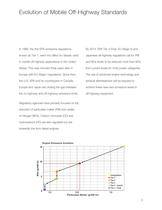
Evolution of Mobile Off-Highway Standards In 996, the first EPA emissions regulations, By 204, EPA Tier 4 Final, EU Stage IV and known as Tier , went into effect for diesels used Japanese off-highway regulations call for PM in mobile off-highway applications in the United and NOx levels to be reduced more than 90% States. This was mirrored three years later in from current levels for most power categories. Europe with EU Stage I regulations. Since then, The use of advanced engine technology and the U.S. EPA and its counterparts in Canada, exhaust aftertreatment will be required to Europe and...
Open the catalog to page 5
Emissions Technology - Cummins MidRange and Heavy-Duty Diesel Engines ■ Fuel System/Controls (mechanical to electronic) ■ Charge Air Temperature Control jacket-water aftercooled [JWAC] to air-to-air aftercooled [CAC]) ■ EGR (cooled Exhaust Gas Recirculation) and VGT (Variable Geometry Turbocharging) While the gap between on- and off-highway emissions is closing, the effect dates for equivalent off-highway emissions levels generally lag on-highway by a few years. This chart illustrates the types of technology driven by on- and off-highway emissions and followed the on-highway market. While the...
Open the catalog to page 6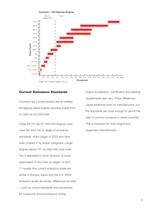
Cummins – Off-Highway Engines Tier / Stage IIIA Tier 2 QSK78 QSK60 QSK50 QSK45 QSK8 QST0 QSK2 QSK9 QSX QSM QSC/QSL QSB4.5/QSB6.7 B./QSB. A Series* 0 200 400 600 800 000 200 400 600 800 2000 2200 2400 2600 2800 000 200 400 600 *Meet Tier 4 Interim below 49 hp Current Emissions Standards Cummins has a broad product line of certified off-highway diesel engines providing power from -500 hp (2-260 kW). engine acceleration. Certification and labeling requirements also vary. These differences cause additional work for manufacturers, but the standards are close enough to permit the sale of common products...
Open the catalog to page 7
Engine Combustion Simulation Particulate Matter Fuel-Rich Region Liquid Fuel The primary focus of the Tier 3/Stage IIIA standard has been NOx reduction. Cummins advanced in-cylinder solution, electronic controls and advanced fuel systems for Tier 3/ Stage IIIA provide a key building block as we move forward to the next level of off-highway The same expertise with advanced in-cylinder combustion and high-pressure common-rail fuel systems has been applied to Cummins range of high-horsepower engines over 751 hp (560 kW) to achieve Tier 2 emissions levels, introduced in January 2006 for applications...
Open the catalog to page 8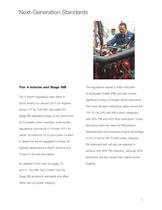
Next-Generation Standards Tier 4 Interim and Stage IIIB Tier 4 Interim regulations take effect in North America in January 20 for engines above 7 hp (29 kW). Equivalent EU Stage IIIB regulations begin at the same time for European Union countries, while similar regulations commence in October 20 for Japan. A maximum of 5-ppm sulfur content in diesel fuel will be regulated for these offhighway applications in North America and 0 ppm in Europe and Japan. As detailed in the chart on pages 0 The regulations require a major reduction of particulate matter (PM) and also require significant oxides of...
Open the catalog to page 9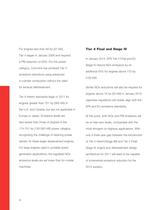
For engines less than 49 hp (7 kW), Tier 4 began in January 2008 and required a PM reduction of 50%. For this power category, Cummins has achieved Tier 4 emissions reductions using advanced in-cylinder combustion without the need for exhaust aftertreatment. Tier 4 Interim standards begin in 20 for engines greater than 75 hp (560 kW) in the U.S. and Canada, but are not applicable in Tier 4 Final and Stage IV In January 204, EPA Tier 4 Final and EU Stage IV reduce NOx emissions by an additional 45% for engines above 7 hp (29 kW). Similar NOx reductions will also be required for engines above 74...
Open the catalog to page 10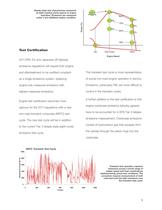
Steady-state test characterizes emissions at eight isolated points typical of engine operation. Emissions are measured under a hot-stabilized engine condition. Test Certification 20 EPA, EU and Japanese off-highway emissions regulations will require both engine and aftertreatment to be certified compliant This transient test cycle is more representative as a single emissions system, replacing of actual non-road engine operation in service. engine-only measured emissions with Emissions, particularly PM, are more difficult to tailpipe-measured emissions. control in the transient cycles. Engine...
Open the catalog to page 11
ULSD Fuel Standards In meeting the 2011 emissions requirements, diesel fuel is a critical part of the solution. Ultra-Low Sulfur Diesel (ULSD) is necessary for most aftertreatment technology as high levels of sulfur will render the aftertreatment less effective and may not be emissions-compliant The introduction of ultra-low sulfur diesel fuel provides other beneficial effects beyond ensuring effective operation of aftertreatment. It inherently produces less PM from combustion and will also enable a major reduction in sulfur dioxide (SO2) emissions from off-highway engines. due to the increased...
Open the catalog to page 14All Cummins Inc. catalogs and technical brochures
 QSC8.3
2 Pages
 Cummins Repower™
2 Pages
 QSM11
QSM112 Pages
 QSL9
QSL92 Pages
 QSF3.8
2 Pages
 QSB6.7 / QSB7
2 Pages
 QSB4.5
2 Pages
 introducing ISL G NEAR ZERO
2 Pages
 ISL G
ISL G6 Pages
 G5.9 And GTA5.9.
2 Pages
 Dependable Power. Every™ Track
12 Pages
 Underground Mining Engines.
8 Pages
 MCRS Overview.
2 Pages
 Cummins Dual
4 Pages
 SCHOOL BUS ENGINES
6 Pages
 Every™Innovation. ISMe
4 Pages
 ReCon Awareness
10 Pages
 Cummins 2013 RV Applications
12 Pages
 Centinel / Eliminator
4 Pages
 Cummins Westport ISL G
6 Pages
 2013 Driver Tips Card
6 Pages
 This is Cummins Brochure
20 Pages
 ISL G Euro 6 Engine Brochure
6 Pages
 ISB5.9 G Engine
6 Pages
 Cummins ISV5.0 Brochure
5 Pages
 ISB Euro 6 Engine
10 Pages
 C Gas Plus Engine Brochure
6 Pages
 B Gas Plus Engine Brochure
6 Pages
 2013 Urban Transit Brochure
10 Pages
 2013 School Bus Engines Brochure
10 Pages
 QSF2.8 Folded Brochure
6 Pages


Archived catalogs
 PowerSpec Brochure
4 Pages
 Diesels for Defence Brochure
16 Pages
 QSL
QSL6 Pages
 EVERY CHALLENGE
8 Pages
 Better Every™ Call
2 Pages
 Better Every™ Mile
2 Pages
 Big Results. EveryTM Job
6 Pages
 Cummins Mining Engine Range
20 Pages
 Cummins Tier 3 Engine Range
24 Pages


- Power generator
- Diesel generator set
- Industrial genset
- Automation software solution
- 50 Hz generator set
- Stationary genset
- Analysis software solution
- Real-time software
- Soundproof generator set
- Control software
- Water-cooled generator set
- Cummins multi-cylinder engine
- Industrial software
- Direct fuel injection generator set
- Measurement software
- 60 Hz generator set
- Friction brake
- Single-phase generator set
- Cummins turbocharged engine