
- Catalogs
- Cubic Sensor and Instrument Co.,Ltd
- Understanding the Differences Between Thermal Mass and Ultrasonic Gas Flow Meters

- Company
- Products
- Catalogs
- News & Trends
- Exhibitions
Understanding the Differences Between Thermal Mass and Ultrasonic Gas Flow Meters
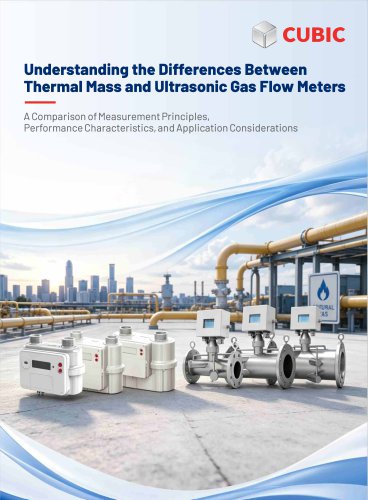
Understanding the Differences Between Thermal Mass and Ultrasonic Gas Flow Meters
Introduction
This document compares thermal mass and ultrasonic gas flow meters, focusing on their measurement principles, performance characteristics, and application considerations.
Measurement Principles
Thermal Mass Flow Meters: Measure gas flow by detecting heat transfer from a heated sensor to the flowing gas, which correlates to mass flow rate.
Ultrasonic Flow Meters: Use the transit time difference of ultrasonic pulses traveling with and against the gas flow to determine velocity and calculate volumetric flow.
Performance Characteristics
Thermal Mass Meters: Provide direct mass flow measurement, high accuracy for low flow rates, and are sensitive to gas composition and temperature changes.
Ultrasonic Meters: Offer high accuracy over a wide flow range, are less affected by gas composition, and have no pressure drop due to non-intrusive measurement.
Application Considerations
Thermal Mass Meters: Best suited for clean, dry gases with stable composition; limited in high particulate or wet gas environments.
Ultrasonic Meters: Suitable for a broad range of gases, including wet or dirty conditions; require straight pipe runs for accurate measurement.
Summary of Key Differences
- Thermal meters measure mass flow directly; ultrasonic meters measure volumetric flow and require compensation for density.
- Thermal meters are sensitive to gas composition changes; ultrasonic meters are more robust in varying gas conditions.
- Ultrasonic meters have no pressure drop; thermal meters introduce minor pressure loss.
Recommendations
Select thermal mass meters for applications requiring direct mass flow measurement with stable gas composition and low flow rates. Choose ultrasonic meters for applications demanding wide flow range, minimal maintenance, and operation in challenging gas conditions.
Catalog excerpts
了 CUBIC Unde 『standing the Differences Between Thermal Mass and Ultrasonic Gas Flow Meters A Comparison of Measurement Principles, Performance Characteristics, and Application Considerati
Open the catalog to page 1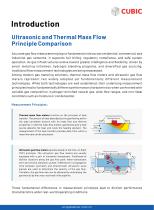
IntroductionUltrasonic and Thermal Mass Flow Principle Comparison Accurate gas flow measurement plays a fundamental role across residential, commercial, and industrial gas networks. It supports fair billing, regulatory compliance, and safe system operation. As gas infrastructures evolve toward greater intelligence and flexibility, driven by smart metering initiatives, hydrogen blending programs, and diversified gas sourcing, traditional flow measurement technologies are being reassessed. Among modern gas metering solutions, thermal mass flow meters and ultrasonic gas flow meters represent two...
Open the catalog to page 2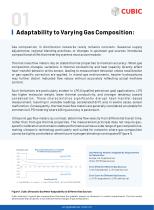
Gas composition in distribution networks rarely remains constant. Seasonal supply adjustments, regional blending practices, or changes in upstream gas sources introduces compositional shifts that metering systems mustaccommodate. Thermal mass flow meters rely on stable thermal properties to maintain accuracy. When gas composition changes, variations in thermal conductivity and heat capacity directly affect heat-transfer behavior at the sensor, leading to measurement deviation unless recalibration or gas-specific correction are applied. In mixed-gas environments, heavier hydrocarbons may further...
Open the catalog to page 3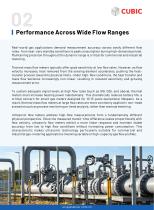
Real-world gas applications demand measurement accuracy across vastly different flow rates: from near-zero standby conditions to peak consumption during high-demand periods. Maintaining precision throughout this dynamic range is critical for commercial and industrial metering. Thermal mass flow meters typically offer good sensitivity at low flow rates. However, as flow velocity increases, heat removed from the sensing element accelerates, pushing the heat-transfer process toward its physical limits. Under high-flow conditions, the heat transfer and mass flow becomes increasingly non-linear, resulting...
Open the catalog to page 4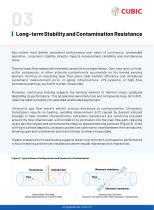
Gas meters must deliver consistent performance over years of continuous, unattended operation. Long-term stability directly impacts measurement reliability and maintenance costs. Thermal mass flow meters are inherently sensitive to contamination. Overtime, dust, oil mist, sulfur compounds, or other airborne contaminants accumulate on the heated sensing element, forming an insulating layer that alters heat-transfer efficiency and introduces systematic measurement error. In aging infrastructure, LPG systems, or high-flow commercial settings, such drift is often irreversible. Moreover, continuous...
Open the catalog to page 5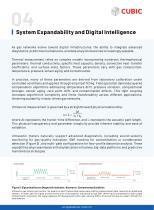
As gas networks evolve toward digital infrastructures, the ability to integrate advanced diagnostics, predictive maintenance, and data analytics becomes increasingly valuable. Thermal measurement relies on complex models incorporating numerous thermophysical parameters: thermal conductivity, specific heat capacity, density, convective heat-transfer coefficients, and surface-state factors. These parameters vary with gas composition, temperature, pressure, sensor aging, and contamination. In practice, many of these parameters are derived from laboratory calibration under controlled conditions and...
Open the catalog to page 6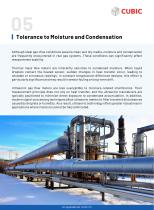
Although ideal gas-flow conditions assume clean and dry media, moisture and condensation are frequently encountered in real gas systems. These conditions can significantly affect measurement stability. Thermal mass flow meters are inherently sensitive to condensed moisture. When liquid droplets contact the heated sensor, sudden changes in heat transfer occur, leading to unstable or erroneous readings. In constant temperature-difference designs, this effect is particularly significant and may result in sensor fouling or long-term drift. Ultrasonic gas flow meters are less susceptible to moisture-related...
Open the catalog to page 7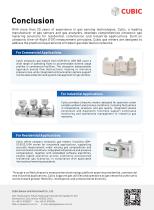
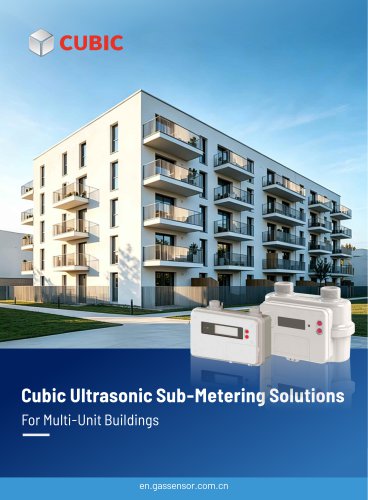
With more than 20 years of experience in gas sensing technologies, Cubic, a leading manufacturer of gas sensors and gas analyzers, develops comprehensive ultrasonic gas metering solutions for residential, commercial, and industrial applications. Built on ultrasonic time-of-flight (TOF) measurement principles, Cubic gas meters are designed to address the practical requirements of modern gas distribution networks. Cubic ultrasonic gas meters from USM G6 to USM G65 cover a wide range of operating flows to accommodate diverse usage profiles in commercial facilities. The ultrasonic measurement approach...
Open the catalog to page 8All Cubic Sensor and Instrument Co.,Ltd catalogs and technical brochures
 Portable Particle Counter
2 Pages
 Cubic TDLAS CH4 Sensor
4 Pages
 Gasboard-7500H-OPC
13 Pages
 NDIR CO2 Sensor Module-CM1106LS
18 Pages
 Laser Particle Sensor-PM2008M-M
22 Pages
 Laser Particle Sensor-PM2012
19 Pages
 Test Instruction of AM4100-I
7 Pages
 Test Instruction of AM1008W
7 Pages
 Test Instruction of PM5000
7 Pages
 Test Instruction of PM1006
8 Pages
 Test Instruction of CM1107T
7 Pages
 Test Instruction of CM1107BN
8 Pages
 Test Instruction of PM3006T
7 Pages
 Test Instruction of PM2009
8 Pages
 Test Instruction of CM1106SH
8 Pages
 Test Instruction of CM1107
8 Pages
 Test Instruction of CM1106S
8 Pages
 Test Instruction of CM1106LS
8 Pages
 Laser Particle Sensor-PM2008
21 Pages
 Laser Particle Sensor-PM2009
20 Pages
 Laser Particle Sensor-PM2105-M
20 Pages
 NDIR CO2 Sensor Module-CM1106S
18 Pages
 Gas Sensor Line-up
1 Page
 About Cubic
1 Page
 CEMS Solution - Gasboard 9050
22 Pages
 NDIR CO2 Sensor Modules
7 Pages
 Gasboard-7020
4 Pages
 Gasboard-7500
7 Pages
 Mainstream ETC02 module
5 Pages
 Gasboard 3400P
5 Pages
 Analyzer Gasboard 3800P
6 Pages
 LANDFILL APPLICATIONS
8 Pages
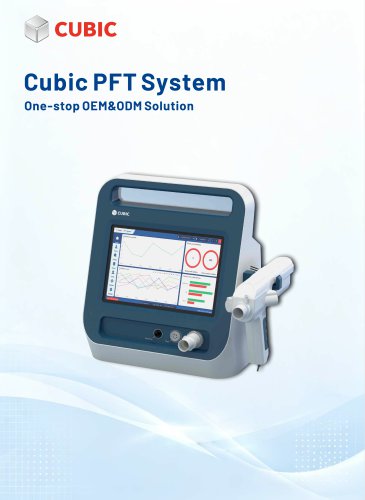
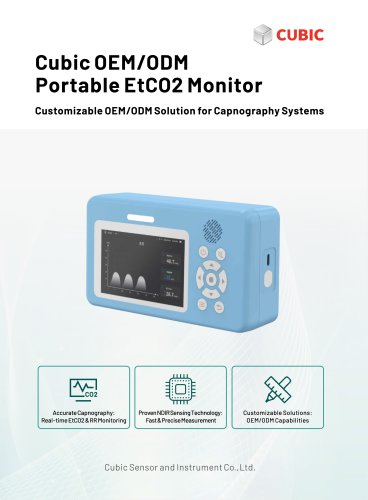
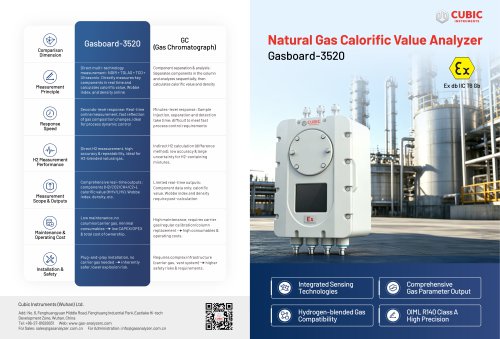
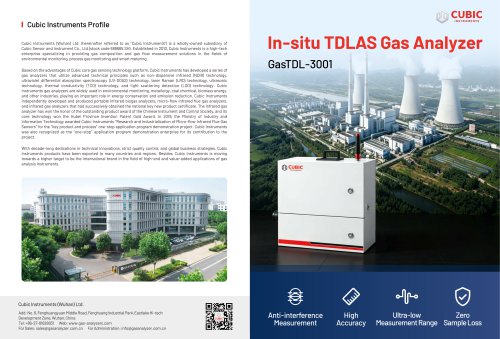


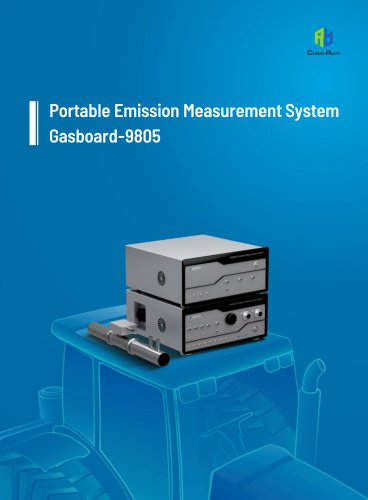


Archived catalogs
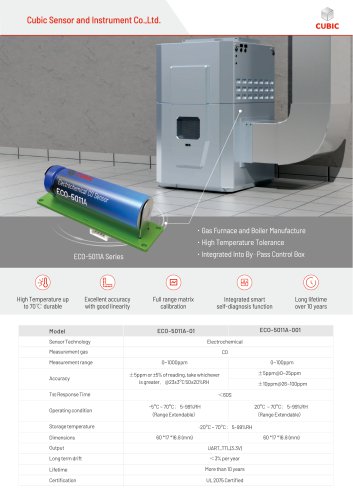 Cubic CO Sensor Brochure
2 Pages
 Air quality monitor AM7000
11 Pages
 RHB Series
8 Pages
 Syngas portable analyzers
4 Pages
 Opacity meter
1 Page
 Infrared Methane gas sensor
3 Pages


- Cubic volume flow meter
- Liquid flow monitor
- Cubic concentration analyzer
- Cubic monitoring analyzer
- Cubic liquids analyzer
- Measuring machine
- Cubic automatic analyzer
- Calibration system
- Cubic waterproof flow meter
- Benchtop analyser
- Cubic solids analyzer
- Stainless steel flow monitor
- Air blower
- Industrial flow monitor
- Gas detector
- Cubic process analyzer
- Pressure probe