


- Company
- Products
- Catalogs
- News & Trends
- Exhibitions
Linear guides

Linear guides
CTS linear wheel guides are versatile and maintenance-free, suitable for industries like textiles, paper, and food where contamination must be avoided.
Wheel choice depends on the environment. Standard wheels have dust guards, while sealed versions are for fine particles or moisture. Polymer-coated wheels are economical for light loads in aggressive environments.
Standard wheels operate between -20°C and +80°C, with special wheels available for -70°C to +300°C.
Speed should match load and precision needs, with standard limits of 3 m/s and 7 m/s². Higher speeds require consultation.
Concentric wheels must be tightened to specified torque. Preload eccentric wheels by rotating the pin until tight without play. Excessive preload can cause damage.
Wheel size is based on axial and radial forces within catalog limits. CTS provides assistance and a sizing questionnaire.
Wheel guides are lubricant-free and adjustable for sliding force, suitable for dusty environments. Ball bearing guides require lubrication and are more compact but less adaptable.
Guides come in "screwed" and "rolled" versions. Screwed guides are for longer paths and heavy loads, while rolled guides offer better parallelism.
Options include toothed belts, chains, racks, and screws, each with specific characteristics and limitations.
Used in textile machinery, packaging, food industry equipment, woodworking, and more.
Stainless steel versions are available for humid environments. Ball bearing guides are compact and rigid but require lubrication.
Wheel guides come in "screwed" and "compact" versions, with specific recommendations for installation types.
Various options are outlined, each with specific characteristics and limitations.
Used in industries like textile machinery, packaging, and food processing.
Wheel type choice depends on the environment, with options for protection against particles and moisture.
Temperature limits for lubricants and speed considerations are specified.
Proper preload adjustment is crucial to avoid damage.
Wheel guides are lubricant-free and suitable for dusty environments, while ball bearing guides require lubrication.
Technical specifications and guidelines for CI, AS, AV6, and AD systems are provided, focusing on compact dimensions and load handling.
- CI Series: For small and light loads, made from anodized aluminum with steel bars.
- AS System: Adjustable center-to-center distances, requiring careful alignment.
- AV6 System: Stability with a compact design, supplied with carriages and wheels.
- AD System: Various models with different load capacities and dimensions.
- Precise alignment is required for installation.
- Guides are supplied cut to specified lengths.
- Use parallel guides for larger loads.
- Ensure proper alignment for stability.
- Load capacities and dimensions for each system type are provided.
- Specifications for wheels are detailed.
The document emphasizes the versatility and modularity of linear motion systems, highlighting the importance of precise installation.
Various models of guide systems are outlined, each with specific dimensions and load capacities.
Assembly is the purchaser's responsibility, with options for expansion in some systems.
Steel bars are hardened and chromium-plated, with specific recommendations for securing bars.
Detailed specifications for each model, including load capacities and dimensions, are provided.
Each system is designed for specific applications, with recommendations based on load requirements.
Technical specifications and guidelines for wheels and trolleys are provided, emphasizing applications and customization options.
Multiple wheel types are listed with dimensions and load capacities.
Instructions for adjusting preload on wheels are provided.
Recommendations for dust covers and seals are provided.
Custom manufacturing options are highlighted.
Detailed dimensions and specifications for each wheel type are provided.
Use of cross trolleys for movement along two axes is discussed.
Various models of motorizable guides and pulleys are outlined.
Standardized components and materials are detailed.
Instructions for belt tensioning and motorization are provided.
Recommendations for environments with oxidizing agents are provided.
Side assembly is suitable for various drive systems.
Detailed measurements and specifications for each model are provided.
Assembly and specifications for motorized guides are outlined.
Assembly results in a robust support beam and compatibility with specific belts.
Detailed specifications for different models are provided.
Motorization using a rack, pinion, and flange is described.
Designed for light loads using a screw solution.
Consists of an aluminum profile with ball screw guides.
Various components and specifications for mechanical systems are outlined.
Systems for joining guides longer than 6 meters are described.
Bellow boots are recommended for protection.
Various support profiles are detailed.
Specifications for shafts and flanges are provided.
Instructions for assembling motorized guides are provided.
Details on assembling trolleys with wheels are provided.
Examples of special axes for high rigidity applications are provided.
Mechanical systems for movement applications are discussed.
Recommendations for long strokes and quiet transmission are provided.
Telescopic guides are ideal for compact spaces.
Three X-Z systems are described for specific applications.
Two handling solutions are presented for stability and automation.
Catalog excerpts

GUIDE LINEARI - LINEAR GUIDES - GLISSIERES LINEARES ISO 9001 Cert. n°1399
Open the catalog to page 1
Indice - Contents - Contenu Introduzione Introduction Introduction Sistema CI CI system Système CI Sistema AS AS system Système AS Sistema AV6 AV6 system Système AV6 Sistema AD AD system Système AD Sistema AV AV system Système AV Sistema AG AG system Système AG Rotelle Wheels Roulettes Carrelli Trolleys Chariots Sistema curvilineo Curvilinear system Système curviligne Codici per ordinazione guide motorizzate ordering codes for motorizable guides codes de commande pour les guides motorisables AK… – GUIDE MOTORIZZABILI AK… – MOTORISABLE GUIDES AK… – GLISSIERES MOTORISABLES AD…M – GUIDE MOTORIZZABILI...
Open the catalog to page 2
INTRODUZIONE ALLE GUIDE LINEARI A ROTELLE Le guide lineari a rotelle CTS possono essere utilizzate in tutti i campi di applicazione. Lavorando a secco, ovvero non avendo necessità di lubrificazione nel contatto pistarotelle (le rotelle hanno già una lubrificazione interna come nei normali cuscinetti) sono particolarmente indicate negli ambienti polverosi, nelle zone dove sia difficile una costante manutenzione, e soprattutto nelle applicazioni dove è importante non inquinare il prodotto finale, come nel campo tessile, cartotecnico ed alimentare, dove il sistema può essere interamente inox. Ambiente...
Open the catalog to page 3
Nelle guide rullate, per effetto del fissaggio continuo delle barre sul profilo d’alluminio, si ha un miglior parallelismo tra le barre rispetto a quello sulle guide avvitate, che invece sono fissate rispettando l’interasse S riportato nelle varie tabelle. Si consiglia l’impiego di guide avvitate quando la guida è montata sottosopra con il carico appeso e quando si è in presenza di forti carichi a sbalzo. In questi casi, per irrobustire la tenuta delle barre d’acciaio, sul profilo d’alluminio si può aumentare il numero delle viti di fissaggio riducendo il passo S. Tutte le guide con doppia barra...
Open the catalog to page 4
INTRODUCTION TO LINEAR GUIDE WITH WHEELS CTS linear wheel guides can be used in all fields of application. These systems operate dry, which means they do not require lubrication between the track and the wheels (which already have internal lubrication like normal bearings). For that reason, they are particularly suitable in dusty environments or places where constant maintenance is difficult. They are especially indicated for applications where it is important not to contaminate the final product, such as the textile, paper and food industries, where the system can be made entirely of stainless...
Open the catalog to page 5
All guides with double bars have a predetermined wheelbase. If it is necessary to increase or reduce this wheelbase, the single S10-S20 guides can be used. The wheels with 120° grooves can also be used on a hexagonal bar. This is useful when a low cost system is required and where there are chemical agents that can corrode aluminium. In this case, an AISI304 or AISI316 stainless steel bar can be used. Since the wheel runs on two surfaces instead of two points, as with the round bar, the reactive forces to the load are distributed over a larger surface and therefore it is not necessary to subject...
Open the catalog to page 6
INTRODUCTION AU GUIDE LINÉAIRE AVEC ROUES Les glissières linéaires à roulettes CTS peuvent être utilisées dans tous les champs d’application. En travaillant à sec, c’est-à-dire sans lubrification dans le contact piste/roulettes (les roulettes ont déjà une lubrification interne comme pour les roulements normaux), elles sont particulièrement indiquées dans les espaces poussiéreux, dans les zones où un entretien constant est difficile, et surtout pour les applications où il est important de ne pas polluer le produit final, comme dans le secteur textile, cartonnier et alimentaire, où le système peut...
Open the catalog to page 7
série CI). Les glissières vissées peuvent être assemblées entre elles en réalisant des brochages mâle/femelle et en créant ainsi des voies de coulissement plus longues de 6 m, tandis que, avec les glissières roulées, cela n’est pas possible et la longueur maximum est de 6 m. Pour les glissières roulées, grâce à la fixation continue des barres sur le profil en aluminium, on obtient un meilleur parallélisme entre les barres par rapport à celui obtenu sur les glissières vissées, qui sont en revanche fixées en respectant l’entraxe S reporté aux différents tableaux. On conseille d’utiliser des glissières...
Open the catalog to page 8
' ll carico radiale e diretto a sollecitare solo le 2 rotelle concentriche - Radial load is applied only on the 2 concentric wheels - Le charge radiale a pour but de ne solliciter que les 2 galets concentriques
Open the catalog to page 9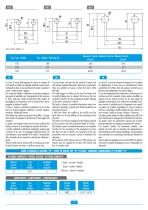
SCALA - SCALE - ECHELLE 1:1 Tipo - Type - Modele Peso - Weight - Poids (kg/m) CI32 CI42 CI65 Momento d’inerzia - Moment of inertia - Moment d’inertie LX (cm4) LY (cm4) La serie CI nasce dall’esigenza di avere un sistema di scorrimento a rotelle con ingombri ridotti che possa essere impiegato la dove ci siano problemi di spazio o quando il carico e molto piccolo e leggero. Per carichi più elevati o voluminosi si possono accoppiare due guide in parallelo con l’accorgimento di far scaricare la forza sulle due rotelle concentriche (vedi schema di montaggio). Così facendo si avrà la certezza che il...
Open the catalog to page 10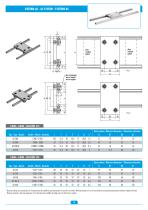
GUIDA - GUIDE - GLISSIERE S10 * Distanza minima: puo aumentare con I'interposizione di rondelle di spessoramento fra il carrello e la rotella - Minimum distance: it can be increased by inserting shimming washers between trolley and wheel Distance minimale : elle peut augmenter si l'on interpose des rondelles de calage entre le chariot et la roulette.
Open the catalog to page 11All C.T.S. catalogs and technical brochures
 AL8080
3 Pages


- Linear axis
- Electric linear axis
- Ball bearing linear guide
- Slide carriage block
- Precision linear axis
- Compact linear guide
- One-way clutch with internal bearings
- Precision linear guide
- Aluminum linear guide
- Screw linear axis
- Track linear guide
- Roller backstop
- Aluminum linear axis
- Backstop freewheel
- Screw spindle linear axis
- Overrunning clutch freewheel
- Compact linear axis
- Indexing one-way clutch
- Robot linear axis