


- Company
- Products
- Catalogs
- News & Trends
- Exhibitions
Free wheels, Back stop, Overrunning clutch

Free wheels, Back stop, Overrunning clutch
Introduction
Freewheels are unidirectional joints composed of a drive ring and a driven ring, allowing motion in one direction. They disengage when the driven ring rotates faster or in the opposite direction. The primary uses include backstop, overrunning clutch, and intermittent feed.
Types of Freewheels
Roller Type Freewheels: Suitable for intermittent feed and medium to low rpm applications, featuring a cylindrical external ring and an internal 'star' wheel.
Freewheels with Asymmetrical Contact Bodies: Ideal for high rpm backstop applications, consisting of two cylindrical rings with a cage containing asymmetrical contact bodies.
Precision and Speed
Precision in roller type freewheels can be improved with reinforced springs and specific lubricants. Maximum idle speed limits depend on dimensions and lubricant type, with safety margins recommended to prevent damage.
Durability
Factors affecting lifespan include speed, engagements, loads, and lubrication. Speed and lubrication are critical for backstop mode, while torque is essential for overrunning clutch mode.
Special Applications
Custom solutions are available for unique challenges, with modifications tailored to specific needs.
1. Torque and Inertia: Includes parameters like transmission side nominal torque and load side nominal torque, with formulas for calculations.
2. Motor Power and Rotation: Details on motor power rating and shaft rotations.
3. Dimensions and Scale: Provides tolerances and measurements for components.
1. Recommended Lubricants: Use CL type oils per DIN 51517. Avoid additives like molybdenum disulfide and graphite.
2. Temperature Considerations: Consult the manufacturer for temperatures above 80°C. Use SAE10W-40 oil for 0°C to 80°C.
3. Lubrication Types: Discusses oil and grease methods, with instructions for maintaining levels.
1. Fitting Instructions: Ensure correct alignment and centering. Use appropriate seals and screws.
2. Lubrication Process: Steps for oiling and greasing, avoiding certain additives.
3. Maintenance Schedule: Initial lubricant change after 100 hours, then every 2000 hours.
4. Pre-Fitting Checks: Verify neutral direction and shaft tolerances.
5. Post-Fitting Checks: Ensure free rotation and adequate lubrication.
- Use approved lubricants to maintain warranty.
- Regularly check and maintain lubrication.
- Follow installation and maintenance procedures to prevent damage.
Details specifications for series like UF, GF, GV, GVG, and GL, with tolerances for shafts and housings.
Freewheels must be lubricated before operation. Oil lubrication is essential for high-speed operations.
References DIN 6885 standards for keyways.
Specific recommendations for series like GF, GV, GVG, and GL, emphasizing clearance and lubrication.
Tables provide specifications for models, including dimensions, weight, speed, and resistance torque.
Failure to use paper gaskets can cause severe damage. Proper installation and lubrication are crucial.
Special applications and linear guides available upon request. Contact information for further inquiries.
Catalog excerpts

MADE IN ITALY SINCE 1977 RUOTE LIBERE - FREE WHEELS - ROUES LIBRES ISO 9001 Cert. n°1399
Open the catalog to page 1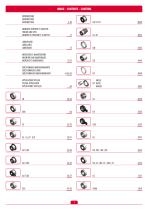
Indice - Contents - Contenu IntrodUzione Introduction Introduction Momento torcente e chiavette Torque and keys Moment de torsion et clavettes Lubrificanti Lubricants Lubrifiants Anelli GP Races Bagues Montaggio e manutenzione Mounting and maintenance Montage et maintenance Questionario dimensionamento Questionnaire sizing Questionnaire dimensionnement Applicazioni speciali Special application Applications spéciales UK..ZZ - UKC..ZZ - UKCC..ZZ
Open the catalog to page 2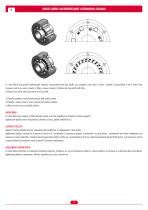
RUOTE LIBERE: un’interessante alternativa italiana Le ruote libere sono giunti unidirezionali composti essenzialmente da due anelli, uno conduttore che traina e l’altro condotto. La peculiarità è che il moto viene trasmesso solo in un senso, mentre è libero, ovvero avviene il distacco dei due anelli, nell’altro. Il distacco fra le due parti può avvenire in due modi: 1) l’anello condotto ruota più velocemente dell’anello motore. 2) l’anello motore ruota in senso contrario all’anello condotto. L’utilizzo avviene in tre modalità di base: ANTIRITORNO La ruota libera gira sempre in folle. Quando il...
Open the catalog to page 3
TIPOLOGIE COSTRUTTIVE Ruote libere a rulli: Le ruote libere a rulli sono composte da un anello esterno cilindrico e da un anello interno detto “stella “ per la sua forma particolare, che consente ad un determinato numero di rulli cilindrici (ognuno tenuto in continuo contatto di lavoro da uno o due pistoncini spinti da molle elicoidali) di trasmettere la coppia con immediatezza. Sono le più adatte all’impiego come avanzamento intermittente, ma vanno altrettanto bene come supero di velocità e antiritorno ai regimi di giri medio bassi. Ruote libere a corpi di contatto asimmetrici: Questa tipologia...
Open the catalog to page 4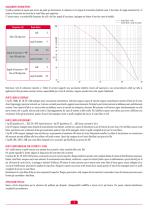
Il grafico riportato di seguito puo servire da guida per determinare la relazione tra la coppia da trasmettere (indicata come % del valore di coppia nominale Tn) e il numero d'inserzioni massimo che la ruota libera puo sopportare. E' buona norma, a seconda della frequenza dei cicli e del loro angolo d'inserzione, impiegare un fattore di servizio come da tabella: Nota bene: tutte le indicazioni riportate e i fattori di servizio suggeriti sono puramente indicativi, basati sull'esperienza e non universalmente validi per tutte le applicazioni. Non possiamo assumerci alcuna responsabilita per errori...
Open the catalog to page 5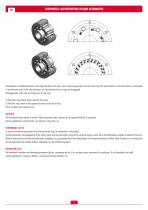
FREEWHEELS: an interesting Italian alternative Freewheels are unidirectional joints consisting basically of two rings, one is a drive ring used to drive the other ring. The special feature is that the motion is transmitted in one direction only. In the other direction, it is free because the two rings are disengaged. Disengagement of the two parts may occur in two ways: 1) The driven ring rotates faster than the drive ring. 2) The drive ring rotates in the opposite direction to the driven ring. There are three basic modes of use: BACKSTOP The freewheel always rotates in neutral. When movement...
Open the catalog to page 6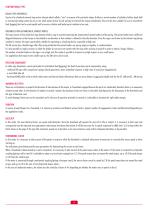
CONSTRUCTIONAL TYPES Roller type freewheels: Consist of a cylindrical external ring and an internal wheel called a “star” on account of its particular shape. It allows a certain number of cylindrical rollers (each held in constant operating contact by one or two small pistons driven by coil springs) to transmit the torque immediately. They are the most suitable for use in intermittent feed (jogging) but can be used equally well as overrun clutches and backstops at medium to low rpm. Freewheels with asymmetrical contact bodies: This type consists of two cylindrical rings between which a cage is...
Open the catalog to page 7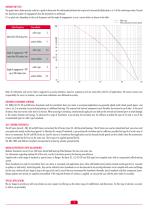
The graph shown below may be useful as a guide to determine the relationship between the torque to be transmitted (indicated as a % of the rated torque value Tn) and the maximum number of engagements that the freewheel can withstand. It is a good rule, depending on the cycle frequency and the angle of engagement, to use a service factor as shown in the table: Note: all indications and service factors suggested are purely indicative, based on experience and not universally valid for all applications. We cannot assume any responsibility for errors in selection, not even when indications were followed...
Open the catalog to page 8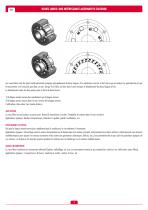
ROUES LIBRES: une intéressante alternative italienne Les roues libres sont des joints unidirectionnels composés principalement de deux bagues, d’un conducteur qui tire et de l’autre qui est conduit. La particularité est que le mouvement n’est transmis que dans un sens, lorsqu’il est libre, ou bien dans l’autre lorsque le détachement des deux bagues a lieu. Le détachement entre les deux pièces peut se faire de deux façons: 1) la bague menée tourne plus rapidement que la bague moteur. 2) la bague moteur tourne dans le sens inverse de la bague menée. L’utilisation a lieu selon trois modes de base:...
Open the catalog to page 9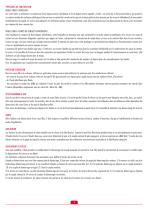
TYPOLOGIES DE CONSTRUCTION Roues libres à rouleaux : Les roues libres à roulements se composent d’une bague externe cylindrique et d’une bague interne appelée « étoile » en raison de sa forme particulière, qui permet à un certain nombre de rouleaux cylindriques (chacun tenu en contact de travail continu par un ou deux petits pistons poussés par des ressorts hélicoïdaux) de transmettre immédiatement le couple. Ce sont les plus adaptées à l’utilisation comme avance intermittente, mais elles conviennent aussi au dépassement de vitesse et à l’anti-retour aux régimes de tours moyens bas. Roues libres...
Open the catalog to page 10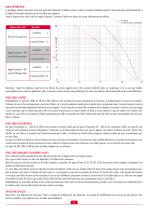
AVANCE INTERMITTENTE Le graphique reporte ci-apres peut service de guide pour determiner la relation entre le couple a transmettre (indiquee comme % de la valeur de couple nominal Tn) et le nombre d'insertions maximum que la roue libre peut supporter. Selon la frequence des cycles et de leur angle d'insertion, il convient d'utiliser un facteur de service conformement au tableau : Nota bene : toutes les indications reportees et les facteurs de service suggeres sont a titre purement indicatif, bases sur l'experience et ils ne sont pas valables universellement pour toutes les applications. Nous...
Open the catalog to page 11All C.T.S. catalogs and technical brochures
 Linear guides
77 Pages
 AL8080
3 Pages

- Linear axis
- Electric linear axis
- Ball bearing linear guide
- Slide carriage block
- Precision linear axis
- Compact linear guide
- One-way clutch with internal bearings
- Precision linear guide
- Aluminum linear guide
- Screw linear axis
- Track linear guide
- Roller backstop
- Aluminum linear axis
- Backstop freewheel
- Screw spindle linear axis
- Overrunning clutch freewheel
- Compact linear axis
- Indexing one-way clutch
- Robot linear axis