

- Products
- Catalogs
- News & Trends
- Exhibitions
CID V300

CID V300
The CID-PRO software requires a minimum of Windows 98, 2000, or XP, a Pentium processor of 350MHz or higher, a CD-ROM drive, a free serial interface, a USB port for a hardware key, a mouse, a VGA video adapter, at least 64MB of memory, and 100MB of free disk space.
Insert the CD-ROM and exit all programs before installation. If it doesn't start automatically, run 'autorun.exe'. Choose your language and click the red arrow to begin. For serial port connections, install the full version and the hardware key driver. For network connections, choose the Remote/Demo-Version. Install Acrobat Reader for documentation access. Uninstall any previous versions before reinstalling. The default installation directory is 'c:\cts_soft'.
Install the hardware key driver before starting CID-PRO. Configure the number of chambers, connection ports, and scanning intervals. Ensure communication protocol settings are correct if connection issues arise.
The software includes various masks such as Status, Overview, Editor, Graphics, Auto, Recording, Config, Cycles, and Report, each serving different functions like displaying chamber status, creating test cycles, and recording data.
CID-PRO supports networking via a TCP/IP module for LAN monitoring. It interfaces with Microsoft Word and Excel, and other applications can be integrated.
The manual includes an index for easy navigation and troubleshooting tips for common errors.
The keyboard can be locked, ignoring all inputs until the chamber is powered down or the main switch is toggled. A symbol bar allows users to switch between display modes.
Displays temperature and humidity curves over time, using specific colors to differentiate between actual and set values.
Provides detailed information about the running test cycle, displayed as both a graph and text.
Allows creation and modification of test cycles using mouse or keyboard inputs, with options to set points, modify parameters, and assign wait functions.
Channels can be switched off or modified, with options to save, load, and delete test cycles.
Users can program loops by marking start and end lines within the editor, with a maximum of 20 different loops allowed.
Must exist before creating the main program, with each having a different number. They cannot overlap and stop at the end of the main program.
Allow branching based on digital input signals, acting like an interrupt and affecting loop counts.
Allows for graphical representation and analysis of measurements, with various display options available.
Cycles can be transmitted to a chamber and saved with a program number, with options for starting times and cycle offsets.
Allows continuous writing of measurements into a file, with settings specific to each chamber.
For long, stable tests, a recording interval of 3 to 5 minutes is sufficient, while shorter tests require intervals of 30 to 120 seconds.
Allows setting the number of chambers and communication settings, with options for serial port or Ethernet connections.
Password protection can be activated to prevent unauthorized access, and the software limiter displays saved configuration values.
Preferences allow changes to window size and display settings, with options for default paths and email configurations.
Displays time and round counters, with warnings highlighted in red. The report function records user and chamber actions.
Shows current errors for selected chambers and records power on/off durations.
Can be configured to send alerts via SMTP server, with active configurations highlighted in green.
Users can save configurations and activate email processing, with options for multiple active configurations.
Facilitate high temperature changes by moving specimens between zones, with parameters for temperature indices and time durations.
Allows starting or creating programs for thermal shock chambers, with options for wait functions to ensure temperature stability.
Help is accessible via right-click or the F1 key, with contact information for CTS GmbH.
Masks from CID-PRO can be inserted into WINWORD, and measurements can be converted to EXCEL format.
Supports networking chambers over a LAN using TCP/IP, with configuration for communication parameters and file storage paths.
CID software can exchange data with other applications over TCP/IP.
CID-PRO attempts to restore its previous state after unexpected shutdowns, supporting integration into Windows autostart.
Catalog excerpts
omputer ntegrated User manual Copyright National Instruments Corporation. All rights reserved
Open the catalog to page 1
To run CID-PRO the following minimum requirements are needed: • Win98, Winows 200 or WinXP • PC with Pentium processor 350MHz or higher • CD-ROM drive • one free serial interface • one free USB-port for hardware key • mouse • VGA video adapter(256 colours, 640 x 480 pixel) • a minimum of 64MB of memory • 100 MB free fixed-disk storage
Open the catalog to page 5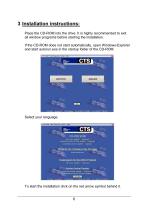
Place the CD-ROM into the drive. It is highly recommended to exit all window programs before starting the installation. If the CD-ROM does not start automatically, open Windows-Explorer and start autorun.exe in the startup folder of the CD-ROM. Select your language. £1£ CTS GmbH - C lima Temperatur Systeme - English CID-PRO V3.00 full version: (english) Q or (german) Q manual (full version, PDF-file): (english) □ or (german) Q remote/demo version: Driver for the Hardware-Key (Dongle) Install sentinel driver Q ' Testproqram forth© ASCII-Protocol Adobe Acobat Reader version 6.0 install: (english)...
Open the catalog to page 6
If you want to connect your cabinets via serial port, you must install the full version to communicate with the cabinets. In this case you need a hardware key. To use the hardware key his driver must be installed. If the cabinets are connected over network or if you want to monitor cabinets which are connected to an other PC, choose the Remote/Demo-Version. The test programme for ASCII-protocol installs an application that shows you data and protocol frame for ASCII-protocol. This is useful if you plan to control the cabinet with your own software and therefore want to see the protocol data....
Open the catalog to page 7
Uninstall..: You can uninstall the CID-Software in system settings – software or in start - programme files – CID-PRO – uninstall CID. Uninstallation deletes all programme files for installation directory, files that where created during work with the programme (e.g. measure files, reports, configuration files) are not deleted. So after a consecutive installation your settings are kept. If you do not need them any more, you can delete all files from the installation directory of CID-Pro.
Open the catalog to page 8
Before you start CID-PRO for the first time you must install the driver software for the hardware key. see cap. 3 Start CID-PRO with a click on the icon When you start the programme for the first time, the configuration mask will appear. (s. chapter 4.7) Enter here the amount of chambers you have, the port that they have been connected to and the intervals at which the chambers must be scanned. Don’t you get any connection to the chamber(s), please control the communication protocol. To do this: type ‘E ‘P’ ‘P’: now you had to see in the upper LCD ‘CID’, when not: toggle to ‘CID’ with the + /...
Open the catalog to page 9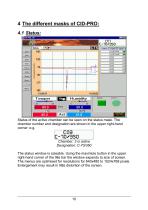
Status of the active chamber can be seen on the status mask. The chamber number and designation are shown in the upper right-hand corner: e.g. C03 C-10/350 Chamber: 3 is active Designation: C-70/350 The status window is sizeable. Using the maximize button in the upper right-hand corner of the title bar the window expands to size of screen. The menus are optimised for resolutions for 640x480 to 1024x768 pixels. Enlargement may result in little distortion of the screen.
Open the catalog to page 10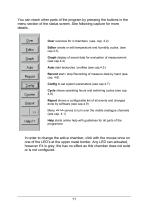
You can reach other parts of the program by pressing the buttons in the menu section of the status screen. See following capture for more details. Over overview for 4 chambers (see. cap. 4.2) Editor create or edit temperature and humidity cycles. (see cap.4.3) Graph display of saved data for evaluation of measurement (see cap.4.4) Auto start testcycles / profiles (see cap.4.5 ) Record start / stop Recording of measure data by hand (see cap. 4.6) Config to set system parameters (see cap.4.7) Cycle shows operating hours and switching cycles (see cap 4.8) Report shows a configurable list of all...
Open the catalog to page 11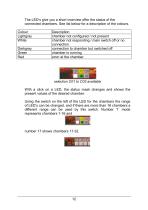
The LED’s give you a short overview offer the status of the connected chambers. See list below for a description of the colours. selection C01 to C03 available With a click on a LED, the status mask changes and shows the present values of the desired chamber. Using the switch on the left of the LED for the chambers the range of LED’s can be changed, and if there are more than 16 chambers a different range can be used by this switch. Number ‘1’ mode represents chambers 1-16 and number 17 shows chambers 17-32.
Open the catalog to page 12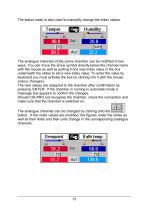
The status mask is also used to manually change the index values. The analogue channels of the active chamber can be modified in two ways. You can move the arrow symbol directly below the channel name with the mouse as well as putting in the new index value in the box underneath the slides to set a new index value. To enter the value by keyboard you must activate the box by clicking into it with the mouse (colour changes). The new values are assigned to the chamber after confirmation by pressing ‘ENTER’. If the chamber is running in automatic-mode a message box appears to confirm the changes....
Open the catalog to page 13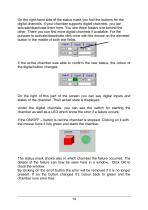
On the right-hand side of the status mask you find the buttons for the digital channels. If your chamber supports digital channels, you can activate/deactivate them here. You see three folders one behind the other. There you can find more digital channels if available. For the purpose to activate/deactivate click once with the mouse on the elevated button in the middle of both text fields. If the active chamber was able to confirm the new status, the colour of the digital button changes. On the right of this part of the screen you can see digital inputs and states of the chamber. Their actual...
Open the catalog to page 14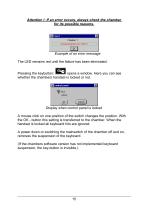
Attention !: If an error occurs, always check the chamber for its possible reasons. Example of an error message The LED remains red until the failure has been eliminated. Pressing the keybutton: opens a window. Here you can see whether the chambers handset is locked or not. Display when control panel is locked A mouse click on one position of the switch changes the position. With the OK - button this setting is transferred to the chamber. When the handset is locked all keyboard hits are ignored. A power down or switching the mainswitch of the chamber off and on, removes the suspension of the...
Open the catalog to page 15All CTS Clima Temperatur Systeme GmbH catalogs and technical brochures
 VOC emission test chamber EK1000
12 Pages
 G1 Control
6 Pages
 CDI V4.02
174 Pages
 CID V2.01
88 Pages
 Environmental Simulation
7 Pages
 CTS Climatic Test Cabinets
2 Pages
 CTS Shocktest cabinet
2 Pages
 Customised Solutions
8 Pages
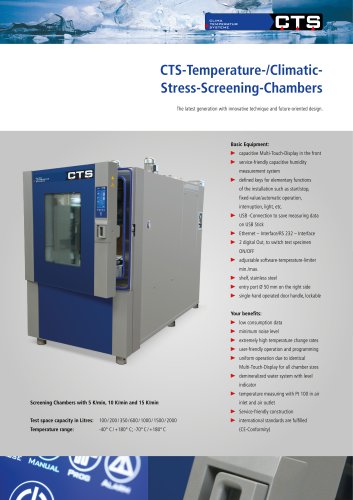

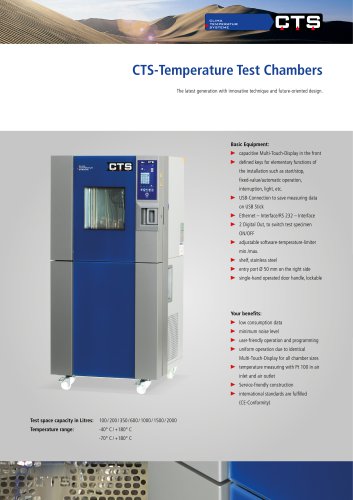
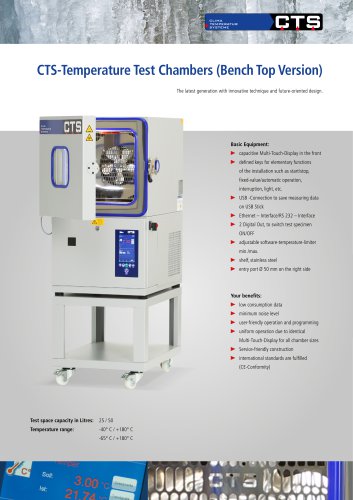
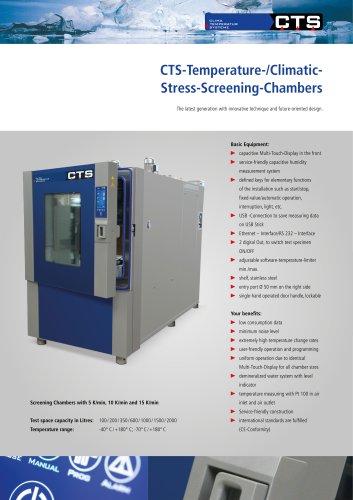
- CTS Clima Temperatur Systeme test chamber
- CTS Clima Temperatur Systeme temperature test chamber
- CTS Clima Temperatur Systeme climate chamber
- CTS Clima Temperatur Systeme quality control test chamber
- Humidity test cabinet
- Environmental test chamber
- Stainless steel test chamber
- Floor-standing test chamber
- CTS Clima Temperatur Systeme test chamber with window
- LED test chamber
- Test chamber for the aeronautical industry
- Battery test chamber
- Aging test chamber
- Electrical equipment test chamber
- Thermostatic test chamber
- Simulation test chamber
- European standards-compliant test chamber
- Material test chamber
- Compact test chamber
- Solar panel test chamber