CDI V4.02

CDI V4.02
1 / 174 PagesView full catalog

CDI V4.02

Product catalog summary
Overview: The CID-Pro 4.02 User Manual by CTS GmbH provides comprehensive guidance on the installation, configuration, and operation of the CID-Pro 4.02 software, essential for managing computer-based documentation systems.
Installation and System Requirements: This section details the installation steps, licensing notes, system requirements, and authorizations needed for CID-Pro 4.02. It includes the installation of the software, hardware key driver, and additional components, as well as uninstallation procedures.
Program Start-up: Instructions for launching the software and setting up units are provided to ensure effective initial use.
Program Parts and Functions: A breakdown of the software's components and functionalities, including status overview, configuration settings, test-cycle program editor, and graphical measurement-data analysis.
Test Program Management: Guidance on creating, editing, and managing test programs, including generating test cycles and managing test program files.
Measurement and Analysis: Focuses on recording and analyzing measurement data, with instructions for manual and automatic recording, graphical data analysis, and exporting data.
Event Logs and Reports: Instructions on creating and managing event logs and reports, including generating, loading, deleting, and exporting them.
Visualization: Guidance on using the software's visualization features, including configuring, saving, and loading settings for test unit displays.
Special Menus: Instructions for specific test unit types, such as Temperature Shock Test Cabinets, to cater to specialized testing needs.
Conclusion: The CID-Pro 4.02 User Manual is a vital resource for maximizing the functionality of documentation systems, providing detailed instructions and best practices for installation, configuration, and operation.
Licensing Notes: CID-Pro 4.02 can be tested with a demo version, with full communication requiring the full version and a hardware key for serial or Ethernet communication.
System Requirements: Requires a PC with specific hardware and software specifications, including a Pentium processor, Windows OS, and a USB port for the dongle.
Authorizations: Administrative privileges are necessary for installation, with read and write access to the installation folder required.
Installation Process: Involves starting the computer, logging in as an administrator, and following setup instructions from the installation CD.
Driver Installation: The Sentinel hardware key driver must be installed before connecting the dongle.
ASCII Protocol Test Program: Checks communication via serial or Ethernet interfaces.
Manuals and Adobe Reader: PDF manuals require Adobe Acrobat Reader for access.
Uninstallation: CID-Pro 4.02 can be removed via the Control Panel, with personal settings and files remaining post-uninstallation.
Software Launch: The software can be started from the Start menu or a desktop shortcut, with initial setup requiring defining test units and connection intervals.
Unit Configuration: Ensure correct protocol and address settings for network communication.
Status Overview: Provides information on unit status, error messages, and program automation, with quick access to various functions.
Test Units: Symbols indicate the current status of test units, with color-coded descriptions for easy identification.
Symbol Colour Configuration: Outlines color-coded status indicators for test units, with specific colors indicating different statuses.
Test Unit Configuration: Users can configure up to 16 test units, with options for naming and modifying configurations.
Unit Information: Displays non-changeable information such as unit name and device type.
Unit and Error Status: Displays operational and error statuses, with errors requiring acknowledgment before continuing operation.
Program Automatic: Displays program information, with options to interrupt or continue based on error status.
Trend Graph: Shows temperature and humidity profiles, with data temporarily stored.
Messages: Event logs provide an overview of system changes, errors, warnings, and operation messages.
Digital Channels: Displays softkeys and indicators for the current test unit.
Analog Channels: Displays analogue channels, with options to change set values manually or via program operation.
Disable Control Terminal: Allows enabling or disabling of the test unit's control terminal.
Configuration and Error Handling: Outlines configuration options, including enabling keyboard locking and handling power outages.
Configuration Settings: Allows users to set the number of test units, language, and communication parameters.
Client/Server Communication: Explains client/server communication, with examples of server and client setup.
Test Unit Configuration: Instructions for configuring individual test units, with a step-by-step guide for adding new test units.
Program Mode and Display Settings: Allows for temporary plotting of actual values on a graphic display.
Representation Options: Outlines various representation options for value curves.
Configuration Management: Users can load, store, and reset settings using temporary configuration files.
Test Specimen Protection: Software limits can be set for unit channels, with errors reported if limits are exceeded.
Directories: Default directories for various files can be set, with options to change paths for backup purposes.
Options: Global and unit-specific options can be adjusted, with options saved using a "save options" button.
Login Options: Two access authorization versions are available: simple password and access configuration.
General Options: Includes settings for ignoring unused test units, enabling terminal locking, and automatic recording.
Access Configuration: Outlines the process for changing access modes, with symbols indicating user status.
PDF Settings: Users can choose whether PDF files should open immediately by checking a specific box in the settings.
Test Units Overview: Provides information on the state of test units, including unit name, type, mode, and error status.
Test-Cycle Program Editor: Allows users to create new test programs with available analog and digital channels.
Editing Test Programs: Users can insert, change, delete, cut, copy, and paste lines using keyboard shortcuts or menu options.
Graph Interaction: Users can insert value lines by clicking on the graph, with points plotted based on mouse coordinates.
Plotting Points: Points for test cycles can be plotted sequentially on a graph.
Editing Values: Users can change values lines by adjusting temperature, humidity, or other parameters.
Managing Test Programs: Explains how to create, open, save, and delete test programs.
Printing and PDF Functions: Users can print test programs and create PDF files with similar content.
Advanced Functions: Covers advanced functions such as copying and inserting blocks of lines, using loops, and calling subprograms.
Specifications and Procedures: Outlines the functionalities of the CID-Pro 4.02 User Manual, focusing on program parts and functions.
Conditional Jumps: Allows program adaptation based on digital input states.
Inserting Programs: Module programs must be created before the main program and can be inserted using the F10 key.
Templates: Templates can be created for recurring programs or test cycles.
Editor Options: Offers options for loop expansion, line deletion, scaling, and time axis adjustments.
Gradient Settings: Explains how to set gradients for program creation.
Save File in Data Pool: The data pool is a virtual area for saving globally valid test programs.
Save File as Library: Libraries differ from templates as they are displayed for all test units.
Editor Comments: An input window allows for entering comments about the current test-cycle program.
Editor Zoom Functions: The zoom function allows for enlarging specific areas up to 20 times.
Graphical Measurement-Data Analysis: Provides options for graphically presenting and analyzing measurement data.
Zoom Functions (Graphical Measurement-Data Analysis): Allows users to enlarge a specific area up to 20 times.
Display: Shows the currently displayed curves and their colors.
Analysis: Analysis values derive from two cursors placed at characteristic positions.
Options (Graphical Measurement-Data Analysis): Allows users to set preferences for channels, display, and evaluation.
Excel Conversion Program: Measurement files can be converted to ASCII formatted text files for Microsoft Excel.
Display Measurement Values: Allows users to view data records from a loaded measurement file in a separate window.
Copy to Clipboard: Users can copy the graphical measurement-data analysis view to the clipboard.
Merge Measurement Files: Allows merging of measurement files through selection dialogs.
Cut Current Measurement File (Cursor): Users can cut a specific time range from a measurement file using cursors.
Read Out the Measurement Buffer: Reads and stores data from a unit's measurement buffer.
Settings: Settings for the graphic display can be saved and switched with a mouse click.
Comments: Users can add comments to the measurement data.
Starting Test Programs (Automatic): Users select the desired test unit and program type.
Recording the Test-Cycle Program: Users can start a test program recording, append measurements to existing files, and set recording intervals.
Start Options: Users can set a start time and date for the program.
Automatic Mode: Automatic operation begins after confirmation.
Manual Measurement Recording: Allows continuous saving of measured data.
Starting a Manual Measurement Recording: The recording rate defines the minimum time intervals between measurement points.
Start Options: Recording can start immediately or be delayed.
Cyclic Storage: Useful for large datasets or long test cycles.
Stopping a Manual Measurement Recording: Manual recordings do not stop automatically and must be stopped manually.
Operating Hours and Event Counter: Displays operating hours and event counters for components.
Event Logs (Reports): Records user and test unit actions, creating monthly report files.
Power Failures: Logs power failures by listing the periods when the test unit was switched on or off.
E-Mail Messaging: Allows setting up automatic email notifications for specific events.
Options (Event Logs): Users can filter and color-code messages in the report file display.
Visualization: Users can visually present unit surroundings using background and individual unit images.
Special Menus for Temperature Shock Test Cabinets: Provides a menu for creating test programs for shock test cabinets.
Pretempering Process: Describes the pretempering process for heating and cooling chambers.
Temperature Development: A diagram illustrates the temperature development in both chambers.
Program Parts and Functions: Outlines program functions, including program start and test program creation.
Networking: Details networking options for test units, including serial interfaces and TCP/IP networks.
Software Buttons: Includes various buttons for status overview, test-cycle program editing, and graphical data analysis.
Specifications and Procedures: Outlines the functionalities of the CID-Pro 4.02 User Manual, focusing on program parts and functions.
Key Functions: Includes key functions such as Ctrl+S for save functions and F1 for help information.
End User License Agreement: Outlines copyright, license agreement, warranty, and legal jurisdiction.
Recommendations and Best Practices: Includes ensuring software is used within the terms of the license agreement and regularly updating and backing up data.
Technical Support: Contact information for CTS GmbH is provided for technical support.
See more

Catalog excerpts

CDI V4.02-1

User Manual Computer Integrated Documentation - PRO 4.02 User Manual CTS GmbH Lotzenäcker 21 72379 Hechingen

 Open the catalog to page 1
CDI V4.02-2

User Manual ©1997-2014 CTS GmbH • Lotzenäcker 21 • 72379 Hechingen • Germany http://www.cts-umweltsimulation.de Text, figures, and examples were created with the greatest care. The issuer assumes neither legal nor any other liability for erroneous information and its consequences. This document is copyright protected. All rights reserved. No part of this documentation may be reproduced in any form, by photocopy, microfilm, or other processes, or translated into a language usable by machines, particularly data processing equipment, without the issuer’s written consent. The rights to reproduce...

 Open the catalog to page 2
CDI V4.02-3

Section 1 Table of Contents User Manual

 Open the catalog to page 3
CDI V4.02-4

Section 1 Table of Contents User Manual

 Open the catalog to page 4
CDI V4.02-5

Section 1 Table of Contents User Manual

 Open the catalog to page 5

CDI V4.02-7

Section 2 Installation and system requirements 2.1 Licensing notes The CID-Pro 4.02 can be tested free and without obligation. You can evaluate measurement files and create test programs with the demo version; communication over the serial interface is available exclusively in the full version. If you have an Ethernet connection at the test unit, licensing would be carried out over this connection and communication would occur via the Cl D-Pro network version. CID-Pro 4.02 is licensed per computer or per test unit. That means, you need a hardware key (dongle) to communicate via serial interface...

 Open the catalog to page 7
CDI V4.02-8

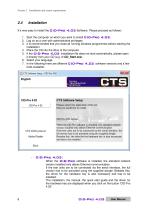
Installation and system requirements It’s very easy to install the CID-Pro 4.02-Software. Please proceed as follows: 1. Start the computer on which you want to install CID-Pro 4.02. 2. Log on as a user with administrative privileges. 3. It is recommended that you close all running windows programmes before starting the installation. 4. Place the CD into the drive of the computer. 5. If the CID-Pro 4.02 installation file does not start automatically, please open it directly from your CD (e.g. d:\CD_Start.exe). 6. Select your language. 7. In the following there are different CID-Pro 4.02 software...

 Open the catalog to page 8
CDI V4.02-9

Section 2 Installation and system requirements - ASCII Protocol test program The test program for the ASCII protocol installs an application with which you can investigate transmitted data based on this protocol. This can be helpful when you control the test unit using your own software and want to try out the necessary commands and data for this. - Adobe Reader Acrobat Reader is needed to be able to display the documentation, also located on CD, in electronic form. - Quick Start Guide (PDF) The Quick Start Guide describes all the important standard functions in two pages. - Driver for the hardware...

 Open the catalog to page 9
CDI V4.02-10

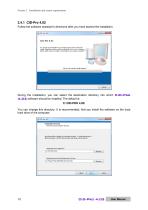
Installation and system requirements 2.4.1 CID-Pro 4.02 Follow the software assistant’s directions after you have started the installation. During the installation, you can select the destination directory into which 4.02 software should be installed. The default is: C:\CID-PRO 4.00\ You can change this directory. It is recommended, that you install the software on the local hard drive of the computer. User Manual

 Open the catalog to page 10
CDI V4.02-11

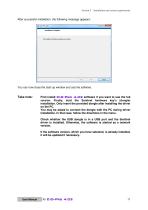
Section 2 Installation and system requirements After successful installation, the following message appears: Section 2 Installation and system requirements You can now close the start-up window and use the software. Take note: First install CID-Prd 4.02 software if you want to use the full version. Finally, start the Sentinel hardware key’s (dongle) installation. Only insert the provided dongle after installing the driver on the PC. You may be asked to connect the dongle with the PC during driver installation. In that case, follow the directions in the menu. Check whether the USB dongle is...

 Open the catalog to page 11
CDI V4.02-12

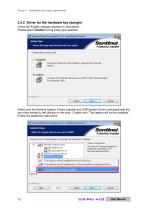
Installation and system requirements 2.4.2 Driver for the hardware key (dongle) Follow the English software assistant’s instructions. Please select Custom during setup type selection. Select only the Sentinel System Drivers (parallel and USB System Driver) and deactivate the two other entries by left clicking on the entry. Confirm with “This feature will not be available.” Follow the additional instructions.

 Open the catalog to page 12
CDI V4.02-13

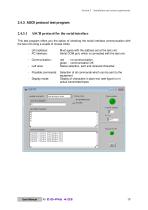
Section 2 Installation and system requirements This test program offers you the option of checking the serial interface communication with the test unit using a couple of mouse clicks. - Unit address: Must agree with the address set at the test unit. - PC interface: Serial COM port, which is connected with the test unit. - Communication: red - no communication green - communication OK - Left area: Status selection, sent and received character. - Possible commands: Selection of all commands which can be sent to the equipment - Display mode: Display of characters in plain text...

 Open the catalog to page 13
CDI V4.02-14

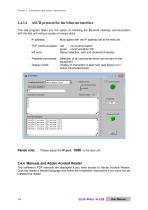
Section 2 Installation and system requirements 2.4.3.2 ASCII protocol for the Ethernet interface This test program offers you the option of checking the Ethernet interface communication with the test unit using a couple of mouse clicks. Must agree with the IP address set at the test unit. - TCP Communication: red - no communication green - communication OK - left area: Status selection, sent and received character. - Possible commands: Selection of all commands which can be sent to the equipment - Display mode: Display of characters in plain text (see figure) or in actual transmitted...

 Open the catalog to page 14
CDI V4.02-15

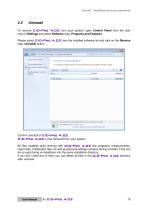
Section 2 Installation and system requirements 2.5 Uninstall To remove CID-Frd 4.02 from your system, open Control Panel from the start menu’s Settings and select Software resp. Programs and Features. Please select CID-Frd 4.02 from the installed software list and click on the Remove resp. Uninstall button. Section 2 Installation and system requirements Confirm uninstall of CID-Frd 4.02. CID-Frd 4.02 is now removed from your system. All files installed while working with CID-Frd 4.02 like programs, measurements, report files, initialization files, as well as personal settings remains during uninstall....

 Open the catalog to page 15

CDI V4.02-16

Installation and system requirements User Manual

 Open the catalog to page 16
*Prices are pre-tax. They exclude delivery charges and customs duties and do not include additional charges for installation or activation options. Prices are indicative only and may vary by country, with changes to the cost of raw materials and exchange rates.