
- Catalogs
- Cross & Morse
- Clamping Elements Type RCK 50

- Company
- Products
- Catalogs
- News & Trends
- Exhibitions
Clamping Elements Type RCK 50

Clamping Elements Type RCK 50
Overview of Shaft Clamping Elements Type RCK 50
The RCK 50 clamping elements consist of two conical rings designed to minimize radial space, allowing compact assemblies and use within small hub diameters. These units require the customer to provide their own thrust ring assembly. They provide low torque transmission per unit but can be combined up to four units to increase torque capacity. When fully clamped, they offer excellent gastight sealing. However, they do not self-center and require external centering of the hub.
Design and Usage Recommendations
- Recommended tolerances for full torque transmission:
- Shafts up to 38 mm diameter: shaft tolerance h6, hub tolerance H7
- Shafts 40 mm and above: shaft tolerance h8, hub tolerance H8 - Clamping surfaces should have a finish of Rz < 15 µm.
- Torque capacity increases with the number of elements combined:
- 2 elements: 1.55 M Nm
- 3 elements: 1.86 M Nm
- 4 elements: 2.03 M Nm
Key Dimensions and Parameters
The document provides a detailed table listing various RCK 50 models with parameters including shaft diameter, hub diameter, torque capacity (Nm), axial force (kN), surface pressure (N/mm²), minimum hub diameter, and weight. For example, the RCK50-6x9 model supports 6 Nm torque with a minimum hub diameter of 37 mm and weighs approximately 10.9 grams. Larger models support higher torque and axial forces, with corresponding increases in hub diameter and weight.
Minimum outside hub diameters are based on medium carbon steels with a yield strength of 320 N/mm². For other materials or hub types, additional references are provided.
Additional Notes
- Assembly and disassembly instructions are referenced on page 24.
- Clamping rings for shafts up to 200 mm diameter are available on request.
Clamping Elements Types CCE 54 and CCE 55
These clamping elements utilize a single lock nut to apply clamping pressure, enabling quick assembly and removal. The lock nut can be secured by bending a tab of the lock washer. The thin walls of the clamping cones and low hub pressures make these suitable for soft materials such as aluminum and small hub diameters.
Type Selection and Usage
- Type CCE 54 is recommended where axial space is limited and torque requirements are low.
- Type CCE 55 is designed for higher torque transmission.
- Recommended tolerances for full torque transmission include shaft tolerance hs and clamping surfaces finished to Rz ≤ 15 µm.
Dimensions and Performance Data
The document includes detailed tables for both CCE 54 and CCE 55 types, listing parameters such as shaft and hub diameters, torque capacity (Nm), axial force (kN), surface pressure (N/mm²), locking nut type and thread, locking torque (Nm), minimum hub diameter, and assembly weights.
For example, the CCE54-14x25 model supports 32 Nm torque with a minimum hub diameter of 65 mm and uses an M20 locking nut with 95 Nm locking torque.
Minimum hub diameters are based on medium carbon steels with yield strength of 320 N/mm². For other materials or hub types, further references are provided.
Additional Notes
- Assembly and disassembly instructions are referenced on page 24.
Critical Specifications and Best Practices
- Ensure shaft and hub tolerances meet recommended values for full torque transmission.
- Maintain clamping surface finish to Rz <= 15 µm to ensure proper sealing and torque capacity.
- Use external centering methods for RCK 50 units as they do not self-center.
- Combine multiple RCK 50 units to increase torque capacity when needed.
- Secure lock nuts properly on CCE types to prevent loosening during operation.
- Refer to assembly and disassembly instructions carefully to avoid damage and ensure correct installation.
Summary of Tables
The tables provide comprehensive data on dimensions, torque capacities, axial forces, surface pressures, minimum hub diameters, and weights for various models of RCK 50, CCE 54, and CCE 55 clamping elements. These data are essential for selecting the appropriate clamping element based on shaft size, torque requirements, and material considerations.
Catalog excerpts

These shaft clamping elements consist of just two conical rings which require the minimum of radial space, so providing compact assemblies, and enabling use within small hub diameters. The design offers the maximum versatility of design, but does require the customer to provide their own thrust ring assembly. Whilst only providing low torque transmission per unit they can be combined (up to 4 units) to increase torque capacity. When fully clamped these units provide excellent gastight sealing. Many designs of thrust rings are possible and sketches to the left are two typical designs. These units do not self centre, so require external means of centring the hub. Recommended tolerances for full torque transmission are:-Up to 38m shaft 0:- Shaft h6 40mm and above shaft 0:- Shaft h8 Clamping surfaces to be finished to Rz < 15 /xm. Factor for combining elements in one assembly. Number of Elements Torque Capacity 2 1.55M Nm Surface Pressure Axial Force necessary to clamp * Minimum outside diameter of hubs manufactured in medium carbon steels with yield strength > 320 N/mm . For hub types, and other materials, refer to page 3. For assembly and disassembly instructions refer to page 24. t Clamping Rings for shafts up to 200mm diameter are available to order. 18 ^ INDEX ^ BACK NEXT ^
Open the catalog to page 1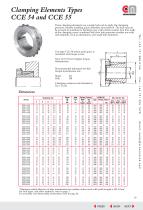
These clamping elements use a single lock nut to apply the clamping pressure, thereby enabling quick assembly and removal. The lock nut can be secured in postition by bending over a tab of lock washer. The thin walls of the clamping cones, combined with low hub pressures enables use with soft materials, such as aluminium, and small hub diameters. —i Use type CCE 54 where axial space is restricted and torque is low. Type CCE 55 is for higher torque transmission. Recommended tolerances for full torque transmission are:-Shaft h8 Clamping surfaces to be finished to Rz < 15 (im. Surface Pressure Assy...
Open the catalog to page 2All Cross & Morse catalogs and technical brochures
 Taper Bushes
2 Pages
 CS Mini Series Couplings
1 Page
 Sheargard Flexible Couplings
2 Pages
 Sheargard Overload Clutches
4 Pages
 PVR Paver Bearings
12 Pages
 Stainless Steel Taper Bushes
2 Pages
 Straight Racks
1 Page
 Spur Gears
4 Pages
 Bevel and Mitre Gears
6 Pages
 Torque Limiters & Couplings
6 Pages
 KE Couplings
2 Pages
 'L'Series - Jaw Couplings
2 Pages
 Clamping Elements RCK 15
1 Page
 Clamping Elements RCK 13
1 Page
 SC Inverted Tooth Chain
3 Pages
 HV Inverted Tooth Chain
7 Pages
 Roller Chain Catalogue
3 Pages
 Classical Timing Belts
3 Pages
 Clamping Elements RCK 10-12
2 Pages
 'M' Series Sprag Clutches
2 Pages


Archived catalogs
 Gold bearing products
209 Pages
 Transmissions
90 Pages
 Shaft Clamping Elements
28 Pages
 Overload Protection Clutches
4 Pages
 Freewheel Clutches
21 Pages
 Belt & Chain Tensioners
7 Pages
 General Product Catalogue
12 Pages
 Sealmaster Bearings
4 Pages
 Standard Gears
16 Pages
 Shaft Couplings
22 Pages


- Power transmission belt
- Flexible coupling
- Shaft shaft coupling
- Transmission chain
- Flange coupling
- Metal chain
- Torque coupling
- Transfer chain
- Polymer belt
- Transmission coupling
- Rigid coupling
- Timing belt
- Roller chain
- Bearing unit
- Steel chain
- Friction clutch
- Compact coupling
- Sleeve coupling
- Synchronous power transmission belt
- Misalignment correction coupling