
- Catalogs
- Cross & Morse
- Clamping Elements RCK 10-12

- Company
- Products
- Catalogs
- News & Trends
- Exhibitions
Clamping Elements RCK 10-12

Clamping Elements RCK 10-12
Catalog excerpts
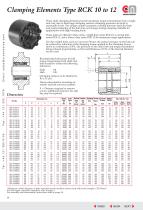
Clamping Elements Type RCK 10 to 12 These shaft clamping elements provide maximum torque transmission from a single unit, but, due to their large clamping surfaces clamping pressures are kept to reasonable levels. The design enables automatic centring between shaft and hub, and axial positioning of the hub does not change during clamping. Suitable for applications with high bending loads. For thin walled hubs, such as Conveyor Drums, the surface pressure on the hub can be reduced by reduction of the clamping torque applied to the Clamping Screws down to a minimum of 50%; the pressure on the outer hub and torque transmitted being reduced proportionaly, so that wall thickness of 12% of the internal diameter can be used. Recommended tolerances for full torque transmission both shaft and hub should be within the following tolerances: Shaft Hub Clamping surfaces to be finished to Rz ≤ 15 µm. These units ideal for mounting of wheels and belt conveyor pulleys. X = Distance required to remove screws, additional clearance for alan key may be required. Surface Pressure Clamping Screws Extraction Approx Shaft Hub Size Torque Screws Weight Ps Ph 2 2 kg Size N/mm N/mm Nm Email: [email protected] These units are offered in three series. A light duty series RCK 10, a normal duty series RCK 11, and a Heavy duty series RCK 12 for maximum torque applications. *Minimum outside diameter of hubs manufactured in medium carbon steels with yield strength ≥ 320 N/mm . For hub types, and other materials, refer to page 3. For assembly and disassembly instructions refer to page 24.
Open the catalog to page 1
Clamping Elements Type RCK 11 and 12 Dimensions Dimensions mm Surface Pressure Clamping Screws Extraction Approx Shaft Hub Size Torque Screws Weight Ps Ph 2 2 kg Size N/mm N/mm Nm *Minimum outside diameter of hubs manufactured in medium carbon steels with yield strength ≥ 320 N/mm . For hub types, and other materials, refer to page 3. For assembly and disassembly instructions refer to page 24. Email: [email protected]
Open the catalog to page 2All Cross & Morse catalogs and technical brochures
 Taper Bushes
2 Pages
 CS Mini Series Couplings
1 Page
 Sheargard Flexible Couplings
2 Pages
 Sheargard Overload Clutches
4 Pages
 PVR Paver Bearings
12 Pages
 Stainless Steel Taper Bushes
2 Pages
 Straight Racks
1 Page
 Spur Gears
4 Pages
 Bevel and Mitre Gears
6 Pages
 Torque Limiters & Couplings
6 Pages
 KE Couplings
2 Pages
 'L'Series - Jaw Couplings
2 Pages
 Clamping Elements RCK 15
1 Page
 Clamping Elements RCK 13
1 Page
 SC Inverted Tooth Chain
3 Pages
 HV Inverted Tooth Chain
7 Pages
 Roller Chain Catalogue
3 Pages
 Classical Timing Belts
3 Pages
 'M' Series Sprag Clutches
2 Pages


Archived catalogs
 Gold bearing products
209 Pages
 Transmissions
90 Pages
 Shaft Clamping Elements
28 Pages
 Overload Protection Clutches
4 Pages
 Freewheel Clutches
21 Pages
 Belt & Chain Tensioners
7 Pages
 General Product Catalogue
12 Pages
 Sealmaster Bearings
4 Pages
 Standard Gears
16 Pages
 Shaft Couplings
22 Pages


- Power transmission belt
- Flexible coupling
- Shaft shaft coupling
- Transmission chain
- Flange coupling
- Metal chain
- Torque coupling
- Transfer chain
- Polymer belt
- Transmission coupling
- Rigid coupling
- Timing belt
- Roller chain
- Bearing unit
- Steel chain
- Friction clutch
- Compact coupling
- Sleeve coupling
- Synchronous power transmission belt
- Misalignment correction coupling