
- Catalogs
- CRE TECHNOLOGY
- Synchro Compact


- Company
- Products
- Catalogs
- News & Trends
- Exhibitions
Synchro Compact

Synchro Compact
The COMPACT RANGE is a series of synchronizing and load-sharing protection controllers designed for flexibility and efficiency. It supports synchronizing, active and reactive load sharing, fixed power, frequency or voltage, and load-dependent start/stop management. The hardware is available in both panel-mounted and core base-mounted versions, compatible with i4GEN touchscreen displays. Configuration can be done via the front panel, remote touchscreen, or CRE PC software.
The front face of the SYNCHRO COMPACT includes navigation buttons, generator and mains circuit breaker controls, and indicators for alarms and faults. The LCD display provides status information and allows for parameter adjustments.
The unit is designed for panel mounting with specific environmental requirements: operating temperature from -30°C to 70°C, storage temperature from -40°C to 80°C, and altitude up to 2000 meters. Proper precautions against electronic static discharges are necessary.
The documentation outlines advanced wiring diagrams, emphasizing circuit separation and specific ratings for mains, current inputs, and communication circuits. It includes details on overvoltage categories and the necessity of using isolating current transformers.
The document provides guidance on using the controller, including password protection, LCD settings, and wiring instructions. It covers digital and analog inputs/outputs, speed/voltage control, synchronization, and protection settings.
Advanced functions include a scheduler, alternatives selection, and Easyflex®. Communication options cover Modbus mapping, Modbus TCP/IP, CRE-Link®, CANopen, and SAE J1939, with best practices for CAN bus usage.
The appendices provide additional technical details on analog voltage regulation, ECU J1939, analog speed regulation, troubleshooting, standards for generators, certifications, and software variables.
The document outlines the technical specifications for a generator control module. Key specifications include a maximum current rating of 15A for 10 seconds, with a burden of 1VA. The external current transformer (CT) has a maximum ratio of 3250:1 or 16250:5. The power supply operates at 7-38VDC, consuming 130 mA at 24V.
Installation requires the use of protective equipment and adherence to safety protocols to prevent electric shock or equipment damage. The module should be installed in a pollution degree 2 environment, with a maximum surrounding air temperature of 45°C. Wiring should be done with insulated tools, and fuses must be installed to protect against overcurrent.
The document emphasizes the importance of keeping lead lengths short to maintain accuracy and recommends using shielded cables to avoid electromagnetic interference. It also advises on the segregation of power and communication cables to prevent crosstalk.
The module features a secured password system for accessing different configuration levels. The LCD screen provides navigation through display, configuration, and system menus. Users can change settings via the module or through Modbus TCP.
The module can display up to 15 active alarms/faults and 30 archived ones, each time-stamped. Users are advised to correct the condition that triggered the protection before resetting events.
Detailed instructions are provided for wiring, including the use of specific cable connectors and the importance of following national wiring regulations. The document also includes connection diagrams for potential transformers and advises on the use of external fuses for protection.
Several warnings are issued regarding the risk of electric shock, equipment damage, and the importance of using qualified personnel for installation and servicing. The document stresses the need for proper disconnection devices and the avoidance of renewable link fuses in fused switches.
- Digital Inputs: Configurable as normally open or closed. Delays can be set between 0 and 6553 seconds in 100ms steps.
- Digital Outputs: Configurable with attributes like direction (normally energized or de-energized) and pulse length. Functions are set via CRE Config Software.
- Analog Inputs: Measure resistance (0-500W) and can serve as digital inputs or 20mA transducer inputs. Attributes include accuracy, unit, and calibration settings.
- Calibration: Uses interpolation between resistance values. Reference tables provided for oil pressure and water temperature.
- Protections: Configurable thresholds for analog inputs with attributes like level, delay, validation, and direction.
- Speed Control: Adjustments made via analog signals or pulses. Procedures for setting amplitude and offset are detailed for synchronization and load sharing.
- Voltage Control: Similar procedures as speed control, with adjustments for synchronization and reactive load sharing.
- Contact/Pulse Control: Digital outputs can control speed/voltage through pulses. Parameters for pulse configuration are provided.
- Functioning: Automatic synchronization starts with remote activation. Parameters for voltage and frequency acceptance are configurable.
- Adjustments: Procedures for setting PID parameters to ensure synchronization. Safety precautions are emphasized.
- Verification: Steps to verify synchronization and check phase differences.
- Safety Precautions: Emphasizes the need for qualified electricians and PPE during installation and maintenance.
- Verification Steps: Detailed procedures for ensuring correct synchronization and phase matching.
The document outlines an arbitration procedure to prevent simultaneous closing of two circuit breakers when generators are unsynchronized. In emergencies, if CRE-Link® communication fails, units switch to a safe mode, delaying closing commands based on unit number using a specific formula.
Protections are triggered by events such as alarms or faults, viewable on an LCD screen and configurable via CRE Config Software. Protections remain active in all operating modes and can trigger external alarms.
The document provides a method for empirical PID gain tuning, involving adjustments to P, D, and I gains to stabilize oscillations and correct errors.
The Scheduler can activate functions based on one-time or repeated events, with precise timing and duration settings.
This function allows switching parameters between two values using a digital input, configurable via CRE Config Software.
Easyflex provides a programming method using calculation and comparison operators to perform operations and store results, with mechanisms for handling overflow and conditional execution.
Users can configure Modbus blocks for custom data reading and writing, with detailed instructions for setting up and using these blocks.
The Logger tool tracks up to 10 variables, with configurable logging intervals, and allows for data erasure.
Instructions for setting up PC connections and configuring IP addresses are provided, including DHCP settings and hostname assignments.
The document details Modbus TCP/IP capabilities, supported functions, and access rights, emphasizing the need for correct configuration to ensure proper communication.
Modbus TCP allows for writing individual permissions and includes counters encoded on 32 bits for various metrics such as generator kWh and engine running hours. Bitfields are used to decrease communication bus load by packing up to 16 logic variables inside a single register. These variables include breaker positions, faults, and alarms. A reset is required for certain bitfields to return to zero.
CRE-Link® uses a CAN bus for communication between units in a power plant, supporting features like load sharing and dead bus management. Alarms or faults can occur due to issues like missing or isolated products, unknown products, or version mismatches. Proper CAN bus practices are essential for reliable communication.
CANopen modules can expand the number of digital inputs and outputs. Configuration involves setting coupler IDs and the number of inputs/outputs. Inputs and outputs are accessed by specific codes and have attributes similar to regular inputs/outputs.
J1939 is used for communication with electronic motors, allowing data exchange and command sending. The protocol supports reading engine and alternator data and sending commands like start, stop, and speed control. The MODULE can monitor diagnostic messages and trigger protections based on these messages.
Reliable CAN communication requires adherence to specific rules, including using shielded cables in EMI environments and ensuring proper termination and connection of CAN bus components. Failure to follow these practices can result in equipment damage.
The document outlines the deployment of a CAN bus using a bus topology, avoiding mesh, ring, or star configurations. Both ends of the CAN bus must be terminated with a 120Ω resistor, and no resistor should be installed in the middle unit. The incoming and outgoing wires should be connected on the same terminal, with a maximum size of 1.5 mm² or AWG16.
The maximum length of a CAN bus is dependent on the communication speed and the quality of wires and connectors. A table is provided showing the maximum length for various bit rates, ranging from 5000 meters at 10 Kbits/s to 50 meters at 800 Kbits/s.
Instructions are provided for accessing the MODULE via a PC connected through an Ethernet connector. Users should use a web browser and enter the IP address or MODULE Hostname, followed by the MODULE password.
File transfer is only possible when the engine is stopped. Users are advised to download the MODULE file, change settings, and send the new file back to the MODULE using CRE Config Software or the embedded website. Configuration files, log files, and lists of actions on alarms/faults can be downloaded and saved in .txt format.
Firmware updates require an Ethernet connection and a PC. The generator must be stopped, and the current configuration saved as a text file. The update process involves connecting to CRE Config Software or the MODULE website, selecting the firmware update, and waiting for the process to complete.
Various models and their specifications for amplitude, offset, AVR output, and common notes are listed for different manufacturers like BASLER ELECTRIC, CATERPILLAR, CUMMINS, and others.
Detailed information is provided on ECU configurations for various manufacturers, including CATERPILLAR, CUMMINS, DETROIT DIESEL, DEUTZ FAHR, IVECO, JOHN DEERE, MTU, PERKINS, SCANIA, and VOLVO PENTA. The document includes tables with parameters for fuel, air, exhaust, alternator, oil, and coolant.
Specifications for analog speed regulation are provided for models from manufacturers like BARBER COLMAN, CUMMINS, DEUTZ FAHR, HEINZMANN, JOHN DEERE, MTU, PERKINS, VOLVO PENTA, and WOODWARD.
Instructions for obtaining a history of alarms and faults are provided, requiring the generator to be stopped and connected to CRE Config Software.
This document provides technical guidance on configuring and troubleshooting CRE Config Software for generator systems. It includes procedures for resetting factory settings, addressing common fault messages, and ensuring compliance with standards and certifications.
- Factory Reset: Navigate to CRE Config Software/System/PC to reset factory settings.
- Fault Messages: Detailed steps are provided for resolving common issues such as "Sensor lost," "Oil pressure," "Isolated product," "Missing product," "Unknown product," and "Mismatch version."
- J1939 Communication: Ensure ECU is powered and configured correctly. Power cycle the MODULE and ECU if necessary.
- Breaker Fault: Verify breaker type and connections. Adjust "breaker feedback" time-out if needed.
- Engine Speed Issues: Check wiring, fuel supply, and speed output.
- PC Connection Issues: Consider deactivating the firewall.
- Various error codes (e.g., ERROR 001 to ERROR 029) are explained, detailing issues like unknown file types, write errors, and configuration incompatibilities.
- Warnings (e.g., WARNING 001 to WARNING 009) indicate potential configuration file issues that do not prevent operation but require attention.
- ISO 8528-1: Defines load-duration profiles and power designations for generators.
- ISO 3046: Covers power and speed governor performance classes.
- NEC700 and NFPA110: Standards for emergency power supply systems, including start-up requirements and fault lists.
- Certifications: Includes a declaration of conformity and ISO certification details.
- Lists variables related to power plant, generator, bus, prime mover, and protections, with specific parameters and settings for each.
This section discusses the parameters related to voltage unbalance, including thresholds, timers, and control mechanisms. It highlights the importance of maintaining balanced voltage levels to ensure system stability.
Details the protection mechanisms for analog inputs, including thresholds, timers, and validation processes. It emphasizes the need for accurate labeling and calibration to prevent system errors.
Covers the protection parameters for battery systems, including maximum and minimum voltage thresholds, timers, and validation processes. It ensures the longevity and safety of battery operations.
Includes protections for speed output and AVR output, with specific timers and control settings to prevent system overloads or failures.
Describes the configuration of digital and analog inputs and outputs, including functions, polarity settings, and calibration points. It ensures proper communication and control within the system.
Outlines the setup for CANopen communication, including configuration settings, coupler IDs, and baud rates. It facilitates efficient data exchange between system components.
Discusses synchronization parameters such as voltage, frequency, and phase angle acceptance. It includes control loops for maintaining synchronization during operations.
Details the logging functions and Modbus redirection variables, ensuring accurate data recording and communication within the system.
Provides general configuration settings for power plants, including the number of generators, dead bus management, and voltage system settings. It ensures proper setup and operation of the power plant.
1. Under-voltage Protection:
When the generator voltage reaches the under-voltage protection threshold, various control actions can be selected:
- Unused: No action is taken.
- Generator Electrical Fault: Opens the generator breaker and attempts to re-synchronize. The number of attempts is set by variable 2807.
- Mains Electrical Fault: Opens the mains breaker and attempts to re-synchronize. Breaker selection can be changed using variable 2311.
- Alarm: An alarm is displayed on the front panel.
- Fault (softShutDown): Opens the generator breaker, allowing the engine to cool down before stopping.
- Security (hardShutDown): Opens the generator breaker and stops the engine immediately without cooling down.
- +Help: Requests another genset to start through inter-module Buscan to replace the faulty generator.
2. Voltage Unbalance Protection:
Two thresholds are defined for voltage unbalance protection, each with its own timer and control actions:
- Threshold 1: Initial threshold set at 50% with a timer of 30 seconds.
- Threshold 2: Secondary threshold set at 100% with a timer of 30 seconds.
3. Analog Input Protections:
Protections are set for three analog inputs, each with customizable labels, thresholds, timers, and validation actions:
- Analog Input 1: Thresholds and timers are adjustable, with actions triggered if thresholds are met for the set duration.
- Analog Input 2: Similar settings as Analog Input 1, with separate thresholds and timers.
- Analog Input 3: Follows the same configuration pattern as the previous inputs.
4. Direction Setting:
Defines whether the thresholds for analog inputs are minimum or maximum limits, affecting when actions are triggered.
The document outlines the settings for battery voltage protection, both overvoltage and undervoltage, for two batteries. Each protection type includes a threshold setting (0V to 35V) and a timer (0s to 999.9s) to delay detection. If the voltage issue persists after the delay, actions such as alarms, generator or mains electrical fault responses, or shutdowns (soft or hard) are triggered.
The boost battery output is controlled by low and high threshold settings (0V to 35V), which activate or deactivate the output. These settings are only applicable if a specific variable is activated.
The document specifies protections for speed and AVR output signals, including timers for alarm activation and control selections for responses to faults, such as opening breakers and attempting resynchronization.
Digital inputs include configurations for activation, deactivation timers, and polarity settings. Analog inputs have calibration points and hysteresis settings, which define thresholds and timers for digital output activation.
Digital outputs and relays are configured with associated functions, polarity settings, and pulse lengths. These settings determine the behavior of outputs in response to system conditions.
The document includes settings for CANopen configurations, allowing for different I/O configurations and client-specific coupler identifiers.
- Baud Rate: The CANopen baud rate ranges from 0 to 65,535, with an initial value of 125. It defines the speed of the CAN bus 2 for J1939/CANopen communication.
- Error Timer: The CANopen error timer ranges from 0.0 to 6553.5 seconds, with an initial setting of 100 seconds, used to monitor communication errors.
- Coupler ID: Each coupler can be assigned a unique identifier ranging from 0 to 255, with an initial value of 1.
- Inputs and Outputs: Each coupler is associated with input and output numbers ranging from 0 to 32.
- Logic Input Usage: Modes include Never, Always, Post Starting, and Stabilized, with an initial setting of 1.
- Execution Delay: Delay after logic input status change can be set from 0.0 to 6553.5 seconds.
- Direction: Logic input can be Normally Open or Normally Closed.
- Function Selection: Function executed upon logic input state change, with a range of 0 to 65,535.
- Logic Output Direction: Can be Normally Energized or De-energized.
- Status Change: Depends on the selected function, with a range of 0 to 65,535.
- Stabilization Time: Speed and voltage stabilization time ranges from 0.0 to 999.9 seconds, initially set at 50 seconds.
- Horn Timer: Trigger time for the horn ranges from 0.0 to 6553.5 seconds, with an initial setting of 10 seconds.
- Voltage Acceptance: Ranges from 0.0% to 12.0%, initially set at 50%.
- Frequency Acceptance: Ranges from 0.00 Hz to 0.20 Hz, initially set at 10 Hz.
- Phase Angle Acceptance: Ranges from 0 to 30 degrees, initially set at 10 degrees.
- Fail to Synchronize Timer: Maximum timer for synchronization is 0.0 to 999.9 seconds, initially set at 1200 seconds.
- Control on Fail to Synchronize: Validation fail to sync ranges from 0 to 7, with a default value of Alarm (3).
- Proportional, Integral, and Derivative Gains: These gains adjust the response, accuracy, and stability of the system for synchronization frequency, phase, and voltage, with initial values set for each parameter.
- Log Mode: Archiving mode can be set to OFF, NEVER, ALWAYS, POST STARTING, or STABILIZED.
- Log Variable: Logger variable ranges from 0 to 65,535.
- Log Period: Interval between each archiving ranges from 0 to 9999 seconds.
- Modbus Variable: Allows redirection to the Modbus address 10,000, with a range of 0 to 65,535.
- Includes various controls such as generator breaker feedback, fault reset, speed and voltage adjustments, and CAN bus inhibitions for multiple generators.
The document provides detailed technical specifications and descriptions of various digital inputs, outputs, alarms, and faults related to industrial and marine generators. It also includes a company profile of CRE TECHNOLOGY, highlighting its history, achievements, and product offerings.
The document lists digital inputs and outputs, including CANopen digital inputs and outputs, and their corresponding bit descriptions. It specifies how analog inputs can be configured as digital inputs and details the setup for relays and digital outputs.
Various alarms and faults are described, each associated with specific bit variables. These include issues related to bus breakers, engine parameters (such as water temperature and oil pressure), generator and bus/mains parameters (such as kW, kVAR, voltage, and frequency), and J1939 protocol alarms.
The document outlines maintenance cycles in days and hours, as well as meters for generator and mains total kWh and kVARh, engine running hours, and start attempts.
CRE TECHNOLOGY is a French manufacturer specializing in control and protection solutions for generators. The company is ISO 9001 certified and known for its innovation, technical expertise, and extensive product range. It has a global distribution network and reinvests significantly in R&D.
Key milestones include the launch of the GENSYS product line, achieving ISO certification, and expanding product offerings to include battery chargers and marine solutions. The company has a strong focus on innovation and expanding its distribution network.
The document introduces the new UNIGEN 2.0, expanding the range of Parallel and Solutions offerings. It highlights continuous improvements in the global range with new PLC Solutions for enhanced customization and the addition of a new AVR COMPACT to the catalogue.
The company is focused on launching new products, expanding its distribution network, and engaging in new projects.
- Postal Address: 130 allée Charles-Victor Naudin, Zone des Templiers, Sophia-Antipolis, 06410 BIOT, FRANCE
- Phone: +33 (0)4 92 38 86 82
- Fax: +33 (0)4 92 38 86 83
- Website: http://www.cretechnology.com
- Email: [email protected]
- Phone: +33 (0)4 92 38 86 86 (8H30 – 12H00 / 14H00 – 18H00 GMT +1)
- Email: [email protected]
- Skype: support-cretechnology.com (Spoken only)
Catalog excerpts

CRE TECHNOLOGY 130, allee Charles-Victor Naudin Zone des Templiers - SOPHIA ANUROUS 06410 BIOT - FRANCE Phone: + 33 (0)4 .92.38.86.82 www.cretechnology.com [email protected] COPYRIGHT © CRE TECHNOLOGY. ALL RIGHTS RESERVED
Open the catalog to page 1
TECHNICAL DOCUMENTATION
Open the catalog to page 2
TECHNICAL DOCUMENTATION PRESENTATION COMPACT RANGE SYNCHRONIZING & LOAD SHARING, PROTECTION CONTROLLERS The COMPACT RANGE offers the following single or combined features: synchronizing, active and reactive load sharing, fixed power, fixed frequency or voltage, load dependent start/stop management, and protections. The COMPACT RANGE offers flexibility and time saving thanks to its simple wiring, all features included (no option), and easy engineering & programming. Hardware & Display The COMPACT RANGE is a new generator controller range available in both switchboard panel mounted version with display,...
Open the catalog to page 3
TECHNICAL DOCUMENTATION
Open the catalog to page 4
(1) Not available for SYNCHRO COMPACT NAVIGATION KEYS Keys Navigation Mode Edit Mode Scrolling menus Modifiying parameters values once selected: When up/down keys are used to modify values, holding the key w ill accelerate the entry scrolling. Navigating right/left in display w ill increase/decrease the contrast of the LCD display Return to parent menu (3 presses to go to main screen) or to previous menu Accessing a Menu / Sw itching to Edit Mode In manual mode and circuit breaker open use increase/decrease: ■ The speed w hen the speed control page is displayed ■ The voltage w hen the voltage...
Open the catalog to page 5
TECHNICAL DOCUMENTATION BUTTON INHIBITION To inhibit front panel buttons, use the CRE Config Software/System/Button inhibition page. This page shows the list of front panel buttons, tick the corresponding box to inhibit actions on the button. Table below shows the 16 bits variable use for remote button inhibition by Modbus, each bit is assigned to a button: external button REquEsts It is possible to remotely activate button actions by MODBUS TCP, for a remote manual control or BMS for example. If a button action is controlled by Modbus, the last request received (external or from the front panel)...
Open the catalog to page 6
TECHNICAL DOCUMENTATION Rear Face SYNCHRO COMPACT Simplified Wiring Diagram
Open the catalog to page 7
TECHNICAL DOCUMENTATION The unit is designed for panel mounting, which provdes user with access only to the front panel. WARNING THE UNIT IS NOT GROUNDED Take all measures against Electronic Static Discharges. Do not try to open the unit._ Failure to follow these instructions may damage the unit Envronmental requirements • Operating temperature: -30°C (-22°F) ... 70°C (158°F); LCD display slows down a bit under -5°C (23°F). Avoid direct exposure to the sun. • Storage temperature: -40°C (-40°F) ... 80°C (176°F). • Altitude: < 2000 m (6561 ft); on higher altitudes, recommended max. AC voltage :...
Open the catalog to page 8
TECHNICAL DOCUMENTATION Mounting
Open the catalog to page 9
TECHNICAL DOCUMENTATION ADVANCED WIRING DIAGRAM CIRCUIT SEPARATION The communication, sensor, and/or battery derived circuit conductors shall be separated and secured to maintain at least 1/4” (6 mm) separation from the generator and Mains connected circuit conductors unless all conductors are rated 600 V or greater. MAINS RATINgS Overvoltage category: III, 300Vac system voltage Sensing Generator / Bus Voltage measurement (J4): 300 VAC max P-N, 2 phases ; 500VAC P-P 3 phases, 35-75Hz 10 A56 SYNCH 90020-D-EN
Open the catalog to page 10
Current inputs (J5): Must be connected through listed or recognized isolating current transformers with secondary rating of 5 A max 50/60Hz. (XODW2.8) Instrument transformers (according to IEEE C57.13 series Or the equivalent) Communication Circuits: Must be connected to communication circuits of UL Listed equipment Output Pilot Duty (J3): 250Vac, 5A max general purpose, 240VAC, 1/4HP for NO contact, 1/6HP for NC contact Pilot duty: C150, C300 Digital Outputs (J1): FET: Fuel shutoff: 63VA, 1.8A max current OTHER CIRCUITS RATINGS
Open the catalog to page 11
Not available according to MODULE used OVERCURRENT PROTECTION (DC SUPPLY & L1, L2, L3, N) Installer shall protect DC supply & L1, L2, L3, N by fuse Type: R/C (JDYX2/7), or R/C (JDYX2) & CSA Certified Class 1422-30 Rating of fuses: • DC supply to be protected by 5A, 40VDC max. • L1, L2, L3, N, fuse protection 100mA/600VAC max. TERmlNALS Wimg Terminal (Screw type): • Tightening Torque : 3.5lb.in (0.4 Nm) Wires : • 28-14 AWG, Cu, 75°C min Conductor protection must be provided in accordance with NFPA 70, Article 240 Low voltage circuits (35VDC or less) must be supplied from the engine starting...
Open the catalog to page 13
TECHNICAL DOCUMENTATION Cut out the panel to 220x160 mm minimum (8.7 in x 6.3 in). Make sure the cut-out is smooth and clean
Open the catalog to page 14
TECHNICAL DOCUMENTATION The menus will be automatically locked if no operation is performed during the time set in the System menu (Factory setting: 5 minutes). The standby screen will be displayed. The MODULE provides secured password access to protect configuration changes and limit accessible data: Passwords can be changed via PC software: CRE Config Software To access the Display menu, press To access the Configuration and System menus, the padlock must be released: to select Configuration or System 2. Press (afeUau to switch to password input mode (as for other settings); the first character...
Open the catalog to page 15
TECHNICAL DOCUMENTATION and type in the level 1 password as described above to access the top level menu: A black pointer spots the currently selected item/setting; a white one features other items/settings. Three main menus are available on the LCD screen and the web client monitor: · Display gives information on generator & busbar, & displays real-time information & status · Configuration is used to hone the settings done inCRE Config Software /Configuration · System is used to change on the fly the settings done inCRE Config Software /System (Date/Hour, Screen features, ...) To cycle through...
Open the catalog to page 16
TECHNICAL DOCUMENTATION Alarms-faults Up to 15 active alarms/faults and up to 30 archived alarms/faults can be displayed on the screen. Each event is time-stamped as follows: jj/mm/yy hh:mn:ss protec. label To reset events, press Note: Correct the condition that triggered the protection before performing a reset; if necessary, the protection will trip again. Information These pages allow to display the power and engine current state with the associate elapsed time in this state. Power [4000] displays the unit current state regarding power management. Custom variables: to display any variable,...
Open the catalog to page 17All CRE TECHNOLOGY catalogs and technical brochures
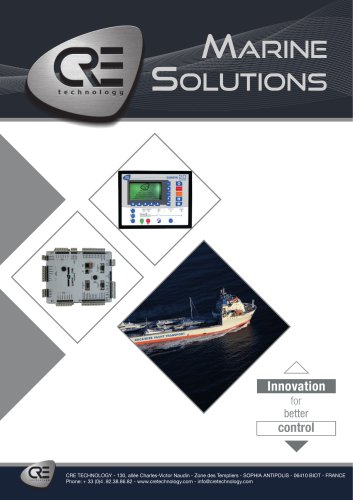 Marine Solutions 2025
4 Pages
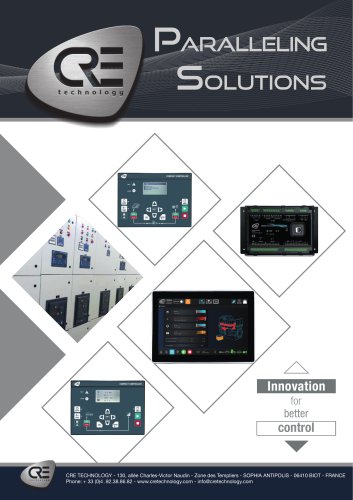 Paralleling
6 Pages
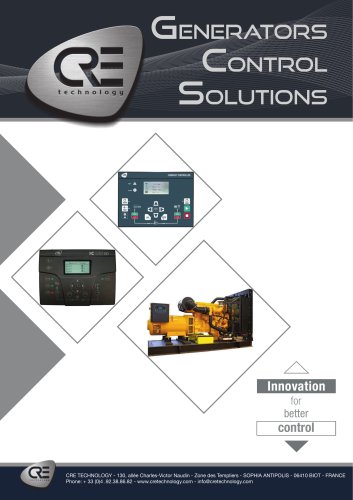 Generator control
4 Pages
 Hybrid range
6 Pages
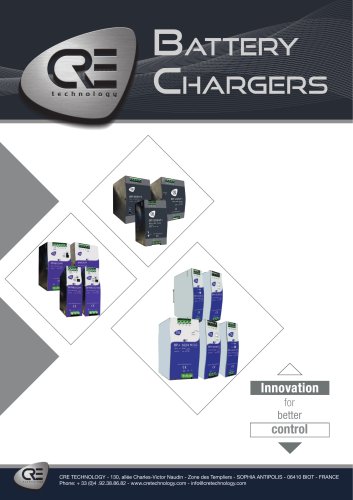 Battery Chargers 2025
4 Pages
Archived catalogs
 DC/DC Converters
2 Pages
 I4GEN suite
2 Pages
 I4GEN.10
2 Pages
 BTB COMPACT
4 Pages
 SCR 2.0
2 Pages
 gensys 2.0 range
4 Pages
 SCR2.0 SALES DOCUMENTATION
2 Pages
 BSD 2.0 SALES DOCUMENTATION
2 Pages
 MARINE SOLUTIONS
4 Pages
 BATTERY CHARGERS
4 Pages
 TRAININGS SESSIONS
4 Pages
 i4GEN
i4GEN2 Pages
 BP range
2 Pages
 GENSYS 2.0 CORE
4 Pages
 product applications
4 Pages
 C2S
C2S16 Pages
 Battery chargers
24 Pages
 ICGEN2.0
55 Pages
 mda-sales-documentation-uk
2 Pages
 GENERATOR CONTROL SOLUTIONS
4 Pages
 avrcompact
2 Pages
 c2s sales documentation
2 Pages
 c2s technical documentation
16 Pages
 paralleling range en c2020
6 Pages
 battery-chargers-range-technical
24 Pages
 COMPACT RANGE
4 Pages


- Electrical cable
- Ethernet switch
- Industrial network switch
- CRE TECHNOLOGY digital I/O
- Power cable
- Junction block
- IO module
- Gigabit Ethernet ethernet switch
- Analog I/O
- Electrical data cable
- RJ45 network switch
- Digital IO module
- DIN rail mounted network switch
- Waterproof network switch
- DC-DC converter
- Unmanaged switch
- Industrial cable
- HMI
- Fieldbus I/O module