
- Catalogs
- COUDOINT S.A.S.
- Coudoint Test Equipment Documentation

Coudoint Test Equipment Documentation

Coudoint Test Equipment Documentation
Load banks are essential for testing electrical equipment by providing controlled electrical loads. They are categorized into battery discharge testers, laboratory and teaching load banks, aerospace load banks, and general DC or AC load banks. These devices include resistive loads, cooling systems, load switches, and control devices. Emphasis is placed on reliability and longevity, with options for standard models and custom designs.
Available in five series with varying power ranges, these testers include manual and electronically controlled models. Special designs cater to specific applications.
- DVIM Series: Manual load step selection, portable (~13 kg), dissipates up to 6 kW, forced-air cooled.
- DVTM Series: Manual load step selection, portable (~28 kg), dissipates up to 12 kW, forced-air cooled.
- DXVA Series: Electronically controlled, portable (~35 kg), dissipates up to 16 kW, forced-air cooled.
- DXLA Series: Electronically controlled, portable, dissipates up to 45 kW, forced-air cooled.
These load banks are used for testing electrical devices and systems in educational and laboratory settings.
Specifically designed for testing aerospace generators and equipment, handling DC voltages of 28 V or 3-phase 400 Hz AC voltages.
- DC Load Banks: Used for testing DC generators and power supplies.
- AC or AC/DC Load Banks: Used for testing AC generators and other electrical equipment.
Details on identifying products based on specifications and features are provided.
This document details specifications and features of various load banks, including models from the DCLA series and special designs for specific applications such as aerospace and laboratory use. It outlines electrical and mechanical characteristics, safety features, and standard options.
- Electronically controlled, portable, capable of dissipating up to 150 kW.
- Models include DCLA-230 and DCLA-240, with varying voltage and current capacities.
- Features include forced-air cooling, digital controllers, and automatic load regulation.
- Mechanical features include portable aluminum housing, caster wheels, and IP20 ingress protection.
- Safety features include master ON/OFF switch, reverse-voltage protection, and over-voltage protection.
- Hand transportable models with manual load current selection and forced-air cooling.
- Load banks with remote control panels and programmable discharge currents.
- Laboratory load banks with selectable operating voltages and forced-air cooling.
- Aerospace load banks designed for specific voltage and current requirements.
- Custom designs for aerospace applications, including hand transportable and rack mountable models.
- Features include natural-air cooling, electronic power switches, and Profibus-driven interfaces.
- DC load banks with natural-air cooling and selectable load steps.
- AC and AC/DC load banks with continuously adjustable load steps and forced-air cooling.
- Welding power load banks designed to test welding power sources.
- All models include safety features such as fuse protection and emergency stop buttons.
- Mechanical features include portable designs with carrying handles and caster wheels for mobility.
The document provides comprehensive information on the specifications, features, and applications of various load banks, highlighting their versatility and adaptability for different industrial needs.
- Model ET1543: Multi-voltage load bank supporting 28 VDC, 230 VAC, and 380 VAC. Features include power and ground connections via M3 terminal blocks, hand transportability with handles and wheels, and dimensions of W500 x D408 x H753 mm with a weight of 35 kg. Protection degree is IP 20.
- Model ET1441: Multi-voltage load bank with operating voltages of 28 VDC, 230 VAC, and 380 VAC. Includes voltage selection by rotary switch, load step selection, digital wattmeters, and emergency stop button. Dimensions are W703 x D850 x H1704 mm, weighing 190 kg with IP 20 protection.
- Test Bench 24 VAC 650 Amps: Single-phase test bench with built-in transformer, electronic control, and remote control panel. Portable with dimensions W552 x D692 x H1606 mm and weight of 190 kg. Ingress protection is IP 20.
- 3-Phase Test Bench: Achieved by coupling three single-phase benches in a master-slave configuration.
The identification code for standard models follows a specific pattern, with special designs designated by a special code and production engineering number.
Catalog excerpts

Test Equipment Load Banks Test Benches Battery Discharge Testers Hardware Reference Document 1101028 - Edition May 2009
Open the catalog to page 1
Benches Hardware Reference 1 General Presentation Different types of load banks and benches Load banks are constructed of switched loads, used for electrically loading electric equipments for testing. When the loads are fixed loads, they are considered simple resistor assemblies, in open frame constructions or in resistor enclosures; examples of these assemblies are provided in the documentation on the different types of resistors (wirewound resistors, edgewound resistors and woven resistors). Depending on their use, benches are split into 4 categories : • battery discharge testers are used to...
Open the catalog to page 3
Benches Hardware Reference 2 Battery Discharge Testers Standard models of battery discharge testers can be chosen in 5 series, each series corresponding to a given power range. A few examples of special designs show the variety of the solutions we provide, from hand-transportable units with manual selection to multiple electronically controlled units in a master/slave configuration. 2.1 Standard Series 2.1.1 Product Selection Guide Manual selection Electronically controlled 6 12 16 45 150 (kW) DVIM DVIM-12 • 12 V / 250 A DVIM-28 • 28 V / 200 A DVIM-48 • 48 V / 120 A DVTM DVTM-48 • 48 V / 250...
Open the catalog to page 4
Benches Hardware Reference 2.1.2 DVIM Series Load banks in the DVIM series: - have manual load step selection - are hand transportable (~ 13 kg, small size) - dissipate up to 6 kW - are forced-air cooled (built-in fan) Standard models are : • DVIM-12 : 12 V/250 A max. • DVIM-28 : 28 V/200 A max. • DVIM-48 : 48 V/120 A max. For illustration purpose only Mechanical features • overall dimensions (W)313 x (D)508 x (H)356 mm • lightweight aluminum case - ingress protection IP20 • weight : approximately 13 kg depending on the model • one carrying handle • forced-air cooling (built-in fan) • maximum...
Open the catalog to page 5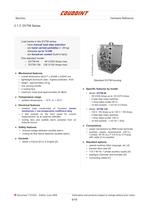
Benches Hardware Reference 2.1.3 DVTM Series Load banks in the DVTM series: - have manual load step selection - are hand carried portables (~ 28 kg) - dissipate up to 12 kW - are forced-air cooled (built-in fans) One standard model : • DVTM-48 : 48 V/250 Amps max. • DVTM-128 : 128 V/100 Amps max. For illustration purpose only Mechanical features • overall dimensions (W)317 x (D)495 x (H)543 mm • lightweight aluminum case - ingress protection IP20 • weight : approximately 28 kg • one carrying handle • 2 cooling fans • maximum noise level approximately 54 dB(A) Temperature range • ambient temperature...
Open the catalog to page 6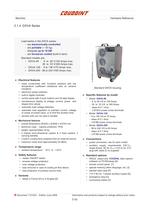
Benches Hardware Reference 2.1.4 DXVA Series Load banks in the DXVA series: - are electronically controlled - are portable (~ 35 kg) - dissipate up to 16 kW - are forced-air cooled (built-in fans) Standard models are: • DXVA-48 : 9 to 26 V/100 Amps max. 26 to 53 V/300 Amps max. • DXVA-128 : 9 to 136 V/75 Amps max. • DXVA-240 : 96 to 240 V/60 Amps max. or illustration purpose only Electrical features • loads constructed with Coudoint resistors with low temperature coefficient resistance wire on ceramic insulators • electronic power switches • built-in digital controller • control panel with 4...
Open the catalog to page 7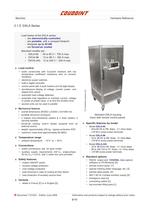
Benches Hardware Reference 2.1.5 DXLA Series Load banks of the DXLA series: - are electronically controlled - are portable, with a compact footprint - dissipate up to 45 kW - are forced-air cooled Standard models are : • DXLA-60 : 40 to 60 V / 750 A max. • DXVA-96 : 12 to 96 V / 300 A max. • DXVA-240 : 12 to 240 V / 200 A max. autres besoins : nous consulter For illustration purpose only Load control • loads constructed with Coudoint resistors with low temperature coefficient resistance wire on ceramic insulators • electronic power switches • built-in digital controller • control panel with 4...
Open the catalog to page 8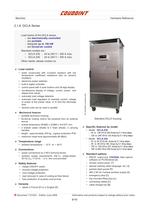
Benches Hardware Reference 2.1.6 DCLA Series Load banks of the DCLA series: - are electronically controlled - are portable - dissipate up to 150 kW - are forced-air cooled Standard models are : • DCLA-230 : 24 to 240 V / 250 A max. • DCLA-240 : 24 to 240 V / 450 A max. Other needs: please contact us For illustration purpose only Load control • loads constructed with Coudoint resistors with low temperature coefficient resistance wire on ceramic insulators • electronic power switches • built-in digital controller • control panel with 4 push buttons and 24-digit display • simultaneous display of...
Open the catalog to page 9
Benches Hardware Reference 2.2 Examples of Special Designs Hand transportable 3 kW; 48 VCC / 60 Amps & 127 VCC / 40 Amps • manual load current selection by rotary switches, 1 Amp steps • forced-air cooling powered from external 220-volt singlephase source • power connections by 3-pins power sockets, 2-meter cable with power plugs at both ends provided • 4 test sockets on the front panel for voltage and current measurement by an external multimeter • cooling fan low speed detection (audible alarm) • fuse for circuit protection • dimensions : W315 x D508 x H395 mm • weight 15 kg, ingress protection...
Open the catalog to page 10
Benches Hardware Reference Load bank 250 V/420 Amps; 105 kW with remote control panel • adaptation of the DCLA-250 standard model • programmable discharge current up to: 180 Amps from 20 to 48 V, 280 Amps from 48 to 63 V, 200 Amps from 125 to 135 V, 420 Amps from 230 to 250 V • forced-air cooling (bottom intake, top exhaust) by a built-in blower powered from an external 380 V 3-phase source • built-in digital controller with display/keyboard local control panel • remote control panel with 20-meter cable, with: - discharge current adjustment potentiometer - emergency stop button • load removed...
Open the catalog to page 11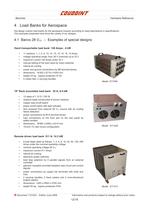
Benches Hardware Reference 4 Load Banks for Aerospace We design custom load banks for the aerospace industry according to need descriptions or specifications. The examples presented here show the variety of our designs. 4.1 Bancs 28 VCC – Examples of special designs Hand transportable load bank 126 Amps ; 4 kW • 11 sections: 1, 1, 2, 5, 10, 15, 15, 15, 15, 15, 15 Amps • voltage operating range: from 28 V (nominal) up to 32 V • maximum current 126 Amps under 32 V • manual setting of the load value by rotary switches • natural-air cooling • power and ground connections by M6 terminal blocks • dimensions...
Open the catalog to page 12All COUDOINT S.A.S. catalogs and technical brochures
 Rotary Rheostats
13 Pages
 Sliding Rheostats
20 Pages
 Woven Resistors
7 Pages
 Wirewound Resistors
23 Pages
 Coudoint Edgewound Resistors
25 Pages



- Wire-wound resistor
- Manual potentiometer
- Rotary potentiometer
- Power resistor
- Analog potentiometer
- Precision potentiometer
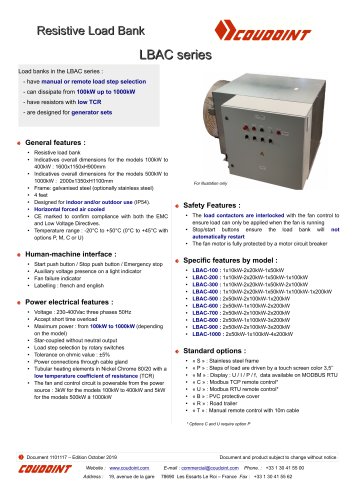
- Resistive load bank
- Wire-wound potentiometer
- Voltage resistor
- High-voltage resistor
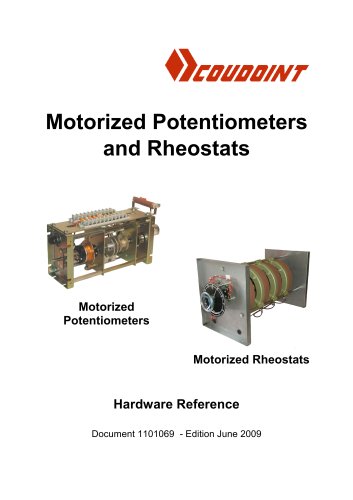
- Motorized potentiometer
- Test load bank
- Resistor with mounting bracket
- Mobile load bank
- Portable load bank
- Low-inductance resistor