- Catalogs
- CORDENKA GmbH & Co. KG
- Profile of premium rayon reinforcement for high performance tires

Profile of premium rayon reinforcement for high performance tires

Profile of premium rayon reinforcement for high performance tires
Catalog excerpts

Profile of premium rayon reinforcement for high performance tires
Open the catalog to page 1
Rayon is defined as a chemical fiber based on renewable resources. This definition points out two fundamental aspects of rayon production: the renewable raw material base on the one hand and the defined industrial production process on the other. The result is a high-performance, renewable material which has well-defined properties and comprises a contemporary, sustainable product. Cordenka rayon, also referred to as high-tenacity multifilament viscose yarn, is a thermostable reinforcement fiber: it owes its resistance to heat and stress to its cellulose origin. Today, Cordenka yarns are applied mainly...
Open the catalog to page 2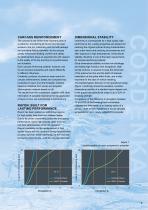
RAYON: BUILT FOR LASTING PERFORMANCE Rayon has been applied as reinforcing material for high quality tires since the nineteen forties. Due to its proven outstanding properties and lasting performance, rayon high tenacity yarns have not lost their attractiveness to the tire designer. Rayon’s suitability for the reinforcement of high quality tires is not only apparent during the production process, but even more importantly, on the road and during the entire tire life - until the very last kilometer. DIMENSIONAL STABILITY CARCASS REINFORCEMENT The carcass is one of the most important parts of a...
Open the catalog to page 3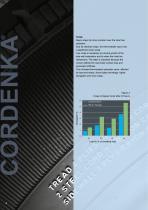
Creep Rayon stays far more constant over the time than polyester. Due its cellulose origin, the thermostable rayon has a significant lower creep. Low creep is necessary to prevent growth of the side wall indentation and to retain the initial tire dimensions. The latter is important because the contour affects the road tread contact area and pneumatic stiffness. The oil based thermoplastic polyester yarns, affected by heat and stress, show higher shrinkage, higher elongation and more
Open the catalog to page 4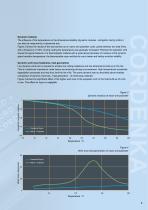
Dynamic modulus The influence of the temperature on the dimensional stability (dynamic modulus - elongation during motion) can also be measured by a dynamical test. Figure 3 shows the results of this test carried out on rayon and polyester cords cycled between two load limits, with a frequency of 10Hz. During cycling the temperature was gradually increased. Whereas the polyester cord shows the typical behavior of a thermoplastic material with a quite abrupt decrease of modulus at the dynamic glass transition temperature, the thermostable rayon exhibits its much better and lasting modulus stability....
Open the catalog to page 5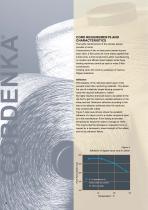
CORD REQUIREMENTS AND CHARACTERISTICS The textile reinforcement of the carcass always consists of cords. Constructions of two or three yarns twisted around each other; 2-fold cords are more widely applied than 3-fold cords. 2-fold constructions allow manufacturing on modern and efficient direct cablers while these twisting machines cannot be used to make 3-fold constructions. Twisting yarns into cords is necessary to improve fatigue resistance. Adhesion The reactivity of the cellulose based rayon cords exceeds most other reinforcing materials. This allows the use of a relatively simple dipping...
Open the catalog to page 6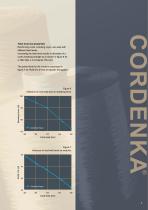
The same holds for the modulus expressed in figure 7 as FASE 2% (Force at Specific Elongation). Twist level and properties Reinforcing cords, including rayon, are used with different twist levels. Increasing the twist level results in decrease of a cord’s breaking strength as is shown in figure 6 for a 1840 dtex x 2 Cordenka 700
Open the catalog to page 7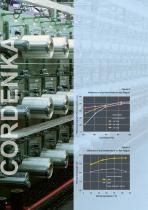
Influence of cord twist level on disc fatigue Influence of test temperature on flex fatigue
Open the catalog to page 8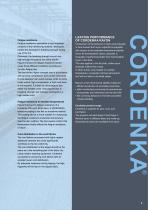
Fatigue resistance at elevated temperatures Figure 9 shows the fatigue resistance of a Cordenka 700 cord, 2440 dtex x 2 (Z330/S330) tested according to the flex or shoeshine method. This testing device is more suitable for measuring the fatigue resistance at elevated temperature than the disc method. The test results confirm that temperature hardly affects the fatigue resistance of rayon. Cord distribution in tire cord fabrics Tire cord fabrics processed with highly regular distances between the cords significantly contribute to the tire uniformity. The cord distribution at the edges should be the...
Open the catalog to page 9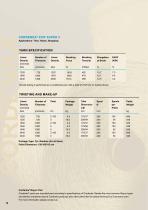
Applications: Tires, Hoses, Strapping YARN SPECIFICATION Linear Density (nominal) dtex Linear Density Breaking Force Breaking Tenacity Tensile testing is performed at a conditioned yarn with a twist of Z100 t/m on testing device TWISTING AND MAKE-UP Linear Density (nominal) dtex Package Weight Package Type: Cyl. Bobbins (for all titers) Pallet Dimension: 126/105/110 cm Cordenka® Rayon Yarn Cordenka® yarns are manufactured according to specifications of Cordenka. Beside the most common Rayon types and deniers mentioned above Cordenka produces also other yarns like the award-winning Eco Endurance...
Open the catalog to page 10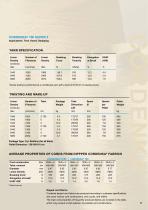
Applications: Tires, Hoses, Strapping YARN SPECIFICATION Linear Density Number of Linear Filaments Density (nominal) Breaking Tenacity Tensile testing is performed at a conditioned yarn with a twist ofZlOO t/m on testing device Package Type: Cyl. Bobbins (for s | Cord construction *Tested oven-dry Dipped cord fabrics Cordenka dipped cord fabrics are produced according to customer specifications and cover various cord constructions, end counts, and widths. The main cord properties of frequently produced fabrics are included in the table, which only present a brief selection of possible cord constructions....
Open the catalog to page 11
CORDENKA Email: [email protected] www.cordenka.com ® Reg. trade mark © CORDENKA GmbH & Co. KG 6/2026 The data contained in this sheet are for general purposes only. They reflect the state of knowledge at the time of publication. CORDENKA gives no guarantee in respect thereof and does not accept liability for deviations therefrom exhibited by their products. Cordenka GmbH & Co. KG Industrie Center Obernburg 63784 Obernburg Germany Phone + 49 6022 81 3264 Fax + 49 6022 81 326
Open the catalog to page 12All CORDENKA GmbH & Co. KG catalogs and technical brochures
 The Company
2 Pages
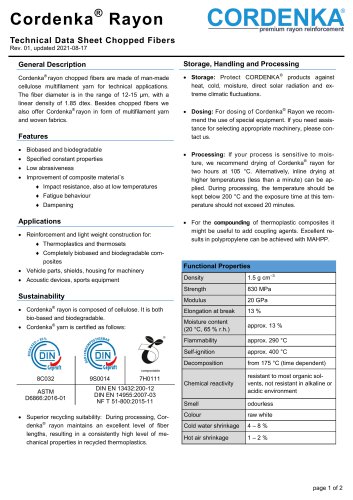 Cordenka® Rayon
2 Pages