- Catalogs
- CORDENKA GmbH & Co. KG
- for Brake Hoses and Industrial Hoses

for Brake Hoses and Industrial Hoses
for Brake Hoses and Industrial Hoses
Cordenka® rayon is a high-performance reinforcement material used in brake hoses and industrial hoses. It is favored for its safety, durability, and sustainability, making it a preferred choice in the automotive industry, particularly in Europe.
Specifications and Properties
Cordenka rayon is a high-tenacity fiber made from cellulose, offering low thermal shrinkage, high tensile modulus, and chemical resistance. These properties make it ideal for reinforcing hoses, ensuring consistent performance even at high temperatures.
Performance and Advantages
Rayon-reinforced brake hoses exhibit excellent dimensional stability and maintain high tensile modulus at temperatures up to 120°C. Compared to thermoplastic fibers like PVA, rayon shows superior performance, especially at elevated temperatures, ensuring reliable braking force transmission.
Testing and Standards
Brake hose volumetric expansion tests confirm the superior stability of rayon-reinforced hoses. These tests, conducted according to FMVSS 106 standards, demonstrate that rayon hoses have lower volume expansion compared to PVA hoses, particularly at higher temperatures.
Applications and Customer Value
Rayon is used in both premium and compact car segments due to its superior performance in maintaining brake fluid volume and minimizing pedal travel. It supports fast reaction times in Electronic Stability Control systems, crucial for vehicle safety.
Industrial Hose Applications
Rayon's chemical resistance makes it suitable for industrial hose applications, including fuel pump and feeder hoses. It shows excellent resistance to organic compounds and biodiesel, ensuring durability in harsh chemical environments.
Processing and Manufacturing
Cordenka rayon is compatible with major hose production techniques, offering low heat shrinkage and resistance to degradation during vulcanization. This ensures high-quality hose production with consistent performance.
Company Overview
Cordenka GmbH & Co. KG is a leading producer of industrial rayon, known for its quality and supply reliability. Based in Obernburg, Germany, the company provides superior products and services to its global customers.
Catalog excerpts

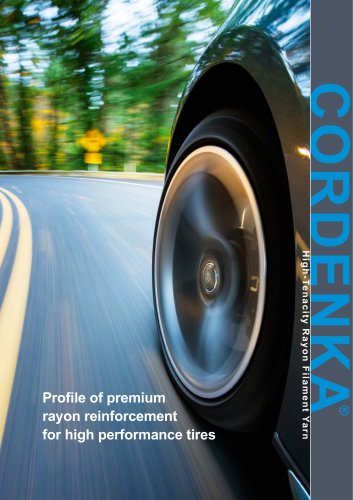
CORDENKA for Brake Hoses and Industrial Hoses
Open the catalog to page 1
Among the many challenging demands placed by consumers on today’s automobiles, safety is definitely a core topic. When constructing brake systems for highperformance vehicles, therefore, no compromises are made on quality. That is why rayon is the material of choice for the reinforcement of brake hoses in the premium segment of Europe’s automobile industry. The excellent volume constancy - even at high temperatures - is one of the major benefits of brake hoses reinforced with Cordenka rayon. It constitutes a clear advantage of rayon over thermoplastic fibers in this application. Brake hoses reinforced...
Open the catalog to page 2
Rayon is defined as a chemical fiber based on renewable resources. This definition points out two fundamental aspects of rayon production: the renewable raw material base on the one hand and the defined industrial production process on the other. The result is a high-performance, renewable material which has well-defined properties and comprises a contemporary, sustainable product. Cordenka rayon, also referred to as high-tenacity multifilament viscose yarn, is a thermostable reinforcement fiber: it owes its resistance to heat and stress to its cellulose origin. Today, Cordenka yarns are applied mainly...
Open the catalog to page 3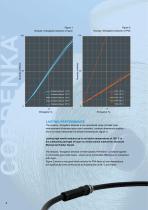
LASTING PERFORMANCE The tenacity / elongation behavior in the operational range of brake hose reinforcements illustrates rayon yarn’s excellent, Constant dimensional stability – which is widely independent of ambient temperatures (figure 1). Lasting high tensile modulus up to and above temperatures of 120° C is the outstanding strength of rayon as reinforcement material for advanced Mechanical Rubber Goods. The tenacity / elongation behavior of thermoplastic PVA fibers - a material applied in commodity-type brake hoses - shows some remarkable differences in comparison with rayon. Figure 2 shows...
Open the catalog to page 4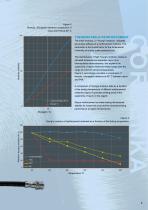
THERMOSTABLE REINFORCEMENT The initial modulus, or ‘Young’s modulus’, indicates the tensile stiffness of a reinforcement material. This parameter is the crucial factor for the dimensional uniformity of a hose under pressure load. The maintenance of high Young’s modulus values at elevated temperatures separates rayon from thermoplastic reinforcements; this explains the superiority of rayon-reinforced brake hoses over the range of common service temperatures. Figure 3, accordingly, provides a comparison of tenacity / elongation relations at 60° C between rayon and PVA. A comparison of Young’s-modulus...
Open the catalog to page 5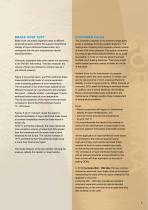
Volumetric expansion tests were carried out according to the FMVSS 106 method. This test measures the volume of brake fluid present in a brake hose at a pre-defined pressure. Figure 5 shows that rayon- and PVA-reinforced brake hoses exhibit similar levels of volume expansion under increasing pressure at room temperature. The comparison of two brake hoses applied by two different European car manufacturers demonstrates the typical – relatively smaller – advantages of rayonreinforced brake hoses at room temperature. The volume expansion of the rayon-reinforced hose compared to that of the PVA-reinforced...
Open the catalog to page 7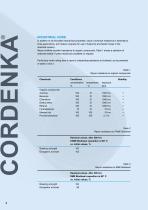
INDUSTRIAL HOSE In addition to its favorable mechanical properties, rayon’s chemical resistance is essential to hose applications, and makes it popular for use in fuelpump and feeder hoses in the chemical industry. Rayon exhibits excellent resistance to organic compounds. Table 1 shows a selection of materials tested. Further results are available on request. Particularly worth noting here is rayon’s outstanding resistance to biodiesel, as documented in tables 2 and 3. Table 1 Rayon resistance to organic compounds Chemicals c hemicals Organic compounds Acetone Benzene Chloroform Diethyl ether...
Open the catalog to page 8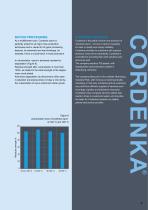
In vulcanization, rayon is extremely resistant to degradation (Figure 8). Residual strength after vulcanization is more than 100%, as related to the initial strength of the dipped rayon cords tested. Aminolytic degradation (a phenomenon often seen in polyester processing) does not play a role during the vulcanization of rayon-reinforced rubber goods. CORDENKA SERVICE RAYON PROCESSING As a multifilament yarn, Cordenka rayon is perfectly suited for all major hose production techniques and is valued for its good processing features. Its extremely low heat shrinkage, for example, forms a crucial factor...
Open the catalog to page 9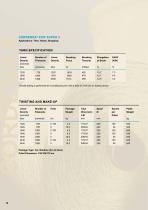
Applications: Tires, Hoses, Strapping Linear Density Number of Filaments (nominal) Linear Density Breaking Tenacity Linear Density Number of Filaments (nominal) Package Tube Spool Spools Pallet Weight Dimension 0 per Weight Package Type: Cyl. Bobbins (for al Pallet Dimension: 126/105/110 cm
Open the catalog to page 10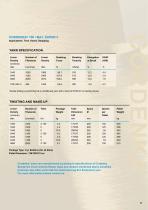
Applications: Tires, Hoses, Strapping Linear Number of Linear Breaking Breaking Elongation EASF Density Filaments Density Force Tenacity at Break (45N) dtex (nominal) dtex N mN/tex % % Tensile testing is performed at a conditioned yarn with a twist ofZlOO t/m on testing device Package Type: Cyl. Bobbins (for all titers) Pallet Dimension: 126/105/110 cm
Open the catalog to page 11
CORDENKA Email: [email protected] www.cordenka.com ® Reg. trade mark © CORDENKA GmbH & Co. KG 6/2026 The data contained in this sheet are for general purposes only. They reflect the state of knowledge at the time of publication. CORDENKA gives no guarantee in respect thereof and does not accept liability for deviations therefrom exhibited by their products. Cordenka GmbH & Co. KG Industrie Center Obernburg 63784 Obernburg Germany Phone + 49 6022 81 3264 Fax + 49 6022 81 326
Open the catalog to page 12All CORDENKA GmbH & Co. KG catalogs and technical brochures
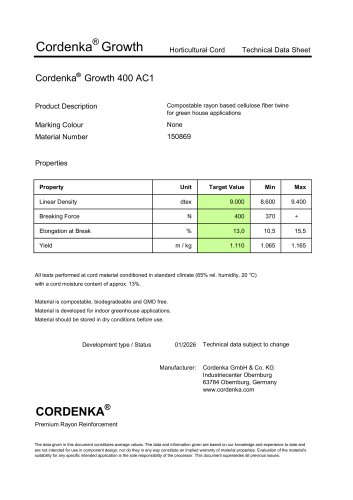 Cordenka Growth 400 AC1
1 Page
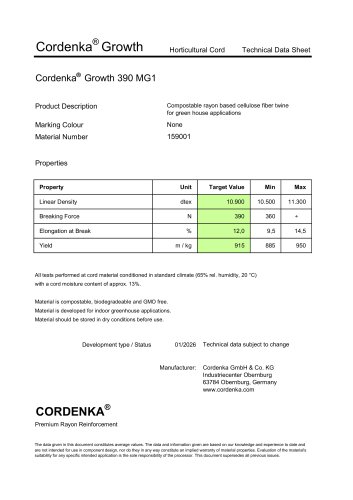 Cordenka Growth 390 MG1
1 Page
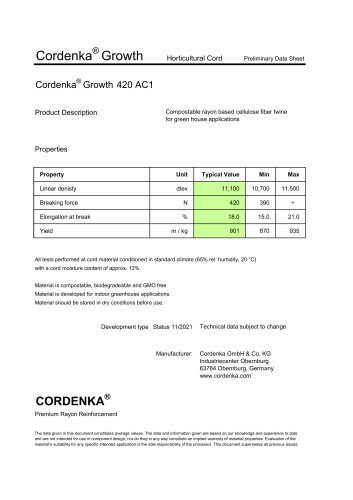 Cordenka® Growth 420 AC1
1 Page
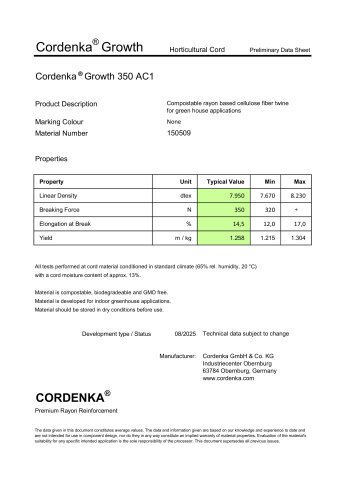 Cordenka Growth 350 AC1
1 Page
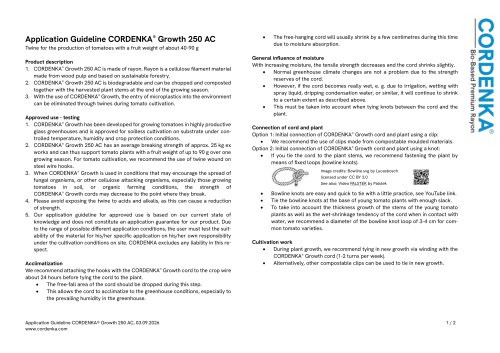
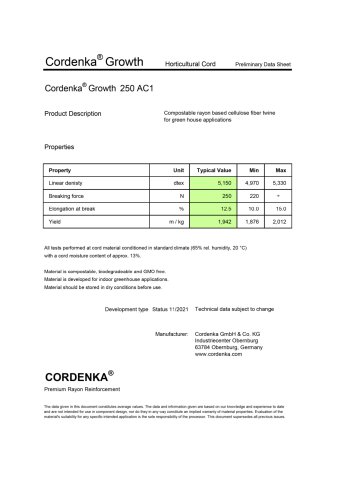 Cordenka® Growth 250 AC1
1 Page
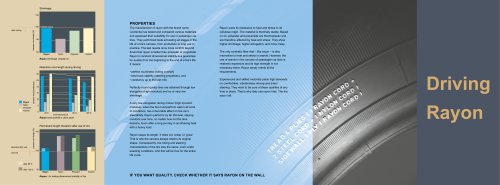 Driving Rayon
2 Pages
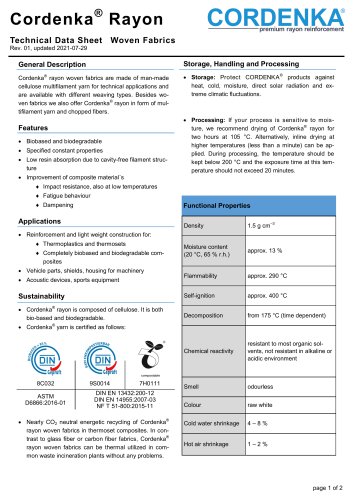
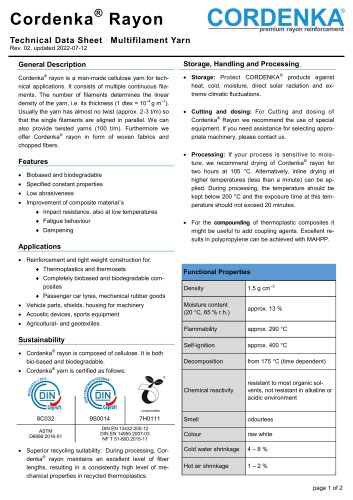 Cordenka® Rayon
2 Pages
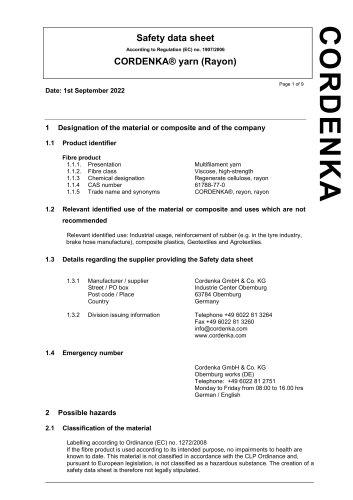 CORDENKA® yarn (Rayon)
9 Pages
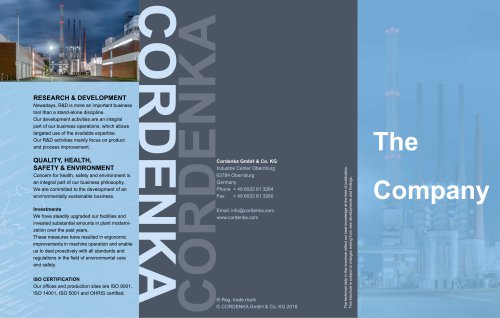 The Company
2 Pages
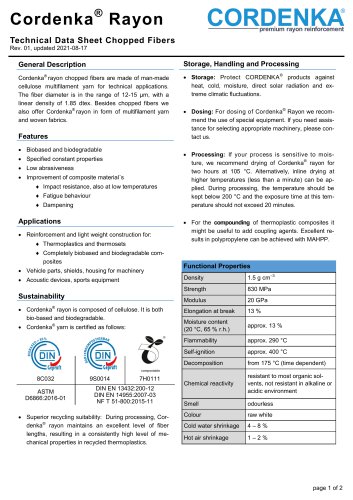 Cordenka® Rayon
2 Pages