


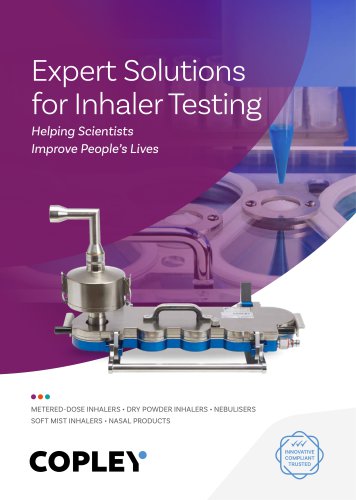
Expert Solutions for Inhaler Testing
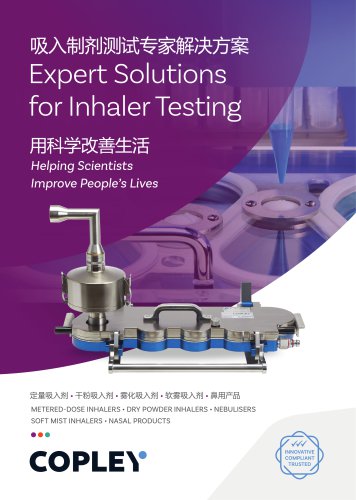
Expert Solutions for Inhaler Testing
Copley Scientific, established in 1946 in Nottingham, UK, specializes in inhaler testing solutions, offering precision instruments and a connected ecosystem to enhance laboratory workflows, data accuracy, and compliance with global standards.
For over 80 years, Copley Scientific has supported scientists in developing inhaled medicines, providing advanced hardware and software solutions for data management, traceability, and consistency, along with training and maintenance services to ensure compliance with ISO 9001:2015 standards.
The document details various inhaler types, including Metered-Dose Inhalers (MDIs), Dry Powder Inhalers (DPIs), Nebulisers, Soft Mist Inhalers (SMIs), and Nasal Products, each with specific characteristics and testing requirements.
Copley Scientific ensures adherence to international standards and pharmacopoeias, including the European Pharmacopoeia, United States Pharmacopeia, Chinese Pharmacopoeia, and Japanese Pharmacopoeia.
Copley Scientific offers comprehensive inhaler testing solutions, supporting accurate and compliant data collection and analysis, enhancing the development and delivery of inhaled medicines.
Orally inhaled drugs are used for local or systemic therapy via the lungs, while nasal preparations are traditionally for local administration with potential for rapid systemic absorption, including the "Nose to Brain" pathway for central nervous system diseases.
National regulatory bodies like the EMA, FDA, and NMPA oversee medicine safety, quality, and efficacy. The EMA and FDA provide specific guidelines for OINDPs, while the ICH promotes harmonization of drug regulation.
Pharmacopoeias define medicine standards, with guidelines and testing methods for OINDPs provided by the European, United States, Chinese, and Japanese Pharmacopoeias.
Significant R&D focuses on inhalation drug delivery, with the FDA supporting generic development to ensure bioequivalence.
Implementing guidelines for OINDPs is complex due to manufacturing challenges and unclear in vitro-in vivo correlations, with the EPAG working to establish best practices.
Groups like IPAC-RS, PQRI, and ISO play roles in advancing OINDP standards and regulations.
DDU is a critical quality attribute for consistent drug delivery, involving testing throughout the inhaler's life using various apparatus and automated systems.
Includes apparatus like the Dose Uniformity Sampling Apparatus (DUSA) and automated systems like Vertus III for efficient testing.
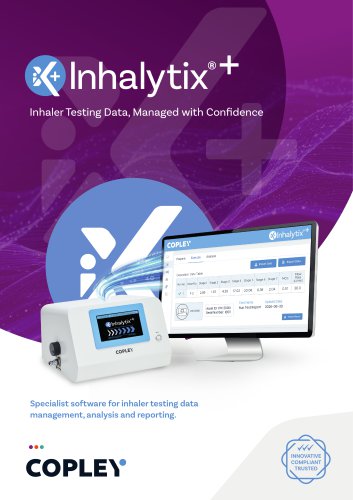
Tools like Inhalytix+ automate data handling, enhancing data integrity and traceability.
Details specifications for inhaler testing apparatuses like NGI, ACI, MSLI, and GTI, each designed for specific applications.
Emphasizes adherence to pharmacopoeial standards for accuracy and reliability in pharmaceutical testing.
Suggests using impactors with multiple stages for better APSD resolution and automation tools for efficiency.
Copley offers comprehensive services, including training and technical support, to optimize pharmaceutical testing processes.
The document provides a thorough overview of inhaler testing tools and systems, emphasizing standardization, automation, and data management for accurate and reliable testing.
Catalog excerpts
Expert Solutions for Inhaler Testing 用科学改善生活 Helping Scientists Improve People’s Lives 定量吸入剂 • 干粉吸入剂 • 雾化吸入剂 • 软雾吸入剂 • 鼻用产品
Open the catalog to page 1
Inhaler Testing Founded in 1946 and headquartered in Nottingham, UK, Copley Scientific remains a family-owned and managed company. For over 80 years, the company has helped scientists worldwide generate reliable data that supports the development and quality of inhaled medicines. Copley customers benefit from: • End-to-end orally inhaled and nasal drug product testing solutions supporting accurate and compliant data • Integrated digital data management for traceability and workflow efficiency • Automation technologies that enhance repeatability and data integrity • Expert training, qualification...
Open the catalog to page 2
The Copley Promise Innovative Novel solutions that maximise understanding and productivity. Compliant Certified to the standards defined by global regulators and pharmacopoeias. Trusted Quality products with accuracy, robustness and reliability built-in.
Open the catalog to page 3
Inhaler Testing ISO 9001: 2015 Quality Management System 2 Orally Inhaled & Nasal Drug Products (OINDPs) Orally Inhaled Drug Products 7 Metered-Dose Inhalers (MDIs) 7 Dry Powder Inhalers (DPIs) 8 Soft Mist Inhalers (SMIs) 10 Nasal Drug Products 10 Organisations and their Roles 12 Regulatory Bodies in the UK, European Union, China, Japan and USA 12 International Regulation and Harmonisation 14 Drug Safety, Quality and Efficacy -The Pharmacopoeias 15 United States Pharmacopeia (USP) 15 Device Safety, Quality and Efficacy - International Standards Organisation (ISO) 16 European Pharmaceutical Aerosol...
Open the catalog to page 4
Cold Freon® Effect 261 Spray Force Tester SFT 1000 262 Special Applications Abbreviated Impactor Measurement (AIM) 265 Fast Screen Andersen (FSA) 267 Fast Screening Impactor (FSI) 270 Volume and Resistance Compensator VRC 272 Generic Drug Development 274 Fluticasone Propionate/Salmeterol Aerosols & Powders 275 Albuterol Inhalation Aerosols 278 Device Robustness/Inhaler Misuse 280 Patient Exhalation Simulator PES 280 Drop Test Apparatus DTA 282 Qualification Services Impactor Qualification Stage and Components Mensuration Data Interpretation Impactor Performance Restoration In-House and On-Site...
Open the catalog to page 5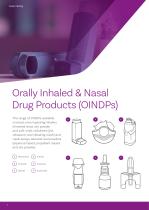
Inhaler Testing Orally Inhaled & Nasal Drug Products (OINDPs) The range of OINDPs available is broad, encompassing inhalers (metered-dose, dry powder and soft mist), nebulisers (jet, ultrasonic and vibrating mesh) and nasal sprays, aerosols and powders (aqueous-based, propellant-based and dry powder). Metered-Dose Soft Mist Nasal Spray Nasal Powder
Open the catalog to page 6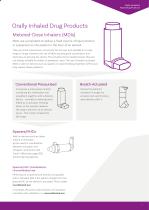
Orally Inhaled & Nasal Drug Products Orally Inhaled Drug Products Metered-Dose Inhalers (MDIs) MDIs use a propellant to deliver a fixed volume of liquid solution or suspension to the patient in the form of an aerosol. They are small, inexpensive, convenient for the user and suitable for a wide range of drugs. However, the use of MDIs requires good coordination and technique to actuate the device. The actuation force needed means they are not always suitable for elderly or paediatric users. The use of breath-actuated MDIs or add-on devices such as spacers or valved holding chambers (VHCs) can...
Open the catalog to page 7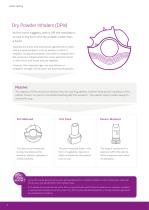
Inhaler Testing Dry Powder Inhalers (DPIs) As the name suggests, with a DPI the medication comes in the form of a dry powder, rather than a liquid. Typically, the active pharmaceutical ingredient(s) is mixed with a coarser excipient, such as lactose, to which it attaches. During aerosolisation the active is stripped from the carrier and inhaled whilst the carrier particles impact on the mouth and throat and are ingested. However, their relatively high cost and reliance on inhalation strength and duration are potential drawbacks. Passive The majority of DPIs are passive devices, that is to say...
Open the catalog to page 8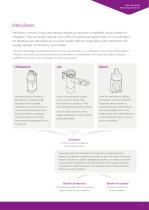
Orally Inhaled & Nasal Drug Products Nebulisers Nebulisers convert a liquid into aerosol droplets to produce a respirable cloud suitable for inhalation. They are widely used at home and in hospital and require little or no coordination for effective use. Nebulisers are normally loaded with the drug before each treatment and usually operate continuously once loaded. The main advantage of nebulisers is that their use requires little or no coordination on the part of the patient. However, they tend to be cumbersome and require either compressed air or an electrical supply. Expense, inefficiency...
Open the catalog to page 9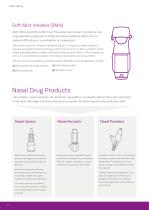
Inhaler Testing Soft Mist Inhalers (SMIs) Both MDIs and DPIs suffer from the same two inherent problems: low lung deposition (typically 5-20%) and dose variability (often due to patient difficulties in coordination or inspiration). SMIs (often known as “Inhalation Metered Sprays’’ or “Aqueous Droplet Inhalers”) actively aerosolise the liquid, forming a ‘soft mist’ to overcome these problems. These inhalers generally deliver a higher fine particle fraction than MDIs or DPIs. However, as with any multi-dose liquid system, microbial contamination can be a problem. SMIs do not use a propellant to...
Open the catalog to page 10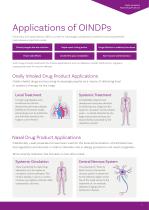
Orally Inhaled & Nasal Drug Products Applications of OINDPs Pulmonary and nasal delivery offers a number of advantages compared to traditional oral and parenteral (subcutaneous injection) routes: Directly targets the site of action Rapid onset of drug action Drugs effective in relatively low doses Fewer side effects Avoids first pass metabolism Non-invasive administration Such drugs include treatments for diverse applications such as diabetes, erectile dysfunction, migraine, osteoporosis and for vaccine delivery. Orally Inhaled Drug Product Applications Orally inhaled drugs are becoming increasingly...
Open the catalog to page 11
Inhaler Testing The ultimate responsibility for the safety, quality and efficacy of medicines and medical devices lies with the various national regulatory bodies designated to safeguard public health. At present, there are no worldwide standards that are specifically applicable to OINDPs. In the European Union, the responsibility for the regulation of medicines lies with the European Medicines Agency (EMA) in the form of the Committee for Medicinal Products for Human Use (CHMP). The EMA was set up in 1995 to harmonise the work of existing national regulatory bodies in Europe. The main guidance...
Open the catalog to page 12All COPLEY catalogs and technical brochures
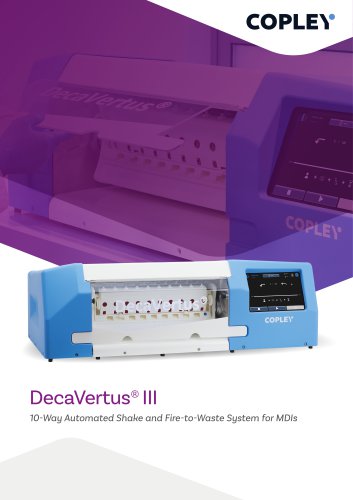 DecaVertus® III
4 Pages
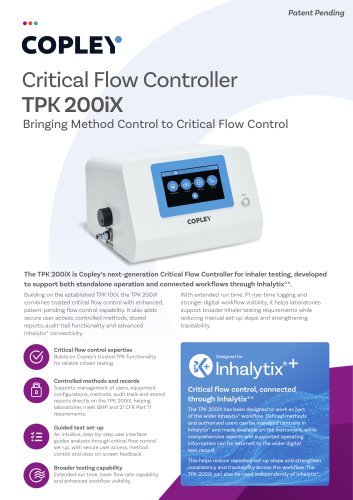 TPK 200iX
4 Pages
- Flowmeter
- Test machine
- Test cabinet
- Vacuum pump
- Automatic cleaning system
- Temperature test chamber
- Automated testing machine
- Solids separator
- Gas flow monitor
- Indentation hardness tester
- Climatic test cabinet
- Computer-controlled test machine
- Portable tester
- Lubricated vacuum pump
- Humidity test cabinet
- Oil-free vacuum pump
- Environmental test chamber
- Digital tester
- Centrifugal classifier
- Laboratory shaker