
- Catalogs
- Copley Controls
- Accelus Card

- Products
- Catalogs
- News & Trends
- Exhibitions
Accelus Card

Accelus Card
The Accelus™ digital servo drive is engineered for controlling both brushless and brush motors in various modes such as position, velocity, or torque, utilizing full digital control. It employs sinusoidal commutation with encoder feedback and Hall signals for phase initialization and correction, ensuring efficient motor operation.
The drive supports field-oriented control for optimal speed and torque, featuring auto-tuning and auto-phasing capabilities. It includes programmable I/O with 6 inputs and 2 outputs, supporting digital encoder and Hall feedback. The drive can handle a peak current of up to 18 Amps DC and a continuous current of up to 6 Amps DC, depending on the model.
Communication is facilitated via an RS-232 link using CME 2™ software for setup and tuning. It supports both analog and digital reference inputs for torque, velocity, and position control. A bi-color LED indicates status, and various digital inputs are available for enabling and controlling the amplifier.
The drive includes protections against overvoltage, undervoltage, over-temperature, and short circuits. It features programmable current limiting and motor over-temperature shutdown.
Accelus™ is a PCB-mounted device with solderless connectors for easy installation. It can be configured on-site for different machine axes, and a development kit is available for mounting multiple amplifiers.
The drive is suitable for use with motion controllers that close position loops using incremental encoder feedback. It is compatible with various control signals, including analog, PWM, and digital step-motor control signals.
Two formats for stepper-command signals are described: CW/CCW (clockwise/counter-clockwise) and Pulse & Direction. In the CW/CCW format, pulses at IN6 increase the position-command, while pulses at IN5 decrease it. In the Pulse & Direction format, pulses at IN6 adjust the position-command based on the DC level at the Direction input, IN5.
There are three types of motor connections: phase, Halls, and encoder. Phase connections carry amplifier output currents to drive the motor. Hall signals provide absolute position feedback within an electrical commutation cycle, while encoder signals offer incremental position feedback for velocity and position modes.
The motor encoder input circuit uses a differential line-receiver with R-C filtering. Differential outputs are preferred for noise reduction. Encoder cabling should use twisted pair cables, and shielded twisted-pair is recommended for better noise rejection.
Hall signals are single-ended and provide absolute feedback within one electrical cycle of the motor. They are used for commutation-initialization after startup and for checking motor phasing.
The amplifier outputs connect to a three-phase PWM inverter, converting DC buss voltage into sinusoidal voltage waveforms to drive the motor phase-coils. Proper cabling and routing are essential to minimize noise.
Accelus operates from transformer-isolated, unregulated DC power supplies. External capacitance is required to handle ripple currents. Regulated switching power supplies can be used with a diode to prevent regenerative energy from reaching the supply output.
All circuits share a common circuit-ground. High-current paths are through +HV and HV Return connections, while low-current paths are through I/O signals and Signal Ground. Proper grounding and routing are crucial to minimize noise and voltage drops.
Fusing protects external circuits and motors from amplifier failures. Motor phase fusing is recommended for linear motor applications due to their lower thermal capacity. Proper sizing and testing of fuses are necessary to prevent false-tripping.
The document provides details on the programmable functions of input and output signals, as well as the specifications for PC board mating connectors.
The document includes ordering instructions for the Accelus Development Kit and related components, specifying part numbers and descriptions.
Catalog excerpts
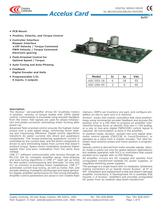
Copley Controls, 20 Dan Road, Canton, MA 02021, USA Tel: 781-828-8090 Fax: 781-828-6547 Tech Support: E-mail: [email protected], Web: http://www.copleycontrols.com Page 1 of 8 DIGITAL SERVO DRIVE for BRUSHLESS/BRUSH MOTORS Accelus Card RoHS description The Accelus™ servoamplifier drives DC brushless motors in position, velocity, or torque modes with 100% digital control. Commutation is sinusoidal using encoder feedback from the motor. Hall signals are used for phase-initialization and phase-correction eliminating motor hunting after power-up. Advanced field-oriented-control ensures the highest motor torque over a wide speed range, minimizing motor heating and maximizing efficiency. Digital control algorithms transform AC stator currents into direct and quadrature components. The torque-producing quadrature current is controlled by the current loop, and the direct component is driven to zero eliminating losses from current that doesn’t produce torque. Space-vector modulation produces higher speeds than sine-pwm modulation from the same buss voltage. CME 2™ software communicates with Accelus through an RS-232 link for complete amplifier setup. Auto-phasing and auto-tuning algorithms in CME 2™ slash set up times for fast system commissioning and eliminate “re-wire and try” so common in brushless motor installations. CME 2™ automates current loop tuning, as well as motor, Hall, and encoder phasing. A powerful oscilloscope and signal generator display amplifier performance for fine tuning thereafter. Amplifier control parameters are saved in non-volatile flash • PCB Mount • Position, Velocity, and Torque Control • Controller Interface Stepper Interface ±10V Velocity / Torque Command PWM Velocity / Torque Command Electronic gearing • Field-Oriented Control for Optimal Speed / Torque • Auto-Tuning and Auto-Phasing • Feedback Digital Encoder and Halls • Programmable I/O: 6 inputs, 2 outputs memory. OEM’s can inventory one part, and configure amplifiers on-site to each axis in a machine. Accelus™ works with motion controllers that close positionloops using incremental encoder feedback and process the position error in a PID filter to produce an amplifier command for torque, force, or velocity. Only one +/-10V analog, or a one or two-wire digital PWM/(DIR) control signal is required. All commutation is done in the amplifier. In position-mode, Accelus™ accepts two-wire digital stepmotor control signals (CW/CCW, or Count/Direction), or operates as a slave from a master encoder. The ratio between input position pulses and motor position is programmable. Velocity control is derived from motor encoder signals. Velocity mode is useful not only for speed-setpoint applications, but enables operation with PLC’s or controllers that output position-error signals with no PID filtering. All amplifier circuits are DC coupled and operate from unregulated transformer-isolated DC power supplies, or regulated switching power supplies. The package is a single board with no heatplate. Solderless mating connectors on pc boards mount Accelus™ at 0° or 90°. Installation and replacement is fast and doesn’t damage amplifier connections. A Development Kit is available that mounts 1~4 Accelus™ amplifiers and provides unregulated DC power from an isolation step-down transformer. Model Ic Ip Vdc ASC-055-18 6 18 55 ASC-090-09 3 9 90
Open the catalog to page 1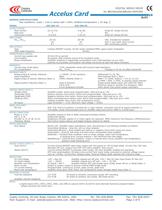
Copley Controls, 20 Dan Road, Canton, MA 02021, USA Tel: 781-828-8090 Fax: 781-828-6547 Tech Support: E-mail: [email protected], Web: http://www.copleycontrols.com Page 2 of 8 Accelus Card RoHS DIGITAL SERVO DRIVE for BRUSHLESS/BRUSH MOTORS GENERAL SPECIFICATIONS Test conditions: Load = 1mH in series with 1 Ohm. Ambient temperature = 25 deg. C. MODEL ASC-055-18 ASC-090-09 Output Power Peak Current 18 (12.73) 9 (6.36) Amps DC (Amps ACrms) Peak time 1 1 Sec Continuous current 6 (4.24) 3 (2.12) Amps DC (Amps ACrms) INPUT POWER HVmin~HVmax 20~55 20~90 VDC, Transformer-isolated 20 10 ADC (1...
Open the catalog to page 2
Copley Controls, 20 Dan Road, Canton, MA 02021, USA Tel: 781-828-8090 Fax: 781-828-6547 Tech Support: E-mail: [email protected], Web: http://www.copleycontrols.com Page 3 of 8 DIGITAL SERVO DRIVE for BRUSHLESS/BRUSH MOTORS Accelus Card RoHS status LED A single bi-color LED gives the state of the amplifier by changing color, and either blinking or remaining solid. Slowblinking is about 1 blink/sec, fast is about 5 blinks/sec. The possible color and blink combinations are: • Green/Solid: Amplifier OK AND enabled. Will run in response to reference input. • Green/Slow-Blinking: Amplifier OK...
Open the catalog to page 3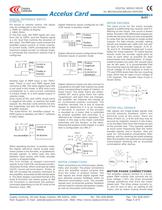
Copley Controls, 20 Dan Road, Canton, MA 02021, USA Tel: 781-828-8090 Fax: 781-828-6547 Tech Support: E-mail: [email protected], Web: http://www.copleycontrols.com Page 4 of 8 Accelus Card RoHS DIGITAL SERVO DRIVE for BRUSHLESS/BRUSH MOTORS Digital Reference Inputs (cont’d) For torque or velocity control, the inputs may be configured in two formats: 1. PWM (0~100%) & Polarity 2. PWM (50%) In the first case, the PWM signal can vary from 0% to 100%, and the Polarity signal is a DC level that controls the direction of the motor. The PWM duty-cycle controls the amplifier output current, or...
Open the catalog to page 4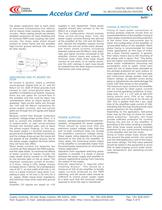
Copley Controls, 20 Dan Road, Canton, MA 02021, USA Tel: 781-828-8090 Fax: 781-828-6547 Tech Support: E-mail: [email protected], Web: http://www.copleycontrols.com Page 5 of 8 DIGITAL SERVO DRIVE for BRUSHLESS/BRUSH MOTORS Accelus Card RoHS POWER Suplies Accelus™ operates typically from transformerisolated, unregulated DC power supplies. These should be sized such that the maximum output voltage under high-line and no-load conditions does not exceed the amplifiers maximum voltage rating. Power supply rating depends on the power delivered to the load by the amplifier. In many cases, the...
Open the catalog to page 5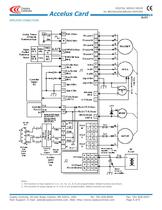
Copley Controls, 20 Dan Road, Canton, MA 02021, USA Tel: 781-828-8090 Fax: 781-828-6547 Tech Support: E-mail: [email protected], Web: http://www.copleycontrols.com Page 6 of 8 Accelus Card RoHS DIGITAL SERVO DRIVE for BRUSHLESS/BRUSH MOTORS amp lifier conne ctions Notes 1. The functions of input signals on J1-2, 14, 16, 21, & 23 are programmable. Default functions are shown. 2. The functions of output signals on J1-13 & 15 are programmable. Default functions are shown.
Open the catalog to page 6All Copley Controls catalogs and technical brochures
 XenusPLUS Compact EtherCAT XEC
30 Pages
 XenusPLUS Compact CANopen XPC
30 Pages
 Control Networks
8 Pages
 R-Series Guide
8 Pages
 Selection Guide
24 Pages
 Xenus R10
30 Pages
 Accelnet R23
24 Pages
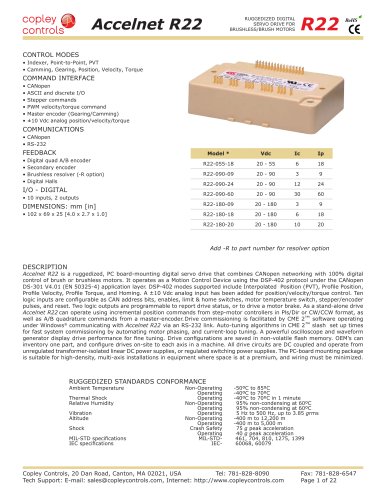 Accelnet R22
22 Pages
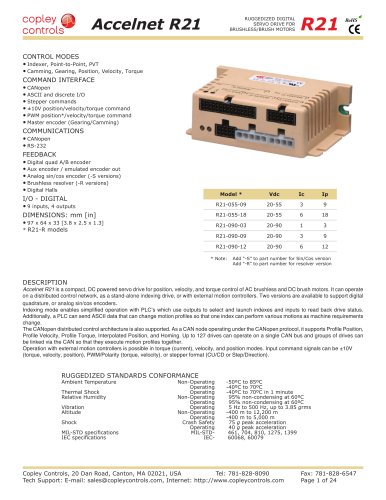 Accelnet R21
24 Pages
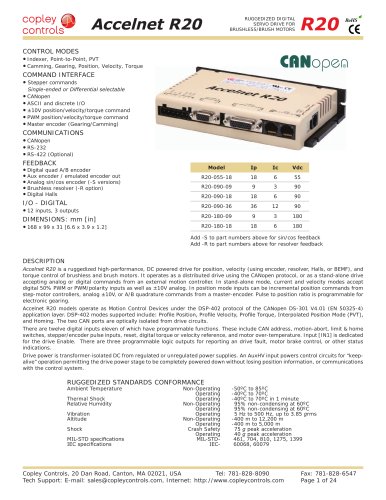 Accelnet R20
24 Pages
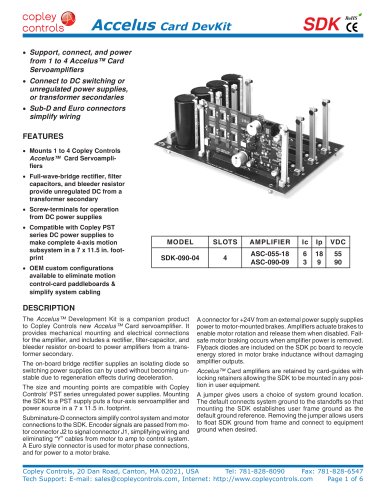 Accelus Card Development Kit
6 Pages
 Accelus Card
8 Pages
 ASP-X2 Accelus Panel Dual
10 Pages
 Junus
Junus10 Pages
 CAN-PCI-02
2 Pages
 CAN-IPM-01
8 Pages
 Bantam
18 Pages
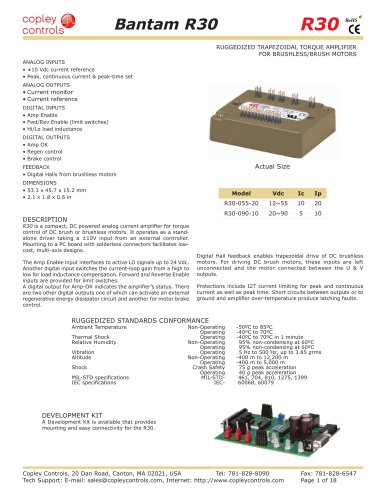 Bantam R30
18 Pages
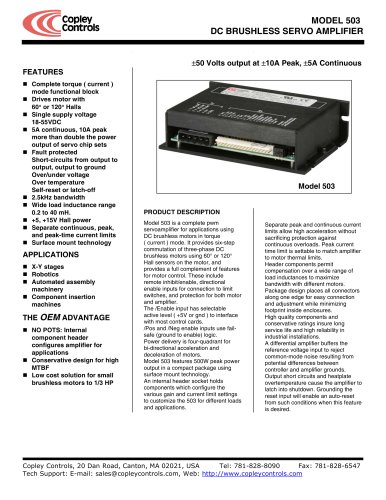 503
5036 Pages
 Power Supply Subsystem
8 Pages
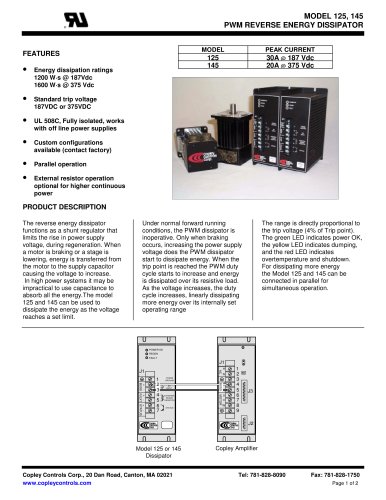 Shunt Regulator
2 Pages
 Xenus PLUS 2-Axis CANopen
34 Pages
 Xenus RoHS PLUS CANopen
28 Pages
 Xenus PLUS 2-Axis EtherCAT
34 Pages
 Xenus PLUS EtherCAT
28 Pages
 Xenus Edge Filter
16 Pages
 Regen Resistors
24 Pages
 Xenus Micro
24 Pages
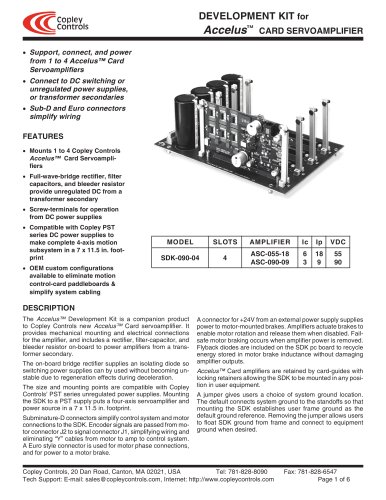 Accelus Card Development Kit
6 Pages
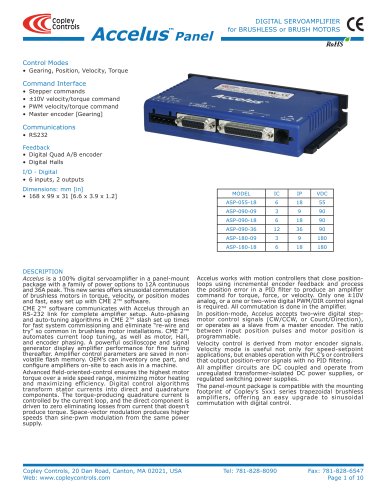 Accelus Panel
10 Pages
 Xenus XTL
30 Pages
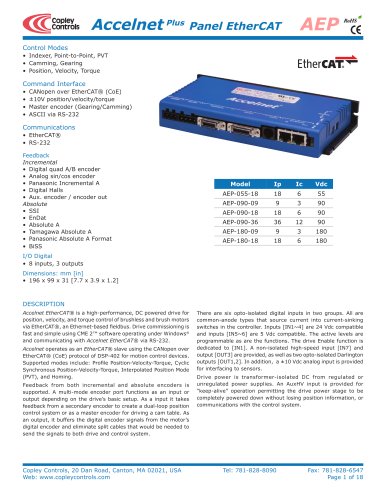 Accelnet Plus EtherCAT Panel
18 Pages
 Accelnet Micro Module and Kit
24 Pages
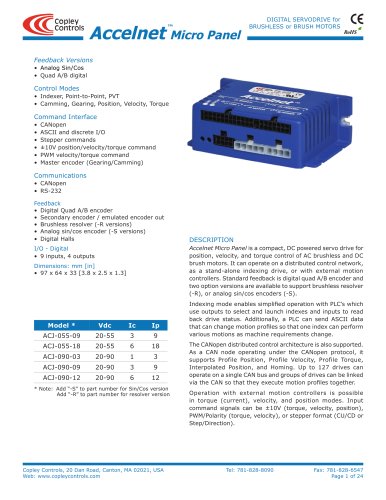 Accelnet Micro Panel
24 Pages
 Accelnet Module Development Kit
8 Pages
 Accelnet Module
14 Pages
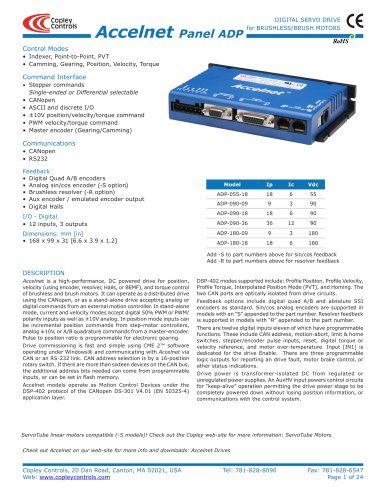 Accelnet Panel ADP
24 Pages





- Digital I/O
- Analog I/O
- Servo-amplifier
- Motor controller
- DC servo-amplifier
- Fieldbus servo-drive
- DC motor controller
- AC servo-amplifier
- Brushless servo-amplifier
- Stepper motor controller
- Communication interface card
- EtherCAT servo-amplifier
- Compact servo-amplifier
- CANopen servo-amplifier
- Digital servo-amplifier
- Stepper servo drive
- Industrial interface expansion card
- CANopen I/O
- Brushless motor control
- Digital input motor controller