
- Catalogs
- Cooper Lighting and Safety
- Fire Solutions

Fire Solutions

Fire Solutions
- Features three separate inputs and outputs, monitored for open and short circuits.
- Soft addressed with an integral short circuit isolator.
- Compatible with DF6000, DF6100, and FX6302 systems.
- Dimensions: 89mm (H) x 150mm (W) x 58mm (D).
- Installation requires a deep double gang back box, with flexible cable entry options.
- Includes base and wall sounders, both soft addressed and featuring built-in short circuit isolators.
- Volume and tone controlled by the fire control panel.
- Base sounder dimensions: 102mm (Dia) x 40mm (D), wall sounder dimensions: 105mm (H) x 105mm (W) x 95mm (D).
- Weatherproof version available with IP66 rating.
- Utilizes LED technology for high-intensity flash with low current consumption.
- Soft addressed with a built-in short circuit isolator.
- Dimensions: 95mm (Dia) x 53mm (D).
- Includes optical, ionisation, photo-thermal, and multi-mode heat detectors.
- Soft addressed with integral short circuit isolators.
- Features 360° visibility LED and automatic drift compensation.
- Dimensions vary by type, with optical detectors at 101mm (Dia) x 45mm (D incl. base).
- Designed for compatibility with Menvier and JSB detectors.
- Features separate loop in and loop out terminals, and selectable detector locking.
- Dimensions: 104mm (Dia) x 22mm (D).
The document provides an overview of various fire detection and alarm system components, including beam detectors, internal and weatherproof bells, callpoints, and conventional fire panels. Each component is designed for specific applications and compatibility with Menvier and JSB systems.
These detectors are zone-powered, requiring no additional power supply, and are easy to install with a range of up to 100 meters. They feature three operational modes: prism targeting, alignment, and normal running. They are designed for use with Menvier and JSB panels and include a test filter for simulating smoke conditions.
Available in various sizes (100mm, 150mm, 200mm), these bells are 24V rated, have high sound output, and low current consumption. They are suitable for applications like schools and are available in both standard and weatherproof versions.
These bells are designed for outdoor use, featuring a weatherproof design and a solenoid operation. They maintain high sound output and low current consumption, with a 200mm size available.
Callpoints are available in flush, surface, and weatherproof versions, with optional LED indicators. They are designed for quick installation and maintenance, featuring a fast-fit clip-on cover and a test key for operation testing. Analogue versions include short circuit isolators and status LEDs.
The document includes compatibility tables for selecting suitable detectors, callpoints, and sounders for Menvier and JSB conventional panels. It highlights the importance of using compatible devices to ensure system functionality.
Each component has specific installation requirements, such as mounting height for beam detectors and cable entry points for bells and callpoints. Proper installation ensures optimal performance and compliance with safety standards.
Detailed specifications are provided for each component, including dimensions, weight, voltage, current consumption, sound output, and IP ratings. These specifications are crucial for selecting the right components for specific applications.
Conventional bases are designed for compatibility with Menvier and JSB detectors and control panels. They feature separate loop in and loop out terminals, a stand-off fixing feature, and accept side entry surface cables. A selectable detector locking feature is also available. The bases are designed for flexibility, simplicity, and speed of installation. Catalogue numbers include FXN520 for JSB detectors and MDB800 for Menvier detectors.
The base includes a retaining clip for positive feedback when the detector is correctly fitted. It can be deactivated for minimal rotational force fitting. Terminals accept up to 2 x 2.5mm cables, and the base has a substantial cable entry aperture. Breakouts allow the base to sit neatly over surface cables. Fixings are suitable for standard BESA box or direct surface fixing.
Bases incorporate devices to provide fault warnings if a detector is removed, maintaining full zone wiring integrity. Menvier bases use a spring contact switch and parallel zener diode, while JSB bases use a series Schottky diode.
Menvier and JSB detectors are designed to operate with their respective control panels and are EN54 approved. They include optical, ionisation, and photo-thermal detectors, with a 360° visibility LED. The detectors are low profile and use light pipe technology for a wide LED viewing angle.
Speech sounders provide clear, intelligible human speech in addition to an alarm tone. They are easy to install, weatherproof, and have a 100dB(A) output. They include automatic synchronisation and are available in red or white with a choice of messages.
The JSB Bi wire base sounder operates with JSB Bi wire panels and complements Bi wire detectors. It incorporates a detector mounting base and can be used as a base sounder or standalone sounder. It features high output, low current consumption, and volume control.
Installation of sounders is straightforward with a first fix base. The base is attached to the mounting surface using two fixing holes, and cable entry can be from the rear or side. Connections are made to a connector block on the main sounder body, which is then clipped into position on the mounting base.
- Device Overview: Designed for wall mounting with integral volume control, compatible with JSB Bi wire systems.
- Device Functionality: Connects on the same pair of wires as detectors and call points, with adjustable volume.
- Sound Output: 96 dB(a) @ 1 Metre.
- Dimensions: 105mm x 105mm x 95mm, Weight: 0.24 Kg.
- Supply Voltage: 25 ~ 32 V DC, Cable size/type: 0.5 ~ 2.5mm/ FIRETUF, FP200 or MICC.
- Current Consumption: 2.5mA, Operating Temperature: -25°C to +70°C, Colour Finish: Red, Material: ABS, IP Rating: IP42.
A discreet flush sounder available in red or white, ideal for retail, hotel, and residential applications. It provides high sound output with a low profile design.
The Menvier MAS175 is a discreet audible and visual alarm designed to alert key staff members before a general alarm is raised. It features twin high-intensity LEDs and an adjustable volume control.
A slim sounder designed for discreet installation, either standalone or mounted above a detector and base. It simplifies system installation by allowing a detector and sounder to be fixed at a single point.
A general-purpose, wall-mounted sounder available in red or white, with adjustable volume and 32 selectable tones. It features a low profile design with pre-drilled cable entries.
A weatherproof, wall-mounted sounder with adjustable volume and 32 selectable tones, suitable for outdoor or industrial applications.
The JSB FX007 provides a maximum output of 120dB(a), ideal for areas with high ambient noise. It is simple to install with a first fix back plate.
The MLC624 offers high sound output with low current consumption, suitable for applications with limited sounder circuit capacity.
High output Xenon beacons complement audible alarms in areas with impaired hearing or high ambient noise. They feature a low profile design and are available in various lens colors.
Designed for industrial applications, these beacons are IP65 rated and support side entry surface cables, providing high light output for attention attraction.
Combines audible and visual alarms in a single installation point, reducing installation time and cost while being less obtrusive than separate devices.
- Xenon beacons offer high light output for maximum attention, while LED variants provide lower power consumption with reduced light output.
- Sounder beacons operate from a nominal 24V supply and can be connected to conventional sounder circuits.
- Weatherproof versions are IP65 rated, suitable for industrial applications.
Installation Procedures
- Devices come with a simple first fix mounting base and pre-drilled fixing and cable entry holes.
- Cable entry is typically from the rear, with connections to the main sounder beacon body.
- Separate loop in and loop out terminals are provided, and the main body is twisted to lock into place.
Device Overview
- High-performance Xenon and LED light sources are available, with adjustable volume control for sounders.
- LED beacons use 18 LEDs for high-intensity output, with selectable flash frequency and power settings via DIP switches.
Sound Output
- Maximum sound output is 101 dB(a) at 24V DC, with adjustable volume control.
Interface Options
- Devices can be connected to any suitably rated conventional sounder circuit.
Technical Specifications
- Operating temperature range: -20°C to +55°C for most devices.
- IP ratings vary, with IP54 for standard devices and IP65 for weatherproof versions.
- Current consumption varies by device type, with LED beacons consuming significantly less than Xenon types.
Catalogue Numbers
- Various models are available with different lens colors and specifications, such as MCD524/SB and FX002/CR.
Control Panels
- The DF6000 system offers single, two, and four-loop panels with a large touch screen display for user interaction.
- Panels include integral power supplies and batteries, with options for extended battery capacity.
- Comprehensive user interface with context-sensitive help and a multifunctional keypad.
- DF6000: Available in configurations with 1, 2, or 4 loops, supporting up to 150 addresses per loop. It can network up to 63 panels, accommodating over 32,000 devices. The panel includes 4 conventional sounder circuits and supports various input/output units.
- DF6100: A single loop panel with a capacity of 150 addresses. It features a large touch screen display for user interaction and supports networking with other DF6100 or DF6000 panels.
- Both panels offer three modes of operation: normal, user maintenance, and engineer mode, accessible via passcodes.
- They support soft addressing, allowing easy addition and removal of devices without affecting existing configurations.
- Short circuit isolators ensure continued communication in case of external short circuits.
- Panels are designed for wall mounting with top or rear cable entry options.
- Networking requires a loop topology and a network card for each panel, enabling centralized control and monitoring across multiple panels.
- Various configurations are available, including integral printers and different finishes.
- Additional accessories include callpoints, interfaces, detectors, and sounders, enhancing system capabilities.
The document outlines the technical specifications for a fire alarm system, which includes features such as 4 independently controlled conventional sounder circuits, fire or non-fire input options, mains rated output relay contact, and multiple input and output contacts. The system is fully networkable up to 63 panels with an additional network card.
The design guide emphasizes the importance of understanding design standards, legal frameworks, and product application theory. It highlights the necessity of consulting with relevant parties and obtaining specialist advice. The guide is not exhaustive but provides a foundation for further detailed advice.
The process includes understanding the need for a fire alarm system, conducting risk assessments, consulting with interested parties, deciding on design standards, and selecting appropriate technology and components. It also covers planning zoning, selecting detectors and callpoints, and ensuring proper installation and maintenance.
The document discusses European legislation affecting fire alarm systems, including the EMC directive, Low Voltage Directive (LVD), Construction Products Directive (CPD), and CE marking. It explains the requirements for equipment to meet these standards and the implications for manufacturers.
Fire alarm systems are crucial for warning occupants of fire, controlling evacuation, and protecting property. They may also serve additional purposes like bomb alert signaling and monitoring high-risk equipment. Insurance and legal requirements often drive the need for such systems.
Risk assessment is a critical first step in the design process, evaluating fire hazards and potential impacts. It helps determine the necessary level of fire protection for different types of buildings, from small premises to large hotels.
BS5839 emphasizes consulting with health and safety authorities, insurers, building users, installers, and fire engineering specialists to ensure the system meets all requirements.
The document references standards like BS5839, which provides codes of practice for fire detection and alarm systems in public and residential premises. These standards represent best practices and are often used to demonstrate compliance with legal requirements.
- BS5839-1: Focuses on life and property protection, offering advice for building owners and system specifiers. Developed over 30 years with industry input.
- BS5588: Forms part of the building regulations for England and Wales, focusing on building structure and design, with some fire detection requirements.
- BS7273, BS EN 60079-14, BS EN 50281-1-2: Codes of practice for fire protection systems, addressing explosive risks in certain environments.
- EN54: Standards for the design and performance of fire detection equipment, with specific requirements for different components.
- BS7671: Covers the installation of fire alarm systems, previously known as the IEE wiring regulations.
- Life Safety: Categories M, L1-L5, ranging from manual systems to comprehensive automatic detection systems.
- Property Protection: Categories P1 and P2, focusing on minimizing fire damage and business disruption.
- Fire Compartments: Parts of a building separated by fire-resistant structures.
- Detection Zones: Divisions within a building to locate fires quickly, with specific recommendations for size and boundaries.
- Alarm Zones: Needed for complex buildings where alarm operation varies by area.
- Component Compatibility: Importance of sourcing components from a single supplier to ensure compatibility.
- Repeater Panels: Required for multiple entry points or remote monitoring locations.
- Automatic Detectors: Selection based on risk, with recommendations for smoke and heat detectors.
- Positioning of Detectors: Guidelines for optimal placement to ensure effective detection.
Smoke detectors should be spaced such that no point in a protected area is more than 7.5m from a detector, while heat detectors should not exceed 5.3m. To ensure complete coverage, especially in corners, spacing should be reduced to 5m for smoke detectors and 3.5m for heat detectors. In corridors less than 2m wide, spacing can be extended to 15m between smoke detectors and 10.6m between heat detectors.
Detectors should be mounted on ceilings to meet height restrictions. For pitched ceilings, spacing can increase by 1% for each degree of slope up to 25%.
Detectors should be at least 500mm away from walls or obstructions greater than 250mm deep. In vertical shafts, detectors should be placed at the top and within 1.5m at each level.
These are suitable for wide open areas but must be positioned to avoid obstructions. If mounted within 600mm of the ceiling, no point should be more than 7.5m from the beam.
These are recommended for areas requiring fast response, such as cold stores. Special training is needed for design.
Should be located on escape routes and within 45m travel distance, reduced to 25m if users have limited mobility. They should be mounted at 1.4m from the floor.
Audible alarms should be at least 65dBA or 5dBA above background noise. Visual alarms are necessary where ambient noise exceeds 90dBA.
Includes door holders and interfaces for controlling smoke vents and other systems. Interfaces should ensure compatibility and isolation between systems to prevent false alarms.
Fireproof cables are required for all parts of the system, with enhanced fire resistance for critical connections. Cables should be segregated from other systems and clearly marked.
Regular testing and inspection of the fire alarm system are crucial to ensure proper operation. Inspections should be logged, and any faults should be investigated and corrected. The Cooper Lighting and Security service division offers maintenance services, providing access to necessary spares and design updates. BS5839-1 outlines minimum testing requirements: daily checks for faults, weekly manual call point tests, and periodic inspections every six months. Over a 12-month period, all components should be tested, and system programming should be verified.
Extensions to fire alarm systems should be carefully planned to maintain system integrity. Compatibility between old and new equipment must be ensured, especially if different manufacturers are involved.
False alarms can disrupt operations and desensitize building occupants to real alarms. They can be categorized into unwanted alarms, equipment false alarms, malicious false alarms, and false alarms with good intent. Equipment selection should consider environmental factors to minimize unwanted alarms.
The International Protection (IP) code classifies the protection level of enclosures against solid objects and liquids. The first digit indicates protection against solids, while the second digit indicates protection against liquids, ranging from no protection to protection against immersion.
This section provides definitions for various terms related to fire alarm systems, including addressable systems, alarm receiving centers, analogue systems, and more. It explains the components and functions of fire alarm systems, such as detectors, control equipment, and transmission links.
The Firedex 2200 range offers flexible, high-specification systems with options for 1, 2, 4, or 8 zones. Features include a "one-shot" auto-reset user test facility, class change contacts, and maintenance-free circuit protection. Custom configurations are available to meet specific project requirements, providing a cost-effective solution for larger installations.
The Firedex 2200 is a flexible, high-specification conventional fire panel suitable for various building types and sizes. It offers a choice of 1, 2, 4, or 8 zone panels and includes a battery for 24-hour standby with a temperature-compensated charger. An 8-zone repeater panel is available for larger installations.
The panel features a robust design with a simple 5-button keypad for control. It includes a "one-shot" weekly user test with auto-reset, comprehensive LED indicators for power, fire, and fault, and a piezo buzzer for onboard indications. A logbook storage facility is provided behind a hinged door.
Each zone can support up to 20 detectors, with monitoring for open circuit, short circuit, and detector removal. Alarm capacity varies by panel size, with up to four separate alarm lines on the 8-zone panel, each supporting a maximum load of 500mA.
The panels are available in recessed and surface-mounted options, with specific dimensions provided for each configuration. Installation notes emphasize wall mounting, appropriate conduit entry for cables, and the inclusion of end-of-line devices.
The repeater panel matches the main panel's style and provides essential status information at key locations. It requires a single pair of wires for signal reception and local mains power supply.
Custom configurations are available for project-specific requirements, including additional sounder circuits and programmable features. A semi-recessing back box is also available for certain panel configurations.
The panels comply with standards EN54-2:1998, EN54-4:1998, and others. They operate at 24V DC with a 230V AC mains input. Environmental ratings and humidity specifications are provided, ensuring suitability for various conditions.
Specific catalogue numbers are provided for different panel configurations, including those designed for use with repeater panels.
- Specifications: Available in 2 or 4 zone panels, each supporting up to 20 detectors per zone. Includes end-of-line devices for both detector and alarm circuits.
- Interface Options: Features class change input, programmable relay output, and auxiliary 24V DC power supply.
- Installation Notes: Panels are wall-mounted with keyhole slots, and include multiple conduit entries for cables. End-of-line devices must be fitted at the end of each circuit.
- System Overview: Basic fire detection suitable for smaller installations, with a 24-hour standby battery and temperature-compensated charger.
- User Interface: Simple 5-button control, LED indicators, and a piezo buzzer for alerts.
- Detection and Alarm Capacity: Supports up to 20 detectors per zone, with monitoring for open/short circuits and detector removal. Alarm lines have a maximum load of 150mA (2 zone) or 400mA (4 zone).
- System Functionality: Includes normal and supervisor modes, with features like test mode, zone disabling, and commissioning walk test.
- System Functionality: Offers auto-learn and fully programmed modes, with zonal LED and text display for fire/fault conditions. Supports up to 99 addresses per loop.
- System Overview: Compatible with a range of analogue devices, with integral power supply and battery. Supports networking of up to 63 panels.
- User Interface: Features a backlit LCD display and a 5-button keypad for setup and maintenance.
- Detection and Alarm Capacity: Supports up to 99 addresses per loop, with a total alarm load of 800mA.
- Interface Options: Includes zone monitor units, sounder circuit controllers, and mains rated input/output units.
- Installation Notes: Wall-mounted with top or rear cable entry, and includes multiple cable entry facilities.
The document provides a detailed overview of fire detection and alarm systems, specifically the MF200, MF400, and MF9300 series panels. These systems are designed for various building sizes and offer different zone capacities, ranging from 2 to 16 zones. The panels are equipped with features such as standby batteries, user-friendly interfaces, and comprehensive monitoring capabilities.
The MF200 and MF400 panels are suitable for smaller installations, offering 2 or 4 zones with a 24-hour standby battery, extendable to 72 hours for the MF400. The MF9300 series caters to larger installations with options for 2, 4, 8, or 16 zones and includes advanced features like coincidence detection and alarm delay.
The panels feature an easy-to-use keypad and LED indicators for power, fire, and fault status. The MF9300 series includes an 8-button keypad and can be surface or recessed mounted.
Each zone can support up to 20 detectors for the MF200/400 and 32 detectors for the MF9300 series. Alarm lines are monitored for faults, with the MF9300 offering up to four alarm lines for larger panels.
The systems operate in normal and supervisor modes, with the latter requiring a security code for access. Features include test modes, one-man walk tests, and the ability to disable zones or alarm circuits for maintenance.
The panels are constructed from ABS/Polycarbonate with steel back boxes, rated IP30 or IP20 for environmental protection. They operate on a 24V DC system voltage with a mains input of 240V AC or 230V AC, depending on the model.
Installation requires routing cables through designated conduit entries, with end-of-line devices supplied for circuit monitoring. The panels are wall-mounted, with options for surface or recessed installation.
The systems comply with standards such as EN54-2:1998, EN54-4:1998, and EN50130-4:1996, ensuring reliability and safety in fire detection and alarm applications.
Optional accessories include fire and fault relay PCBs, and repeater panels are available for larger installations to provide remote status indication.
The document provides an overview of various fire detection and alarm system components, including a heavy-duty relay and a remote indicator. The relay is powered by a 24V DC external supply and features two sets of changeover contacts, with a front-mounted status LED indicating when the relay is energized. The remote indicator is designed for easy installation and is compatible with Menvier and JSB detectors, featuring a wide viewing angle LED for activation indication.
The relay has dimensions of 150mm x 89mm x 58mm, a weight of 0.24 kg, and an IP rating of IP40. The remote indicator measures 87mm x 87mm x 30mm, weighs 0.1 kg, and has an IP rating of IP30.
The document discusses the functionality of conventional and analogue addressable fire detection systems. Conventional systems divide buildings into zones, requiring manual search for alarm sources, while analogue systems use unique addresses for each device, allowing precise identification and communication with the control panel. Analogue systems offer enhanced performance, reduced false alarms, and integration with building management systems.
Installation details for the remote indicator and zone monitor unit are provided. The remote indicator can be mounted on a single gang back box or directly on walls or ceilings, with cable entry options. The zone monitor unit, compatible with Menvier and JSB detectors, is fixed to a deep double gang back box and supports up to 20 detectors and unlimited callpoints.
The document advises on selecting the appropriate fire detection system based on building size and requirements. Conventional systems are suitable for small premises, while analogue systems are recommended for larger installations due to their sophistication and reliability. Bi-wire systems offer a cost-effective solution by combining detection and alarm circuits.
The zone monitor unit monitors a zone of conventional detectors, using active end-of-line monitoring for wiring integrity. It is easy to install, requires no additional power supply, and supports mixed zones of callpoints and detectors.
Catalog excerpts
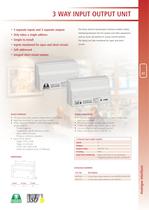
The three channel input/output interface enables simpleinterfacing between the fire system and other equipment such as nurse call systems or access control systems. The inputs are fully monitored for open and short circuits. > 3 Channel input output unit is fixed to a deep double gang back box (supplied)ՕAll connections are via heavy duty terminalsCable entry can be top, bottom, side or rearՕCan be surface or semi recessed mountedRelay contacts are rated at 24V DC 1A DEVICEOVERVIEW ՕAll inputs and outputs operate independently of each otherInputs are monitored for open and short circuits ՕWhen used with DF6000 or DF6100 outputs can be programmed for:-Global triggering -Triggering by specific devices or zones-Delay before activation-Pulsing or continuous operationInput can be used to-Trigger a fire or fault -Trigger on evacuate-Control day/night mode-Isolate pre assigned group of addresses 3 Channel input output monitor DIMENSIONS INSTALLATIONNOTES Inputs 3 Outputs 3 Output rating 24V DC 1A IP rating IP40 Input fault monitoring Open and short circuit monitored(Triggering requires specific resistance) > WHD CATALOGUENUMBERSCat. No.Description > MIO3243 way input/output interface to suit DF6000 & DF6100FXN5103 way input/output interface to suit FX6302 H (mm)W (mm)D (mm) 8915058 Analogue Interfaces size="-4">
Open the catalog to page 1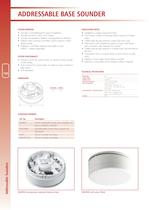
Supply voltage 17 ~ 32 V DC Standby current < 320 uA Operating temperature -10 to +55C (95%RH) Tones (set by panel) Continuous 910HzPulsed 910Hz / 0Hz pulse 1Hz Two tone 610 / 910Hz @ 1Hz cycle > Slow whoop 10240 Sound output @ +/-3dB (set by panel) Low volume : 87dB @ <2mAMedium volume : 93dB @ <3mA High volume : 100dB @ <6mA IP rating IP40 Dia D > Addressable Sounders
Open the catalog to page 3
Weight (Kg) 0.25 Supply Voltage 17 ~ 32 V DC Standby current < 320 uA Operating temperature -10 to +55C (95%RH) Tones (set by panel) Continuous 984HzPulsed 984 / 0Hz pulse 1Hz Two Tone 644 / 984Hz @ 1Hz cycle > Slow whoop 500-1200Hz in 3.5 seconds/0.5secs gap Sound output @ +/-3dB (set by panel) Low volume : 87dB @ <2mAMedium volume : 93dB @ <3mA High volume : 100dB @ <6mA IP rating IP42 >
Open the catalog to page 4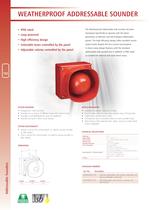
Weight (Kg) 0.57 Supply voltage 17 ~ 32 V DC Cable size/type 0.5 ~ 2.5mm/ FIRETUF, FP200 or MICC Standby current < 320 uA Operating temperature -10 to +55C (95%RH) > Tones (set by panel) Continuous 984HzPulsed 984 / 0Hz pulse 1Hz Two Tone 644 / 984Hz @ 1Hz cycle WD Slow whoop 500-1200Hz in 3.5 seconds/0.5secs gap Sound output @ +/-3dB (set by panel) Low volume : 87dB @ <2mAMedium volume : 93dB @ <3mA High volume : 100dB @ <6mA IP rating IP66 H >
Open the catalog to page 5
Weight (Kg) 0.15 Supply voltage 17 ~ 32 V DC > Cable size 0.5 ~ 2.5mm Recommended cable FIRETUF, FP200 or MICC Lens colour/material Red Polycarbonate Standby current < 250 uA Alarm current < 4.1 mA Flash frequency 1/2 Hz Operating temperature -10 to +55հC (95%RH) IP rating IP54 D >
Open the catalog to page 6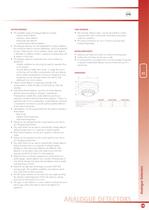
I E O V N E B R O P A S R D S L O SYSTEMOVERVIEW USERINTERFACE The available range of analogue detectors consists:-Optical smoke detector-Ionisation smoke detector-Multi-mode heat detector-Combined photo thermal detectorՕAll analogue detectors are soft addressed for simple installation,this avoids the need for manual addressing, which has potentialfor error. When panel is set to autolearn mode, each detector is allocated an address number in sequence corresponding withits position on the loopAll analogue detectors incorporate short circuit isolators as standard to:-Simplify installation by removing...
Open the catalog to page 8
Analogue addressable optical smoke detector MAP820 FXN723 Analogue addressable ionisation smoke detector MAI810 FXN721 Analogue addressable photo/thermal detector MAOH850 FXN722 Analogue addressable multi-mode heat detectorMAH830 FXN725Common baseMAB800FX720 > Analogue Detectors size="-1">
Open the catalog to page 9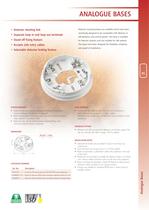
Detector mounting bases are available which have beenspecifically designed to be compatible with Menvier or JSB detectors and control panels. One base is available for Menvier systems and one suitable for JSB systems. The bases have been designed for flexibility, simplicity and speed of installation. > SYSTEMOVERVIEW USERINTERFACE ՕBases incorporate purpose designed shorting link to ensure wiring continuity if a detector is removedBase incorporates a retaining clip to provide positive feedback when detector is correctly fittedՕRetaining clip can be deactivated to achieve fitting with minimum...
Open the catalog to page 10
SYSTEMOVERVIEW SYSTEMFUNCTIONALITY Beam detectors are typically used to replace individual point detectors in large open areas such as warehouses, advantagesinclude:-Single device to install instead of numerous point detectors-Provides single point of maintenance.-Wall mounted for ease of maintenance, especially in warehouses with racking ՕBeam detector is supplied with reflector (single reflector for 50 Metre version and 4 individual reflectors mounted together for 100 Metre version)Beam detector is powered directly from the zone or loop,no additional power supply is requiredՕSimple two wire...
Open the catalog to page 12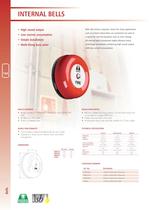
MBM244MBM246/FX006MBM248 Weight (Kg) 0.491.05 1.88 Voltage 24V DC24V DC24V DC Protection polarized polarised polarised & suppressed & suppressed & suppressed Current consumption 25mA 25mA 25mA > Sound Output @ 1M 85/87dBA 92/94dBA 94/96dBA Movement Motor, pinion & Motor, pinion &Motor, pinion & striker strikerstriker D > Finish Stove enamelledStove enamelledStove enamelled >
Open the catalog to page 13
Weight (Kg) 0.49 200104 Voltage 24V DC Protection polarised & suppressed Current consumption 25mA Sound output @1M 95dBA (+/- 2) Movement Solenoid Finish Stove enamelled Dome colour Red IP rating IP54 D >
Open the catalog to page 14
RANGEOVERVIEW - GENERAL INSTALLATIONNOTES All callpoints (Menvier & JSB, analogue and conventional) sharecommon design themesՕStandard components such as replacement glass elements and test keys used throughout for ease of maintenanceSurface, flush and weatherproof versions are available-Various accessories can be ordered to customise the callpoint for particular applications (refer to optional accessories section for full details)ՕAll callpoints are supplied as standard with a frangible glass element and a test key Surface callpoint has standard rear BESA fixing facilities.In addition, back...
Open the catalog to page 16All Cooper Lighting and Safety catalogs and technical brochures
 Cooper EDI Flyer
2 Pages
 Cooper Oil & Gas Brochure
13 Pages
 Cooper ARRA Flyer
2 Pages
 Cooper Stimulus Brochure
5 Pages
 Cooper Green Brochure
5 Pages
 Cooper Mining Brochure
13 Pages
 Lechenti LED
6 Pages
 Lechenti
6 Pages
 RXS LED
8 Pages
 One Cooper
26 Pages
 Micropoint 2
6 Pages
 Linergy II
8 Pages
 LED Solutions
4 Pages
 LED Emergency Solutions
4 Pages
 i-P65
i-P656 Pages
 Guide to Emergency Lighting
8 Pages
 Gladiator LED
4 Pages
 Energy Solutions for Lighting
24 Pages
 Easicheck
8 Pages
 CORE Collection
88 Pages


Archived catalogs
 Lighting Solutions
494 Pages
- LED lighting
- LED floodlight
- AC/AC power supply
- Waterproof lighting
- Outdoor lighting
- IP65 lighting
- Outdoor floodlight
- Storage hall lighting
- Ceiling-mounted lighting
- Tubular lighting
- Light bar
- Surface-mounted lighting
- Emergency lighting
- Suspended lighting
- High bay light
- Rugged lighting
- Fixed bollard
- Office lighting
- Explosion-proof lighting