

- Products
- Catalogs
- News & Trends
- Exhibitions
General catalog RFID 16/17
General catalog RFID 16/17
Contrinex is a Swiss company established in 1972, specializing in sensors for factory automation. It has grown into a multinational group with over 500 employees and more than 15 subsidiaries worldwide, leading in inductive and photoelectric sensors, safety systems, and RFID technology across 60 countries.
Product Categories
- Inductive Sensors: Includes models like Full Inox Basic with IO-Link, Full Inox Weld-Immune, and high-temperature models up to 230°C.
- Photoelectric Sensors: Features contrast sensors with IO-Link, cubic subminiature models, and distance measurement options using triangulation and TOF.
- Safety Systems: Offers type 2 light curtains for hand protection.
- RFID Systems: Provides LF and HF R/W modules, HF tags for high temperatures, and EtherCat interfaces.
Technological Innovations
Contrinex has pioneered innovations like the first inductive sensor with full-metal housing and ASIC technology for sensors, designed for extreme conditions such as high pressure and temperature.
Industry 4.0 and IO-Link
Contrinex sensors are equipped with IO-Link, enhancing data quality and economic installation, crucial for Industry 4.0.
RFID Systems
Branded as ConIdent®, these systems include transponders, Read/Write Modules, and interfaces in low and high frequency technologies, designed for harsh environments.
Applications
Used in washing stations, machine tools, testing lines, and paint shops, Contrinex products enhance automation and reduce human error in challenging conditions.
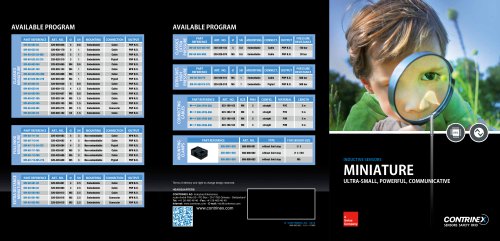
Details various cable products with specifications like type, cable length, and material, including socket straight/plug straight configurations with lengths from 0.3m to 5m, made from PUR and PVC.
Software Overview
The ConID HF-LF software is for demonstration, training, and development, featuring a user-friendly interface with intuitive controls for component access and frame analysis, supporting low and high-frequency operations.
Software Features
The interface includes BUS View, RWM View, TAG View, TREE VIEW, and TOOLBAR, with a working area structured into component attributes, command field, and results box, capturing detailed transaction frames.
RFID Products
Details various RFID products, including transponders and Read/Write Modules, with specifications on temperature ranges, material types, and programming options, available in metal and plastic materials.
Connectivity and Interfaces
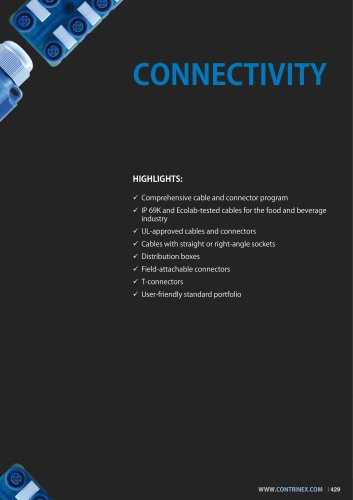
Outlines connectivity options and interfaces, including connectors and command sets, supporting protocols like USB, PROFIBUS-DP, DeviceNet, EtherNet/IP, and more.
Global Presence
Contrinex operates globally with subsidiaries in Europe, Africa, the Americas, Asia, Australasia, and the Middle East, headquartered in Switzerland.
Catalog excerpts

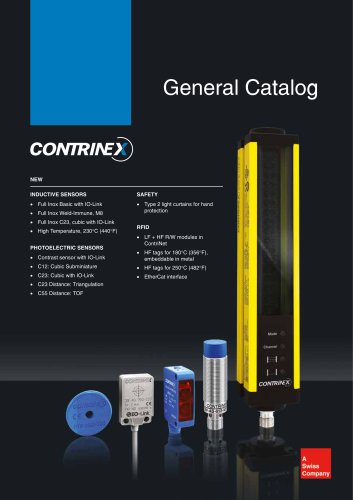
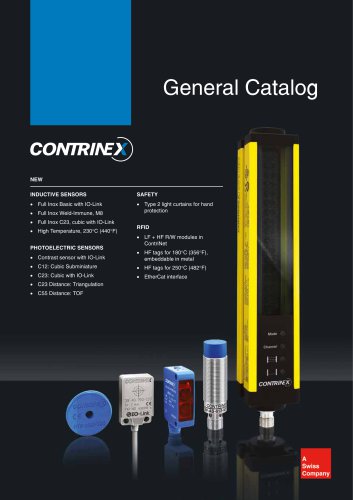
NEW INDUCTIVE SENSORS • Full Inox Basic with lO-Link • Full Inox Weld-Immune, M8 • Full Inox C23, cubic with IO-Link • High Temperature, 230°C (440°F) PHOTOELECTRIC SENSORS • Contrast sensor with IO-Link • C12: Cubic Subminiature • C23: Cubic with IO-Link • C23 Distance: Triangulation • C55 Distance: TOF SAFETY • Type 2 light curtains for hand protection RFID • LF + HF R/W modules in ContriNet • HF tags for 180°C (356°F), embeddable in metal • HF tags for 250°C (482°F) • EtherCat interface
Open the catalog to page 1
INTRODUCTION CONTRINEX Contrinex is a leading manufacturer of sensors for factory automation. The Swiss company, headquartered in Givisiez near Fribourg (CH), has a unique and innovative range of products whose features far surpass those of standard sensors. Since its foundation in 1972 by Peter Heimlicher, Dipl Ing ETH, Contrinex has grown from a one-man operation to a multinational group with over 500 employees worldwide. More than 15 subsidiaries cover the core markets in Europe, Asia, North and South America. At a glance • Technology leading manufacturer of inductive and photoelectric sensors...
Open the catalog to page 2
Intelligent Sensors for the 4th Industrial Revolution: Industry 4.0 Fit for the future with IO-Link Intelligent sensors are the fundamental building blocks of modern smart factories. They enable sensorsupported production resources (machines, robots, etc.) to configure, control, manage and optimize themselves. Precise, reliable sensor data is now more essential than ever. Sensors from Contrinex, the leader in intelligent sensor technology, ensure excellent data quality. To communicate that data, all Contrinex inductive and photoelectric ASIC sensors will be equipped with IO-Link as standard....
Open the catalog to page 3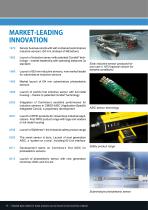
Sensor business starts with self-contained subminiature inductive sensors: Ø4 mm (instead of M8 before) Launch of inductive sensor with patented Condist® technology – market leadership with operating distances 3x standard Launch of Ø3 mm inductive sensors, now market leader for subminiature inductive sensors Market launch of Ø4 mm subminiature photoelectric sensors Launch of world’s first inductive sensor with full-metal housing – thanks to patented Condet® technology Integration of Contrinex’s excellent performance for inductive sensors in CMOS-ASIC (Application-Specific Integrated Circuit),...
Open the catalog to page 4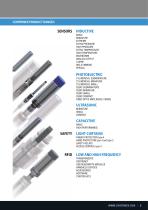
CONTRINEX PRODUCT RANGES SENSORS SAFETY INDUCTIVE BASIC MINIATURE EXTREME EXTRA PRESSURE HIGH PRESSURE EXTRA TEMPERATURE HIGH TEMPERATURE WASHDOWN ANALOG OUTPUT 2-WIRE WELD-IMMUNE SPECIAL PHOTOELECTRIC CYLINDRICAL SUBMINIATURE CYLINDRICAL MINIATURE CYLINDRICAL SMALL CUBIC SUBMINIATURE CUBIC MINIATURE CUBIC SMALL CUBIC COMPACT FIBER-OPTIC AMPLIFIERS, FIBERS ULTRASONIC MINIATURE SMALL COMPACT CAPACITIVE BASIC HIGH PERFORMANCE LIGHT CURTAINS FINGER PROTECTION type 4 HAND PROTECTION type 4 and type 2 SAFETY RELAYS ACCESS CONTROL type 4 RFID LOW AND HIGH FREQUENCY TRANSPONDERS CONTRINET USB READ/WRITE...
Open the catalog to page 5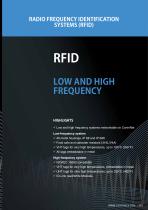
Radio Frequency Identification Systems (RFID) rfid Low and High Frequency Highlights ü Low and high frequency systems networkable on ContriNet Low-frequency system ü All-metal housings, IP 68 and IP 69K ü Food safe and saltwater resistant (316L/V4A) ü VHT tags for very high temperatures, up to 180°C (356°F) ü All tags embeddable in metal High-frequency system ü ISO/IEC 15693 compatible ü VHT tags for very high temperatures, embeddable in metal ü UHT tags for ultra high temperatures, up to 250°C (482°F) ü IO-Link read/Write Modules
Open the catalog to page 7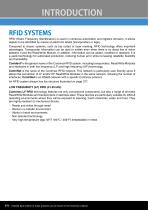
INTRODUCTION RFID systems RFID (Radio Frequency IDentification) is used in numerous automation and logistics domains. It allows objects to be identified by means of electronic labels (transponders or tags). Compared to classic systems, such as bar codes or laser marking, RFID technology offers important advantages. Transponder information can be read or written even when there is no direct line of vision between it and the Read/Write Module. In addition, information can be added, modified or replaced. It is a useful technology for automated production, reducing human error while increasing reliability,...
Open the catalog to page 8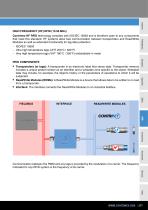
HIGH FREQUENCY (HF) RFID (13.56 MHz) − ISO/IEC 15693 − Ultra high temperature tags (UHT 250°C / 482°F) − Very high temperature tags (VHT 180°C / 356°F) embeddable in metal Transponders (or tags): A transponder is an electronic label that stores data. Transponder memory includes a unique preset number as an identifier and a writeable zone specific to the object. Writeable data may include, for example, the object’s history or the parameters of operations to which it will be subjected. • Read/Write Modules (RWMs): A Read/Write Module is a device that allows data to be written to or read from a...
Open the catalog to page 9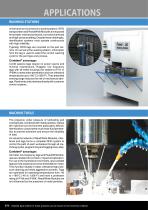
In the harsh environment of a washing station, RFID transponders and Read/Write Modules are exposed to hot water, mechanical shocks, corrosive chemicals and high-pressure jetting. Despite these challenges, identification systems must operate continuously with high reliability. Typically, RFID tags are mounted on the part carriers. On arrival at the washing station, information from the tag is used to select the correct washing cycle for the part type and process. ConIdent® advantages ConID passive tags require no power source and minimal maintenance. Rugged, low frequency tags with all-metal...
Open the catalog to page 10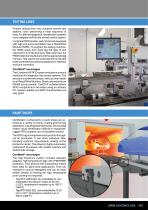
Product testing lines may comprise several test stations, each performing a fixed sequence of tests. For efficient diagnosis, identification systems must integrate well into the overall control system. In a typical RFID system, part carriers are equipped with tags and every test station has a Read/Write Module (RWM). To program the testing machine, the RWM reads from each tag the type of test required for an individual part. After each test, the RWM writes the results back into the appropriate tag memory. Test reports are automatically forwarded to the controller for product acceptance or rejection and...
Open the catalog to page 11All CONTRINEX catalogs and technical brochures
 RFID Catalog
64 Pages
 Safety Catalog
48 Pages
 Program Overview
20 Pages
 General catalog Opto 16/17
135 Pages
 General Catalog 2016-2017
493 Pages
 General catalog Inductive 16/17
168 Pages
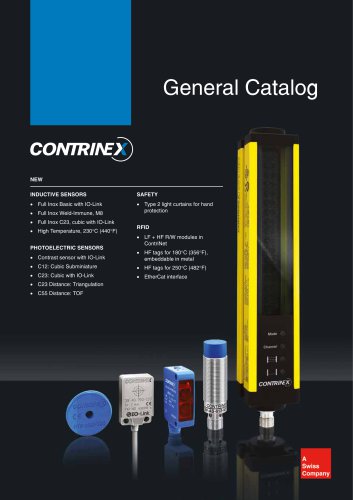 General catalog Capacitive 16/17
32 Pages
 General catalog Safety 16/17
50 Pages
 General catalog Glossary 16/17
21 Pages
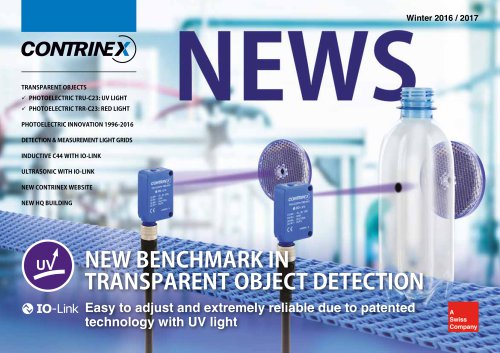 News catalog winter 16/17
28 Pages
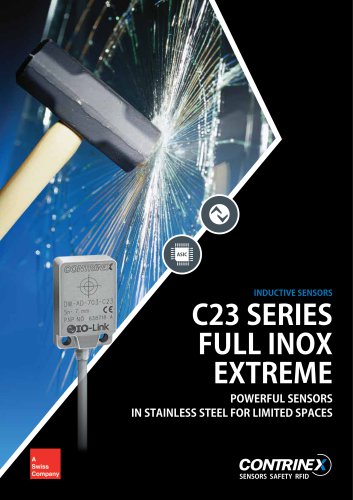 Inductive Extreme Flyer
2 Pages
 LTS-4050-101
3 Pages
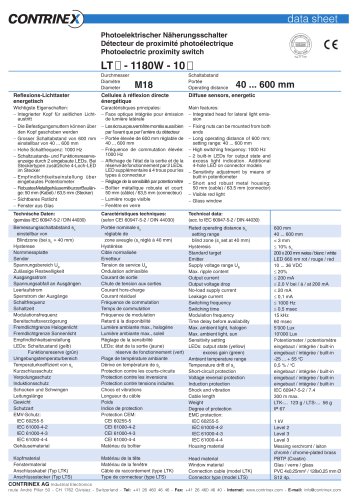 LTK-1180W-101
2 Pages
 LTK-1120-301
2 Pages
 LTK-1040-301
2 Pages


Archived catalogs
 Winter 2012 / 2013 NEWS
16 Pages
 Sensor-Tester
2 Pages
 Multi-beam synthetic fiber
2 Pages

- Data connector
- Rectangular housing
- Metal connector
- Proximity switch
- Metal box
- IP67 connector
- Cylindrical proximity sensor
- Inductive proximity sensor
- Cable connector
- IP67 proximity sensor
- Straight connector
- Compact housing
- DC proximity sensor
- Nickel-plated brass connector
- Voltage connector
- Power distribution box
- Rectangular photoelectric sensor
- Right-angle electrical connector