

OTR

OTR
This document provides detailed information on Continental's off-the-road (OTR) tire range, emphasizing the importance of correct tire inflation and adherence to load and speed limits for safety and longevity. The tires comply with international standards such as ETRTO, TRA, JATMA, and ISO.
Standards and Compliance
Continental's OTR tires meet international standards for load capacity and inflation pressure. In case of discrepancies, the most suitable standard is applied.
Legal Disclaimer
The information is for informational purposes only and subject to change. Continental disclaims any warranties and liabilities related to its use.
OTR Tire Portfolio
The portfolio includes tire solutions for material handling and earthmoving, with a vehicle matrix detailing preferred tire applications.
Classification of OTR Tires
This section covers tire measurements, markings, load index, and speed symbols, indicating maximum load and speed capabilities.
Tire Construction
Details on radial, cross-ply, and V.ply tire constructions are provided, highlighting performance differences.
Port and Material Handling Tires
Information on V.ply tires for port and material handling applications is included, with technical data.
Underground Mining, Surface Mining, and Construction Tires
This section introduces tires for mining and construction, providing technical data for earthmoving tires.
OTR Tire Maintenance and Care
Guidelines for tire maintenance, including wear measurement, pressure maintenance, and regrooving, are provided.
Conclusion
Continental's OTR tires are designed for high performance and durability. Proper maintenance is crucial for optimizing performance and reducing costs.
The document outlines the load index (LI) for tires, specifying load capacity in kilograms and pounds. It emphasizes that service conditions and speeds affect this capacity. The load index ranges from 1 to 252.
Speed Ratings
Speed symbols indicate the maximum speed a tire can handle, ranging from 5 km/h to 300 km/h.
Classification of OTR Tires
OTR tires are classified based on carcass strength, using star and ply ratings. A stronger carcass allows for higher load capacity.
Dual Marked Tires
Some tires are dual marked for broader applications, with different load indices and speed symbols.
TKPH/TMPH Rating
This rating measures the working capacity of OTR tires, indicating heat generation and dissipation.
Tire Construction
The document compares radial and cross-ply tire constructions, highlighting the benefits of each.
Performance Matrix
A performance matrix compares radial and V.ply tires across various criteria.
V.ply tires offer better traction and stability, while radial tires provide better fuel economy. V.ply tires have a wider bead, reducing stress on rim components.
Solid Tire Construction (TeleMaster)
The construction includes a wear-resistant tread, protective sidewalls, and a base with embedded wire cores.
Port & Material Handling Tires
Continental offers a range of tires for challenging environments like ports, tailored for specific applications.
Material Handling - OTR V.ply
Specifications and load capacities for various tire models are provided.
Earthmoving Tires
Continental's Earthmoving tire range is designed for mines, quarries, and construction sites.
Surface Mining / Construction Tires
EM-Master and RDT-Master tires are designed for loaders and dump trucks, offering features like deep tread designs.
Abnormal Wear and Repairs
Abnormal wear indicates maintenance issues and should be investigated. Repairs should be conducted by qualified experts.
Effects of Incorrect Inflation
Incorrect inflation reduces tire service life and increases costs.
Pressure Maintenance
Regular pressure checks are essential to maintain correct air pressure.
Digital Monitoring Systems
ContiPressureCheck and ContiConnect systems provide real-time monitoring of tire pressure and temperature.
Regrooving of Tires
Regrooving extends tire life and should be performed by qualified personnel.
Rims and Rim Maintenance
Proper rim selection and maintenance are crucial for tire performance.
Catalog excerpts

Off-The-Road Tires Technical Data Book
Open the catalog to page 1
Preface This data book contains comprehensive information on our off-the-road (OTR) tire range. We recommend that the inflation pressure of every tire is checked and adjusted regularly. Wrong inflation pressure, greater loads or higher speeds than those recommended by the vehicle or tire manufacturer may shorten the service life of the tire or may result in premature failure. These instructions must be followed if tire and vehicle safety is to be guaranteed. For further information, please see our safety instructions. Continental’s OTR tires are produced in accordance with internationally accepted...
Open the catalog to page 2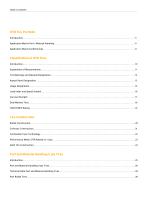
Technical Data Port and Material Handling Tires____ Port Radial Tires
Open the catalog to page 3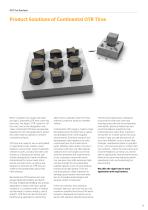
When conditions are rough and loads are high, Continental OTR tires come into their own. The letters "OTR” stand for "off the road”, and as this designation indicates, Continental OTR tires are specially designed for off-road applications, where they often have to operate on uneven, unfinished surfaces. OTR tires are made for use on articulated or rigid dump trucks, loaders, reach stackers, various other types of specialty vehicles in ports, construction sites, and surface or underground mining. Specifically developed for harsh conditions characterized by heavy loads, sharp stones, and hard rocks,...
Open the catalog to page 5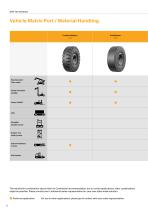
The vehicle/tire combination above refers to Continental recommendation, but in certain applications, other combinations might be possible. Please consult your Continental sales representative for your own tailor-made solution. Preferred application For use in other applications, please get in contact with your sales representative
Open the catalog to page 6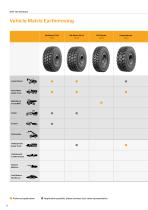
Vehicle Matrix Earthmoving EM-Master E3/L3 Radial Articulated Dump Truck Rigid Dump Truck (RDT) RDT-Master Radial DumperMaster Radial Underground Dump Truck Underground Loader (Scoop) Support Machine Coal Haulers Shuttle Car b Application possible, please contact your sales representative.
Open the catalog to page 8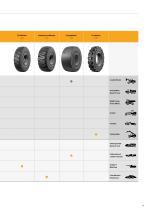
DrillMaster V.ply UndergroundMaster V.ply ScoopMaster V.ply TeleMaster Solid Articulated Dump Truck Rigid Dump Truck (RDT) Underground Dump Truck Underground Loader (Scoop) Support Machine Coal Haulers Shuttle Car
Open the catalog to page 9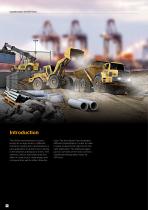
Introduction The off-the-road business is characterized by a huge variety of different machines ranging from reachstackers in port application to dump trucks running in the deepest underground mines. This diversity calls for specialized tires that differ in construction, tread design and compounds as well as other characteristics. The tire industry has developed different classifications in order to make it easier to identify the right tire for the right application. The following pages give an overview of the most common classification/designation types for OTR tires.
Open the catalog to page 10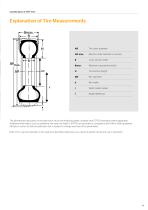
Explanation of Tire Measurements Bmax. Tire section height Rim diameter Static loaded radius Maximum operational width Cross section width Max tire outer diameter in service Tire outer diameter Radial deflection The dimensional data given in this data book and in the following tables complies with ETRTO standards where applicable. Additional information, such as additional tire sizes not listed in ETRTO, are provided in compliance with DIN or WdK guidelines. All data is correct at date of publication but is subject to change and cannot be guaranteed. Note: The in-service diameter is the maximum...
Open the catalog to page 11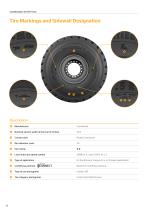
Tire Markings and Sidewall Designation Nominal section width of the tire (in inches) 29.5 Star rating Load index and speed symbol E3 (Earthmover transport) or L3 (Loader application) Manufacturer Continental Tire category (pictogram) Construction/Earthmover Radial Constuction
Open the catalog to page 12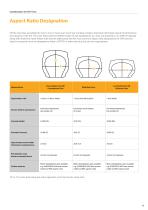
Off-the-road tires are labeled for size in one or more ways. Each size marking contains important information about the dimensions and capacity of the tire. The chart below lists the different types of size designations you may see stamped on an OTR tire sidewall along with what they mean. Please note that the table below lists the most common aspect ratio designations for OTR tires but doesn't necessarily show all designations listed in ETRTO or other technical tire and rim organizations. 70' or 75' series tires follow the same approach as for the the 65' series tires.
Open the catalog to page 13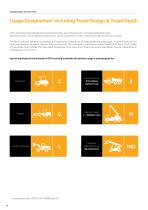
Usage Designation* including Tread Design & Tread Depth Some tires have dual-markings which indicate that they were developed for a broader application range (example: E and L on the sidewall means the tire can be used both for OTR machines like ADTs but also for loaders). The letter codes are followed by a number that represents a special kind of tread design and tread depth. In general there are five basic tread designs: Rib, Block, Traction, Rock, and Smooth. The tread depth is defined as regular tread (100%) Deep Tread (150%) or Extra Deep Tread (250%). The tread depth designation is an index...
Open the catalog to page 14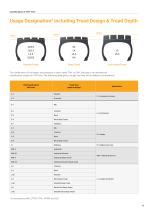
Regular Tread Deep Tread 250% -5 Extra Deep Tread The combination of the letters and numbers is often called TRA- or EM-Code and is an international classification system for OTR tires. The following table gives a rough overview of the different combinations. TRA Classification/ EM-Code*
Open the catalog to page 15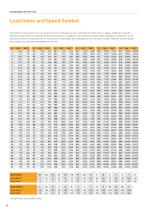
The maximum load which can be carried by a tire is indicated by the Load Index (LI). This tire LI is always related to a specific reference speed which is indicated by the Speed Symbol. In addition to the reference speed other application conditions can be specified by the tire manufacturer. It is important to understand that changing service conditions and/or different vehicle speeds may impact the load-carrying capacity of the tire.
Open the catalog to page 16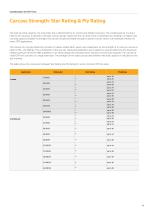
The load-carrying capacity of a pneumatic tire is determined by air volume and inflation pressure. The compressed air in a tire is held by the caracass. In general a stronger carcass design means the tire can hold more compressed air, resulting in a higher load carrying capacity. Despite its strength, the carcass should be flexible enough to absorb shocks, which is an essential criterion for many OTR applications. The carcass of cross-ply (bias) tires consists of rubber-coated fabric layers, also called plies, so the strength of a Cross-ply carcass is rated in PRs - Ply Ratings. The combination...
Open the catalog to page 17All Continental Tires catalogs and technical brochures
 ContiRV20 All Season
2 Pages
 Port
Port17 Pages
 Tubeless Sealing Ring
6 Pages
 Enhanced by expertise
17 Pages
 Industrial Pneumatic Tires
20 Pages
 Continental Solid Tires
24 Pages
 Off-The-Road Tires
48 Pages
 Continental Earthmover Tires
28 Pages


