
- Catalogs
- Continental Disc Corp.
- Composite Flat Seat Rupture Disc

Composite Flat Seat Rupture Disc

Composite Flat Seat Rupture Disc
The document discusses two types of rupture discs: MICRO X and Composite, which are safety devices designed to protect systems from overpressure by bursting at a predetermined pressure.
MICRO X Rupture Disc:
This disc features a flat seat, cross-scored design for a full, non-fragmenting opening pattern, with a smooth inlet surface to resist corrosion.
Composite Rupture Disc:
Used with a Unisert Holder, it includes a metallic top section and seal, featuring a patented seven-hole design for non-fragmenting performance across various pressures.
UNISERT Assembly:
A rupture disc holder that enhances sealing capabilities and accommodates both MICRO X and Composite discs, allowing flexibility without replacing the holder.
Installation Features:
Includes alignment pins, a J-Hook for orientation, a stainless steel nameplate, and flow direction tags for correct installation verification.
Material and Temperature Specifications:
Available in materials like 316 Stainless Steel, Monel, Nickel, and Inconel, with specified maximum temperature limits for proper selection.
Pressure Ranges and Burst Tolerances:
Tables outline burst pressures and tolerances for MICRO X and Composite discs, ensuring precise performance.
Additional Features:
Protective liners, rings, and vacuum supports enhance durability and performance in corrosive or vacuum conditions.
Specifications:
Burst pressure ratings and manufacturing ranges are detailed, with adjustments for pressures below and above 50 psig. Special reduced ranges are available upon request.
B.D.I.® Alarm System:
Provides immediate notification of pressure relief, compatible with various designs, and triggers alarms upon disc rupture.
Code Compliance:
Manufactured in compliance with codes like ASME, DIN, EN, BSI, and JIS, with authorization to use the ASME Code Symbol Stamp.
Flow Performance Certification:
Certified by The National Board of Boiler and Pressure Vessel Inspectors, with an ASME accepted flow laboratory for testing.
Holder Specifications:
Ordering details include quantity, size, bolting class, material, and options, with a design that protects the disc during installation.
Quality Assurance/Documentation:
Includes ASME Code tests, special cleaning, packaging, tagging, temperature testing, and material test reports.
Operating Specifications:
Details required include maximum allowable working pressure, operating pressure and temperature, vacuum/backpressure, cycle conditions, and media type.
Contact Information:
Contact details for Continental Disc Corporation's headquarters and international offices are provided.
Catalog excerpts
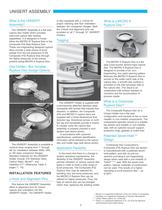
is also equipped with a J-Hook for proper indexing and flow orientation between the companion flanges. Both the J-Hook and alignment pins are provided on all 1" through 12" UNISERT Holders. > The UNISERT Assembly is a flat seatrupture disc holder which provides improved rupture disc sealing capabilities. It is designed to house either the MICRO X > Rupture Disc or theComposite Flat Seat Rupture Disc. These non-fragmenting designed rupture discs provide a wide choice of burst ratings from the low pressures of the Composite (FS) Rupture Disc through the higher pressures of the scored positive acting...
Open the catalog to page 2All Continental Disc Corp. catalogs and technical brochures
 HPX-Ta™ Rupture Disc
2 Pages
 SANITRX HPX® II
2 Pages
 SANITRX® LPX
2 Pages
 WMP Welded Muffled Plug
4 Pages
 B.D.I.®
8 Pages
 Burst Rating Types
4 Pages
 BDI-FLX ™
8 Pages
 Heat Shields Datasheet
2 Pages
 General Conversion Tables
2 Pages
 ENVIRO GUARD®
2 Pages
 Emergency Services Leaflet
2 Pages
 Composite Type Rupture Disc
14 Pages
 CFR & CFS Formed Vent Panels
2 Pages
 CERTIFLOW®
4 Pages
 CDC PRODUCT SELECTION GUIDE
24 Pages
 BDI-FLX
8 Pages
 STAR X® Rupture Disc
20 Pages
 HPX
HPX24 Pages
 UNISERT® ASSEMBLY
12 Pages
 Standard Type
10 Pages
 SANITIX LPX ENG
2 Pages
 V R D
V R D8 Pages
 Union Holder
2 Pages
 PRE-TORQUED HOLDER ASSEMBLY
2 Pages
 PIPE END COVERS
2 Pages
 Pressure Relief Products
8 Pages
 CERTIFLOW ®
4 Pages
 PRODUCT SELECTION GUIDE
20 Pages
 SANITARY FITTING ASSEMBLY
10 Pages
 ICON™ Rupture Disc
2 Pages
 Tanksert Rupture Disc
2 Pages


Archived catalogs
 BURST DISC INDICATOR
8 Pages
 ENVIRO-SEAL™ Rupture Disc
14 Pages
 Composite 30° Seat Rupture Disc
14 Pages
 CFR & CFS Vent Panels
2 Pages
 LOTRX® Rupture Disc
6 Pages
 VENT PANELS
12 Pages


- Displacement transducer
- Metal stand
- Linear displacement sensor
- Steel bracket
- Potentiometer displacement sensor
- Inductive displacement sensor
- Metal rupture disc
- Inverted rupture disc
- Stainless steel rupture disc
- Draw-wire displacement sensor
- Low-pressure rupture disc
- Flange holder
- Explosion vent panel
- Reverse acting rupture disc
- Alarm panel
- Forward acting rupture disc
- High-pressure rupture disc
- Flexible displacement sensor