
- Catalogs
- CONTA-CLIP Verbindungstechnik GmbH
- Electrical and electronic cabinet components


- Company
- Products
- Catalogs
- News & Trends
- Exhibitions
Electrical and electronic cabinet components

Electrical and electronic cabinet components
- Functional Relays: Includes various types such as multi-function timing relays, undervoltage monitoring relays, and star-delta switching relays.
- Opto-Couplers and Solid-State Modules: Features opto-coupler modules, solid-state output modules, and solid-state relays.
- Interface Modules: Offers a variety of interface modules including RJ45, USB, and SD modules.
- Converter Units: Covers temperature, voltage, and current converter units, as well as multi-function signal converter units.
- Accessories: Includes locking-base systems, fuses, and other essential components.
- Comprehensive product line for various applications in industrial automation, building automation, and more.
- Innovative connection technologies including push-in, screw, and tension-spring systems.
- Customizable solutions for specific customer needs.
- Short-circuit safe outputs
- LED indicators for operational status
- Various output voltages and current strengths available
- Compact design suitable for different mounting configurations
1. Output current up to 0.5 A with short-circuit safe output.
2. LED indicator for operational status.
3. Output voltage can be fixed or variable, with an accessible adjustment mechanism.
4. Input voltage requirements depend on the set output voltage: minimum input voltage is Uout + 5 V, and maximum is Uout + 8 V.
1. CONTA-PROTECT overvoltage protection complies with VDE 110-1, IEC 61643-1, EN 61643-11, and VDE 0185 sect. 100 standards.
2. CP V 40 and CP VH 40 arresters provide reliable protection with remote signaling and integrated monitoring.
3. CDS 98 arresters offer protection for supply lines within switchgear and cabinets, signaling overload with an LED.
4. Type 2 (C) and Type 3 (D) arresters are available, with various technical specifications including rated voltage, discharge current, and protection level.
1. Relay technology is crucial for industrial control and automation, offering secure electrical isolation and contact multiplication.
2. Interface Relay Compact (IRC) and Multi-function timing relay (MFR) provide space optimization, ease of use, and functionality.
3. PRC and PRS relay couplers offer compact designs with various connection options and coil voltages.
4. RM and RIM relay modules provide pre-wired circuit tracks and toggle switches for manual, off, or automatic modes.
The document provides detailed technical specifications and features of the PRC and PRS relay systems by CONTA-ELECTRONICS. These systems are designed for integration into various electrical applications, offering modular and versatile relay bases that can be mounted on standard TS 35 DIN rails.
Key Features
- Socket Base: The relay bases are designed for easy mounting and dismounting, featuring high-quality connection terminals available in screw or tension-spring systems. They include integrated EMC coil circuitry and LED indicators.
- Relay: The relays offer load-independent switching, high interference immunity, and electrical isolation of control and load circuits. They are available with AgNi 90/10 contacts and feature minimal contact resistance.
- Pluggable Modules: These modules provide easy insertion with reverse-connect protection and are effective in parallel to the coil of the deployed relay.
Specifications
- Insulation Data: The relays have a dielectric strength of up to 5000 Veff and are designed with strengthened insulation for coil-contact arrangements.
- Environmental Conditions: The relays operate within an ambient temperature range of -40 to +85°C and are rated for a contamination degree of 3.
- Contact Data: The relays support a reliable range of operating voltages and have a contact lifespan under 250 V AC resistive load.
- Coil Data: The DC version relays have specified rated operating ranges and resistances, ensuring efficient performance.
Applications and Approvals
The relay systems are suitable for various applications, with approvals from UL/CUL and compliance with IEC and VDE standards. They are designed for easy integration into existing systems, providing reliable and efficient performance.
- Insulation and Flammability: Insulation complies with IEC 664/VDE 0110, rated voltage 250 V, contamination degree 3, overvoltage category III, and flammability class UL 94 V-0.
- Test Voltage: Coil/contact test voltage is 5 kV.
- Pinning: 5 mm pinning is standard.
- Operating Temperature: Ranges from -40 to +70 °C.
- Input Voltage: Options include 12 V DC, 24 V DC, 48 V DC, and 60 V DC.
- Power Consumption: 0.40 W for DC inputs and 0.75 VA for AC inputs.
- Contacts: Available in 2 CO and 4 CO configurations.
- Switching Voltage: 250 V AC with a maximum of 440 V AC.
- Current Ratings: Max continuous current is 8 A with an inrush current of 15 A for 2 CO, and 6 A with an inrush current of 12 A for 4 CO.
- Response Time: Typical response time is 7 ms with a release time of 2 ms for 2 CO, and 15 ms/10 ms for 4 CO.
- Contact Material: AgNi 90/10.
- Electrical Lifespan: 1.5 x 10⁵ operations at specified load.
- Mechanical Lifespan: Greater than 30 x 106 operations.
- Mounting: Suitable for DIN rails TS 35.
- Connection Type: Screw connection with a maximum screw torque of 0.8 Nm.
- Protection Degree: IP 20 enclosure.
- Approvals: UL/CSA certified.
- Insertion Module: PRS LED with status display and free-wheel diode, protected against polarity reversal.
- Socket Base: PRS 2 and PRS 4 types available.
- Holding Clip: PRS C 1/2 and PRS C 4 types available.
1. General Specifications:
- Relay modules are designed to mount on TS 32/TS 35 rails with screw connections.
- They feature an LED for indicating the switching status and are available in soldered or pluggable designs.
- The modules comply with DIN VDE specifications, including DIN EN 50178 and DIN VDE 0110, with a contamination degree of 2 and overvoltage category III.
- Operating temperature ranges from -20 to +50 °C, with a stripping length of 7 mm and connection cross-section of 0.2 – 2.5 mm²/AWG 22 – 14.
2. Relay Modules 1 CO RM L:
- Power relay with a capacity of 16 A, available in various input voltages (24 V DC, 24 V AC/DC, 48 V DC).
- Maximum switching voltage is 250 V AC, with a continuous current of 16 A and inrush current up to 80 A for 20 ms.
- Contact material is primarily AgNi 90/10, with a mechanical lifespan exceeding 10 million operations.
3. Relay Modules 1 CO Contact RIM:
- These modules include free-wheel and reverse-polarity protection diodes.
- Available in various input voltages (12 V DC to 230 V AC) with a power consumption of 0.6 W to 1.0 VA.
- Maximum power rating is 2000 VA at 250 V AC, with a mechanical lifespan over 10 million operations.
4. Relay Modules 1 CO Contact RIM S:
- Features a switch for Manual/Off/Automatic operation.
- Available with or without a feedback loop, and gold-plated contacts are optional.
- Similar electrical specifications to the RIM series, with a focus on manual control.
5. Relay Modules 1 CO Contact RIM-16 A:
- Designed for higher power applications with a 16 A power relay and an inrush current capacity of 80 A.
- Offers manual control options and is available in both soldered and pluggable designs.
6. Relay Modules 2 CO Contact RIM:
- These modules feature two changeover contacts (2 CO) and similar protective features as the 1 CO versions.
- They are designed for applications requiring dual contact switching capabilities.
The document outlines the specifications for various relay modules, including test voltage, pinning, operating temperature, stripping length, and connection cross-section. The relays are categorized under overvoltage category III with a test voltage of 4 kV. The operating temperature ranges from -20 to 50 °C, and the connection cross-section is 0.2 – 2.5mm²/AWG 22 – 14.
Relays are available with input voltages of 24 V DC, 48 V DC, 115 V DC, 24 V AC, 115 V AC, and 230 V AC. Power consumption is consistent at 0.5 W for DC and 1.0 VA for AC. Each relay has a maximum switching voltage of 250 V AC/DC and a maximum continuous current of 4 A with an inrush current of 8 A. The contact material is AgNi, and the mechanical lifespan exceeds 10 million cycles.
Modules are available with 2, 4, 8, and 16 relays, each with 2 CO contacts. The dimensions and weight vary depending on the number of relays, with the largest module (16 relays) measuring 87 x 293 x 72 mm and weighing up to 764 g.
Functional relays are designed for automation engineering applications, offering features like multi-function timing, undervoltage monitoring, and voltage monitoring. The MFR series provides various timing functions such as ON-delay, impulse-ON, and OFF-delay, with adjustable time settings.
The relays operate within an ambient temperature range of -25 to +55 °C and can be stored or transported between -25 to +70 °C. They are designed to withstand relative humidity from 15% to 85% and have a vibration resistance of 10 to 55 Hz.
The GSM-PRO2 module offers remote control and maintenance solutions via 2G/3G networks, allowing monitoring and control of decentralized facilities through SMS or email notifications. It supports digital and analogue inputs and can be configured using mobile apps.
The document describes various types of relays and their specifications. The housing is made of self-extinguishing plastic with IP40 protection, allowing for any mounting position. Screw connections are protected against accidental contact, complying with VBG 4 standards, and offer IP20 protection. The screw connection specifications include various wire sizes and a maximum torque of 0.5 Nm.
Environmental Conditions:
The relays operate within an ambient temperature range of -20 to +50 °C and can be stored between -40 to +70 °C. They function in relative humidity levels of 25% to 75% and have a contamination degree of 2.
Functional Descriptions:
The document details several relay functions, including ON delay, Impulse-ON with control contact, F-flip-flop, Flasher begin with delay, OFF-delay with control contact, Impulse-OFF with control contact, and Impulse-ON voltage controlled. Each function is described with the behavior of LEDs indicating the status of the supply voltage and output relay.
Relay Types and Functions:
- MFR 7: Includes functions like E, R, Ws, Wa, Bp, F, Wu, with time ranges from 50 ms to 10 h. It has a green LED for supply voltage indication and a yellow LED for output relay status.
- MFR 6: Features functions like Ip and Ii, with time ranges from 50 ms to 100 h. It includes a wide-range input and a potential-free CO contact.
- USR 1 and USR 2: These are undervoltage monitoring relays for three-phase AC mains, with fixed or variable switching thresholds and a fixed hysteresis.
General Information:
The relays are designed for mounting on TS 35 rails and have a mechanical lifespan of up to 20 million switching cycles. They are rated for various voltages and have specific switching capacities, with detailed accuracy and tolerance specifications.
Protection and Safety:
The relays are designed with overvoltage category III protection and rated impulse voltages of 4 kV. They are built to withstand environmental conditions such as vibration and shock resistance as per IEC standards.
- Supports various wire sizes with and without wire-end ferrules.
- Maximum torque is 1 Nm.
- Upon applying supply voltage, the star protection relay activates, indicated by a yellow LED.
- The star time begins, shown by a flashing green LED, and upon expiration, the delta protection relay activates.
- To restart, the supply voltage must be interrupted and reapplied.
- Operating temperature ranges from -25 to +55 °C.
- Storage and transportation temperatures range from -25 to +70 °C.
- Relative humidity is between 15% to 85%.
- Vibration and shock resistance are specified according to IEC standards.
- Star-delta start-up with time ranges for star and transit times.
- Supply voltage ranges from 12 to 240 V AC/DC.
- Output circuit includes potential-free CO contacts with specific voltage and switching capacities.
- Monitors phase sequence, asymmetry, and phase loss in three-phase systems.
- Provides protection against incorrect phase rotation and phase loss.
- Includes features for monitoring undervoltage and window functions.
- Monitors phase loss and sequence with adjustable thresholds.
- Detects neutral wire breakage and phase voltage irregularities.
- Includes a compact design with IP40 protection.
- GSM-PRO2 modules allow for increased inputs and outputs.
- Provide remote control and maintenance solutions via 4G connectivity.
- Inputs and Outputs: GSM-PRO2 has two multi-functional inputs, a relay output, and a pulse counter input. GSM-PRO2E has ten multi-functional inputs, four relay outputs, and a pulse counter input capable of processing up to 1000 pulses per second.
- Communication: The modules can connect to a PLC using a Modbus RTU interface, allowing for expanded GSM functionality and remote control capabilities.
- Web Portal: A web-based portal software allows for centralized monitoring and control of all modules in the field.
- OTA Capabilities: The modules support over-the-air configuration and firmware updates, enabling remote adjustments and updates.
- Smartphone Apps: iPhone and Android apps provide an intuitive interface for monitoring and controlling the modules.
- Dimensions and Weight: GSM-PRO2: 95 x 36 x 67 mm, 135 g; GSM-PRO2E: 95 x 88 x 67 mm, 188 g.
- Input/Output Specifications: Multi-function inputs support 0-10 V, 0(4)-20 mA, and 24 V DC. Relay outputs have a maximum switching capacity of 1200 VA at 240 V AC.
- GSM Specifications: Supports 2G, 3G, and 4G frequency bands with a nano SIM card and SMA plug antenna.
- Environmental Conditions: Operating temperature range is -20°C to +50°C, with a maximum relative humidity of 80%.
The document provides detailed information on various solid-state modules and opto-couplers designed for industrial applications. These components are characterized by their compact design, high power ratings, and secure electrical isolation, making them suitable for automation engineering.
Solid-State Compact PSC
The PSC Solid-State Compact features a slim design (6.2 mm) and can handle a continuous current of 2 amps. It is available in eight variants with different wire connection options and input voltages ranging from 24 to 60 VDC and 240 VAC. The modules support the AQI cross-connection system for potential distribution and offer customizable labeling options.
Opto-Coupler Modules OKI
OKI modules are available with four or eight switching channels and support output voltages between 5 and 48 V. They feature an LED for switching status indication and a standard transmission frequency of 100 Hz, with higher frequencies available upon request.
Solid-State Relays SSR & Base SSOIF
These modules are designed for high output currents up to 3 A, with short-term surges up to 5 A. They ensure electrical isolation and feature integrated safety fuses and LED status indicators. The SSOIF base supports mounting on standard TS 32 and TS 35 DIN rails.
Specifications
The document includes detailed specifications for various modules, including input and output specifications, rated voltages, power ratings, and operating temperature ranges. It also provides information on the construction and mounting options for the modules.
Additional Features
The modules offer flexible mounting options, user-friendly design for easy relay replacement, and high-quality connection terminals. They are available with either screw or tension-spring connection systems.
Approvals and Standards
The components comply with relevant DIN VDE specifications and are designed for use in environments with specific contamination and overvoltage categories.
- Solid-State Relays: The G 4 generation relays are pluggable with integrated LED indicators and removable fuses. They operate within a voltage range of 5-60 V DC or 24-280 V AC, with a maximum current of 3 A at 45°C and 2 A at 70°C.
- Fuse Modules: SM fuse modules are available with three or six micro-fuse receptacles, suitable for 5x20 fuse cartridges. They can be mounted on TS 32/TS 35 rails and feature screw connections.
- Component Modules: BSM modules have two rows of solder pins for versatile assembly with components. They are designed for operating voltages up to 250 V AC and a maximum current of 5 A.
- Diode Modules: DM modules are used for protection against reverse polarity, decoupling, and arc suppression. They support a maximum operating voltage of 250 V AC/DC and a diode reverse voltage of 1000 V.
- Lamp Test Modules: LPM modules detect and decouple group status messages, featuring diodes connected in pairs for visual indication of switching or signal status.
- All modules comply with DIN EN 50178 and DIN VDE 0110 standards, with a contamination degree of 2 and overvoltage category III.
- Operating temperature for most modules ranges from -20 to +50°C, with a stripping length of 7 mm and connection cross-section of 0.2 – 2.5 mm².
- Available in shielded and unshielded designs.
- Features include type A and type B USB connections.
- Specifications include a width of 47 mm, operating temperature range of -20 to +50 °C, and a test voltage of 0.75 kV.
- Connection data includes input voltage of 125 V AC/DC, rated current of 1 A, and a maximum cable length of 100 m.
- Mounts on TS 32/TS 35 with screw or tension-spring connections.
- Available in male and female versions with module versions ranging from 9 to 50 connections.
- Operating temperature range is -20 to +50 °C with a test voltage of 0.67 kV eff.
- Includes LED display and protection against polarity reversal for certain models.
- Mounts on TS 35 with screw or tension-spring connections.
- Module versions range from 10 to 64 connections.
- Specifications include a test voltage of 0.67 kV eff and an input voltage of 125 V AC/DC.
- Compatible with ELCO 8016 series.
- Available in left and right versions with an offset arrangement to avoid interference with neighboring modules.
- Specifications include a test voltage of 0.8 kV and an operating temperature range of -20 to +55 °C.
- Designed for signal exchange in various industrial applications.
- Standardized signal strengths include current levels from 0 to 20 mA and voltage levels from 0 to 10 V.
- Signal converters are available in thin form factors for space-constrained environments.
- Designed to convert signals from field sensors to standard signals for controllers.
- Features include selectable conversions (current, voltage, frequency) and three-way electrical isolation.
- Includes a digital output for alarm indication.
- Available in open-mounting profiles for TS 35 and TS 32 DIN rails.
- Supports conversions for voltage, current, and potentiometric signals.
- Converts PT100 resistance thermometers to standard analogue signals.
- Features adjustable output signals and accessible OFFSET and SPAN settings.
- Available for various temperature ranges from -50°C to +400°C.
- Supports multi-channel thermocouple input and multi-function analogue output.
- Features adjustable temperature conversion and limit-value relay with setpoint and hysteresis.
- Handles thermocouple inputs according to EN 60584 standards.
- Offers selectable cold junction compensation and adjustable output signals.
- Converts standard analogue signals with three-way input and output options.
- Features adjustable signals via DIP switch and accessible OFFSET and SPAN settings.
- Provide multi-function analogue input and output with adjustable signal conversion.
- Offer features like signal doubling, inverting, and two-channel conversion.
- DIN VDE and CE compliance for electromagnetic properties and protection class IP 20.
- Operating temperature range from -20°C to +55°C.
- Power supply typically 24 V DC with variations depending on the model.
The document outlines the specifications for various electronic converter units, adhering to DIN EN 50178:1987 and DIN VDE 0110 standards, with a contamination degree of 2 and overvoltage category III. The units are CE compliant and operate within a temperature range of -20 to +55 °C. They feature pluggable screw connections with a stripping length of 7 mm and support connection cross-sections from 0.2 to 2.5 mm² (AWG 22-14).
Electrical Characteristics:
The converters have a transmission error of less than 0.5% of the end value and a temperature coefficient of less than 0.02%/°C. They are powered by a 24 V DC supply with varying current requirements depending on the model. Insulation voltage between input/output and power supply/signal is 1 kV, 50 Hz for 1 minute.
Functional Capabilities:
The units offer functionalities such as signal doubling, inverting, and 2-channel conversion. Input and output signals are adjustable via DIP switches, with initial settings typically ranging from 0 to 10 V or 0 to 20 mA. Load resistances and offset values are specified for both voltage and current outputs.
Product Variants:
Several product types are detailed, including CMS-I10A-UI, CMS-UI-R, CMS-F-UI, CML-POT-UI, and CAE series, each with specific features like multi-function analogue outputs, relay outputs, and potentiometric signal conversion. The CMS series units are designed for mounting on TS 35 rails, with compact designs and three-way electrical isolation.
Additional Features:
The document also highlights the availability of customized solutions for electrical engineering applications, emphasizing CONTA-CLIP's capability to develop prototypes and provide customer-specific solutions from design to production.
The document provides a comprehensive list of product categories and their respective specifications, including voltage ranges and types. Key product categories include FIRCP, FIRCI, FIRCO, MFR, TW/IRC, FCA/IRC, IRCU, IRCPU, IRCIU, IRCOU, FIRCU, FIRCPU, FIRCIU, FIRCOU, and GSM-PRO series. Each product is associated with specific voltage ratings, such as 6-12-24V AC/DC, 110-125V AC/DC, and 230-240V AC.
GSM Products:
The document lists various GSM-related products, including antennas and cables, with specific models like GSM-PRO-10DI, GSM-PRO-4AO, GSM-PRO-8AI, GSM-PRO-4DO, and GSM-ANTENNA series. These products are designed for different connectivity and signal enhancement purposes.
Company Information:
Conta-Clip is the company behind these products, located in Hövelhof, Germany. Contact information includes phone and fax numbers, as well as an email address and website for further inquiries.
Product Categories:
The document outlines several product categories under the Conta brand, including:
- CONTA-CONNECT: Terminal blocks with various connection systems.
- CONTA-LABEL: Marking components for different marking systems.
- CONTA-BOX: Housings for various applications.
- CONTA-CABLE: Cable entries and shielding solutions.
- CONTA-ELECTRONICS: Electrical and electronic cabinet components.
- CONTA-CON: PCB terminals and connectors.
Conclusion:
This document serves as a detailed catalog of Conta-Clip's product offerings, providing essential specifications and contact information for potential customers and partners.
Catalog excerpts

Electrical and electronic cabinet components
Open the catalog to page 1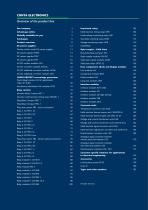
CONTA-ELECTRONICS Overview of the product line Our company Functional relays Advantage online Multi-function timing relays MFR Undervoltage monitoring relays USR Star-delta switching relays SDSR Primary switch-mode DC power supplies DC power supplies PSPM DC power supplies PSPC DC power supplies PSPI Solid-state output modules SSOIF AC/DC rectifier modules GM Solid-state relays OPTO 22 AC/DC converter modules ACDCG Fuse, component, diode and display modules DC/DC stabilized converter modules VSTAB DC/DC stabilized converter modules CML CONTA-PROTECT overvoltage protection Overvoltage arresters...
Open the catalog to page 2
CONTA-CLIP – Thinking ahead with connection technology CONTA-CLIP was founded in 1978. We operate globally as an owner-operated medium-sized company. Users of electrical and electronic connection systems trust our reliable products and our many years of industrial and global market expertise. Our company is now one of the most important manufacturers in the field. For over 40 years, our components and solutions have been used in process and industrial automation applications, including: railway technology, materials handling, building automation, air conditioning, mechanical and facility engineering,...
Open the catalog to page 3
Advantage online: the CONTA-CLIP Online Catalogue No matter where you are, as long as you're online you can access our digital catalogue to look at our services and quickly identify suitable solutions for your requirements. Fast results Use the full-text search, enter an order number or use the convenient "step-bystep" feature search function. P roject planning at a glance: After you've selected the products, all the master data for the materials (sales data, technical data, drawings, connection diagrams, classifications and approvals) are made available as a data sheet or export file. D etailed...
Open the catalog to page 4
Globally available for you Are you working abroad? No problem. Our worldwide sales and distribution partners help us to be globally networked and provide on-time reliable deliveries. Simply scan the QR code shown and you'll learn on our website about the sales partner responsible for your country. Our locations in Africa Algeria Morocco South Africa Our locations in Asia Bahrain China Hong Kong India Israel Japan Jordan Malaysia Oman Pakistan Qatar Saudi Arabia Singapore South Korea Taiwan Turkey United Arab Emirates Our locations in Oceania Australia New Zealand Our locations in Europe Austria...
Open the catalog to page 5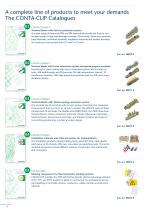
A complete line of products to meet your demands The CONTA-CLIP Catalogues 01 CONTA - CONNEC T Terminal blocks with Push-in connection system CONTA-CONNECT Terminal blocks with Push-in connection system Our wide range of innovative PRK and FRK terminal blocks with the Push-in connection system include feed-through terminals, PE terminals, disconnect terminals, fused terminals, multi-level terminals, installation terminals and initiator terminals, for conductor cross-sections from 0.2 mm² to 25 mm². CONTA - CONNEC T Terminal blocks with Screw connection system and special purpose terminals CONTA-CONNECT...
Open the catalog to page 6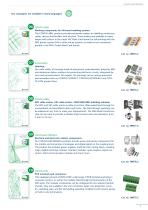
Our catalogues are available in many languages! Marking components for ink-based marking systems CONTA-LABEL Marking components for ink-based marking systems The CONTA-LABEL products provide polyamide markers for labelling conductors, cables, devices and facilities with ink print. These markers are available in many shapes and colours: in the classic MC Maxi-Card format for self-printing with the EMS plotter system EMS or other ink-jet systems, or ready-to-use customized printed in the PMC Pocket-Maxi-Card format. CONTA-BOX Housings Our wide variety of housings made of polystyrene, polycarbonate,...
Open the catalog to page 7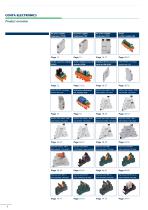
CONTA-ELECTRONICS Product overview Single-phase PSPC Single-phase PSPI AC/DC converter modules DC/DC stabilized converter Stabilized DC/DC converter CONTA-PROTECT overvoltage modules VSTAB CONTA-PROTECT overvoltage Interface relay compact - IRCU Interface relay compact - IRCPU link modules IF-OF relay terminal, 1 CO contact relay terminal, 1 CO contact Interface relay compact - IRCIU Interface relay compact - IRCOU Interface relay compact - MFR IRCPU Plug relay compact - PRC 1 relay terminal, 1 CO contact relay terminal, 1 CO contact timing relay terminal, 1 CO contact relay terminal, 1 CO contact...
Open the catalog to page 8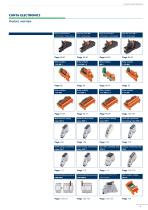
CONTA-ELECTRONICS Product overview Plug relay system PRS XT Plug relay system PRS 1 Plug relay system PRS 2 Plug relay system PRS 4 1+2 CO contact / tension spring Relay modules Relay modules Relay modules Relay modules Relay modules Relay modules Relay modules Relay modules Multi-function timing Multi-function timing Multi-function timing Clock-pulse generator Undervoltage monitoring Undervoltage monitoring Star-delta switching relay Voltage-monitoring relay Communication processor Communication processor Plug solid-state compact PSC Sol- Opto-coupler modules id-State terminals
Open the catalog to page 9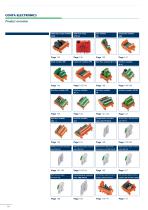
CONTA-ELECTRONICS Product overview Solid-state output modules Solid-state relays Fuse modules Component modules Lamp test modules LPM Interface modules Interface modules Interface modules SD-HD Interface modules Interface modules Temperature converter Thermocouple / thermal sensor units CMS..UI Voltage and current converter Multi-function signal converter Multi-function high-current Multi-function signal converter units CML-UI-UI units CMS-UI-UI units CMS-UI-R Multi-function signal Potentiometric converter CAE analogue signal converter CAE analogue signal converter converter unit units CML-POT-UI...
Open the catalog to page 10
CONTA-ELECTRONICS Product overview Potentiometric modules Clip-on base system Fuse cartridges
Open the catalog to page 11
The 24 V DC control voltage has come to globally dominate in systems and machines in automation engineering, in the DC power supplies for encoders, input signals, actuators and electronic components. However the voltage range from 6V DC to 60 V DC is also required for analogue and digital signals in various control schemes. The functionality of an electronic control is largely dependent on the reliability of its corresponding power supply. A stable and safe power and voltage supply guarantees a trouble-free production process in systems and mechanical engineering. CONTA-CLIP offers many different...
Open the catalog to page 12All CONTA-CLIP Verbindungstechnik GmbH catalogs and technical brochures
 KDS Cable entries KES Cable entries
100 Pages
 Housings
94 Pages
 Marking components
80 Pages
 tension-spring connection
143 Pages
 Push-in connection system
155 Pages
 Round cable entries
20 Pages
 INDIVIDUAL SOLUTIONS
4 Pages
 GSM-PRO
6 Pages
 GSM-PRO2
20 Pages
 Cabling ducts VK
16 Pages
 TTPCard
48 Pages
 Housing Systems
92 Pages
 P.C. BOARD CONNECTORS
168 Pages
 CONNECTION SYSTEMS
576 Pages
 SUPPLEMENTS
36 Pages


