
- Catalogs
- Comline Elektronik Elektrotechnik GmbH
- IRSphinx Biogas Market Segment

IRSphinx Biogas Market Segment
IRSphinx Biogas Market Segment
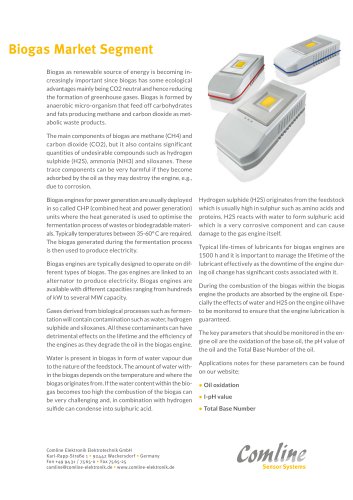
Biogas is a renewable energy source that is CO2 neutral, helping to reduce greenhouse gas emissions. It is produced by anaerobic microorganisms decomposing carbohydrates and fats, resulting in methane and carbon dioxide. However, it also contains harmful compounds like hydrogen sulfide, ammonia, and siloxanes, which can cause engine corrosion. Biogas engines, used in combined heat and power (CHP) units, require careful contaminant management to maintain efficiency and longevity. Key monitoring parameters include the oxidation of base oil, pH value, and Total Base Number.
Mid-infrared (Mid-IR) spectroscopy measures organic molecules' concentration by analyzing light absorption in the 2000 nm to 12000 nm range. It identifies molecular structures by their characteristic absorption wavelengths and can be conducted in transmission or Attenuated Total Reflection (ATR) mode.
Oil degradation involves oxidation, additive depletion, and contamination. Oxidation is accelerated by high temperatures and contaminants, leading to acid formation and deposits. Additives in lubricants combat degradation but deplete over time, necessitating monitoring. Contaminants like water and foreign substances can be identified using Mid-IR spectroscopy.
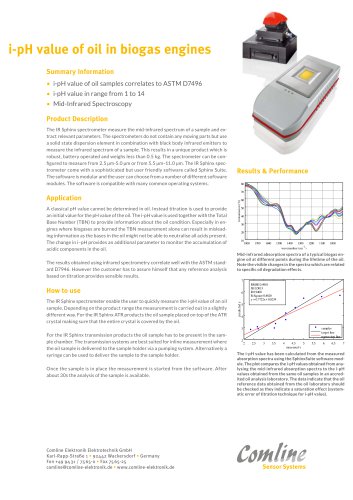
Mid-IR spectroscopy is effective for oil condition analysis, detecting changes in absorption spectra due to oil aging. The IR Sphinx series sensors provide real-time monitoring of oil degradation mechanisms without consumables, enhancing safety and reducing costs. These sensors are available for portable, laboratory, and industrial applications.
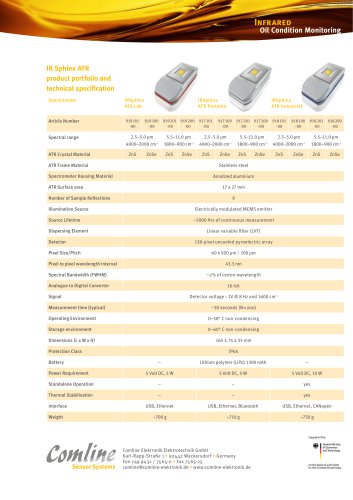
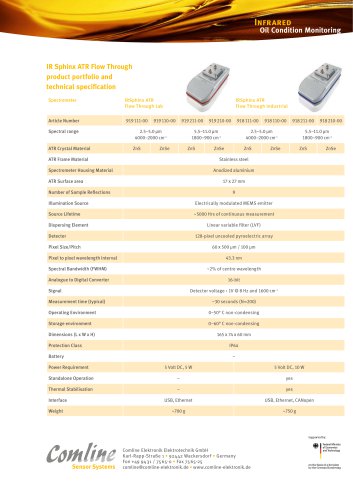
The IR Sphinx series includes ATR and Transmission spectrometers with varying specifications for different applications. They feature durable construction, multiple interfaces, and options for standalone operation, providing critical data for maintenance and operational decisions.
The document outlines the features and functionalities of the Sphinx Suite software used with Spectrolytic's products. It highlights the modular nature of the software, its integration capabilities, and the specific modules available.
- Automation Module: Facilitates automatic evaluation of IR spectra, visualization of control values, saving analytical results, and generating customized reports. It includes a standalone OCOM interface for controlling the spectral meter via an external interface.
- Frequency Modulation Module: Optimizes emitter modulation frequency between 5–20 Hz.
All Spectrolytic products come with the proprietary Sphinx Suite software, which is customizable and can interface with common data processing software like Unscrambler. The default Basic software module enables users to perform measurements, save, and export data.
- Menu Bar: Contains configuration options.
- Measurement Options: Includes import/export configuration.
- Control Buttons: Start & Stop measurement buttons.
- Graphic Display: Visual representation of data.
- Data Selection Tabs: For selecting different data sets.
- Measurement Selection: Options for choosing specific measurements.
- Status Bar: Displays battery charge level, connection status, and folder information.
The document includes a diagram depicting the available software modules within the Sphinx Suite, including Prediction, Frequency Modulation, Chemometrics, Standalone Automation, and Basic modules.
Catalog excerpts
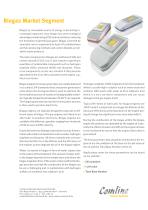
Biogas Market Segment Biogas as renewable source of energy is becoming increasingly important since biogas has some ecological advantages mainly being CO2 neutral and hence reducing the formation of greenhouse gases. Biogas is formed by anaerobic micro-organism that feed off carbohydrates and fats producing methane and carbon dioxide as metabolic waste products. The main components of biogas are methane (CH4) and carbon dioxide (CO2), but it also contains significant quantities of undesirable compounds such as hydrogen sulphide (H2S), ammonia (NH3) and siloxanes. These trace components can be very harmful if they become adsorbed by the oil as they may destroy the engine, e.g., due to corrosion. Biogas engines for power generation are usually deployed in so called CHP (combined heat and power generation) units where the heat generated is used to optimise the fermentation process of wastes or biodegradable materi als. Typically temperatures between 35-60° C are required. The biogas generated during the fermentation process is then used to produce electricity. Biogas engines are typically designed to operate on different types of biogas. The gas engines are linked to an alternator to produce electricity. Biogas engines are available with different capacities ranging from hundreds of kW to several MW capacity. Gases derived from biological processes such as fermentation will contain contamination such as water, hydrogen sulphide and siloxanes. All these contaminants can have detrimental effects on the lifetime and the efficiency of the engines as they degrade the oil in the biogas engine. Water is present in biogas in form of water vapour due to the nature of the feedstock. The amount of water within the biogas depends on the temperature and where the biogas originates from. If the water content within the biogas becomes too high the combustion of the biogas can be very challenging and, in combination with hydrogen sulfide can condense into sulphuric acid. Comline Elektronik Elektrotechnik GmbH Karl-Rapp-Straße 1 • 92442 Wackersdorf • Germany Fon +49 94 31 / 75 65-0 • Fax 75 65-25 [email protected] • www.comline-elektronik.de Hydrogen sulphide (H2S) originates from the feedstock which is usually high in sulphur such as amino acids and proteins. H2S reacts with water to form sulphuric acid which is a very corrosive component and can cause damage to the gas engine itself. Typical life-times of lubricants for biogas engines are 1500 h and it is important to manage the lifetime of the lubricant effectively as the downtime of the engine during oil change has significant costs associated with it. During the combustion of the biogas within the biogas engine the products are absorbed by the engine oil. Especially the effects of water and H2S on the engine oil have to be monitored to ensure that the engine lubrication is guaranteed. The key parameters that should be monitored in the engine oil are the oxidation of the base oil, the pH value of the oil and the Total Base Number of the oil. Applications notes for these parameters can be found on our website: • Oil oxidation • I-pH value • Tot
Open the catalog to page 1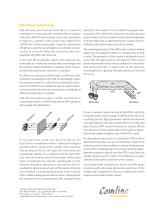
Mid-infrared spectroscopy Mid infrared spectroscopy (Mid IR) is a powerful technique for measuring the concentration of organic molecules. Mid-IR spectroscopy covers the absorption of light by a sample in the range from 2000 nm to 12000 nm. In this wavelength range the absorption of light at a specific wavelength can be linked unequi vocally to a certain molecular structures that sub sequently identifies the molecule. In the Mid-IR wavelength region each molecule absorbs light at a molecule characteristic wavelength and the amount of light absorbed is a measure of the concentration of the particular...
Open the catalog to page 2
Oil conditioning monitoring based on Mid-IR spectroscopy Many different substances can be used to lubricate a surface. Oil and grease are the most common. Grease is composed of oil and a thickening agent to obtain its consistency, while the oil is what actually lubricates. Oils can be synthetic, vegetable or mineral-based as well as a combination of these. The application determines which oil, commonly referred to as the base oil, should be used. In extreme conditions, synthetic oils can be beneficial. Where the environment is of concern, vegetable base oils may be utilized. Lubricants containing...
Open the catalog to page 3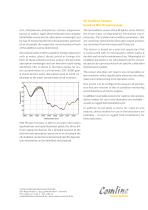
Oil Condition Sensors based on Mid-IR spectroscopy zinc, molybdenum, phosphorus, calcium, magnesium, barium or sodium. Again these molecules have uniquely identifiable characteristic absorption wavelength and by way of measuring the infrared absorption spectrum of an oil sample the respective concentrations of each of the additives can be determined. Oil contamination is often caused by foreign substances such as water, glycol, diesel, petrol or foreign oils. Each of these substances have unique characteristic absorption wavelength and can therefore easily being identified. This is shown in the...
Open the catalog to page 4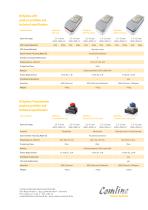
IR Sphinx ATR product portfolio and technical specification Spectrometer IRSphinx Sensor Systems Comline Elektronik Elektrotechnik GmbH Karl-Rapp-Strafie 1 • 92442 Wackersdorf • Germany Fon +49 9431 / 7565-0 • Fax 7565-25 [email protected] • www.comline-elektronik.de
Open the catalog to page 5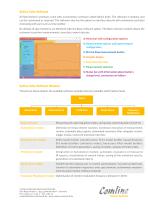
Sphinx Suite-Software All Spectrolytic’s products come with a proprietary software called Sphinx Suite. The software is modular and can be customised as required. The software also has the option to interface directly with commonly used data processing software such as Unscrambler. By default all spectrometers are delivered with the Basic software option. The Basic software module allows the customer to perform measurements, save data, export data etc. A: Menu bar with configuration options B: Measurement options and import/export configuration C: Start & Stop measurement button D: Graphic display...
Open the catalog to page 6All Comline Elektronik Elektrotechnik GmbH catalogs and technical brochures
 Moulding
2 Pages
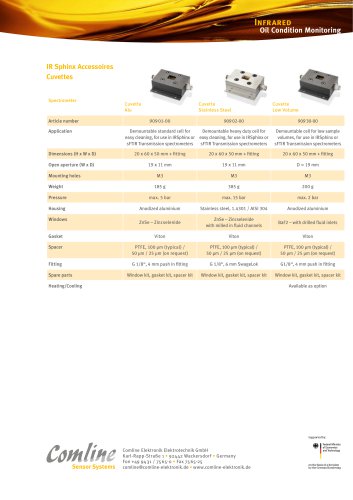 IR Sphinx Accessoires
1 Page
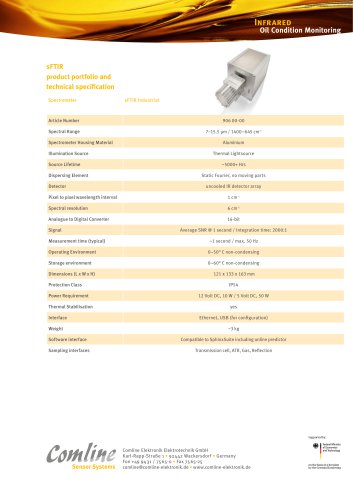 sFTIR
sFTIR1 Page
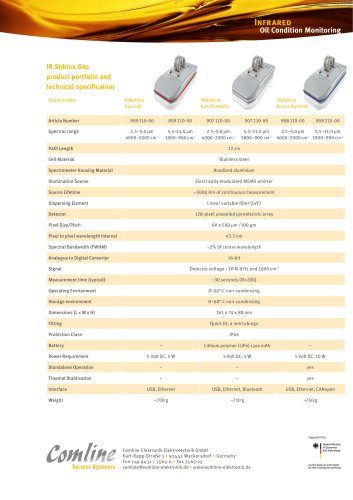 IR Sphinx Gas
1 Page
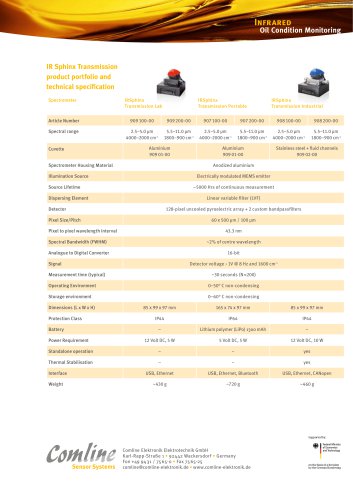 IRSphinx Transmission
1 Page
 Development
2 Pages
 IRSphinx ATR
1 Page
 Cable-Systems
2 Pages
 Processing
2 Pages
- Automation software solution
- Analysis software solution
- Process software
- Windows software
- Visualization software solution
- Cable assembly
- Laboratory spectrometer
- Creation software
- Calculation software
- Compact spectrometer
- Portable spectrometer
- USB spectrometer
- Infrared spectrometer
- Gas analysis spectrometer
- Power electrical cable assembly
- Mid-infrared spectrometer
- High-voltage cable harness