


GTR

GTR
The GTR torsionally rigid coupling is engineered for high torque applications, capable of handling up to 130,000 Nm of torque with a 205 mm bore. It is constructed from fully turned steel with a phosphating treatment and features a stainless steel disc pack. The coupling is maintenance-free, wear-resistant, and offers high torsional rigidity. A double disc pack version, GTR/D, is available for higher torque needs.
The coupling is made from steel UNI EN10083/98 and stainless steel AISI 304-C, with connection screws in steel class 10.9. It is statically balanced according to DIN ISO 1940-1:2003 Q 6.3. Customizations include high-temperature applications, full stainless steel versions, and reinforced couplings for heavy-duty applications.
The disc packs, the core components, are made from AISI 304-C stainless steel discs connected by steel bushes. They are available as continuous ring or sectional disc packs, depending on the coupling size.
Custom manufacturing options include personalized spacers, internal hubs to reduce axial dimensions, and solutions for vertical mounting. Adaptors allow for easy disc pack replacement without moving the hubs.
The document provides detailed dimensions and torque specifications for various coupling sizes, including permissible torque values with clamp locking and technical characteristics for both GTR/S and GTR/D models.
The GTR/DBSE model includes a spacer for applications requiring connection over a distance. It is made from steel with a galvanized corrosion-proof finish and is maintenance-free. The spacer version allows for dynamic balancing and customization for specific needs.
The coupling is suitable for high-speed applications and can accommodate significant misalignment. Balancing requirements depend on application specifics, such as speed and spacer length.
Guidelines for selecting the appropriate coupling size are provided, including formulas for calculating nominal torque and considering factors like peak torque and load conditions.
The document discusses torsionally rigid couplings, specifically the GTR & GTR/DBSE models. It highlights the importance of considering flexibility and misalignments when calculating and verifying the torque to be transmitted. Axial and radial misalignments are inversely proportional, and their combined percentage should not exceed 100% as illustrated in a graphic.
The document provides a graphical representation of the relationship between axial force and axial misalignment. It also includes an order example detailing model types, sizes, and locking types.
The rated outputs are based on normal use without shocks and well-aligned shafts. Factors influencing the maximum speed of the coupling include peripheral speed, weight, spacer length, rigidity, and balance quality. Dynamic balancing is generally not required but should be evaluated for specific applications.
1. Achieve precise radial and axial alignment to maximize misalignment absorption and coupling life.
2. Ensure shafts are assembled square with the half-coupling surface.
3. Tighten screws with a torque wrench in a cross sequence to the specified torque.
4. Check that disc packs are perpendicular to the shaft axis, adjusting screws if necessary.
For couplings with spacers, increase the distance between hub flanges by 1.5-2 mm to reduce natural axial frequency and prevent spacer oscillation.
For vertical installations, refer to the execution proposal on page 9.
Catalog excerpts

TORSIONALLY RIGID COUPLING Up to 130.000 Nm of torque and 205 mm bore GTR
Open the catalog to page 1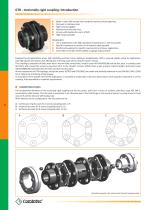
GTR - torsionally rigid coupling: introduction Made in steel fully turned with standard treatment of phosphating. Disc pack in stainless steel. High torsional rigidity. Maintenance and wear free. Version with double disc pack: GTR/D. High torque possible. ON REQUEST Use in applications with high operation temperatures (> 150 °C) possible. Specific treatments or version in full stainless steel possible. Reinforced couplings for specific requirements and heavy applications. Connection to torque limiter (safety coupling) range possible. Designed to suit applications where high reliability, precision...
Open the catalog to page 2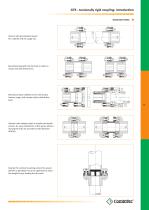
Version with personalized spacer for a specific D.B.S.E. (page 12). Manufacturing with internal hubs in order to reduce the axial dimensions. Manufacturing in addition to the /SG torque limiters range, with simple and/or double disc pack. Solution with adaptors both in simple and double version, for easy substitution of disc packs without moving the hubs (in accordance with directive API610). Solution for vertical mounting, where the spacer (GTR/D or gtr/dbse) has to be supported to avoid the weight by pre-loading the disc pack.
Open the catalog to page 3
GTR - torsionally rigid coupling: technical data ■ DIMENSIONS
Open the catalog to page 4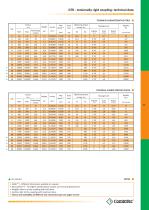
TECHNICAL CHARACTERISTICS GTR/S ■ • Qstd (*1) - Different dimensions available on request. • Max speed (*2) - For higher speeds please contact our technical department. • Weights refer to to the coupling with pilot bore. • Inertias refer to the coupling with maximum bore. • Choice and availability of different hub connection type see pages 4 and 5.
Open the catalog to page 5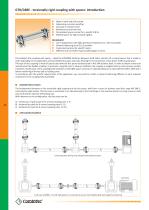
GTR/DBSE - torsionally rigid coupling with spacer: introduction Made in steel and fully turned. Galvanizing corrosion proofing. Disk pack in stainless steel. Maintenance and wear free. Personalized spacer version for a specific D.B.SE. Welded spacer for high torsional rigidity. ON REQUEST Use in applications with high operation temperatures (> 150 °C) possible. Dynamic balancing up to Q=2,5 possible. Customized versions for specific needs. Different hub connection type possible (pages 4 and 5). This backlash free coupling with spacer , called the GTR/DBSE (Distance Between Shaft Ends), consists...
Open the catalog to page 6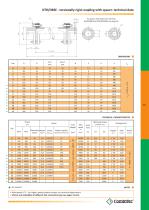
DIMENSIONS Size TECHNICAL CHARACTERISTICS ■ Size 13 A On request NOTES ■ • Max speeds (*2) - For higher speeds please contact our technical department. • Choice and availability of different hub connection type see pages 4 and 5.
Open the catalog to page 7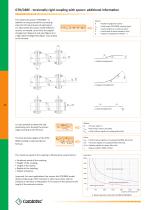
GTR/DBSE - torsionally rigid coupling with spacer: additional information The model with spacer "GTR/DBSE", in addition to being essential for connecting elements of transmissions situated apart , it is able (unlike the classic model GTR/S) to recover, as needed, up to twice the angular misalignment (figure 2) and axial (figure 3) or a high radial misalignment (figure 1) according to the formula: Where: K = Radial misalignment [mm] Ltot = Total length GTR/DBSE coupling [mm] N = Useful length of an half-hub [mm] P = Useful part of elastic element [mm] α = Angular misalignment GTR/S [ ° ] It is...
Open the catalog to page 8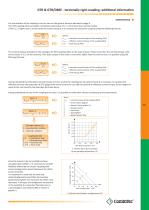
GTR & GTR/DBSE - torsionally rigid coupling: additional information DIMENSIONING For pre-selection of the coupling's size you can use the generic formula indicated on page 6. The GTR coupling will accomodate momentary peak torque "C.C." of 2,5 times than nominal torque. If the C.C. is higher than 2,5 times than the nominal torque, it is necessary to choose the coupling using the following formula: C'nom= Where: C’nom = theoretic nominal torque of the coupling [Nm] C nom = effective nominal torque of the coupling [Nm] C.C. = peak torque [Nm] The nominal torque indicated on the catalogue for GTR...
Open the catalog to page 9
GTR & GTR/DBSE - torsionally rigid coupling: additional information The rated outputs on the catalogue refer to normal use without shocks and with shafts well-aligned with the environmental temperature The value of axial thrust (+- 20%) is relevant to the axial movement (graphic 7). The maximum speed of the coupling is influenced by several factors: • Peripheral speed of the coupling; • Weight of the coupling; • Length of the spacer (pages 12-14); • Rigidity of the coupling; • Quality of balance. In general, for most applications dynamic balancing is NOT required; in other cases there is need...
Open the catalog to page 10All ComInTec catalogs and technical brochures
 Axial force limiter 'DSA'
4 Pages
 Proximity sensor 'PRX'
1 Page
 Accouplement a lamelles ``GTR``
10 Pages
 DF
DF10 Pages
 Gear coupling ``GD``
4 Pages
 RIGID COUPLING
4 Pages
 DSS/F/SG/PR-V
6 Pages
 DSM
DSM6 Pages
 PULLEYS & SLIDE
16 Pages
 LOCKING RINGS & WASHERS
8 Pages
 Chain Coupling ``GC``
2 Pages
 DSR/F/AP
6 Pages
 DSS/SG
12 Pages
 DSR
DSR10 Pages
 FRICTION TORQUE LIMITER
10 Pages
 TORQUE LIMITERS - CLUTCHES
44 Pages


- Proximity switch
- Cylindrical proximity sensor
- Flexible coupling
- Inductive proximity sensor
- Shaft shaft coupling
- IP67 proximity sensor
- Flange coupling
- Torque coupling
- Zero-backlash shaft coupling
- Transmission coupling
- Friction clutch
- Metal washer
- Sleeve coupling
- Compact coupling
- Threaded proximity sensor
- Stainless steel proximity sensor
- Brass proximity sensor
- Misalignment correction coupling
- Motor shaft coupling