


- Products
- Catalogs
- News & Trends
- Exhibitions
EnergyMax-USB/RS Sensors

EnergyMax-USB/RS Sensors
Coherent has been a leader in laser measurement and beam diagnostics for over 40 years, focusing on product reliability, responsiveness, and technical support. The EnergyMax-USB/RS sensors are designed for superior reliability and performance, with a warranty rate of less than 1%, calibration turnaround of under 5 days, and on-time delivery over 95%.
The EnergyMax-USB/RS sensors integrate meter electronics within the sensor head cable, offering RS-232 or USB 2.0 connectivity. They measure energy per pulse or average power of pulsed lasers across various wavelengths and repetition rates, suitable for OEM integration and laboratory use.
- Measurement of every pulse up to 10 kHz with USB and 1 kHz with RS-232.
- Direct USB 2.0 connection with power via USB or RS-232 with +4-20 VDC input.
- High accuracy with a 14-bit A/D converter and up to five digits of measurement resolution.
- Unique spectral compensation for accurate measurements across different wavelengths.
- EnergyMax PC applications software includes trending, tuning, histogram, and statistics features.
- Data logging up to 10 kHz in Turbo mode and support for multiple device operation.
- Easy integration with LabVIEW drivers and simple ASCII host commands for remote interfacing.
- Pyroelectric technology for high repetition rate measurement.
- Wide dynamic range and high damage threshold.
- Temperature compensation for ambient and laser-induced heat changes.
The guide provides selection charts for identifying suitable sensors based on energy range, average power capabilities, and repetition rate capabilities. Sensors are categorized by coating type and active area diameter, with specific models designed for different energy and wavelength ranges.
Coherent's EnergyMax sensors offer high performance, user-friendly operation, and cost-effectiveness, ideal for a wide range of laser energy measurement applications.
The document details specifications and features of various EnergyMax-USB/RS sensors for measuring laser energy across different wavelengths and power levels, designed for high accuracy and durability.
The sensors cover a wavelength range from 0.19 to 12 µm, with energy measurement capabilities from 500 nJ to 3J. They feature coatings like MaxBlack, Diffuse Metallic, and MaxUV, each offering unique advantages in damage resistance and operational range.
- J-50MB-HE/LE, J-25MB-HE/LE, J-10MB-HE/LE: Use MaxBlack coating for high damage resistance, suitable for high repetition rates with built-in spectral compensation.
- J-50MT-10KHZ, J-25MT-10KHZ, J-10MT-10KHZ: Equipped with Diffuse Metallic coating, handle high and low repetition rates, offering enhanced damage resistance at shorter wavelengths.
- J-50MB-YAG, J-50MB-IR: Designed for high energy and peak power lasers, using MaxBlack coating and diffusers for superior damage resistance, suitable for Nd:YAG and IR lasers.
- J-50MUV-248, J-25MUV-193: Feature MaxUV coating for high DUV damage threshold, optimized for ArF and KrF lasers.
- J-10SI-HE: Part of the Quantum series, uses a Silicon photodiode for low energy pulse measurements, operating at high repetition rates.
The sensors offer high signal-to-noise characteristics, automatic temperature compensation, and precise spectral compensation. Calibration is typically performed at specific wavelengths like 1064 nm, with uncertainties around ±2% to ±3%.
These sensors are suitable for various laser applications, including those requiring high energy and peak power handling, as well as precise measurements at low energy levels.
These sensors measure smaller signals using a photodiode element, making them more sensitive than pyroelectric sensors. They include an integrated input beam tube to limit the field of view and reduce measurement errors from stray light sources.
Heat sink accessories extend the energy and repetition rates of EnergyMax sensors by increasing their average power capability, with options for small, medium, and large heat sinks.
Test slides protect sensors when measuring unknown beams, indicating the need for beam attenuation if damage is visible.
Orders can be placed online, by phone, fax, email, or mail. A 20% discount is available for customers who have purchased a Coherent laser over $5,000 in the past year.
Payment terms include cash, credit card, C.O.D., or Net 30 with credit approval. Export terms are letter of credit, cash in advance, or credit card. Returns require authorization, and cancellations incur a termination charge.
Products are warranted to be free from defects for 12 months from shipment. Most products are RoHS compliant.
Contact details for Coherent offices worldwide are provided, including the United States, China, France, Germany, Italy, Japan, Korea, Netherlands, and the United Kingdom.
Catalog excerpts

EnergyMax-USB/RS Sensors January 2011 EnergyMax-USB/RS Sensor Guide Superior Reliability & Performance
Open the catalog to page 1
Coherent Operational Excellence Operational Experience You Can Count On nical Support Tech For Product Reliability, Speed of Responsiveness, and Technical Support, make the safe choice you can always count on – Coherent. Overall product warranty rate <1% Calibration turnaround time <5 days On-time delivery for all new orders >95% Shipment of C24 orders within 24 hours Operational Excellence In a recent customer survey we found that Product Reliability, Speed of Responsiveness, and Technical Support are the three top criteria when choosing a laser test and measurement supplier. That’s why we place...
Open the catalog to page 2
Coherent has expanded their meterless laser measurement concept with a new range of energy sensors in which all meter electronics are miniaturized and integrated within the sensor head cable. Specifically, Coherent's entire range of high performance EnergyMax sensors are now available in this form factor with either RS-232 or USB 2.0 connectivity. This product range enables measurement of the energy per pulse or average power of pulsed lasers from the nanojoule to the multi-joule level, over wavelengths from the deep ultraviolet through the far infrared, and from single pulses to repetition rates...
Open the catalog to page 3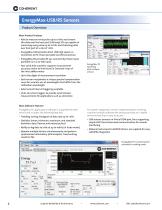
EnergyMax-USB/RS Sensors Product Overview Main Product Features • Able to measure every pulse up to 10 kHz and stream this data over the host port (USB only). RS-232 capable of measuring every pulse up to 10 Khz and streaming data over host port at a rate of 1 kHz. • EnergyMax-USB provides direct USB high speed 2.0 connection to PC. Power provided via USB connection. • EnergyMax-RS provides RS-232 connectivity. Power input provided via +4-20 VDC input. EnergyMax PC operating with multiple sensors • Fast 14-bit A/D converter supports measurement accuracy similar to that found in Coherent’s top-of...
Open the catalog to page 4
EnergyMax-USB/RS Sensors Introduction and Selection Charts Features • Superior damage resistance • High repetition rate operation • Large dynamic range gives each sensor broad coverage • Low noise and excellent linearity for greater accuracy • Large active area Coherent EnergyMax sensors enable laser pulse energy measurement over a broad range of wavelengths, repetition rates, pulse energies and beam diameters. With their unique combination of superior performance and user-friendly convenience, EnergyMax sensors are your best choice no matter what your particular laser energy measurement need....
Open the catalog to page 5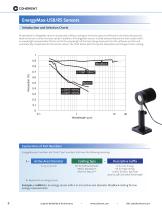
All pyroelectric EnergyMax sensors incorporate a diffuse coating to minimize specular reflections and eliminate spurious beams that can re-enter the laser cavity. In addition, all EnergyMax sensors include onboard electronics that contain built-in wavelength compensation factors. Enter the wavelength of the laser being measured into the software and this will automatically compensate for the sensor output. The chart below plots the typical absorption percentage of each coating. Explanation of Part Numbers EnergyMax part numbers are "Smart" part numbers that have the following meaning: MT for...
Open the catalog to page 6
Overall measurement accuracy is a combination of calibration uncertainty (found in the sensor specification tables) and the wavelength compensation accuracy (found in the "Wavelength Compensation Accuracy" table, below). The combined accuracy is based upon practices outlined in the National Institute of Standards Guidelines for Evaluating and Expressing Uncertainty (NIST Technical Note 1297, 1994 Edition). The combined accuracy of the measurement is calculated by using the law of propagation of uncertainty using the "root-sum-of-square" (square root of the sum of squares), sometimes described...
Open the catalog to page 7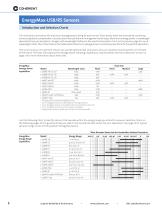
The next table summarizes the maximum average power rating for each sensor. These power levels are achieved by combining active temperature compensation circuitry and enhanced thermal management techniques. Maximum average power is wavelength dependent because absorption changes with wavelength. Reference the spectral absorption chart on the previous page for use at wavelengths other than those listed in the table below. Maximum average power is inversely proportional to the spectral absorption. The 25 mm and 50 mm aperture sensors can accept optional heat sinks that users can install by mounting...
Open the catalog to page 8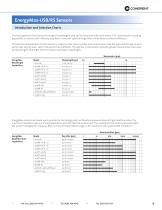
The next selection chart shows the range of wavelengths that can be measured with each sensor. This characteristic is coating dependent, so sensors with diffusers may have a narrower spectral range than similar sensors without diffusers. The spectral compensation of each sensor is unique to that serial number, and is based upon spectral scans performed on each sensor disk (and on each optic if the sensor has a diffuser). The spectral compensation provides greater measurement accuracy for wavelengths that differ from the optical calibration wavelength. EnergyMax Repetition Rate Capabilities
Open the catalog to page 9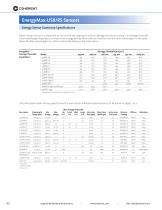
Energy Sensor Summary Specifications Before using a sensor, it is important to ensure that the laser beam will not damage the sensor coating. The damage threshold is also wavelength dependent, and maximum energy density thresholds are listed for common laser wavelengths in the table below. At other wavelengths it is safe to interpolate between the listed values. EnergyMax Damage Threshold (mJ/cm2) Damage Threshold Model 193 nm 248 nm 266 nm 355 nm 532 nm 1064 nm The table below shows the key specifications for each sensor. Additional specifications can be found on pages 7 to 11 Heat Sink. Diffuse...
Open the catalog to page 10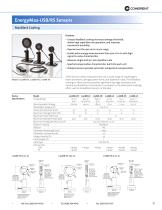
EnergyMax-USB/RS Sensors MaxBlack Coating Features • Unique MaxBlack coating increases damage threshold, allows high repetition rate operation, and improves mechanical durability • Operate over the 190 nm to 12 μm range • Enable pulse energy measurements from 500 nJ to 2J with high signal-to-noise characteristics • Measure single shot to 1 kHz repetition rate • Spectral compensation characteristics built into each unit • Onboard sensors provide automatic temperature compensation These sensors allow measurements over a wide range of wavelengths, beam diameters, average power levels, and repetition...
Open the catalog to page 11All COHERENT catalogs and technical brochures
 ExactCut 430
4 Pages
 INNOVA 70C
4 Pages
 ExciStar
3 Pages
 Compact Mini Series
4 Pages
 Diamond C-40 Series
4 Pages
 Diamond C-20 & C-20+ Series
5 Pages
 Axon
Axon5 Pages
 Astrella
3 Pages
 Innova 90C FreD
2 Pages
 Innova® Sabre
5 Pages
 OBIS LX/LS Laser Box
5 Pages
 Needle Drill System
2 Pages
 Diamond J-5 Series
3 Pages
 Diamond J-3 Series
3 Pages
 Diamond J-2 Series
3 Pages
 StingRay and BioRay
16 Pages
 StarFiber 100/200/400/600
4 Pages
 AVIA LX
4 Pages

Archived catalogs
 Custom OEM Subsystems
5 Pages
 ULN
ULN3 Pages
 Monaco 1035
4 Pages
 Mira HP
2 Pages
 Levante IR fs OPO
4 Pages
 Vitara
6 Pages
 ROFIN_COHERENT_Dat_EasyMark
2 Pages
 EASYJEWEL
2 Pages
 EasyMark/EasyJewel
4 Pages
 Ultrafast Laser Systems
92 Pages
 META 10C
3 Pages
 HighLight FL-1000P
4 Pages
 FLARE NX
4 Pages
 META 2C
3 Pages
 X-LASE SERIES
3 Pages
 HighLight FL-ARM
4 Pages
 HyperRapid NX
4 Pages
 Lasers for Materials Processing
16 Pages
 DC Series
2 Pages
 Laser Trouble Shooting
6 Pages
 Single Emitter Diode Lasers
5 Pages
 O-LASE SERIES
4 Pages
 INNOVA 300C MOTOFRED
2 Pages
 UMB 1430-1470nm
3 Pages
 UMB 1060nm
3 Pages
 UMB 965-985nm
3 Pages
 UMC 780-830nm
4 Pages
 NUV-320-K1
1 Page
 Astrella
6 Pages
 Excimer Catalog 2016
52 Pages
 OBIS LG 355-20
3 Pages
 Compass 115M
2 Pages
 Verdi G-Series Family
4 Pages
 Innova 90C
4 Pages
 MBD-200
2 Pages
 MBR-01 Ring Laser
2 Pages
 MicroLas
6 Pages
 LEAP
LEAP2 Pages
 CrystaLas
6 Pages
 LPXpro Series
2 Pages
 ExciStar XS
2 Pages
 Azure
Azure4 Pages
 Daytona-HE 355
3 Pages
 Staccato
2 Pages
 FLARE
FLARE2 Pages
 HELIOS
3 Pages
 Coherent BioRay
5 Pages
 OBIS
OBIS8 Pages
 AVIA Family of DPSS Lasers
20 Pages
 Talisker Brochure
4 Pages
 FieldMaxII Meter Family
2 Pages
 The Laser Machining Center
8 Pages
 PowerMax-USB/ RS Sensors
18 Pages
 EnergyMax-USB/RS Sensors
20 Pages
 Innova 70C Data Sheet
4 Pages
 Talisker_brochure
4 Pages
 DIAMOND CO2 Laser Systems
4 Pages
 Product catalogue
48 Pages


- Digital imager
- Copper cable
- Process software
- Real-time software
- Benchtop analyser
- USB camera module
- Spectrometer
- Monitoring software solution
- Portable analyzer
- Compact imager
- Quality software
- Industrial cable
- Optical cable
- Transceiver module
- Compact analyzer
- Optical data cable
- EDM software
- CCD video camera
- Power amplifying integrated circuit