

Biomass Combustion Systems

1 / 3 PagesView full catalog
Biomass Combustion Systems
Product catalog summary
Introduction
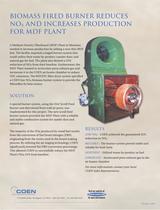
The document discusses the implementation of a biomass-fired burner system by COEN to reduce NOx emissions and increase production efficiency at a Medium Density Fiberboard (MDF) plant in Montana.
Results
Solution
A special burner system using the DAZ Scroll Feed Burner and directional front wall air ports was implemented. This system provided a reliable and stable combustion process for sander dust and natural gas. The air staging technology significantly lowered the conversion of fuel bond nitrogen (FBN), reducing NOx emissions by 25% from the baseline.
System Design and Features
Applications and Benefits
COEN's biomass combustion systems are designed for various industries, including wood product producers, agricultural industries, and food processing industries. The use of biomass waste products as a fuel source replaces expensive fossil fuels, reduces disposal problems, and lowers fuel costs.
Emissions Reduction
COEN's low NOx air heater design allows for air staging, significantly reducing NOx emissions from high fuel-bound nitrogen fuels. The system is designed for longevity, reducing maintenance and downtime, and supports accurate air/fuel ratio control for simultaneous firing of multiple fuels.
The document discusses the implementation of a biomass-fired burner system by COEN to reduce NOx emissions and increase production efficiency at a Medium Density Fiberboard (MDF) plant in Montana.
Results
- Low NOx: Achieved a 25% reduction in NOx emissions.
- Reliability: The burner system proved stable and reliable for both sander dust and natural gas fuels.
- Efficiency: Utilized waste by-products as fuel, reducing costs.
- Lower VOC: Incinerated press exhaust gas in the air heater chamber to reduce VOC emissions.
Solution
A special burner system using the DAZ Scroll Feed Burner and directional front wall air ports was implemented. This system provided a reliable and stable combustion process for sander dust and natural gas. The air staging technology significantly lowered the conversion of fuel bond nitrogen (FBN), reducing NOx emissions by 25% from the baseline.
System Design and Features
- The DAZ Scroll Feed Burner allows for the burning of multiple fuels, either separately or in combination with biomass fuels.
- The "Dual Air Zone" feature enhances mixing through counter-rotating concentric air streams.
- The system supports early ignition and stable flame formation, optimizing combustion.
Applications and Benefits
COEN's biomass combustion systems are designed for various industries, including wood product producers, agricultural industries, and food processing industries. The use of biomass waste products as a fuel source replaces expensive fossil fuels, reduces disposal problems, and lowers fuel costs.
Emissions Reduction
COEN's low NOx air heater design allows for air staging, significantly reducing NOx emissions from high fuel-bound nitrogen fuels. The system is designed for longevity, reducing maintenance and downtime, and supports accurate air/fuel ratio control for simultaneous firing of multiple fuels.
See more
Catalog excerpts
x from their baseline. Furthermore, the MDF Plant wanted to recirculate press exhaust gas and incinerate it in the COEN air heater chamber to reduce VOC emissions. The WESTEC fiber dryer system specified a COEN low NO > x biomass burner system to provide the 90mmBtu/hr heat source. > A special burner system, using the DAZ Scroll Feed Burner and directional front wall air ports, was implemented for this project. The new scroll feed burner system provided the MDF Plant with a reliable and stable combustion system for sander dust and natural gas. The majority of the NO > x produced by wood fuel...
Open the catalog to page 3All Coen catalogs and technical brochures
 Duct Burner Solutions
2 Pages
 QLN? Burner
2 Pages
 ECOjet Ultra-Low N0x Burner
2 Pages
 RMB? Rapid Mix Burner
2 Pages
 Variflame Low-NOx Burner
2 Pages
 Steam Generation Solutions
8 Pages

Archived catalogs
 Fyr-Monitor Control System
4 Pages
 Delta-NOx - Low NOx Burners
3 Pages
 Utility Solutions
8 Pages
 NRT Igniter Firing System
4 Pages
 iScan Flame Detector
3 Pages
 Igniter Systems
3 Pages
 Corporate Brochure
5 Pages


*Prices are pre-tax. They exclude delivery charges and customs duties and do not include additional charges for installation or activation options. Prices are indicative only and may vary by country, with changes to the cost of raw materials and exchange rates.
About DirectIndustry
DirectIndustry is a marketplace that offers B2B players a complete experience, from product sourcing to purchase. DirectIndustry is an entity of VirtualExpo Group.
Are you a buyer?
Are you a supplier?