


- Company
- Products
- Catalogs
- News & Trends
- Exhibitions
Motors, Gear boxes, Variators ...

Motors, Gear boxes, Variators ...
Three-phase aluminium motors are designed with IP55 protection, making them resistant to water, dust, and vermin. They are insulated to Class F standards, allowing a maximum temperature of 155°C, and are suitable for continuous duty (S1 service).
The motors are available in 2, 4, 6, and 8 poles with frame sizes ranging from 56 to 132. They can be mounted in various configurations including B3, B5, B14, with B35 and B34 available upon request. They are compatible with 60Hz frequency and can handle voltage variations of +/- 10% for 230/400V at 50Hz.
The IEC 60034-30 standard harmonizes energy efficiency classes for electric motors globally, covering induction motors, three-phase cage motors, and single-speed motors. It applies to motors with a voltage up to 1000V, power from 0.75 to 375 kW, and 2, 4, and 6 poles.
Motors are available in various configurations with different power ratings and efficiencies. The document provides detailed tables listing motor types, power, speed, efficiency, and other technical specifications.
Diagrams for star and delta connections are provided, indicating clockwise and anticlockwise rotations for three-phase asynchronous motors.
Details on spare parts such as flanges, feet, terminal boxes, fans, and fan covers are included, with specific codes for each motor type and configuration.
The document lists various models of worm gear reducers with specifications such as power ratings, motor types, and dimensions. Each model is identified by a unique code and is associated with specific motor types (B5 or B14) and power ratings in kW.
The service factor is influenced by the severity of the application, environmental conditions like temperature, daily operation duration, and start frequency. Adjustments to Fs are necessary when ambient temperatures exceed 30°C.
Radial forces supported by the output shaft are calculated using the formula: Fr = 2000 * Cs * Fz / Dp, where Cs is the output torque, Fz is the transmission factor, and Dp is the diameter of the transmission component.
Applications are categorized into three types based on load characteristics: Type A (uniform load), Type B (moderate overload), and Type C (significant overload). Each type has specific service factors based on daily operation hours and start frequency.
Efficiency (η) depends on factors like the helix angle of the worm, input speed, and lubricant quality. Irreversibility is linked to efficiency, with dynamic irreversibility occurring if ηd < 0.4 and static irreversibility if ηs < 0.5. Irreversibility should not be solely relied upon for safety; independent braking systems are recommended.
Selection of worm gear reducers involves determining the rotation frequency (Ns), output torque (Cs), service factor (Fs), and radial load (Fr). The document provides tables to find suitable motor-reducer combinations based on these parameters.
Efficiency values for different sizes and speeds are provided, distinguishing between dynamic and static efficiencies. These values help in assessing the performance of the reducers under various operational conditions.
Information on stock availability and pricing is accessible on the ITAFRAN website, allowing for quick selection and ordering of the appropriate reducer model.
The document provides detailed specifications for various models of worm gear reducers and associated components. Each model is identified by a unique code and includes parameters such as dimensions, weight, and compatibility with different motor sizes. The specifications cover a range of sizes from 25 to 130, with detailed measurements for each component.
The selection procedure for gear reducers is outlined, emphasizing the importance of choosing the correct service factor, calculating corrected power, and selecting the appropriate reducer model based on nominal power tables. The document also provides guidance on selecting transmission components for motors operating at different speeds.
Key recommendations include ensuring the reaction arm works in tension and consulting experts in case of doubt. The document also highlights the importance of selecting the correct reduction ratio to avoid exceeding thermal limits.
The document includes extensive tables detailing nominal power ratings for different models and reduction ratios, as well as dimensional characteristics for various components. These tables are crucial for selecting the appropriate gear reducer model based on specific application requirements.
- Ensure compatibility with motor sizes and reduction ratios.
- Follow the selection procedure to determine the correct model and components.
- Consider service factors based on the type of machine and daily operation hours.
- Pay attention to thermal limits and adjust reduction ratios accordingly.
The document details the specifications for the SMSR Power Plus shaft-mounted speed reducers, designed for use with 1440 rpm motors and belt drives. It includes various sizes (H, J, S, T, K, L, M) with different output speeds and pulley ratios. The reducers are compatible with 4-pole motors and are available in multiple configurations, including standard and taper grip options.
Before commissioning, reducers must be filled with the appropriate amount of lubricant based on the mounting position. The document provides a detailed table of oil quantities required for different reducer sizes and reduction ratios.
The reducers are delivered without oil, in compliance with European regulations. The document specifies the ISO viscosity grades for mineral oils suitable for different ambient temperatures and operational speeds. Recommended oil brands include BP Energol, Castrol Alpha, Mobilgear, Shell Omala, and Texaco Meropa.
The document compares the new SMSR Power Plus range with the previous generation, highlighting improvements in dimensions and torque capacities. It provides detailed tables comparing the dimensions and torque ratings of both generations.
The tables provide detailed specifications for each reducer size, including output speed, pulley ratio, pulley diameter, number of belts, and motor reducer compatibility. Additionally, there are tables for oil quantities and viscosity grades for different operational conditions.
Reducers must be installed with the reaction arm in tension to prevent rotation and ensure proper belt tensioning. The document also emphasizes the importance of using the correct lubricant and following the specified oil quantities for optimal performance.
The document provides detailed specifications for various oils used in gear systems, including their viscosity at different temperatures. It lists several brands such as PIVOIL, CONDAT, MOBIL, ESSO, SHELL, ELF, and TOTAL, with specific viscosity values at 40°C and 50°C. The oil capacity is specified for different types of reducers and multipliers, with quantities varying based on the type and size of the equipment.
The selection process involves determining the service factor from a table, calculating the corrected power or torque by multiplying with the service factor, and selecting the appropriate gear ratio. The document provides guidance on choosing the right device based on nominal power and gear ratios, with considerations for speed multiplication and reduction.
The document outlines the available gear ratios and rotations for Spiral-T bevel gears, with specific instructions for speed multiplication and reduction. It also mentions the capability of these gears to handle temporary overloads of up to 200%.
The document describes the range of BERGES variable speed V-belt drive units, highlighting their compact design, precision guides, and maintenance-free operation. It provides details on different models and their specifications, including power capacity and speed ranges.
Detailed instructions are provided for the installation, alignment, and maintenance of variable speed V-belt pulleys. The document emphasizes the importance of proper alignment and regular inspection of belts and bearings to ensure optimal performance and longevity. It also includes guidelines for the axial fixation and dismantling of pulleys.
The document lists various models of pulleys and their specifications, including dimensions, power ranges, and maximum speeds. It provides a comprehensive overview of the available products and their technical details.
- Components: The RGAE units consist of a housing, variable pulleys, and a wide V-belt, designed for mounting with motors and gearboxes with IEC mounting dimensions.
- Features: Equipped with lower or flange bearings and a double-bearing shaft for connecting drive components or direct mounting of gearboxes.
- Customization: Units can be delivered with adjustment controls, motors, and gearboxes upon request. Specifications such as motor type, power, speed, and control type need to be specified.
- Control Options: Available with manual or electric precision controls, including analog speed indicators and transmitters.
- History and Integration: P.I.V., known for its chain variators, was integrated into Itafran in 2009, enhancing its product offerings.
- Design: Features a unique chain transmission with conical wheels and automatic chain tensioning, ensuring positive transmission without slippage.
- Operation: Recommended input speed is 950 rpm, with standard speed ratios of 2:1, 3.5:1, and 6:1. The units are reversible and can be mounted in various positions.
- Specifications: Output power is designed for normal duty cycles, with adjustments needed for continuous operation.
- RGAE Modules: Detailed specifications for various RGAE models, including power ratings, dimensions, and belt sizes.
- P.I.V. Units: Specifications include input/output speed arrangements, power ratings, and operational conditions.
1. Flange Motor with Starting Coupling and Gear: Features a helicoidal gear train with ratios ranging from 1.5 to 2.
2. Feet Motor with Plate on Gear: Utilizes articulated belt drives.
3. Spur Gear with Helicoidal Pair: Offers ratios from 1.4 to 6.7.
4. Flange Motor with Two Helicoidal Pairs: Provides ratios from 8.5 to 40.
5. Flange Motor with Three Helicoidal Pairs: Delivers ratios from 40 to 160.
6. Very Precise Differential Variator: Designed for low ratios.
1. Basic Drive System U: Standard series for variators.
2. Input/Output Arrangements: Codification for PIV chain variable speed drive units.
1. PIV Variator Chains: ITAFRAN has expanded production to include PIV variators and repairs, with slat chains and spare parts available in stock.
1. Table of Codification of Arrangements: Details input and output cage configurations for PIV chain variable speed drive units.
2. Chain Links and Axes: Lists various types of chain links and axes for PIV variators, including connection and riveting types.
Catalog excerpts

Motors, Gear Boxes S ection 2 M otors , G ear B oxes , V ariators M oteurs , R éducteurs , V ariateurs Moteurs. . . . . . . . . . . . . . . . . . . . . . . . . . . . . . . . . . . . . . . . . . . 12 Moteurs triphasés aluminium IEC. . . . . . . . . . . . . . . . . . . . . . . . . . . . . 12 Glissières moteurs. . . . . . . . . . . . . . . . . . . . . . . . . . . . . . . . . . . . . . . . . 18 Réducteurs. . . . . . . . . . . . . . . . . . . . . . . . . . . . . . . . . . . . . . . . 20 Réducteurs roue & vis CMW . . . . . . . . . . . . . . . . . . . . . . . . . . . . . . . . . 20 Réducteurs de vitesse arbre creux FENNER. . . . . . . . . . . . . . . . . . . . . 60 Réducteurs MERGER . . . . . . . . . . . . . . . . . . . . . . . . . . . . . . . . . . . . . . . 80 Renvois d'angles PIV. . . . . . . . . . . . . . . . . . . . . . . . . . . . . . . . . . . . . . . 82 Renvois d'angles SPIRAL-T. . . . . . . . . . . . . . . . . . . . . . . . . . . . . . . . . . 90 Variateurs. . . . . . . . . . . . . . . . . . . . . . . . . . . . . . . . . . . . . . . . . 93 Variateurs de vitesse par courroie BERGES . . . . . . . . . . . . . . . . . . . . . 93 Variateurs à poulies asymetriques BECKER . . . . . . . . . . . . . . . . . . . . 107 Variateurs de vitesse à chaîne PIV . . . . . . . . . . . . . . . . . . . . . . . . . . . 108 Chaînes à lamelles pour variateur PIV . . . . . . . . . . . . . . . . . . . . . . . . 112 Modèle déposé Tous droits de reproduction réservés
Open the catalog to page 1
Three-phase aluminium motors - CEI - IP55 - 50/60Hz Précisions techniques Précisions techniques Technical data Moteurs triphasés aluminium IEC Technical data Moteurs triphasés aluminium IEC Motors, Gear Boxes Moteurs, Réducteurs Three-phase aluminium motors - CEI - IP55 - 50/60Hz Codification – Codification Power supply Tension d’alimentation Motors Moteurs Frame size Hauteur d’axe Number of pole Nomber de pôle MOT 071A 4 B03 A 1 C Spare - Pièces détachées : : Motors - Moteurs BRS : Flange - Brides PAT : Feet - Pattes BAB : Terminal boxes - Boite à bornes VEN : Fans - Ventilateurs CAP : Fan...
Open the catalog to page 2
Three-phase aluminium motors - CEI - IP55 - 50/60Hz Dimensions Moteurs triphasés aluminium IEC Schemas Moteurs triphasés aluminium IEC Motors, Gear Boxes Moteurs, Réducteurs Three-phase aluminium motors - CEI - IP55 - 50/60Hz Modèle déposé Tous droits de reproduction réservés B14 Modèle déposé Tous droits de reproduction réservés
Open the catalog to page 3
Three-phase aluminium motors - CEI - IP55 - 50/60Hz Spare parts Moteurs triphasés aluminium IEC Moteurs triphasés aluminium IEC Pièces détachées STOCK ET PRIX SUR ITAFRAN.COM Equipped with STOCK AND PRICES ON ITAFRAN.COM Motors, Gear Boxes Moteurs, Réducteurs Three-phase aluminium motors - CEI - IP55 - 50/60Hz Modèle déposé Tous droits de reproduction réservés Modèle déposé Tous droits de reproduction réservés
Open the catalog to page 4
Motor bases Moteurs triphasés aluminium IEC Motors, Gear Boxes Moteurs, Réducteurs Three-phase aluminium motors - CEI - IP55 - 50/60Hz STOCK ET PRIX SUR ITAFRAN.COM Motor plates - Glissières moteur Code GM063080 GM063112 GM090132 GM100160 GM160180 Setting range - Courses de réglages Code IEC motors type - Type de moteurs IEC 90L 100L 112M 132S 132M Motor plates - Glissières moteur simples Motor bases - Glissières moteur en 2 parties hauteur d'axe Moteurs Modèle déposé Tous droits de reproduction réservés Modèle déposé Tous droits de reproduction réservés
Open the catalog to page 5
Worm gear reducers Replacement selection procedure Réducteurs roue & vis Replacement selection procedure Réducteurs roue & vis Remplacement, sélection Motors, Gear Boxes Moteurs, Réducteurs Worm gear reducers Remplacement, sélection • Le rapport de réduction i, est le rapport entre la vitesse d’entrée Ne et la vitesse de sortie Ns du réducteur. Pour déterminer un réducteur en 1ère monte, reportez-vous à la page 40 Remplacement, sélection d’un réducteur Dans le cadre du remplacement d’un réducteur roue et vis déjà installé, la sélection se fait principalement sur la base des dimensions et du rapport...
Open the catalog to page 6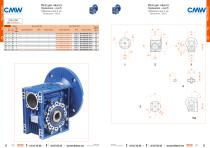
Replacement - size 25 Réducteurs roue & vis Motors, Gear Boxes Replacement - size 25 Réducteurs roue & vis STOCK ET PRIX SUR ITAFRAN.COM pour moteur B14 Codes réducteurs Codes moteurs Codes réducteurs Codes moteurs Masse réducteur Worm gear reducers Moteurs, Réducteurs Worm gear reducers Modèle déposé Tous droits de reproduction réservés Modèle déposé Tous droits de reproduction réservés
Open the catalog to page 7
Motors, Gear Boxes Replacement - size 30 Réducteurs roue & vis Replacement - size 30 Réducteurs roue & vis STOCK ET PRIX SUR ITAFRAN.COM Codes moteurs Codes réducteurs Codes moteurs Codes réducteurs Masse réducteur Worm gear reducers Moteurs, Réducteurs Worm gear reducers Modèle déposé Tous droits de reproduction réservés Modèle déposé Tous droits de reproduction réservés
Open the catalog to page 8
Replacement - size 40 Réducteurs roue & vis Motors, Gear Boxes Replacement - size 40 Réducteurs roue & vis STOCK ET PRIX SUR ITAFRAN.COM Codes moteurs Codes réducteurs Codes moteurs Codes réducteurs Masse réducteur Modèle déposé Tous droits de reproduction réservés Modèle déposé Tous droits de reproduction réservés Worm gear reducers Moteurs, Réducteurs Worm gear reducers
Open the catalog to page 9All CMW catalogs and technical brochures
 2024 leaflet
24 Pages
 Chains & sprockets
96 Pages
 Belts & Pulleys
171 Pages
 Accessories and tools
41 Pages


