


- Company
- Products
- Catalogs
- News & Trends
- Exhibitions
QIROX Sensor systems

QIROX Sensor systems
The document provides an overview of the QIROX sensor systems by CLOOS, designed to enhance automated welding processes. These systems ensure quality control and increase flexibility by compensating for tolerances between programmed paths and actual workpieces. Four main sensor types are discussed: tactile gas nozzle sensor, arc sensor, laser offline sensor, and laser online sensor.
This sensor uses an electro-mechanical principle to detect the start and end of weld seams, correcting deviations due to material tolerances. It can be combined with the arc sensor and is suitable for all materials with electroconductive surfaces. Key tasks include detecting start/end positions, defining workpiece positions, and measuring seam volume.
The arc sensor measures joint positions during welding, correcting torch positions to ensure the seam is centered. It compensates for material tolerances and heat distortions, enhancing productivity and quality. It supports various weld geometries and materials like steels and chrome nickel steels.
This sensor tracks the welding path offline before welding begins, using optical measurements to adjust programs to actual conditions. It is suitable for high-alloy steel, aluminum, and other materials. It offers contactless measurement and can be combined with the arc sensor.
The laser online sensor measures the welding section in real-time, adjusting torch positions and process parameters for optimal results. It offers maximum flexibility and is suitable for a wide range of materials, including coated and contaminated workpieces.
The document provides detailed technical specifications for each sensor type, including tasks, detectable geometries, materials, and sensor-specific data like dimensions, weight, and measuring capabilities.
An example application is provided for Goldbeck GmbH, where a robot system welds steel supports for building constructions using the QIROX system, demonstrating the practical use and benefits of these sensor systems in real-world scenarios.
The document describes a flexible robot system capable of controlling two independent welding robots. These robots can operate simultaneously on a single component or independently on different components. The system includes a turn/tilt positioner for optimal workpiece positioning, a torch changing system for single and tandem processes, and is designed for efficient production with synchronized welding and ancillary activities.
Various industries such as agricultural technology, commercial vehicles, metal construction, and heating technology benefit from CLOOS's welding systems. Specific processes like Speed Weld, Tandem Weld, Vari Weld, and Rapid Weld are tailored to meet the needs of these industries, offering advantages like high deposition rates, reduced component distortion, and minimal rework.
The document outlines several MIG/MAG welding processes, including Control Weld, Rapid Weld, Cold Weld, Tandem Weld, Narrow Gap Weld, TIG welding, Laser Hybrid Weld, and Vari Weld. Each process is designed for specific applications, material types, and thicknesses, ensuring high-quality and efficient welding results.
CLOOS offers comprehensive services from planning and production to commissioning and training. They provide advisory services, design solutions, and complete service packages for inspection, calibration, and maintenance, ensuring smooth installation and operation of their systems.
CLOOS has a worldwide presence with subsidiaries in countries like Austria, Belgium, Brazil, China, Czech Republic, Great Britain, India, Mexico, Russia, Switzerland, Turkey, and the USA, offering localized support and services.
CLOOS's innovative welding technologies and systems provide versatile and efficient solutions for various industries, backed by extensive service and global support. Their focus on quality, productivity, and customer satisfaction positions them as a leader in the welding technology sector.
Catalog excerpts
QIROX Sensor systems Top quality with each weld seam
Open the catalog to page 1
Tactile gas nozzle sensor Page 6 Laser offline sensor Page 10 Laser online sensor Page 12 Technical Data Page 14
Open the catalog to page 2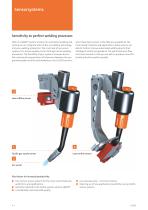
Sensitivity to perfect welding processes With our QIROX® system solution for automated welding and cutting we can integrate state-of-the-art welding technology into your welding production. The main task of our sensor systems is to ensure quality control through precise welding procedures. The flexibility of your systems increases due to the control and compensation of tolerances between the programmed paths and the real workpieces. Four CLOOS sensors which have been proven in the field are available for the most varied materials and applications; these sensors are able to further improve automated...
Open the catalog to page 4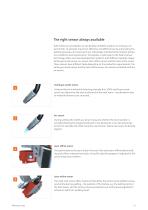
The right sensor always available With intensive consultation we can develop complete solutions to meet your requirements. To generate maximum efficiency and effectiveness by automating the welding processes, all components are individually matched to the relevant production conditions and requirements. This applies in particular to the field of sensor technology, where we have developed four products with different capacity ranges: tactile gas nozzle sensor, arc sensor, laser offline sensor and the laser online sensor. These sensors have different tasks depending on the production requirements....
Open the catalog to page 5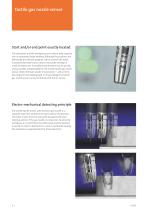
Tactile gas nozzle sensor Start and/or end point exactly located The start point and the workpiece joint contour play a special role in automated robot welding. Although the positions are defined by the relevant program which controls the robot, in practice deviations occur due to inaccurate settings or material tolerances. To enable these deviations to be quickly and accurately compensated for, the CLOOS tactile gas nozzle sensor checks the start and/or end positions – and corrects the programmed welding path correspondingly. The tactile gas nozzle sensor can be combined with the arc sensor....
Open the catalog to page 6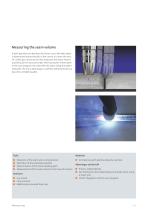
Measuring the seam volume If both positions are defined, the linear run of the weld seam is determined automatically. In the case of a V seam the tactile CLOOS gas nozzle sensor also measures the seam volume according to the same principle. After saving the information in the user program, the robot fills the seam along the optimised path. The main advantage is a perfect welding result as a basis for a reliable quality. Tasks ■ Detection of the start and/ or end position ■ Definition of the workpiece position ■ Determination of the linear welding path ■ Measurement of the seam volume in the case...
Open the catalog to page 7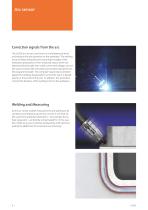
Correction signals from the arc The CLOOS arc sensor uses the arc to simultaneously weld and measure the joint position on the workpiece. The welding torch oscillates along the joint scanning the edges of the weld seam preparation. If the measured values, which are obtained electronically from weld current and voltage, are not the same on both sides, the weld seam position deviates from the programmed path. The computer-based robot controller adjusts the welding head position so that the seam is placed exactly in the centre of the joint. In addition, this procedure corrects the distance of the...
Open the catalog to page 8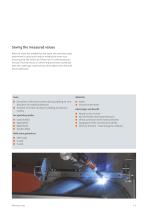
Saving the measured values After the robot has welded the root seam, the correction data determined is saved and used for welding the cover runs ensuring that the build-up of these runs is continuously optimised. The final result is further improved when combined with the CLOOS gas nozzle sensor, which determines the start of the weld seam. Materials ■ Steels ■ Chrome nickel steels Advantages and benefit ■ Nearly no loss in time ■ No interference from attached parts ■ Direct connection to the robot controller ■ Adaptation of the correcting sensitivity ■ Memory function - data storage for welding...
Open the catalog to page 9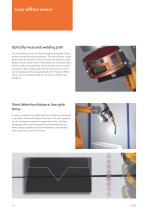
Laser offline sensor Optically measured welding path The laser offline sensor tracks the programmed path offline before starting the welding process. The sensor sends a light beam onto the material surface, receives the reflection and obtains every measurement information on the actual seam position and seam geometry. This procedure can be used for materials made of high-alloy steel and aluminium as well as for unalloyed steel and galvanised steel. The laser offline sensor can be combined with the arc sensor without any problems. Short detection distance, low cycle times In order to achieve very...
Open the catalog to page 10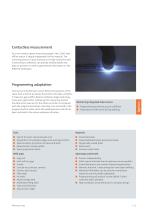
Monitoring Integrated video camera ■ Programming aid where access is difficult ■ Observation of the torch during welding Contactless measurement As a non contact optical measuring system, the CLOOS laser offline sensor is largely independent of the material. The scanning process is quick and due to its high resolution and insensitivity to reflection can provide reliable details and data on positions as well as geometrical information on the different weld types. Programming adaptation During scanning the laser sensor detects the position of the seam start and end, as well as the position of tubes...
Open the catalog to page 11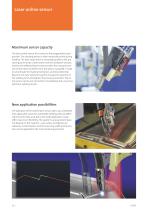
Laser online sensor Maximum sensor capacity The laser online sensor first moves to the programmed start position. The tracking section is then measured online during welding. The laser head which is mounted parallel to the processing point sends a laser beam onto the workpiece surface, receives the reflected beams and transfers the measured results to the robot controller. Here the data is evaluated in order to compensate for material tolerances and heat distortion. Based on the new values the system changes the position of the welding torch and adjusts the process parameter. The online sensor...
Open the catalog to page 12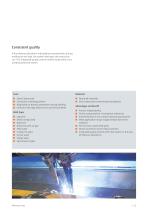
Consistent quality If the tolerance deviations indicated by measurements during welding are too high, the system interrupts the production run. This integrated quality control inhibits faulty welds, thus avoiding extensive rework. Tasks ■ Search seam start ■ Correction of tooling position ■ Adaptation of process parameters during welding ■ Control of the edge offset in the case of butt welds Weld types ■ Lap joint ■ Multi overlap weld ■ Butt joint ■ Butt joint with air gap ■ Fillet weld ■ V weld, HV weld ■ Corner weld ■ Flange weld ■ Special seam types Materials ■ Nearly all materials ■ Even...
Open the catalog to page 13All CLOOS catalogs and technical brochures
 QINEO BASIC 300 C 2020
4 Pages
 QINEO MICRO PULSE 200
3 Pages
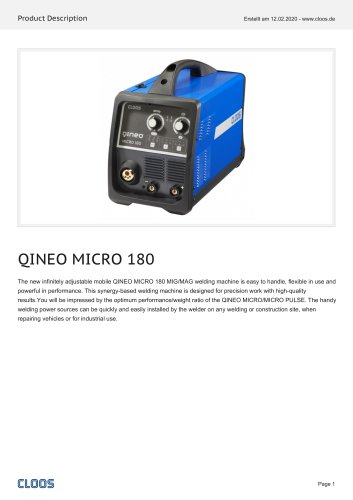 QINEO MICRO 1802020
3 Pages
 QINEO MICRO 300
3 Pages
 QIROX Entry Package
12 Pages
 QIROX RoboPlan
16 Pages
 QIROX Compact cells
32 Pages
 QIROX Welding robots
32 Pages
 QIROX Compact systems
40 Pages
 QINEO NexT
32 Pages
 QINEO – Product Overview
44 Pages
 Welding
32 Pages
 Grinding Solution
4 Pages
 QIROX Laser Cell
12 Pages
 QIROX QC2 Master
2 Pages
 QIROX QC2 Advanced
2 Pages
 Carl Cloos Schweisstechnik GmbH
28 Pages
 C-Gate
4 Pages


Archived catalogs
 QINEO® PULSE
10 Pages
 QINEO MICRO 180 2016
3 Pages
 QINEO BASIC 300 C 2016
4 Pages
 QINEO STEP 350 C
3 Pages
 QINEO Plasma Cut 30
3 Pages
 Laser hybrid head LHP - IMG
2 Pages
 QINEO CHAMP 450
4 Pages
 QINEO TRONIC PULSE 350
3 Pages
 QINEO® STEP
8 Pages
 QINEO STEP 250 C
3 Pages
 QINEO CHAMP 451 PRO
3 Pages
 QINEO CLE 352 (DC)
3 Pages
 QINEO NexT 452 DC
2 Pages
 QWD-M2
2 Pages
 QWD-AR
2 Pages
 MRW 300 - 35° - 78/273
2 Pages
 Narrow gap blade 350-0°-LED
2 Pages
 Single wire cleaning CMR7C
2 Pages
 Standard head
2 Pages
 QN PT 40 Circle cutting set
2 Pages
 TIG Drive CWD 45° Ø1.2 AS21
2 Pages


- Welding system
- Industrial robot
- Chiller
- Automation software solution
- Articulated robot
- Control software
- Liquid recirculation chiller
- Handling robot
- 3D software solution
- Industrial software
- Water recirculation chiller
- HMI
- Programming software
- Compact robot
- Current sensor
- High-speed robot
- Precision welding machine
- Robotic cell
- Creation software
- Test software