

'Double use' Ramps

'Double use' Ramps
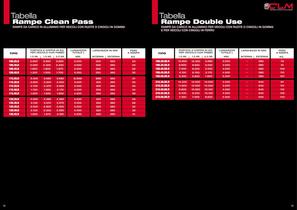
Aluminum Loading Ramps Specifications
This document provides detailed technical specifications for aluminum loading ramps designed for vehicles with rubber wheels or tracks, and for vehicles with iron tracks.
Ramp Types and Load Capacities
The ramps are categorized by type codes (e.g., 100.25.D, 115.30.D, 190.30.SB.R) and are specified according to their load capacity per pair in kilograms (kg). Load capacities vary widely, from 1,300 kg up to 14,000 kg depending on the ramp type and size.
Dimensions and Vehicle Compatibility
- Length (L): Available in 1.0 m, 1.5 m, and 2.0 m lengths, with total length in millimeters (mm) specified for each ramp type.
- Width: Internal and external widths are provided in millimeters, ranging from 300 mm to 640 mm depending on the ramp model.
- Vehicle Wheelbase: Ramps are designed for vehicles with specific wheelbase lengths, ensuring compatibility.
Weight of Ramps
The weight per ramp is listed in kilograms, ranging from 20 kg for smaller ramps up to 143 kg for the largest, heaviest-duty ramps.
Ramp Series Overview
- Clean Pass and Double Use Ramps: These include models such as 100.xx.D, 115.xx.D, and 120.xx.D series, with load capacities from 1,300 kg to 4,500 kg and widths from 300 mm to 380 mm.
- Heavy-Duty Ramps: Models like 190.xx.SB.R and 210.xx.SB.R series support higher loads from 5,300 kg up to 14,000 kg, with wider ramps (580 mm to 640 mm) and heavier weights.
Key Parameters and Recommendations
- Ensure selection of ramp type matches vehicle wheelbase and load requirements.
- Consider ramp width for vehicle track or wheel type compatibility.
- Ramp weight affects handling and installation; heavier ramps correspond to higher load capacities.
This structured data supports informed selection of aluminum loading ramps tailored to specific vehicle configurations and operational needs.
Catalog excerpts
tr.row {} td.cell {} div.block {} div.paragraph {}
Open the catalog to page 1All C.L.M catalogs and technical brochures
 Ramps 21/23 series
1 Page
Archived catalogs
 Ramps for track vehicles
1 Page
 Clean Pass Ramps
1 Page
 Types of connection
1 Page
 Aluminium pedestrian bridges
1 Page
 Load Line
1 Page
 Pont Levis
1 Page


