
- Catalogs
- Climbing Technology
- Catalogo PROFESSIONAL 2017

Catalogo PROFESSIONAL 2017
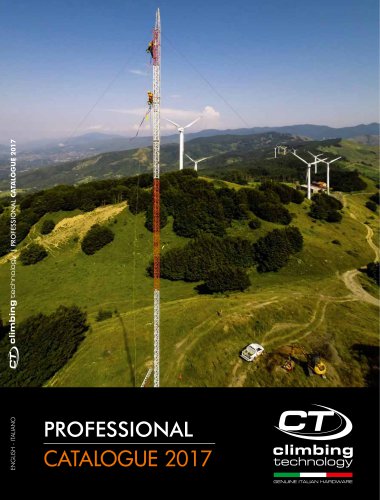
Catalogo PROFESSIONAL 2017
Climbing Technology (CT), a brand under Aludesign S.p.A., specializes in Personal Protective Equipment (PPE) for vertical activities like mountaineering and rescue. Their products, made in Italy, comply with ISO 9001:2008 and EN 14001 standards, focusing on safety and functionality.
The catalogue includes fall arresters, lifelines, rescue tripods, descenders, ascenders, pulleys, anchors, ropes, harnesses, helmets, headlamps, lanyards, connectors, and quick-links, all designed to meet high safety standards with clear instructions.
CT emphasizes the importance of proper training and understanding of PPE use, advising users to undergo specialized courses and thoroughly read product instructions.
Work at height involves risks like falls, requiring protection measures such as collective protection equipment (CPE) and PPE. PPE is used when CPE is not feasible, justified by a risk analysis.
PPE is categorized into three classes: Category I for minor injuries, Category II for serious risks, and Category III for life-threatening risks. Adequate training and emergency procedures are mandatory.
Risks in temporary work at height include prevalent risks (falling from height) and environmental risks (site conditions and weather). Risk reduction measures include ensuring operators are in good condition, providing training, and documenting residual risks.
Specific procedures for rescuing operators after a fall are included, ensuring teams can perform emergency procedures and contact public rescue services.
Includes restraint systems, rescue systems, work positioning systems, fall arrest systems, and rope access systems, each designed for specific safety needs.
Includes full body harnesses, positioning harnesses, complete harnesses, and rescue harnesses, each designed for specific applications.
The fall factor is calculated as the height fallen divided by the rope length. High fall factors can cause severe injuries, mitigated by energy dissipation systems keeping force below 6 kN.
The minimum distance required between the operator and the ground to ensure safety during a fall, calculated by summing device length, rope extension, and safety distance.
Refers to the horizontal distance traveled after a fall, posing a risk of collision with obstacles.
Anchor points are categorized into artificial, natural, and structural types, with artificial anchors complying with EN 795 standards.
Aludesign S.p.A. products are certified under UNI EN ISO 9001:2008, with each product tested according to CE/EN norms. Connectors are tested at 12 kN, and karabiners exceed 100,000 cycles without performance impairment.
Includes Screw Gate, Twist-Lock Gate, Triplex Gate, Automatic Gate, and Double Gate, each requiring specific movements to open and automatically returning to the locking position.
Aludesign S.p.A. holds over 20 worldwide patents, introducing devices that set new safety standards.
Lists various EN standards applicable to PPE for fall protection, evacuation, rescue, and mountaineering.
Regular checks are crucial for ensuring PPE efficiency and safety, conducted every 12 months under normal use, every 6 months for intense use, or when anomalies are detected.
Operators must use appropriate safety equipment, including retractable fall arresters and energy absorber lanyards, with a rescue kit available on-site.
Rescue kits are mandatory for various work scenarios, equipped with components like the Sparrow 200R descender.
Involves descending along a vertical or steep surface using ropes, requiring three ropes: a working line, a safety line, and an emergency line.
Outlines procedures for evacuating people from stationary chairlifts using a team of operators and specific equipment.
Covers techniques for tree maintenance and controlled felling, using equipment like ascending handles and self-braking descenders.
Emphasizes the importance of using certified equipment and following safety standards.
Details various climbing and safety equipment, including harnesses, helmets, headlamps, and lanyards, with compliance to European standards.
Describes a compact and manageable lanyard available in different lengths, with features like a smooth-sliding regulator and large cam diameter.
Details a high-strength safety rope acting as an energy absorber for falls, with features like eyelets with thimbles and double-layer stitching.
Outlines various fall arresters and lifelines, including the Easy Move and SKR-2, designed for grip on dirty or icy ropes.
Equipped with Patron Plus 11 Ø 11 mm rope and connectors, suitable for use with various fall arrester devices.
Provides specifications for retractable fall arrest devices designed for work at height, adhering to EN 360:2002 standards.
Includes checks for fall indicators, connectors, swivels, webbing, and functional checks.
Details connectors designed for expert climbers, made in Italy, and adhering to standards EN 362:2004 and EN 12275:2013.
Provides specifications for descenders, ascenders, and accessories designed for work on ropes and rescue operations.
Describes foot ascenders and pulleys designed for tree climbing and rescue operations, made from durable materials.
Details a rope cutter and rescue tripods designed for lifting people or equipment, with systems like LIFTY and LIFTY X6.
Details various ropes and protective equipment designed for climbing and rescue operations, conforming to EN 1891:1998 standards.
Catalog excerpts

ENGLISH - ITALIANO
Open the catalog to page 1
YOUR SAFETY PARTNER Climbing Technology (CT) is the brand of Aludesign S.p.A., a company with 30 years of international experience developing and manufacturing Personal Protective Equipment (PPE). CT operate in a factory of 6000 sqm located in Italy, between Bergamo and Lecco, a geographical area characterized by a strong and recognized mountaineering tradition. The extensive know-how, combined with the newest manufacturing technologies, is the prerequisite for the development and production of devices conceived to excel in all vertical activities: mountaineering, sport climbing, work at heights,...
Open the catalog to page 3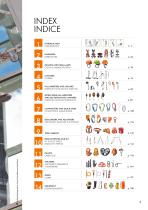
INTRODUCTION INTRODUZIONE HARNESSES IMBRACATURE HELMETS AND HEAD-LAMPS CASCHI E LAMPADE FRONTALI LANYARDS CORDINI FALL ARRESTERS AND LIFELINES DISPOSITIVI ANTICADUTA E LINEE VITA RETRACTABLE FALL ARRESTERS AND SELF RETRACTING LANYARDS DISPOSITIVI ANTICADUTA RETRATTILI CONNECTORS AND QUICK-LINKS CONNETTORI E MAGLIE RAPIDE DESCENDERS AND ASCENDERS DISCENSORI, RISALITORI E ACCESSORI TREE CLIMBING RESCUE TRIPODS AND KIT KIT DI SOCCORSO, PARANCHI E TRIPODI PULLEYS CARRUCOLE ANCHORS ANCORAGGI PERMANENTI E TEMPORANEI ROPES CORDE EQUIPMENT EQUIPAGGIAMENTO 9 10 Climbing Technology archive - photo byPunta...
Open the catalog to page 5
INTRODUCTION PREMESSA For a long time we have wanted to include in our catalogue a practical explanation of how best to use our products. This is not intended to be a manual nor to substitute a training course, but simply to give a summary of the main activities involved in temporary work at height and rescue fields. For us, safety is a constant, absolute “must”. This attitude drives us to invent, produce and sell products which are safe. A safe product isn’t just one which functions correctly and which meets the legal standards: a safe product is functional, logical, ergonomic, long-lasting,...
Open the catalog to page 7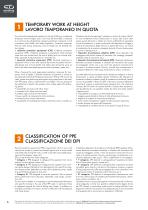
TEMPORARY WORK AT HEIGHT LAVORO TEMPORANEO IN QUOTA Any activity that exposes the operator to the risk of falling is considered temporary work at height: such a risk must be eliminated or reduced to a minimum by adopting the necessary protection measures, in full compliance with Health and Safety legislation. Protection measures that are used during temporary work at height can be divided into two classes: • collective protection equipment (CPE). Collective protection equipment (CPE). Collective protection is equipment which protects more than one worker from the risk of falling and can include...
Open the catalog to page 8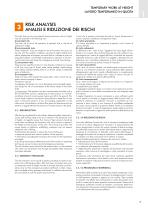
TEMPORARY WORK AT HEIGHT LAVORO TEMPORANEO IN QUOTA RISK ANALYSIS ANALISI E RIDUZIONE DEI RISCHI The risks that can be encountered during temporary work at height may be classified in the following way: A) prevalent risk. The main risk to which the operatory is exposed, that is, the risk of falling from height. B) environmental risks. These “objective” risks are related to the environment, the layout of the site, and the weather conditions: eg risks of objects falling from above, slipperiness of supports, structural failure, collapse of parts not being demolished, uncontrolled working-down, exposure...
Open the catalog to page 9
TYPES OF PPE SYSTEMS SISTEMI DI PROTEZIONE INDIVIDUALE Different PPE devices are assembled together to create systems and subsystems which protect the operator in the event of a fall from a height, preventing or arresting the fall. They can be classified as follows. A restraint system limits the movement of the operator so that s/he cannot reach a zone from which a fall from a height is possible. This system does not arrest a fall, rather, it is designed to prevent a fall taking place. Such a system is not suitable for work situations where the operator needs to be supported by a harness. Un...
Open the catalog to page 10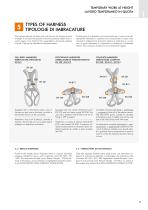
TEMPORARY WORK AT HEIGHT LAVORO TEMPORANEO IN QUOTA TYPES OF HARNESS TIPOLOGIE DI IMBRACATURE The harness restrains the body and must be worn for temporary work at height. It connects the operator to her/his protection system and, in certain cases, it can hold her/him suspended or during the arresting of a fall. They can be classified as illustrated below. FULL BODY HARNESSES IMBRACATURE ANTICADUTA EN 361 L’imbracatura è un dispositivo di contenimento per il corpo ed è indispensabile indossarla in qualsiasi lavoro temporaneo in quota. Essa consente il collegamento al proprio sistema di protezione...
Open the catalog to page 11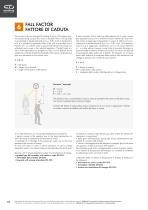
FALL FACTOR FATTORE DI CADUTA The human body can withstand a loading of up to 6 kN without internal injuries being caused. This value is reached when a 100 kg body is accelerated or decelerated at 6 g (1 g = 9,81 m/s2). A deceleration of 6 g is reached, for example, when a fall of 6 m is braked over a distance of 1 m, and this value is used as the maximum the body can withstand and is used in the relevant legislation. The fall factor is a value which describes how dangerous a fall is and is defined as the height lost in the fall divided by the length of the rope (or safety device) that joins...
Open the catalog to page 12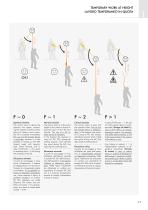
TEMPORARY WORK AT HEIGHT LAVORO TEMPORANEO IN QUOTA Optimal situation. The anchor point is above the operator, the system connecting the operator and the anchor point is in tension, and a possible fall is arrested immediately. The use of a fall arrester device is advisable, however it is also possible to employ an EN 354 lanyard made with dynamic rope. These lanyards, only in case of fall factor < 0.5, grant an arresting force < 6 kN during the arresting of the fall. Normal situation The anchor point is at the same height as the chest or dorsal attachment point of the EN 361 harness. The use...
Open the catalog to page 13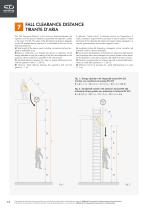
FALL CLEARANCE DISTANCE TIRANTE D’ARIA The “fall clearance distance” is the minimum distance between the operator and the ground needed to guarantee the operator’s safety in the event of a fall. The value of the fall clearance distance depends on the fall arrester device used and it is calculated as the sum of the following distances: A) Total length of the device used, including connectors and any lanyards or extensible arms; B) Rope or cable that runs through the device or extension of the energy absorber during the arresting of the (this value depends on the particular device used and is specified...
Open the catalog to page 14All Climbing Technology catalogs and technical brochures
 Catalog PROFESSIONAL 2020 / 2021
196 Pages
 Catalog OUTDOOR 2021
120 Pages
 EXPLORER
2 Pages
 FLIK
FLIK2 Pages
 CLASSIC-K SLIDER
2 Pages
 MOON
MOON3 Pages
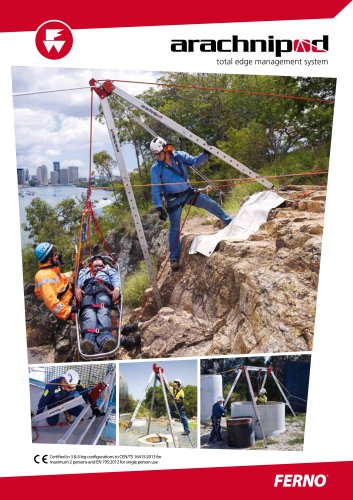 Brochure ARACHNIPOD
8 Pages
 Catalogue OUTDOOR 2019
178 Pages
 Catalog PROFESSIONAL 2018
180 Pages
 Catalog OUTDOOR 2018
196 Pages
- Mechanical protection protection gloves
- Work safety gloves
- Sling
- Hard hat
- Leather protection gloves
- Lanyard
- Fall-arrest harness
- Plastic helmet
- Strap
- Metal carabiner
- Locking carabiner
- ABS helmet
- White helmet
- Yellow helmet
- Full-body harness
- Lightweight helmet
- Shock absorbing fall arrest lanyard
- Cable pulley
- Blue helmet
- Lashing sling