
- Catalogs
- Climbing Technology
- Catalog OUTDOOR 2018

Catalog OUTDOOR 2018

Catalog OUTDOOR 2018
Climbing Technology, a brand of Aludesign S.p.A., has 30 years of experience in designing and manufacturing personal protective equipment for climbing. The company emphasizes safety, functionality, and simplicity, adhering to European standards.
Practical Explanations
This section offers guidance on using Climbing Technology products, focusing on safety and proper usage for Single-pitch sport climbing, Multi-pitch climbing, and Via Ferrata. It includes recommended products and diagrams.
Innovation
Innovative products include the Click Up + belay device, enhancing the assisted-braking system, and the Alpine Up device for versatile belaying and abseiling. The Rollnlock pulley/rope clamp is noted for emergency use.
Single-Pitch Sport Climbing
Necessary Equipment: Helmet, harness, belay device, quickdraws, single rope, chalk bag, slings, screw-gate karabiners, and a rope bag.
Climbing Sequence: Involves buddy checks, leading, belaying, and lowering-off, emphasizing proper equipment and techniques.
Preparing to Climb: Includes harness adjustment, knot tying, and belay device setup, stressing the need for training and safety protocols.
Conclusion
Climbing Technology highlights the importance of safety and proper equipment use, focusing on innovation and user safety.
Discusses belay devices in sport climbing, focusing on assisted braking devices like the Click Up, which allows quick rope payout without jamming and remains safe even if the rope is inserted incorrectly.
Belaying Techniques
Outlines techniques for using the Click Up device, including paying out rope, taking-in rope, holding a fall, and lowering the climber. The device is suitable for beginners and climbing schools.
Clipping Techniques
Guidance on correct clipping techniques to ensure safety, avoiding dangerous situations like back-clipping.
Threading the Belay
Instructions for safely threading the belay when a karabiner is unavailable, using knots to secure the rope.
Multi-Pitch Routes
Describes equipment and procedures for climbing multi-pitch routes, including leading through pitches, building stances, and abseiling descent.
Conclusion
Emphasizes the importance of technical education and safety instructions when using climbing equipment.
Introduces the Alpine Up belay/abseil device for modern multi-pitch sports routes, featuring a Click Up mode for semi-static fall arrest.
Specifications and Usage
Can be used with twin-/half-ropes or a single rope, offering versatility for climbing teams.
Belaying Techniques
Includes adjusting the ascent harness, belaying at the stance, and using the Alpine Up in Click Up mode.
Belaying on Trad/Alpine Routes
The Alpine Up in Dynamic mode allows easy rope payout without jamming.
Positioning Quickdraws
Correct placement of quickdraws is essential to avoid dangerous situations.
Bringing Up Seconds
The Alpine Up in Guide mode allows independent belaying of two climbers.
Abseiling Procedures
Outlines the sequence for safe abseiling, emphasizing proper technique and organization.
Conclusion
Emphasizes the importance of technical education and consulting user instructions for safe climbing practices.
The Alpine Up device in Click Up mode offers abseiling without a backup Prusik knot, providing safety in emergencies.
Multi Chain Evo Daisy Chain
A daisy chain made from Dyneema webbing, designed for mountaineering, with a load-bearing capacity of 24 kN.
Be Up Belay/Rappel Device
Versatile for belaying and abseiling with half, twin, and single ropes, featuring a modular braking system.
Rollnlock Pulley/Rope Clamp
Used for work, rescue, and self-rescue situations, suitable for crevasse rescue and hauling light loads.
Via Ferrata Climbing
Involves using a set of equipment including a helmet, harness, and Via Ferrata set, with safety as a priority.
1. Attachment: Loop the via ferrata set through the harness and form a larksfoot knot.
2. Climbing Steps: Connect both arms of the via ferrata set to the safety cable using karabiners.
3. Warnings: Always use two karabiners on the safety cable, never unclip both simultaneously.
Safety Considerations:
1. Falling: The energy absorber in the via ferrata set activates to absorb energy.
2. Roped Pair Movement: Recommended for children, inexperienced climbers, or difficult sections.
Technical Features:
1. Locking Systems: Various gate types and locking systems ensure safety.
2. Innovations: New rubber fasteners and energy absorbers enhance safety.
Standards and Certifications:
1. Mountaineering Equipment: Standards for ropes, slings, connectors, helmets, ensuring safety.
2. Work Equipment: Standards for protection against falls and connectors.
Product Features:
1. Nimble Fixbar Set: Ergonomic quickdraws with robust carabiners.
2. Carabiners: Designed for sport climbing with ergonomic shapes and catch-free closures.
Specifications:
- AERIAL PRO SET: Lightweight quickdraws with hot-forged carabiners and Dyneema slings.
- LIME SET: Multipurpose quickdraws with classic shape carabiners.
- FLY-WEIGHT EVO: Ultra-light quickdraws with wire gate carabiners.
- GYM SET: Fixed quickdraws for indoor and outdoor use.
Procedures and Recommendations:
- All carabiners feature a catch-free nose to prevent accidental snagging.
- Products focus on weight/strength ratio, using hot-forged light alloy materials.
- Quickdraws equipped with rubber fasteners to prevent rotation.
Standards and Compliance:
- All products comply with EN 12275:2013 standards.
- Manufactured in Italy, ensuring high-quality production standards.
Key Features:
- Hot-forged carabiners for enhanced strength and reduced weight.
- Dyneema and polyamide slings available in various widths and lengths.
- Innovative designs to improve grip and ease of use during climbing maneuvers.
CLICK UP+: Innovative belay device with manual assisted-braking, compatible with single ropes of 8.5-11 mm diameter.
Alpine Up: Versatile belay/rappel device suitable for mountaineering, supporting half, twin, and single ropes.
BE-UP: Designed for multi-pitch sport climbing and trad routes, allowing independent belaying of two climbers.
Groove and Crocodile: Multipurpose belay/rappel devices made from hot-forged light alloy.
Otto and ACLES DX: Light alloy descenders for single ropes, ideal for speleology.
Additional Accessories: Includes pulleys like ORBITER and ROLLNLOCK for hauling and load deviations.
General Recommendations: Users should read device instructions carefully before use to ensure safety and proper handling.
1. Orbiter Series: Designed for use with ropes of Ø 13 mm, complying with EN 12278:2007 standards.
2. Quick Roll: Handle ascender with an integrated pulley, suitable for ropes Ø 8 ÷ 13 mm.
3. Quick’Up+: Ascender designed for ropes Ø 8 ÷ 13 mm, featuring an ergonomic handle.
Procedures and Applications:
1. Caving and Rope Work: Quick Roll handle ascender can be used in caving with a chest ascender.
2. Climbing and Rescue: Quick’Up+ and Chest Ascender models are designed for climbing ropes.
Norms and Standards:
1. EN 12278:2007: Applicable to the Orbiter series for pulley systems.
2. EN 567:2013 and EN 12841:2006-B: Standards for ascenders.
Recommendations and Best Practices:
1. Use of Integrated Pulley: The integrated pulley in the Quick Roll is not PPE.
2. Cam System: Patented cam system in ascenders allows for easy unlocking.
Additional Accessories:
1. Foot Loop and Foot Steps: Designed for mountaineering and caving.
2. Swivels: Twirl and Twister models prevent rope twisting.
Harnesses:
1. WALL and ANTHEA: Lightweight harnesses designed for mountaineering.
2. ON-SIGHT and ASCENT: Harnesses designed for sport climbing.
Detailed specifications and features of climbing and mountaineering equipment, including harnesses, helmets, and headlamps.
Harnesses:
- TAMI Harness: Lightweight, made with breathable mesh fabric, features the Rel-Easy system.
- Explorer Harness: Designed for via ferrata and climbing schools, features padded waist-belt and leg loops.
- Jungle Harness: Full-body harness for children, adjustable, with ergonomic design.
Helmets:
- Orion Helmet: Ultra-light, comfortable, with excellent ventilation.
- Galaxy Helmet: All-round helmet for various climbing activities.
- Eclipse Helmet: Designed for women and children, lightweight.
Headlamps:
- Lumex Pro: High-performance headlamp with 185 lumens.
- Lumex: Ultra-light headlamp with 85 lumens.
Standards and Compliance:
All products comply with relevant European standards, ensuring safety and performance.
Conclusion:
Comprehensive information on the technical features, weight, and compliance standards of various climbing and mountaineering equipment.
Outlines specifications for via ferrata sets, focusing on EN 958:2017 standards.
Innovations:
The SLIDER energy absorber features a progressive tearing mechanism for precise load regulation during falls.
Product Features:
Via ferrata sets equipped with the SLIDER energy absorber, catering to users weighing between 40 kg and 120 kg.
Product Variants:
Includes HOOK-IT SLIDER, TOP SHELL SLIDER, and CLASSIC-K SLIDER, each with specific features.
Additional Equipment:
Descriptions of other climbing accessories like leather gloves, helmets, harnesses, and protection gear.
Conclusion:
Comprehensive information on via ferrata sets and related climbing equipment, emphasizing safety and compliance with standards.
Specifications:
- SYMMETRIC DAISY CHAIN: Made of durable polyamide, with a strength of 22 kN.
- MULTI CHAIN EVO: Constructed with Dyneema webbing, featuring a constant 24 kN-rated strength.
- SPORT CHAIN: Similar to the Multi Chain Evo but with five intermediate loops.
- LOOPER DY: Dyneema loop sling available in various lengths.
- LOOPER PA: Polyester HT high strength sling available in various lengths.
Anchors and Belay Stations:
- PLATE: Made of stainless steel, conforming to EN 959:2007 and EN795:2012 standards.
- ANCHOR BOLTS: Available in various sizes and strengths.
- GLUE-IN ANCHORS: Made of stainless steel, designed for use in corrosive environments.
- PLATE KIT: Includes a bolt and a multidirectional anchor plate.
Tools and Accessories:
- NUTS TOOL: Functional hook in hardened steel.
- FIFI TOOL: Lightweight tool for hauling loads.
Key Standards: Most products conform to EN 566:2006, EN 569:2007, EN 959:2007, and EN795:2012 standards.
1. Plate Kits: Various models with specifications such as weight, diameter, and load capacity.
2. Glue-In Anchors: Different models with specifications including diameter and load capacity.
3. Belay Stations: Models with specifications like diameter and load capacity.
Ice Axes:
1. North Couloir: Designed for ice climbing and technical mountaineering.
2. Alpin Tour: Classic ice axe for glacier travel.
3. Agile: Lightweight ice axe for ski-touring competition.
Crampons:
1. Hyper-Spike: Modular 13-point crampons for steep ice walls.
2. Lycan: Technical twelve-point crampons for mountaineering.
Accessories:
1. Whippy/Swhippy: Elastic slings for ice axes.
2. Snow Blade: Aluminium snow shovel.
3. Ice Hook and Screw: Hardened steel tubular ice screws.
Recommendations:
1. Ensure all equipment conforms to relevant safety standards.
2. Use appropriate gear for specific climbing activities.
3. Regularly inspect equipment for wear and damage.
1. Product Specifications:
- Nuptse Evo Crampons: Available in classic, semiautomatic, and automatic versions.
- Nevis Flex Crampons: Designed for classic lines on glacial terrain.
- Snow Flex Crampons: Designed for ski touring.
- Mini Crampons: Available in 4 and 6 point versions for low-grade winter hikes.
2. Standards and Compliance:
- All crampons adhere to EN 893:2010 standards.
3. Additional Equipment:
- ProSnow Gaiters: Designed for alpinism and winter trekking.
- Ice Traction Crampons: Provide extra grip on various terrains.
4. Storage and Accessories:
- All crampons come with a canvas storage bag.
- Various bars and antibott accessories are available.
5. Manufacturing Details:
- Most products are made in Italy, with some accessories manufactured in P.R.C.
Catalog excerpts

| CLIMBING EQUIPMENT CATALOGUE 2018 Klaus Dell’Orto_Climbing Technology SOUTDC1706ADEA4 _ C. Stenghel, Pian Schiavaneis, Canazei Climbing Technology is a brand of Aludesign S.p.A. via Torchio 22 I 24034 Cisano B.sco BG ITALY Central tel: +39 035 783595 Fax: +39 035 782339 International dpt. : [email protected] Domestic dpt. (Italy) : [email protected] www.climbingtechnology.com Sarl Climbing Technology - France Parc des Erables - 6, rue des Artisans 74100 Vetraz Monthoux - FRANCE Central tel : +33 (0)4 50493741 Mobile : +33 (0)6 20060268 Mail: [email protected] CLIMBING EQUIPMENT
Open the catalog to page 1
A. Orlandi / Climbing Technology Climbing Technology behält sich das Recht vor, ohne vorherige Ankündigung Verbesserungen oder Änderungen der Produkte vorzunehmen.
Open the catalog to page 2
CLIMBING PASSION: TRUE PASSION CAN ONLY GROW. Climbing Technology as a brand holds and celebrates 30 years of passion and experience in the design and manufacturing of personal protective equipment. An accomplice has definitely been the territory, at the foot of the mountains between Bergamo and Lecco, where the mountaineering tradition is very strong, we settled here and set about developing our skills in metalwork and mechanics. In these 30 years we have breathed and developed an extensive know how and combined with the latest generation of manufacturing technology it has enabled us to design...
Open the catalog to page 3
P Biagini, Ombra 8b/+, Finale Ligure . M.Pavana_ Climbing Technology
Open the catalog to page 4
For a long time we have wanted to include in our catalogue a practical explanation of how best to use our products. This is not intended to be a manual nor to substitute a formal climbing course, but simply to give our customers, and friends, a summary of the main activities involved in climbing and mountaineering. For us, safety is a constant, absolute “must”. This attitude drives us to invent, produce and sell products which are safe. A safe product isn’t just one which functions correctly and which meets the legal standards: a safe product is functional, logical, ergonomic, long-lasting, easy...
Open the catalog to page 5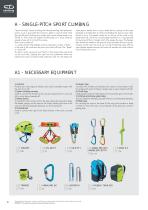
A - SINGLE-PITCH SPORT CLIMBING “Sport climbing” means climbing with already-existing fixed protection points, so as to guarantee the maximum safety in case of a fall. Most (but not all) sport climbing is on single-pitch routes whose length is up 35/40 m. The routes are bolted by enthusiasts or in some cases by people whose job it is to bolt the routes. Each route consists of: • a series of fixed intermediate anchors, expansion or glue-in bolts; • the end of the route and the point you lower-off from, the “belay” or “lower-off”. To climb a route, someone must “lead” it, that means they must climb...
Open the catalog to page 6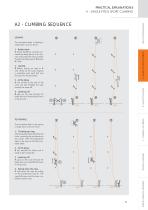
LEADING. The successive steps in leading a single-pitch route are shown. 1 - Buddy check. A checks that B has correctly connected the belay device to his harness and passed the rope correctly through the belay device. B checks A's knot. 2 - Leading. B belays, paying out rope to A who climbs up the route, clipping a quickdraw onto each bolt and the rope into the quickdraw. 3 - At the belay. A has arrived at the end of the route and has threaded the rope through the lower-off. 4 - Lowering-off. B pays out the rope through the belay device to lower A back down to the ground. PRACTICAL EXPLANATIONS...
Open the catalog to page 7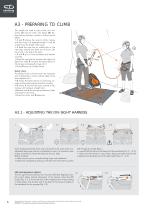
A3 - PREPARING TO CLIMB Two people are need to sport climb, one who climbs (A) and the other who belays (B). Before starting climbing, a series of actions ensure safety: • A and B choose the route to climb, making sure their rope is of adequate length. It must be at least twice the length of the route; • A feeds the rope into an orderly pile on the rope bag, making sure there are no knots. She ties a knot in the end of the rope; • A and B put on their harnesses and helmets correctly; • A ties the rope into her harness with a figure of eight knot while B connects the belay device to his harness...
Open the catalog to page 8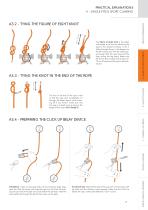
PRACTICAL EXPLANATIONS A - SINGLE-PITCH SPORT CLIMBING The figure of eight knot is the safest and easiest to tie knot for attaching the rope to the climber’s harness. To tie it follow the steps shown in the diagram to the left making sure that the rope passes through both the waist loop and the loop joining the leg loops. Make sure the knot is tied correctly and at least 1012 cm of free end of the rope is left sticking out. A3.3 - TYING THE KNOT IN THE END OF THE ROPE A - SINGLE-PITCH SPORT CLIMBING A3.2 - TYING THE FIGURE OF EIGHT KNOT The knot in the end of the rope is tied so that the rope...
Open the catalog to page 9
A4 - BELAYING THE LEADER Belaying the leader involves paying out rope through the belay device to the leader (A), holding the rope in case of a fall and then lowering the leader back to the ground once she has climbed the route. This lets the leader climb the route in safety. To belay well, the belayer (B) should: • be able to use the belay device properly; • belay themselves to the ground/nearby crag if they are much lighter than the leader (A) or if there is a risk of them falling off an exposed ledge from which they are belaying; • pay constant attention to the leader (A) as she climbs and...
Open the catalog to page 10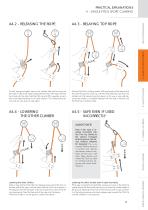
To start paying out again rope to the climber after she has hung on the rope or after a fall, keep holding the free end of the rope with one hand and with the other hold the Click Up and lift it upwards, so as to return the belay karabiner to its initial position. This unblocks the device and you can pay out rope again. A4.4 - LOWERING THE OTHER CLIMBER Lowering the other climber. Take in rope and lock the Click Up. Keeping one hand all the time on the free end of the rope, with the other hold the Click Up as shown in the diagram and with the palm of the hand push the corner of the device downwards....
Open the catalog to page 11
A5 - LEADING “Leading” is when the climber (A) climbs up the route using the natural hand- and footholds present in the rock and clipping the rope into the quickdraws clipped onto the bolts to protect herself in case of a fall. In order to climb safety the leader (A) should: • be correctly tied into the rope and the belayer (B) should belay attentively; • be aware of her own capabilities and know the appropriate climbing techniques; • be able to clip the quickdraw onto the bolt and then the rope into the quickdraw, as correctly as possible; • be able to thread the belay. The following diagrams...
Open the catalog to page 12All Climbing Technology catalogs and technical brochures
 Catalog PROFESSIONAL 2020 / 2021
196 Pages
 Catalog OUTDOOR 2021
120 Pages
 EXPLORER
2 Pages
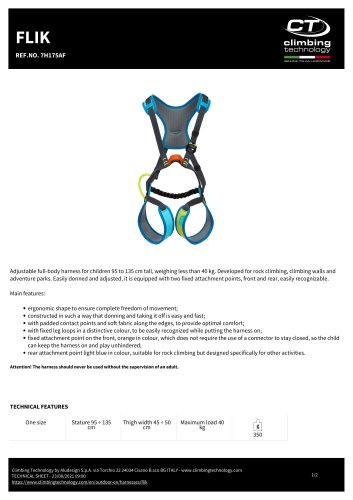 FLIK
FLIK2 Pages
 CLASSIC-K SLIDER
2 Pages
 MOON
MOON3 Pages
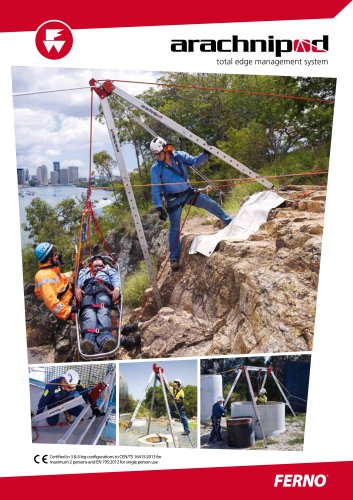 Brochure ARACHNIPOD
8 Pages
 Catalogo PROFESSIONAL 2017
196 Pages
 Catalogue OUTDOOR 2019
178 Pages
 Catalog PROFESSIONAL 2018
180 Pages