


- Company
- Products
- Catalogs
- News & Trends
- Exhibitions
FLAVOUR ENCAPSULATION PROCESS
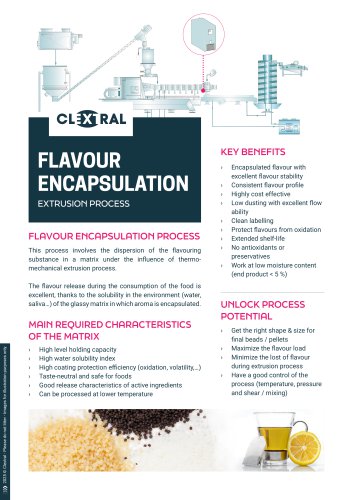
FLAVOUR ENCAPSULATION PROCESS
- Excellent flavour stability and consistent profile.
- Cost-effective with low dusting and excellent flow ability.
- Clean labelling, protecting flavours from oxidation, and extended shelf-life without antioxidants or preservatives.
- Effective at low moisture content (end product < 5%).
This process disperses the flavouring substance in a matrix through thermo-mechanical extrusion, ensuring excellent flavour release due to the solubility of the glassy matrix in water or saliva.
Flavour Encapsulation Process- High holding capacity and water solubility index.
- Efficient coating protection against oxidation and volatility.
- Taste-neutral and safe for foods with good release characteristics of active ingredients.
- Processable at lower temperatures.
- Achieve the right shape and size for final beads/pellets.
- Maximize flavour load and minimize flavour loss during extrusion.
- Maintain good control over temperature, pressure, and shear/mixing.
- Maltodextrine: 40 – 70%
- Sugar (icing): 30 – 50%
- Emulsifier: 0 – 2%
Optimize processing parameters, matrix, and flavour for the best product outcome.
Microencapsulation Techniques- Coacervation, co-crystallization, molecular inclusion, interfacial polymerization.
- Spray-drying, spray chilling/cooling, extrusion, fluidized bed.
Shapes include films, spheres, and irregular particles with structures that are porous or compact, and physical structures that are vitreous or crystalline.
Certifications- ISO 9001:2015 Certification for Quality Management.
- ISO 14001:2015 Certification for Environmental Management.
Worldwide sales contacts: [email protected], [email protected], [email protected]
Headquarters: 1 rue du Colonel Riez, 42700, Firminy, France. Phone: +33 4 77 40 31 31
Catalog excerpts
FLAVOURENCAPSULATION EXTRUSION PROCESS FLAVOUR ENCAPSULATION PROCESS This process involves the dispersion of the flavouring substance in a matrix under the influence of thermomechanical extrusion process. KEY BENEFITS > Encapsulated flavour with excellent flavour stability > Consistent flavour profile > Highly cost effective > Low dusting with excellent flow ability > Protect flavours from oxidation > Work at low moisture content (end product < 5 %) 2025 © Clextral - Please do not litter - Images for illustration purposes only The flavour release during the consumption of the food is excellent, thanks to the solubility in the environment (water, saliva...) of the glassy matrix in which aroma is encapsulated. > High level holding capacity > High water solubility index > High coating protection efficiency (oxidation, volatility,.) > Taste-neutral and safe for foods > Good release characteristics of active ingredients > Can be processed at lower temperature UNLOCK PROCESS POTENTIAL > Get the right shape & size for final beads / pellets > Maximize the flavour load > Minimize the lost of flavour during extrusion process > Have a good control of the process (temperature, pressure and shear / mixing)
Open the catalog to page 1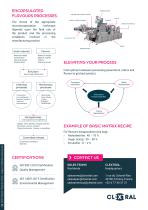
ENCAPSULATED FLAVOURS PROCESSES The choice of the appropriate microencapsulation technique depends upon the final use of the product and the processing conditions involved in the manufacturing product. Wall material Molecular weight Conformation Chemical groups Physical state Flavour Molecular weight Relative volatility Polarity Chemical groups Flavour-wall materal ratio Chemical processes › › › › Coacervation Co-crystallization Molecular inclusion Interfacial polymerization ELEVATING YOUR PROCESS Find optimum between processing parameters, matrix and flavour to get best product. Mechanical processes...
Open the catalog to page 2All Clextral catalogs and technical brochures
 EVOLUM® ROTANTE
2 Pages
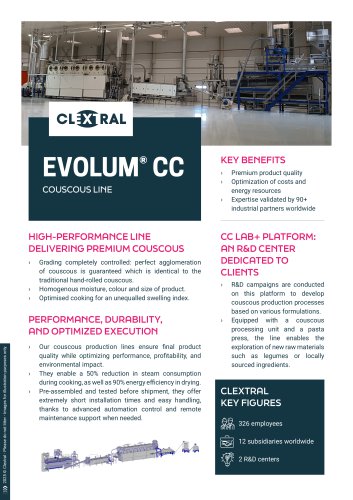 EVOLUM® CC COUSCOUS LINE
2 Pages
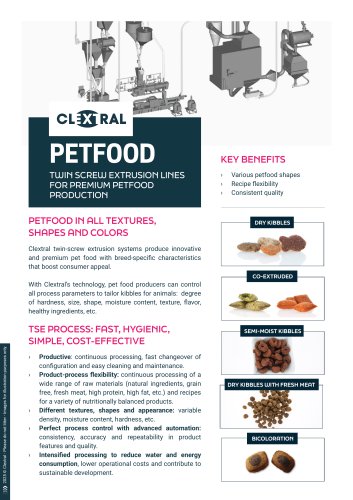 PET FOOD LINE
2 Pages
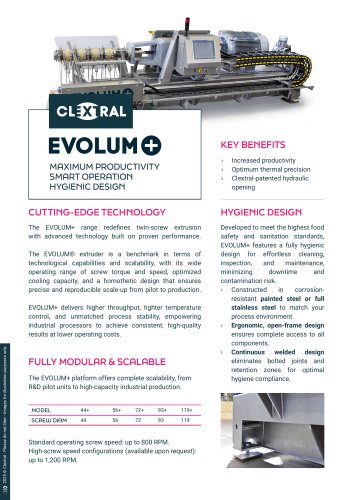 EVOLUM +
2 Pages
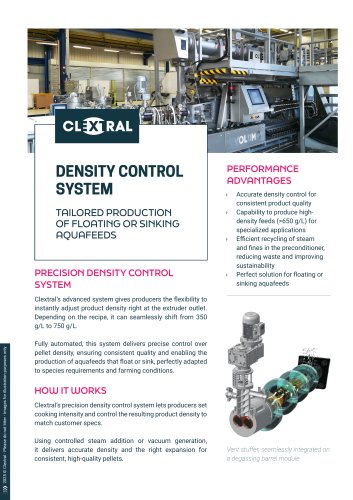 DENSITY CONTROL SYSTEM
2 Pages

- Drying system
- Dewatering system for the food industry
- Steam generator
- Compact dryer
- Processing plant
- Food coating machine
- Food extruder
- Dragée enrober
- Modular dryer
- Processing line for the food industry
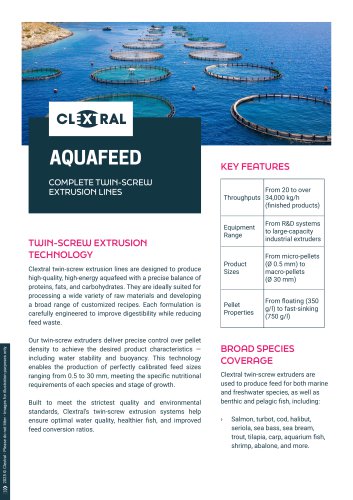
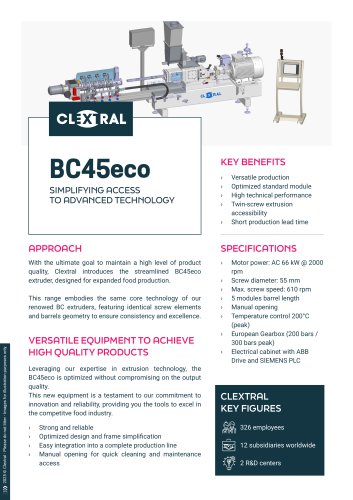
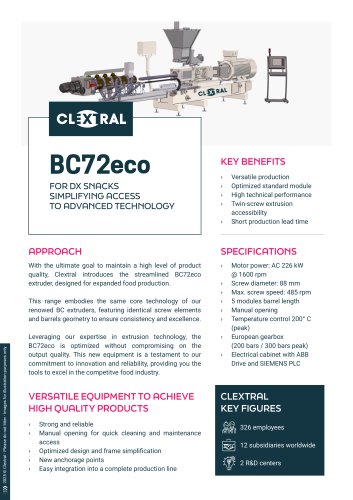
- Twin screw food extruder
- Flow conditioner
- Grain product food extruder
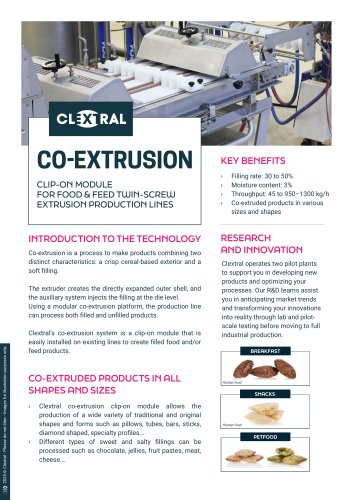
- Coextruder
- Cutting device
- Extrusion twin-screw
- Compact food extruder
- Wear-resistant extrusion twin-screw
- Single screw coextruder
- Wavy chip food extruder