
- Catalogs
- CLEMCO INDUSTRIES
- COMFORT VEST

COMFORT VEST

COMFORT VEST
This technical manual for the Comfort Vest by Clemco Industries Corp. highlights the necessity of thoroughly reading the manual to ensure operator safety and regulatory compliance.
Preface
Employers must identify job site hazards and ensure operator training. Non-compliance with OSHA regulations and manufacturer instructions can lead to severe injury or death. The equipment is unsuitable for hazardous areas as per the National Electric Code.
Regulatory Compliance
Relevant OSHA regulations include those on ventilation, noise exposure, personal protective equipment, and respiratory protection. Users should consult OSHA for comprehensive guidelines.
Product Information
Clemco's products are designed for knowledgeable users in the abrasive blast industry. Users are responsible for ensuring product suitability, efficiency, compatibility, and compliance.
General Instructions
Equipment must be installed, tested, and maintained by trained personnel. Hazards include dust, toxic materials, and physical dangers. Employers must protect workers in accordance with OSHA regulations.
Operational Instructions
Operator Safety Equipment: Respiratory protection is mandatory. Employers must implement a respiratory protection program and provide training. Avoid abrasives with over one percent crystalline silica.
Blast Machines and Remote Controls: Pressure relief valves and remote controls are essential. Exceeding pressure limits or modifying equipment can cause serious injury.
Hoses, Couplings, and Nozzle Holders: Proper sizing and installation are crucial to prevent disengagement and ensure safety.
Maintenance and Repair
Follow service instructions and maintenance intervals. Ensure equipment is depressurized before maintenance.
Warranty
The warranty covers defects in workmanship and materials for one year, excluding damages from improper use or unauthorized repairs.
Daily Setup Checklist
Operators must be trained and equipped with protective gear. Daily checks for leaks and wear are essential.
Safety Alerts
ANSI Z535.4-2011 safety alert signal words indicate potential hazards: 'Notice' for important information, 'Caution' for minor/moderate injury risks, 'Warning' for serious injury risks, and 'Danger' for situations leading to death or serious injury if not avoided.
Compressed Air Supply
Employers must ensure compliance with compressed air requirements. Air pressure and volume should meet specifications, and air quality must meet Grade D standards.
Initial Set-Up
The vest should be worn over street clothing and under protective clothing. It is flame-resistant but not fireproof. Proper protective gear is necessary to prevent serious injury or death.
Set-Up and Adjustments
Instructions include donning the vest, adjusting side straps, and connecting supply tubing. Temperature adjustments should follow manufacturer instructions.
Care and Maintenance
The vest can be dry cleaned or machine washed with mild detergent. Avoid bleach and fabric softeners. Drying should not exceed 280 degrees Fahrenheit.
Accessories and Replacement Parts
The document lists accessories and replacement parts, including temperature control tubes and service kits, identified by stock numbers for easy reference.
Catalog excerpts
© 2015 CLEMCO INDUSTRIES CORP. One Cable Car Dr. Washington, MO 63090 Phone (636) 239-4300 Fax(800)726-7559 Email: [email protected] www.clemcoindustries.com DATE OF ISSUE: May, 2007 A WARNING Do not use this equipment until you have READ this MANUAL and YOU UNDERSTAND its contents. * These WARNINGS are included for the health and safety of the operator and those in the immediate vicinity. *If you are using a Clemco Distributor Maintenance and Parts Guide, refer to the orange warnings insert preceding the Index before continuing with the enclosed instructions. Electronic files include a Preface containing important information.
Open the catalog to page 1
• Employers are responsible for identifying all job site hazards, educating and training all persons who will operate and maintain these products, and ensuring that all blast operators and their assistants understand the warnings and information contained in these instructions relating to safe and proper operation and maintenance of this equipment. • Serious injury or death can result from failure to comply with all Occupational Safety and Health Administration (OSHA)regulations and all manufacturer’s instructions. • This equipment is not intended for use in any area considered hazardous per...
Open the catalog to page 2
OPERATOR SAFETY EQUIPMENT OSHA regulation 1910.134 requires appropriate respiratory protection for blast operators and workers in the vicinity of blasting. These workers must wear properly-fitted, properly-maintained, NIOSH-approved, respiratory protection that is suitable for the job site hazards. Blast respirators are to be worn only in atmospheres not immediately dangerous to life or health from which wearers can escape without use of the respirator. The employer must develop and implement a written respiratory protection program with required worksite- specific procedures and elements for...
Open the catalog to page 3
BLAST MACHINES AND REMOTE CONTROLS OSHA regulation 1910.169 describes the necessity of pressure relief valves on compressed air equipment. Do not operate blast machines with air compressors that are not equipped with properly functioning pressure relief valves. OSHA regulation 1910.244(b) requires the use of remote controls on blast machines. Serious injury or death can result from many sources, among them: Involuntary activation of the remote controls. Never modify or substitute remote control parts; parts are not compatible among different manufacturers. Welding hose is not suitable...
Open the catalog to page 4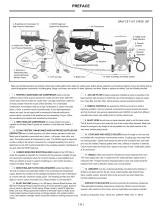
DAILY SET‐UP CHECK LIST 2. Breathing Air Compressor for High Pressure Respirators 3. NIOSH Approved Supplied-Air Respirator 6. ASME Code Blast Machine 8. Remote Controls or Ambient Air Pump for Low Pressure Respirators 7. Air Line Moisture Separator 12. Abrasive 11. Appropriately Sized Nozzle 4. External or Helmet Mounted Carbon Monoxide Monitor /Alarm 10. Hose Couplings and Safety Cables Make sure all blast operators are properly trained and suitably attired with a blast suit, safety boots, leather gloves, respiratory and hearing protection. Every day before start up, check all equipment...
Open the catalog to page 5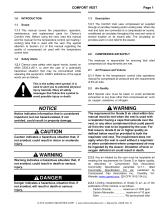
1.1.1 This manual covers the preparation, operation, maintenance, and replacement parts for Clemco’s Comfort Vest. Before using the vest, read this manual and the manual for the temperature control (air heating / cooling) tube that is used with the vest. Pay special attention to Section 2.2 of this manual regarding the quality of compressed air used with the temperature control tube. 1.2 Safety Alerts 1.2.1 Clemco uses safety alert signal words, based on ANSI Z535.4-2011, to alert the user of a potentially hazardous situation that may be encountered while operating this equipment. ANSI's definitions...
Open the catalog to page 6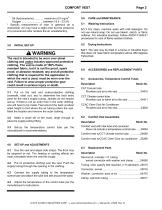
Washing Instructions INITIAL SET-UP WARNING The vest is intended to be worn over street clothing and under industry-approved protective clothing. The vest is made of 100% flame resistant fabric, but it is not fire proof, spark proof, or abrasive resistant; any and all protective clothing that is required for the application in which the vest is used, must be worn over the vest. Failure to wear proper protective gear could result in serious injury or death. 3.1 Put on the vest and outer-protective clothing (coveralls, blast suit, etc) to determine the best entry point for the vest’s supply tubing....
Open the catalog to page 7All CLEMCO INDUSTRIES catalogs and technical brochures
Archived catalogs
 Cool Air Tube (Rev. B)
2 Pages
 CALIPSO Ambient Air Pump
2 Pages
 Bulk Abrasive Blast Machines
2 Pages
 Blast Suit & Gloves (Rev. E)
2 Pages
 Pre-assembled blast-room
4 Pages
 Super Comet
4 Pages
 INEX Blast Cabinet (Rev. E)
2 Pages
 CDF Dust Collectors (Rev. C)
4 Pages
 MB series
2 Pages
 BNP Suction Blast Guns
2 Pages
 Tumble Cabinets
2 Pages
 CAP-4 Ambient Air Pump
2 Pages
 Big Clem Bulk Blast Machines
2 Pages
 Internal Pipe Tools (Rev. A)
8 Pages
 Blast Suit & Gloves (Rev. I)
2 Pages
 RPH
RPH11 Pages
 RPC-2
RPC-212 Pages
 FLAT-TRAK ®
29 Pages
 Clemco Mule
1 Page
 Pulsar III-P
2 Pages
 Operator Safety Equipment
8 Pages
 Pulsar IX Pressure PS
2 Pages
 Pulsar III-PE
2 Pages
 Pulsar III, VI & VI-P
6 Pages
 Pulsar VI-PE
2 Pages
 ZERO Automation
8 Pages
 Climate Control Tube (CCT)
2 Pages
 Apollo 60 and 600
4 Pages
 Options Plus
4 Pages
 Cabinet Dust Collectors
8 Pages
 Automated Air Blast Systems
8 Pages
 BNP A200 Series
4 Pages
 Debris Screen Basket
1 Page
 Tumble Cabinets
8 Pages
 CLASSIC SERIES
12 Pages
 Wetblast FLEX
2 Pages
 Apollo 20 HP
2 Pages
 Apollo 600
4 Pages
 Automated Air Blast Systems
6 Pages


- Manual valve
- Filter with cartridge
- Gas detector
- Dust collector
- Monitoring detector
- Miniature valve
- Flow controller
- Filter dust collector
- In-line filter
- Compressed air pre-filter
- Pneumatic flow regulator
- Detector with alarm
- Carbon monoxide detector
- Blast room
- Compact detector
- Sandblasting machine
- Recuperator
- Manual blast room