
- Catalogs
- CLEMCO INDUSTRIES
- Clem-Cool Air Conditioner with Belt (CCAC)

Clem-Cool Air Conditioner with Belt (CCAC)

Clem-Cool Air Conditioner with Belt (CCAC)
Catalog excerpts
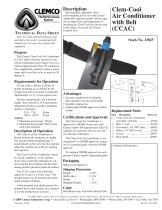
Technical Data Sheet Note: For safe, efficient blasting, read and follow the owner's manual and seek training for everyone who will use this equipment. Purpose The Clemco Clem-Cool Air Conditioner (CCAC) allows the blast operator to control the temperature and volume of air to a Clemco high-pressure Type CE continuous flow supplied-air respirator within a preset range and to cool the air by as much as 50 degrees F. Requirements for Operation 20 cfm at 90 to 100 psi of Grade D quality breathing-air as defined by the Compressed Gas Association Commodity Specification: G-7.1) (www.cganet.com) Pressure requirements vary with hose length, (hose offered in 25 ft increments) Minimum pressure to produce minimum airflow to respirator. 25 ft-75 ft 90 psi 100 ft - 200 ft 95 psi NOTES: 1. Maximum air pressure: 100 psi. 2. Maximum hose length: 200 ft when used with respirator Description of Operation The Clem-Cool Air Conditioner is placed between the respirator air supply line and the helmet breathing tube. A knurled knob on the valve lets the operator adjust the cooling rate of the air entering the respirator. The Clem-Cool Air Conditioner cannot be closed completely, so the operator always has at least the minimum air volume required for breathing and for maintaining positive pressure inside the helmet. The CCAC comes with a belt that adjusts to fit up to a 54-inch waist. The durable buckle can be fastened and unfastened with gloved hands. A belt-mounted heat shield protects the operator from warm exhaust air (a byproduct of the production of cool air). Description Belt-mounted, adjustable valve — cools breathing air for use with Clemco Apollo HP respirator models. Allows operator to adjust flow and temperature of incoming air. Clem-Cool also can be used as the source of cool air for Clemco Comfort Vest. Advantages • Increases productivity by keeping blast operator cool and comfortable • Durable construction • Lightweight NIOSH-approved comfort system Certifications and Approvals The Clem-Cool Air Conditioner is approved by NIOSH for use only with Clemco Apollo HP high-pressure Type CE supplied-air respirators (not for use with low-pressure respirators). The Clem-Cool Air Conditioner is one component of a NIOSH-approved system; use of counterfeit parts voids the NIOSH approval. To maintain NIOSH approval, use only genuine Clemco Apollo replacement parts. Packaging Ships in individual box Shipping Dimensions Height: 4-3/8" Blue/Black body with black shield & belt Clem-Cool Air Conditioner with Belt (CCAC) Item Description Stock No. ISO 9001:2000 certified. Clemco is committed to continuous product improvement. Specifications are subject to change without notice. © 2009 Clemco Industries Corp. • One Cable Car Drive • Washington, MO 63090 • Phone (636) 239-4300 • Fax (800) 726-7559 Stock No. 25396 www.clemcoindustries.com Job No. 1195-0409
Open the catalog to page 1All CLEMCO INDUSTRIES catalogs and technical brochures
Archived catalogs
 Cool Air Tube (Rev. B)
2 Pages
 CALIPSO Ambient Air Pump
2 Pages
 Bulk Abrasive Blast Machines
2 Pages
 Blast Suit & Gloves (Rev. E)
2 Pages
 Pre-assembled blast-room
4 Pages
 Super Comet
4 Pages
 INEX Blast Cabinet (Rev. E)
2 Pages
 CDF Dust Collectors (Rev. C)
4 Pages
 MB series
2 Pages
 BNP Suction Blast Guns
2 Pages
 Tumble Cabinets
2 Pages
 CAP-4 Ambient Air Pump
2 Pages
 Big Clem Bulk Blast Machines
2 Pages
 Internal Pipe Tools (Rev. A)
8 Pages
 Blast Suit & Gloves (Rev. I)
2 Pages
 RPH
RPH11 Pages
 RPC-2
RPC-212 Pages
 COMFORT VEST
7 Pages
 FLAT-TRAK ®
29 Pages
 Clemco Mule
1 Page
 Pulsar III-P
2 Pages
 Operator Safety Equipment
8 Pages
 Pulsar IX Pressure PS
2 Pages
 Pulsar III-PE
2 Pages
 Pulsar III, VI & VI-P
6 Pages
 Pulsar VI-PE
2 Pages
 ZERO Automation
8 Pages
 Climate Control Tube (CCT)
2 Pages
 Apollo 60 and 600
4 Pages
 Options Plus
4 Pages
 Cabinet Dust Collectors
8 Pages
 Automated Air Blast Systems
8 Pages
 BNP A200 Series
4 Pages
 Debris Screen Basket
1 Page
 Tumble Cabinets
8 Pages
 CLASSIC SERIES
12 Pages
 Wetblast FLEX
2 Pages
 Apollo 20 HP
2 Pages
 Apollo 600
4 Pages
 Automated Air Blast Systems
6 Pages


- Manual valve
- Filter with cartridge
- Gas detector
- Dust collector
- Monitoring detector
- Miniature valve
- Flow controller
- Filter dust collector
- In-line filter
- Compressed air pre-filter
- Pneumatic flow regulator
- Detector with alarm
- Carbon monoxide detector
- Blast room
- Compact detector
- Sandblasting machine
- Recuperator
- Manual blast room