

06160
06160
This manual provides comprehensive guidance for the Clemco Classic Blast Machine, emphasizing the necessity of understanding the manual for safety and regulatory compliance.
Employers must identify hazards and ensure operator training. Non-compliance with OSHA and manufacturer guidelines can lead to severe consequences. The equipment is unsuitable for hazardous areas as per NFPA 70 2011.
Key regulations include those on ventilation, noise exposure, and personal protective equipment. Users should refer to OSHA for detailed information.
The manual is for experienced users and does not guarantee suitability for specific applications. Production rates should be based on user experience.
Equipment must be handled by trained personnel. Hazards include dust, toxic materials, and physical dangers. Unauthorized modifications void safety approvals.
Respiratory protection is mandatory. Abrasives with more than 1% crystalline silica should be avoided.
Pressure relief valves are essential. Remote controls must remain unmodified to prevent injury.
Proper sizing and installation are crucial. Safety measures like cotter pins and cables are necessary.
Follow service instructions and ensure equipment is depressurized before maintenance.
Covers defects for one year, excluding improper use or unauthorized repairs. Claims must be made promptly.
Ensure operators are trained and equipped with safety gear, including blast suits and respiratory protection.
Includes air compressors, respirators, CO monitors, and other essential components, emphasizing maintenance and proper setup.
Highlights the importance of understanding safety alerts and potential hazards using ANSI signal words.
The machine is manually controlled and certified to ASME standards. Welding repairs require certified welders.
Guidance on selecting abrasives, avoiding those with high crystalline silica content.
Emphasizes noise reduction and the need for clean, dry air.
The choke valve should be fully open during blasting. Closing it can clear blockages.
Involves closing the inlet valve and opening the outlet valve to depressurize the machine.
Depressurize before loading and use a screen to prevent foreign objects.
Daily emptying prevents condensation issues.
Includes removing protective clothing and draining tanks.
Adjust abrasive flow for optimal cleaning.
Daily, weekly, and monthly inspections are outlined for various components.
Ensure depressurization before maintenance and replace parts as needed.
Includes height adjustment and gasket replacement procedures.
Provides solutions for common issues like no abrasive flow or machine pressurization problems.
Includes a detailed parts list for machine accessories.
Catalog excerpts
© 2017 CLEMCO INDUSTRIES CORP. One Cable Car Dr. Washington, MO 63090 Phone (636) 239-4300 Fax (800) 726-7559 Email: [email protected] www.clemcoindustries.com CLASSIC BLAST MACHINE 2 CU. FT. TO 20 CU. FT. CAPACITY WITH MANUAL CONTROLS O. M.06160 DATE OF ISSUE: 06/01/73 REVISION: N, 02/17 Do not use this equipment until you have READ this MANUAL and YOU UNDERSTAND its contents. * These WARNINGS are included for the health and safety of the operator and those in the immediate vicinity. *If you are using a Clemco Distributor Maintenance and Parts Guide, refer to the orange warnings insert preceding the Index before continuing with the enclosed instructions. Electronic files include a Preface containing the same important information as the orange cover.
Open the catalog to page 1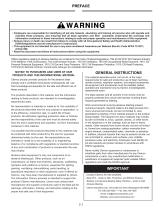
• Employers are responsible for identifying all job site hazards, educating and training all persons who will operate and maintain these products, and ensuring that all blast operators and their assistants understand the warnings and information contained in these instructions relating to safe and proper operation and maintenance of this equipment. • Serious injury or death can result from failure to comply with all Occupational Safety and Health Administration (OSHA)regulations and all manufacturer’s instructions. • This equipment is not intended for use in any area considered hazardous per...
Open the catalog to page 2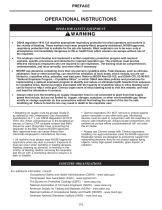
OPERATOR SAFETY EQUIPMENT • OSHA regulation 1910.134 requires appropriate respiratory protection for blast operators and workers in the vicinity of blasting. These workers must wear properly-fitted, properly-maintained, NIOSH-approved, respiratory protection that is suitable for the job site hazards. Blast respirators are to be worn only in atmospheres not immediately dangerous to life or health from which wearers can escape without use of the respirator. • The employer must develop and implement a written respiratory protection program with required worksite- specific procedures and elements...
Open the catalog to page 3
BLAST MACHINES AND REMOTE CONTROLS OSHA regulation 1910.169 describes the necessity of pressure relief valves on compressed air equipment. Do not operate blast machines with air compressors that are not equipped with properly functioning pressure relief valves. OSHA regulation 1910.244(b) requires the use of remote controls on blast machines. Serious injury or death can result from many sources, among them: Involuntary activation of the remote controls. Never modify or substitute remote control parts; parts are not compatible among different manufacturers. Welding hose is not suitable for remote...
Open the catalog to page 4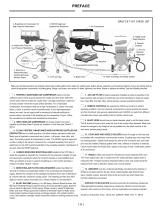
DAILY SET‐UP CHECK LIST 2. Breathing Air Compressor for High Pressure Respirators 3. NIOSH Approved Supplied-Air Respirator 6. ASME Code Blast Machine 8. Remote Controls or Ambient Air Pump for Low Pressure Respirators 7. Air Line Moisture Separator 12. Abrasive 11. Appropriately Sized Nozzle 4. External or Helmet Mounted Carbon Monoxide Monitor /Alarm 10. Hose Couplings and Safety Cables Make sure all blast operators are properly trained and suitably attired with a blast suit, safety boots, leather gloves, respiratory and hearing protection. Every day before start up, check all equipment components,...
Open the catalog to page 5
CLASSIC BLAST MACHINE with MANUAL CONTROLS 1.1.1 These instructions cover set-up, operation, maintenance, troubleshooting, and replacement parts for Clemco Classic, manually-controlled blast machines raging in size from 2 cu ft. through 20 cu ft. These instructions also contain important safety information required for safe operation of the machine. If this machine is intended for use with a blast operator, contact a Clemco distributor for the remote control system. 1.1.2 OSHA requires remote controls (valves that start and stop the blast process from a handle at the nozzle) on all blast machines,...
Open the catalog to page 6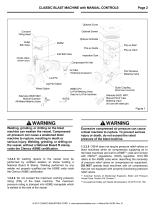
CLASSIC BLAST MACHINE with MANUAL CONTROLS Optional Cover Optional Screen Concave Filling Head Optional Umbrella Outlet Ball Valve Pop-up Seal Pop-up Guide Inlet Ball Valve Pop-up Valve Inspection Door Choke Valve (shown open) Compressed Air Inlet Air Filter *(Optional Accessory) FSV Abrasive Metering Valve Lock Pin Leg Pad Option Wheel Option Alternate 22845 MQV Manual Quantum All-Media Metering Valve 05680 LPV Lo-Pot Metering Valve Used on Lo-Pot machines Quick Coupling (blast hose connector) Alternate 04321 MPV, Manual Pinch Tube Metering Valve (for use with steel grit) WARNING Welding, grinding,...
Open the catalog to page 7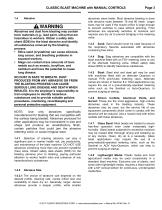
CLASSIC BLAST MACHINE with MANUAL CONTROLS 1.4 Abrasive Abrasives and dust from blasting may contain toxic materials (e.g., lead paint, silica) that are hazardous to workers. Obtain a safety data sheet (SDS) for the blast abrasive and identify all substances removed by the blasting process. • Silica sand (crystalline) can cause silicosis, lung cancer, and breathing problems in exposed workers. • Slags can contain trace amounts of toxic metals such as arsenic, beryllium, and cadmium and have the potential to cause lung disease. NO DUST IS SAFE TO BREATH. DUST PRODUCED FROM ANY ABRASIVE OR FROM...
Open the catalog to page 8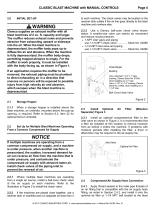
CLASSIC BLAST MACHINE with MANUAL CONTROLS INITIAL SET-UP WARNING Clemco supplies an exhaust muffler with all blast machines of 2 cu. ft. capacity and larger. The muffler reduces exhaust noise and prevents abrasive from exhausting upward or sideways into the air. When the blast machine is depressurized, the muffler body pops up to diffuse the air and abrasive. When the machine is fully depressurized, the muffler body drops, permitting trapped abrasive to empty. For the muffler to work properly, it must be installed with the body facing up, as shown in Figure 1. Close Nipple If an application...
Open the catalog to page 9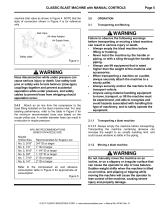
CLASSIC BLAST MACHINE with MANUAL CONTROLS AIR LINE RECOMMENDATIONS BASED ON NOZZLE SIZE Orifice Size Recommended Air Supply Line Refer to the compressed air and abrasive consumption table in Figure 6 for approximate air consumption. Hose disconnection while under pressure can cause serious injury or death. Use safety lock pins or safety wire to lock twist-on (claw-type) couplings together and prevent accidental separation while under pressure, and safety cables to prevent hose from whipping should separation occur. 2.4.2 Attach an air line from the compressor to the hose fitting installed on...
Open the catalog to page 10All CLEMCO INDUSTRIES catalogs and technical brochures
Archived catalogs
 Cool Air Tube (Rev. B)
2 Pages
 CALIPSO Ambient Air Pump
2 Pages
 Bulk Abrasive Blast Machines
2 Pages
 Blast Suit & Gloves (Rev. E)
2 Pages
 Pre-assembled blast-room
4 Pages
 Super Comet
4 Pages
 INEX Blast Cabinet (Rev. E)
2 Pages
 CDF Dust Collectors (Rev. C)
4 Pages
 MB series
2 Pages
 BNP Suction Blast Guns
2 Pages
 Tumble Cabinets
2 Pages
 CAP-4 Ambient Air Pump
2 Pages
 Big Clem Bulk Blast Machines
2 Pages
 Internal Pipe Tools (Rev. A)
8 Pages
 Blast Suit & Gloves (Rev. I)
2 Pages
 RPH
RPH11 Pages
 RPC-2
RPC-212 Pages
 COMFORT VEST
7 Pages
 FLAT-TRAK ®
29 Pages
 Clemco Mule
1 Page
 Pulsar III-P
2 Pages
 Operator Safety Equipment
8 Pages
 Pulsar IX Pressure PS
2 Pages
 Pulsar III-PE
2 Pages
 Pulsar III, VI & VI-P
6 Pages
 Pulsar VI-PE
2 Pages
 ZERO Automation
8 Pages
 Climate Control Tube (CCT)
2 Pages
 Apollo 60 and 600
4 Pages
 Options Plus
4 Pages
 Cabinet Dust Collectors
8 Pages
 Automated Air Blast Systems
8 Pages
 BNP A200 Series
4 Pages
 Debris Screen Basket
1 Page
 Tumble Cabinets
8 Pages
 CLASSIC SERIES
12 Pages
 Wetblast FLEX
2 Pages
 Apollo 20 HP
2 Pages
 Apollo 600
4 Pages
 Automated Air Blast Systems
6 Pages


- Manual valve
- Filter with cartridge
- Gas detector
- Dust collector
- Monitoring detector
- Miniature valve
- Flow controller
- Filter dust collector
- In-line filter
- Compressed air pre-filter
- Pneumatic flow regulator
- Detector with alarm
- Carbon monoxide detector
- Blast room
- Compact detector
- Sandblasting machine
- Recuperator
- Manual blast room