

04124
04124
Scope: This document provides comprehensive instructions for the setup, operation, maintenance, troubleshooting, and replacement parts for Clemco Model 1028 and Model 1042 blast machines, covering both remote-controlled and manually-controlled machines. It highlights the necessity of remote controls as per OSHA regulations when operating the nozzle.
Safety Alerts: Safety alerts follow ANSI Z535.4-1998 standards, using CAUTION, WARNING, and DANGER to indicate increasing levels of potential harm.
Description: The blast machines adhere to ASME standards and require regular maintenance for safety and compliance. Any welding or modifications must be performed by certified professionals.
Compressed Air and Abrasives Consumption: A table is provided detailing air and abrasive consumption rates based on nozzle size and pressure, emphasizing not exceeding the machine's rated pressure.
Abrasive Selection: The choice of abrasive impacts health risks, productivity, and machine maintenance. Abrasives with more than one percent crystalline silica are prohibited due to health risks.
Blast Machine Set-Up: Instructions are provided for installing air supply hose fittings and setting up remote controls.
Transporting and Moving: Machines should be emptied before lifting or transporting to avoid injury, with proper anchoring and handling procedures outlined.
Set-up: The compressor should be positioned upwind from the blasting operation, with proper connection and securing of hoses to prevent accidental disconnection and injury.
Safety cables and lock pins are essential at all quick coupling connections to prevent accidental hose disconnection, which can cause serious injury or death. Only authorized personnel with protective equipment should be near the blast machine.
1. Ensure the choke valve is open and the abrasive metering valve is closed before starting the compressor, which should not exceed 125 psi.
2. Load abrasive following specific instructions, ensuring all valves are correctly positioned for manual or remote-controlled blasting.
3. During operation, ensure the ventilation system is active, and the nozzle is directed only at intended objects.
Operators must wear protective gear, including a NIOSH-approved respirator, and test for toxic materials before blasting. Remote controls are mandatory to prevent accidents.
Adjust the abrasive flow carefully to maintain an optimal cleaning rate, and load abrasive carefully to avoid jamming the machine.
Daily and weekly inspections are crucial for machine integrity, checking for leaks, wear, and secure fittings. Monthly inspections should focus on the pop-up valve and seals.
Before maintenance, depressurize the machine and lock out the air supply. Clear blockages by manipulating the choke valve or fully opening the abrasive metering valve.
Inspect threads and fittings for wear to prevent accidental ejection under pressure. Proper maintenance and adherence to safety protocols are essential to prevent severe injuries.
- Ensure the machine is depressurized before attaching the nozzle and nozzle washer. Inspect threads on the nozzle and holder for wear to prevent ejection under pressure.
- For clearing obstructions, turn off and lockout the air supply, bleed the air line, and inspect the machine for foreign objects and moisture.
- Replace the pop-up valve by removing the inspection door, unscrewing the valve guide, and checking alignment to prevent leakage.
- Replace the pop-up seal by removing the old seal and fitting the new one into the retaining groove.
- If neither abrasive nor air comes out, depressurize the machine and check for obstructions.
- If only air comes out, adjust the abrasive metering valve or check for damp abrasive.
- For heavy abrasive flow, ensure the choke valve is open and adjust the metering valve.
- Address abrasive surging by adjusting the metering valve and depressurizing the machine rapidly.
- Intermittent flow may be due to moisture; drain moisture from the compressor and consider using a dryer.
- If the machine will not pressurize, check the compressor, air supply valves, and inspect for stuck pop-up valves or misaligned piping.
- Various accessories and parts are listed with stock numbers, including remote control systems, filters, regulators, covers, hoses, nozzles, and gaskets.
- Specific parts for models 1028 and 1042 are detailed, including pop-up seals, valves, wheels, and metering valves.
Catalog excerpts
SINGLE CHAMBER BLAST MACHINE MODELS 1028 AND 1042 O. M.04124 DATE OF ISSUE: 01/15/77 REVISION: K, 07/13 Do not proceed with these instructions* until you have READ the orange cover of this MANUAL and YOU UNDERSTAND its contents. © 2013 CLEMCO INDUSTRIES CORP. One Cable Car Dr. Washington, MO 63090 Phone (636) 239-4300 Fax (800) 726-7559 Email: [email protected] www.clemcoindustries.com These WARNINGS are included for the health and safety of the operator and those in the immediate vicinity. *If you are using a Clemco Distributor Maintenance and Part Guide, refer to the orange warnings insert preceding the Index before continuing with the enclosed instructions. Electronic files include a Preface containing the same important information as the orange cover.
Open the catalog to page 1
MODELS 1028 & 1042 BLAST MACHINES1.0 INTRODUCTION1.1 Scope 1.1.1 These instructions include the set-up, operation, maintenance, troubleshooting, and replacement parts for Clemco Model 1028 (0.5 cu ft. capacity) and Model 1042 (1.0 cu ft. capacity) blast machines. The instructions cover remote-controlled machines (when an operator controls blasting from a pneumatically operated control handle mounted at the nozzle), and manually-controlled machines (a blast machine fitted with simple ball valves at the inlet and outlet, that must be manually opened and closed to start and stop the blast process)....
Open the catalog to page 2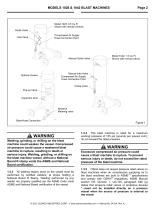
MODELS 1028 & 1042 BLAST MACHINES Model 1028, 0.5 Cu Ft Shown with remote controls Outlet Valve Compressed Air Supply Hose Connection Point Inlet Valve Manual Outlet Valve Optional Screen Model 1042, 1.0 Cu Ft. Shown with manual valves Manual Inlet Valve Compressed Air Supply Hose Connection Point Choke Valve Pop-up Valve Inspection Door Abrasive Metering valve Blast-Hose Connection WARNING Welding, grinding, or drilling on the blast machine could weaken the vessel. Compressed air pressure could cause a weakened blast machine to rupture, resulting in death or serious injury. Welding, grinding,...
Open the catalog to page 3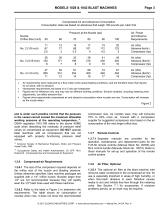
MODELS 1028 & 1042 BLAST MACHINES Compressed Air and Abrasives Consumption Consumption rates are based on abrasives that weigh 100 pounds per cubic foot Pressure at the Nozzle (psi) Air, Power • Air requirements were measured by a flow meter under actual blasting conditions, and are therefore lower than figures for air alone, with no abrasive. • Horsepower requirements are based on 4.5 cfm per horsepower. • Figures are for reference only, and may vary for different working conditions. Several variables, including metering valve adjustments, can affect abrasive flow. • Figures show approximate...
Open the catalog to page 4
MODELS 1028 & 1042 BLAST MACHINES1.4 Abrasive _A WARNING_ Obtain a material safety data sheet (MSDS) for the blast abrasive. Abrasive blasting with sands containing crystalline (free) silica can lead to serious or fatal respiratory disease. As OSHA recommends, do not use abrasives containing more than trace amounts (more than one percent) free silica. 1.4.7 Glass Bead: Most beads are treated to ensure free-flow operation even under moderately high-humidity. Glass beads subjected to excessive moisture may be reused after thorough drying and breaking up any lumps. Clean dry air is a necessity....
Open the catalog to page 5
MODELS 1028 & 1042 BLAST MACHINES 3.1.2 Moving a blast machine Never manually move a blast machine when it contains abrasive. Empty (model 1028 and 1042) machines may be moved when the following criteria are met. 3.1.2.1 An empty machine may be moved manually on level flat surfaces. 3.1.2.2 Move the machine by pushing it in a forward direction. Do not back-up while moving the machine, as potential tripping hazards cannot be seen. 3.2.1 Locate the compressor upwind and/or away from the blasting operation to prevent contaminated air from entering the compressor intake. 3.2.2 Connect a 3/4" ID or...
Open the catalog to page 6
MODELS 1028 & 1042 BLAST MACHINES 3.3 Manual Blasting. Refer to Section 3.4 for blasting with remote controls. 3.3.1 Make sure the ventilation system is running. 3.3.2 Make sure the nozzle fixture is secure and that the nozzle is directed only toward objects intended to be blast cleaned. OSHA requires remote controls on all blast machines when an operator controls the nozzle. Ignoring this warning places the operator at risk of severe injury or death from accidents that could occur from an uncontrolled blast nozzle. 3.3.3 Make sure the blasting area is contained. Abrasive blasting produces harmful...
Open the catalog to page 7
MODELS 1028 & 1042 BLAST MACHINES _A WARNING_ OSHA requires remote controls on all blast machines when an operator controls the nozzle. Do not tie down the control handle or attempt to bypass any part of the remote control system. Doing so will defeat the purpose of the fail-to-safe feature of the remote control. Severe injury or death can result from uncontrolled blasting. 3.4.7 If the abrasive metering valve is closed as instructed, in Section 3.2.6, only air will exit the nozzle. Adjust the metering valve per Section 3.5. 3.4.8 To stop blasting, release the control handle lever. The safety...
Open the catalog to page 8
MODELS 1028 & 1042 BLAST MACHINES 3.7.7 If the nozzle was removed, thoroughly inspect the nozzle holder threads for wear before installing the nozzle washer and attaching the nozzle. 3.8.1 When finished blasting, and after cleanup is completed, remove the respirator outside the respirator-use area and where the air is safe to breathe. 3.8.2 Depressurize the blast machine. 3.8.3 Close the compressed-air supply valve at the compressor. 3.8.4 Drain receiver tank, filters, and water collecting devices, and bleed the compressed-air supply hose. 3.8.6 Cover the machine when not in use. Refer to Section...
Open the catalog to page 9
MODELS 1028 & 1042 BLAST MACHINES 4.3 Monthly Inspection 4.3.1 With the air off, before blasting, inspect the • Check the pop-up valve’s urethane coating for cracks and grooves. Replace the pop-up valve at the first sign of wear. See Section 5.3. • Inspect the rubber pop-up seal, and replace at the first sign of wear, drying, or cracking. See Section 5.4. Failure to observe the following before performing any maintenance could cause serious injury or death from the sudden release of compressed air. • Depressurize the blast machine. • Lockout and tagout the compressed air supply. • Bleed the air...
Open the catalog to page 10All CLEMCO INDUSTRIES catalogs and technical brochures
Archived catalogs
 Cool Air Tube (Rev. B)
2 Pages
 CALIPSO Ambient Air Pump
2 Pages
 Bulk Abrasive Blast Machines
2 Pages
 Blast Suit & Gloves (Rev. E)
2 Pages
 Pre-assembled blast-room
4 Pages
 Super Comet
4 Pages
 INEX Blast Cabinet (Rev. E)
2 Pages
 CDF Dust Collectors (Rev. C)
4 Pages
 MB series
2 Pages
 BNP Suction Blast Guns
2 Pages
 Tumble Cabinets
2 Pages
 CAP-4 Ambient Air Pump
2 Pages
 Big Clem Bulk Blast Machines
2 Pages
 Internal Pipe Tools (Rev. A)
8 Pages
 Blast Suit & Gloves (Rev. I)
2 Pages
 RPH
RPH11 Pages
 RPC-2
RPC-212 Pages
 COMFORT VEST
7 Pages
 FLAT-TRAK ®
29 Pages
 Clemco Mule
1 Page
 Pulsar III-P
2 Pages
 Operator Safety Equipment
8 Pages
 Pulsar IX Pressure PS
2 Pages
 Pulsar III-PE
2 Pages
 Pulsar III, VI & VI-P
6 Pages
 Pulsar VI-PE
2 Pages
 ZERO Automation
8 Pages
 Climate Control Tube (CCT)
2 Pages
 Apollo 60 and 600
4 Pages
 Options Plus
4 Pages
 Cabinet Dust Collectors
8 Pages
 Automated Air Blast Systems
8 Pages
 BNP A200 Series
4 Pages
 Debris Screen Basket
1 Page
 Tumble Cabinets
8 Pages
 CLASSIC SERIES
12 Pages
 Wetblast FLEX
2 Pages
 Apollo 20 HP
2 Pages
 Apollo 600
4 Pages
 Automated Air Blast Systems
6 Pages


