
- Catalogs
- Clayton Power
- The LPS II range

The LPS II range

The LPS II range
The Lithium Power Supply (LPS) is classified as Class 9 dangerous goods (UN3480) and must be installed by authorized professionals following national safety regulations. Key safety measures include ensuring the device is off before connections, not opening the device, and avoiding weather exposure. The LPS should not be mounted upside down or on its side and must be transported in its original packaging by trained personnel.
The LPS II requires secure mounting, preferably with a Clayton Power LPS II bracket, and adequate airflow. A country-specific power cable is included, and the correct type must be used. Maintenance involves periodic charging and ensuring terminals are tightened. The device should be fully charged before storage and recharged every 6 months.
The LPS II includes energy-saving functions like automatic shutdown when no load is detected. Users can adjust settings for maximum current draw and shutdown delay. It supports adjustable AC and DC charging, jumpstart functionality, and solar charging. The menu system allows configuration of these settings.
In case of fire, extinguish the LPS with water or a CO2 extinguisher. Toxic gases may be emitted during combustion. Batteries must be recycled at approved facilities and not mixed with other waste.
The LPS II complies with directives such as the Low Voltage Directive 2014/35/EU and RoHS Directive 2011/65/EU. It is protected by various fuses and relays for safety.
The device is operated via a control panel or remote, with indicators for power status. Users can configure energy saver settings and maximum current through the menu system.
Service should be conducted by Clayton Power or authorized providers to maintain warranty. The device contains no user-serviceable parts.
- 230 VAC Output Overloaded: Error codes 150, 151, 152, 155, 156 indicate overload. Solution: Load error.
- PE/N Relay Failure: Error codes 153, 154 suggest contacting the dealer for service.
- AC Input Errors: Error codes 200, 202, 203, 204, 205, 206, 207, 208 involve issues like high charging current, internal faults, and relay errors. Solutions include restarting the device or contacting the dealer.
Clayton Power provides a 24-month warranty for the original purchaser, covering defects under normal use. The warranty is void if the device is used improperly, modified without approval, or exposed to adverse conditions.
- Models: LPS II 1500, 2500, 3000 with varying battery capacities and specifications.
- Battery Type: Li-ion with LiFePO4 chemicals.
- AC Input/Output: Voltage range of 207-253 VAC, frequency 45-65 Hz, and power output varies by model.
- DC Input/Output: Voltage range of 11.5-32 VDC, with specific power and current ratings.
- Solar Panel Input: Maximum charging power of 400 W and voltage range of 15-50 VDC.
- Operating Conditions: Temperature range of -20 to 50°C, IP21 classification, and forced air cooling.
Catalog excerpts

Manual and safety instructions | English
Open the catalog to page 1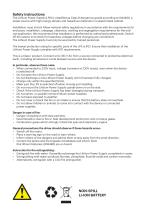
Safety instructions The Lithium Power Supply (LPS) is classified as Class 9 dangerous goods according to UN3480, a power source with high energy density and hazardous materials in a sealed metal cabinet. Installation must strictly follow national safety regulations in accordance with the requirements for enclosure, installation, creepage, clearance, marking and segregation requirements for the enduse application. We recommend that installation is performed by authorised professionals. Switch off the system and check for hazardous voltages before changing any connection! The Lithium Power Supply...
Open the catalog to page 2
All information and instructions have been prepared in accordance with current standards, industry guidelines and our many years of experience. Function overview 1 x LPS charging cable, Neutrik - CEE 7/7 1 x AC output (Neutrik grey) 4 x Caps for M8 4 x M8 screws 2 x M4 screws 4 x Rubber feet 3
Open the catalog to page 3
The LPS II must be securely fastened before use. We recommend using Clayton Power LPS II mounting bracket (not supplied as standard) for secure fastening. When installing the LPS II, sufficient space must be left around it to ensure uninterrupted airflow. NOTE: The Lithium Power Supply must not be mounted upside down or on the side. NOTE: The LPS has forced air cooling. Make sure air can flow freely around the device. Power cable A country-specific power cable is included with the LPS II. The cable comes in three different types, UK, Europe or Denmark (UK, EU, DK). Make sure you use the correct...
Open the catalog to page 4
Batteries bearing the recycling symbol must be processed through a recycling facility approved by an authority in the country concerned. If agreed, the device can be returned to the manufacturer for proper disposal. Batteries must not be mixed with other household or industrial waste. You will find an installation diagram enclosed in the LPS II box. Safety • 230 V AC input protected with 16 A fuse (non-replaceable) • 230 V AC output protected by residual current circuit breaker 30 mA | 13 A (can be replaced by Clayton Power or an authorised service provider) • DC input protected with 50 A midi...
Open the catalog to page 5
Basic operation Power ON and OFF Press the power button (12VDC/230VAC/both) on the front of the control panel or the power button on the remote to start the device. The green LED indicates power ON for either 12VDC or 230VAC. To turn off the device, press the power button. Menu To open the menu, press the "OK" button Navigate around the menu using the "UP" "DOWN" arrows and "OK" to select and "Back" to go back. Menu: 230VAC Output Status: Operation status: On/Off Power: (W)att Voltage: (V)olt Current: (A)mpere Functions: Energy saver No load Energy Saver Threshold Energy saver: No load Energy...
Open the catalog to page 6
Energy saver: Threshold The energy saver threshold is part of the save function, which specifies the power load the LPS II must be below before the timer starts. If the current again exceeds the specified level, the timer will reset and only be activated when the current falls below the level again. Factory setting is 20W. Press "OK" to go to menu - Select "230VAC Output" - Select "Energy saver (Threshold)" and press "OK". Use the arrows in the energy saver window to change the number of watts or set to zero to turn off the function. Press "OK" to activate the selected option. Menu: 230 VAC Charging...
Open the catalog to page 7
Menu: 12 VDC Charging Status: Operation status: Power: Voltage: Current: Selected Voltage: On/Off (W)att (V)olt (A)mpere 12V/24V Functions: Jumpstart functionality: Jumpstart: Set Reference Volt: Set Current: Active/Inactive On/Off Auto/12V/24V (A)mps Jumpstart functionalityJumpstart functionality is a safety feature that must be enabled before it is possible to use the jumpstart function. Press "OK" to go to menu - Select "DC Charging" - Select "Jumpstart Functionality" You can use the arrows in the Jumpstart Functionality window to choose whether the function should be active or inactive. Press...
Open the catalog to page 8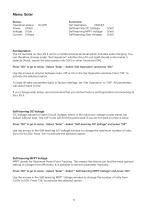
Menu: Solar Status: Operation status: On/Off Power: (W)att Voltage: (V)olt Current: (A)mps Functions: Set Operation: ON/OFF Self-learning OC Voltage: (V)olt Self-learning MPPT Voltage: (V)olt Self-learning Start Voltage: (V)olt Set Operation The C2 terminal on the LPS II unit is a multifunctional terminal which includes solar charging. You can therefore choose under "Set Operation" whether the LPS unit itself should control what it detects (Auto), search for solar panels only (OK) or other functions (Off). Press "OK" to go to menu - Select "Solar" - Select "Set Operation" and press "OK". Use...
Open the catalog to page 9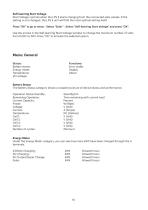
Self-learning Start Voltage Start Voltage controls when the LPS II starts charging from the connected solar panels. If the setting is not changed, the LPS II unit will find the most optimal setting itself. Press "OK" to go to menu - Select "Solar" - Select "Self-learning Start Voltage" and press "OK". Use the arrows in the Self-learning Start Voltage window to change the maximum number of volts from 0.00V to 50V. Press "OK" to activate the selected option. Menu: General Status: Battery status: Energy meter: Temperature: I/O voltage: Functions: Error codes Display About Battery Status The Battery...
Open the catalog to page 10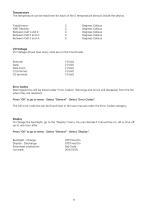
Temperature The temperature can be read here for each of the 5 temperature sensors inside the device. Transformer: IGBT Module: Between Cell 1 and 2: Between Cell 2 and 3: Between Cell 3 and 4: Degrees Celsius Degrees Celsius Degrees Celsius Degrees Celsius Degrees Celsius I/O Voltage I/O Voltage shows how many volts are on the 5 terminals. Remote: Data: Data front: C1 terminal: C2 terminal: V (Volt) V (Volt) V (Volt) V (Volt) V (Volt) Error Codes Warnings/errors will be listed under "Error Codes". Warnings and errors will disappear from the list when they are resolved. Press "OK" to go to menu...
Open the catalog to page 11All Clayton Power catalogs and technical brochures


- DC power supply
- AC/DC power supply
- DC-DC converter
- Photovoltaic solar panel
- Digital power supply
- Chassis-mounted DC/DC converter module
- Black solar panel
- DC/DC converter for the automobile industry
- Vehicle DC/DC converter module
- Battery charger power supply
- Mobile power supply
- Inverter power supply
- Polycrystalline silicon solar module
- MPPT power supply
- CIGS photovoltaic module