

Oscillating Piston Pumps, Principle of Operation

Oscillating Piston Pumps, Principle of Operation
The oscillating piston pump operates by moving a piston through an electromagnetic field generated by a rectified current. This movement compresses a spring and reduces the volume in the suction chamber, allowing liquid to flow into the pressure side. When the current pulse ends, the spring pushes the piston back, increasing pressure and closing the piston valve, directing the liquid through the pressure connection. This cycle repeats 60 times per second at 60 Hz.
Specifications
The flow rate is determined by the piston's size and displacement length. The pump can handle temporary flow stoppages without damage and is powered by 120 VAC or 24 VAC at 50/60 Hz. Flow control can be achieved through pulse width and frequency modulation.
Design and Durability
The pump features precision components, including pistons and bushings, ensuring minimal wear and long lifespan. Various material combinations allow the pump to handle different media and temperatures.
Typical Applications
These pumps are used in air conditioning systems, fuel oil transfer, boiler cleaning, water cleaning equipment, carpet cleaning equipment, heat treatment equipment, accumulators, vending machines, analytical chemical analyzers, diagnostic systems, plotting systems, and other technical equipment.
Contact Information
Clark Solutions, 10 Brent Drive, Hudson, MA 01749. Tel: 978-568-3400, Fax: 978-568-0060.
Catalog excerpts
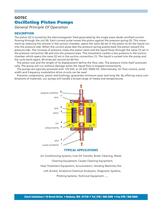
GOTEC Oscillating Piston Pumps General Principle Of Opration DESCRIPTION The piston (5) is moved by the electromagnetic field generated by the single wave diode rectified current flowing through the coil (4). Each current pulse moves the piston against the pressure spring (3). This move-ment by reducing the volume in the suction chamber, opens the valve (6) set in the piston to let the liquid run into the pressure side. When the current pulse dies the pressure spring pushes back the piston toward the pressure side. The increase of pressure closes the piston valve and the liquid flows through the valve (7) set in the pressure connection (8) and into the pressure pipe. This movement creates a low pressure in the suction chamber which opens the valve (2) set in the suction connection (1). The liquid is sucked into the pump and the cycle starts again, 60 times per second (at 60 Hz). The piston size and the length of its displacement define the flow rate. The pressure limits itself automati-cally. The pump will run without damage when the liquid flow is stopped momentarily. The pumps are typically powered with 120 VAC or 24 VAC 50/60 HZ. Alternatively, for flow control, pulse width and frequency modulation drive circuits can be used. Precision components, piston and bushings, guarantee minimum wear and long life. By offering many com-binations of materials, our pumps will handle a broad range of media and temperatures. TYPICAL APPLICATIONS Air Conditioning Systems, Fuel Oil Transfer, Boiler Cleaning, Water Cleaning Equipment, Carpet Cleaning Equipment, Heat Treatment Equipment, Accumulators, Vending Machines (for soft drinks), Analytical Chemical Analyzers, Diagnostic Systems, Plotting Systems, Technical Equipment Clark Solutions 10 Brent Drive 镕 Hudson, MA 01749 Tel. 978 / 568 3400 Օ Fax 978 / 568 0060
Open the catalog to page 1All Clark catalogs and technical brochures
 Type 525
2 Pages
 Type 520
5 Pages
 Mounting Bracket
1 Page
 9QX Series
2 Pages
 15000 series
1 Page
 BOXER
BOXER2 Pages
 CS-810 Anemometer
1 Page
 RVL Series Vortex Flowmeters
3 Pages
 Clark Sonic Ultrasonic Products
35 Pages


