
- Catalogs
- Cirrus Logic
- RC Snubber for Class-D Audio Amplifiers


- Products
- Catalogs
- News & Trends
- Exhibitions
RC Snubber for Class-D Audio Amplifiers

RC Snubber for Class-D Audio Amplifiers
Class-D audio amplifiers use high-speed switching of power MOSFETs, which can lead to output voltage over/undershoot and high-frequency ringing. This can stress the MOSFETs and cause radiated emissions, particularly problematic in portable electronics. An LC filter can reduce emissions but not voltage stress. This document describes using an RC snubber to dampen ringing and reduce stress and emissions.
Class-D amplifiers often use full-bridge architectures. Parasitic components such as inductance and capacitance in the power stage cause over/undershoot and ringing. The switching of MOSFETs and their parasitic capacitance and inductance form an LC tank circuit, leading to these issues.
An RC snubber can be added to the output of the Class-D amplifier to dampen ringing. The snubber is connected across the drain and source of the n-channel MOSFET. The design is based on empirical measurements to determine parasitic capacitance and inductance, followed by calculations to determine snubber component values.
The resonant frequency of the parasitic LC circuit is used to calculate the parasitic capacitance (COSS) and inductance (Lp). An external capacitor can help measure these values by observing changes in resonant frequency.
The snubber resistor value is calculated to achieve critical damping, minimizing overshoot. The snubber capacitor is typically chosen as three times the COSS value. The power rating of the snubber resistor is determined based on power dissipation calculations.
An example design for a CS35L41 amplifier shows how to calculate COSS, Lp, and the snubber resistor value. The design significantly reduces ringing and overshoot, as demonstrated by waveform measurements.
RC snubbers effectively reduce voltage stress and radiated emissions in Class-D amplifiers by damping parasitic LC resonances. Empirical measurements and calculations guide the design process.
The document cites several references for further reading on EMI analysis, snubber design, and Class-D amplifier design basics.
Catalog excerpts

AN_0454 RC Snubber for Class-D Audio Amplifiers INTRODUCTION High speed switching of power MOSFETs in the power stage of Class-D amplifiers results in output voltage over/undershoot and high frequency ringing on the output waveform, as shown in Figure 1. Figure 1 Class-D output over/undershoot and ringing The over/undershoot places additional stress on the power MOSFETs, potentially reducing MOSFET lifetime or, in extreme cases, causing avalanche breakdown. Copyright Cirrus Logic, Inc., 2018 (All Rights Reserved)
Open the catalog to page 1
AN_0454 The high frequency ringing can couple to nearby PCB planes and cables and is therefore a source of radiated emissions (see Reference 1). Radiated emissions can be particularly problematic in portable electronics where the Class-D amplifier may be some distance from the micro speaker and connected by a relatively long unshielded twisted pair or flex cable. An LC filter on the output of the Class-D amplifier can be used to attenuate the ringing, reducing radiated emissions. However, this does not reduce the voltage stress on the power MOSFETs. This application note describes the cause of...
Open the catalog to page 2
AN_0454 RC SNUBBER DESIGN Ringing can be almost eliminated (snubbed) by an RC network on the output of the Class-D amplifier as shown in Figure 3. RSN and CSN damp the voltage over/undershoot and ringing. Figure 3 Class-D power stage with RC snubber Adding an RC snubber damps out ringing, at the expense of increased switching losses. The snubber should be connected directly across the drain and source of the n-channel power MOSFET. The values for the power MOSFET output capacitance and IC package inductance are not always available from IC vendors. Similarly, capacitor package ESL is not readily...
Open the catalog to page 3
Once COSS is known Lp can be calculated from Equation 1: Ұݐ߰ݑ = CALCULATING SNUBBER RESISTOR VALUE Once the parasitic capacitance and inductance are known, the snubber damping resistor value can be calculated. The damping factor of a parallel RLC circuit is given by: ưݜ= pݐ߰ݑ 1 ݢȚ 2ݑ Űݑưݑ pݐ ְݑ°ݑưݑ A damping factor of 1 (critically damped) is chosen for fastest possible rise time with no overshoot (see Reference 5). So, rearranging Equation 5 for RSN: ưݐ߰ݑ 1 ݰݑ Űݑưݑ = bȚ 2 ݐ ְݑ°ݑưݑ SNUBBER CAPACITOR VALUE A good choice of snubber capacitor, CSN, for effective damping and to minimize resistor...
Open the catalog to page 4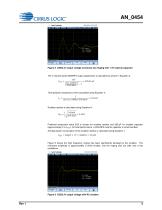
Figure 5 CS35L41 output voltage overshoot and ringing with 1 nF external capacitor The n-channel power MOSFET output capacitance is calculated as shown in Equation 2: ݐ ְݑ°ݑưݑ = Total parasitic inductance is then calculated using Equation 4: ٰݐ߰ݑ = Snubber resistor is calculated using Equation 6: 1 9.99ٰݑ۰ݐ ۰ݑ Űݑưݑ = bȚ = 3.45 Ω 2 205.45ݑݰݐ Preferred component value 3٢Ħ3 is chosen for snubber resistor and 560 pF for snubber capacitor (approximately 3 x COSS). For best performance, a C0G/NP0 ceramic capacitor is recommended. Average power consumption of the snubber resistor is calculated using...
Open the catalog to page 5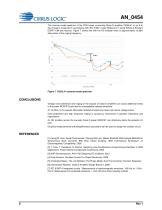
AN_0454 The common-mode spectrum of the PCB traces connecting Class-D amplifier CS35L41 to an 8 Ω, 33 µH load is measured in accordance with IEC 61967-4 (see Reference 7) using Rohde & Schwarz ESRP7 EMI test receiver. Figure 7 shows that with the RC snubber there is approximately 12 dBm attenuation at the ringing frequency. Figure 7 CS35L41 common-mode spectrum CONCLUSIONS Voltage over/undershoot and ringing on the outputs of Class-D amplifiers can cause additional stress to the power MOSFETs and lead to unacceptable radiated emissions. An LC filter on the outputs attenuates radiated emissions...
Open the catalog to page 6
Contacting Cirrus Logic Support For all product questions and inquiries, contact a Cirrus Logic Sales Representative. To find one nearest you, go to www.cirrus.com. The products and services of Cirrus Logic International (UK) Limited; Cirrus Logic, Inc.; and other companies in the Cirrus Logic group (collectively either “Cirrus Logic” or “Cirrus”) are sold subject to Cirrus Logic’s terms and conditions of sale supplied at the time of order acknowledgment, including those pertaining to warranty, indemnification, and limitation of liability. Software is provided pursuant to applicable license terms....
Open the catalog to page 7
AN 0454 REVISION HISTORY DATE
Open the catalog to page 8All Cirrus Logic catalogs and technical brochures
 Professional Service Partners
12 Pages
 CS5343/44
21 Pages
 WM0011
233 Pages
 CS4970x4
31 Pages
 CS4953xx
37 Pages
 WM9081
103 Pages
 CS42L51
84 Pages
 CS42L42
184 Pages
 CS43198
137 Pages
 CS43131
156 Pages
 CS43130
137 Pages
 CS5351
23 Pages
 CS5346
38 Pages
 CS5341/42
21 Pages
 CS35L32
51 Pages
 CS35L00/01/03
34 Pages
 Energy Measurement Brochure
13 Pages


Archived catalogs
 CS48DV2/6
2 Pages
 Mixed-Signal Audio Brochure
64 Pages






- Signal amplifying integrated circuit
- Power amplifying integrated circuit
- Compact converter
- Serial converter
- Industrial converter
- Measuring amplifier
- Voltage amplifier
- Serial receiver
- Power converter
- Digital amplifier
- Digital converter
- Microcontroller
- Current amplifier
- Digital receiver
- Isolated converter
- Analog converter
- Fast converter
- Video converter
- Programmable converter