
- Catalogs
- Cirrus Logic
- CS5341/42


- Products
- Catalogs
- News & Trends
- Exhibitions
CS5341/42

CS5341/42
- Advanced Multi-bit Delta-Sigma Architecture
- 24-bit Conversion supporting audio sample rates up to 192 kHz
- 105 dB Dynamic Range at 5 V
- -98 dB Total Harmonic Distortion plus Noise (THD+N)
- 90 mW Power Consumption
- High-Pass Filter for DC Offset Removal
- Analog/Digital Core Supplies from 3.3 V to 5 V
- Supports Logic Levels between 2.5 V and 5 V
- Low-Latency Digital Filter
- Auto-detect Mode Selection in Slave Mode
- Auto-Detect MCLK Divider
- Supports 384x MCLK/LRCK Ratios
The CS5342 is an analog-to-digital converter for digital audio systems, performing sampling, conversion, and anti-alias filtering. It outputs 24-bit values at sample rates up to 200 kHz per channel using a 5th-order, multi-bit Delta-Sigma modulator. It is suitable for commercial applications from -10° to 70° C, ideal for audio systems requiring wide dynamic range and low noise.
- Operating Conditions: Analog voltages of 3.3 V and 5.0 V
- Absolute Maximum Ratings: Exceeding limits may cause damage
- Analog Characteristics: Dynamic range and THD+N vary with voltage and mode
- Digital Filter Characteristics: Response scales with clock frequency
- Single-, Double-, and Quad-Speed Modes
- Clock Master or Slave Operation
- Serial Audio Interface
- Power-Up Sequence
- Analog Connections
- Grounding and Power Supply Decoupling
- Synchronization of Multiple Devices
- Capacitor Size on Reference Pin (FILT+)
Includes figures on stopband rejection, transition bands, and passband ripple, and tables on speed modes, mode control, and master clock frequencies.
Details power supply requirements and consumption, with a power supply rejection ratio of 65 dB. Specifies voltage levels for input/output.
Provides timing requirements for master and slave modes, including MCLK period, duty cycle, and SCLK and LRCK timing.
Describes each pin's function and connections, including MCLK, SDOUT, and power/ground connections.
Illustrates circuit connections, recommending capacitor values and connections for power, ground, and audio data processing.
Supports I²S and Left-Justified formats, with timing diagrams and format selection guidance.
Emphasizes stable power supplies, clocks, and configuration pins for reliable power-up.
Recommends filters to attenuate noise and optimize source impedance, advising against capacitors with large voltage coefficients.
Recommends arrangements and decoupling capacitor placements for high-resolution performance.
Advises using the same MCLK and LRCK for synchronous sampling in systems with multiple ADCs.
Larger capacitors recommended for optimal low-frequency distortion performance.
Defines parameters like dynamic range, THD+N, frequency response, and interchannel isolation.
Includes package dimensions and thermal characteristics for design integration.
CS5342 is a 105 dB, 192 kHz, Multi-bit Audio A/D Converter in a 16-TSSOP package, Pb-Free, with a temperature range of -10° to 70° C.
Provides dimensions for the 16L TSSOP package.
Available in tube (Order # CS5342-CZZ) and tape and reel (Order # CS5342-CZZR) formats, with an evaluation board mentioned.
Details revisions including changes to serial port timing specs, capacitor values, and output sample rate range.
Information provided "AS IS" without warranty, advising verification of the latest version before orders. Disclaimer on use in critical applications.
Contact Cirrus Logic Sales Representative via their website for inquiries.
Catalog excerpts
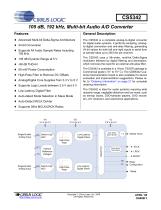
CS5342 105 dB, 192 kHz, Multi-bit Audio A/D Converter Features General Description Advanced Multi-bit Delta-Sigma Architecture The CS5342 is a complete analog-to-digital converter for digital audio systems. It performs sampling, analogto-digital conversion and anti-alias filtering, generating 24-bit values for both left and right inputs in serial form at sample rates up to 200 kHz per channel. 24-bit Conversion Supports All Audio Sample Rates Including 192 kHz The CS5342 uses a 5th-order, multi-bit Delta-Sigma modulator followed by digital filtering and decimation, which removes the need for an external anti-alias filter. 105 dB Dynamic Range at 5 V -98 dB THD+N 90 mW Power Consumption High-Pass Filter to Remove DC Offsets Analog/Digital Core Supplies from 3.3 V to 5 V Supports Logic Levels between 2.5 V and 5 V The CS5342 is available in a 16-pin TSSOP package in Commercial grade (-10° to 70° C). The CDB5342 Customer Demonstration board is also available for device evaluation and implementation suggestions. Please refer to “Ordering Information” on page 21 for complete ordering information. The CS5342 is ideal for audio systems requiring wide dynamic range, negligible distortion and low noise, such as set-top boxes, DVD-karaoke players, DVD recorders, A/V receivers, and automotive applications. Low-Latency Digital Filter Auto-detect Mode Selection in Slave Mode Auto-Detect MCLK Divider Supports 384x MCLK/LRCK Ratios Single-Ended Analog Input Auto-detect MCLK Divider Low-Latency Digital Filters Master Clock Serial Port High-Pass Filter Internal Reference Voltages Slave Mode Auto-detect Single-Ended Analog Input High-Pass Filter Low-Latency Digital Filters Copyright © Cirrus Logic, Inc. 2006 (All Rights Reserved) Mode Configuration Reset
Open the catalog to page 1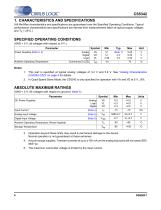
CS5342 1. CHARACTERISTICS AND SPECIFICATIONS (All Min/Max characteristics and specifications are guaranteed over the Specified Operating Conditions. Typical performance characteristics and specifications are derived from measurements taken at typical supply voltages and TA = 25°C.) SPECIFIED OPERATING CONDITIONS (GND = 0 V, all voltages with respect to 0 V.) Parameter Analog Digital Logic Power Supplies (Note 2, 3) Ambient Operating Temperature Notes: 1. This part is specified at typical analog voltages of 3.3 V and 5.0 V. See “Analog Characteristics (CS5342-CZZ)” on page 5 for details. 2. In...
Open the catalog to page 4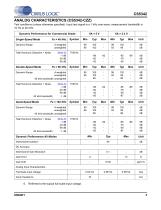
CS5342 ANALOG CHARACTERISTICS (CS5342-CZZ) Test conditions (unless otherwise specified): Input test signal is a 1 kHz sine wave; measurement bandwidth is 10 Hz to 20 kHz. Dynamic Performance for Commercial Grade Single-Speed Mode Dynamic Range Double-Speed Mode Quad-Speed Mode Dynamic Range A-weighted unweighted 40 kHz bandwidth unweighted Total Harmonic Distortion + Noise A-weighted unweighted 40 kHz bandwidth unweighted Total Harmonic Distortion + Noise A-weighted unweighted Total Harmonic Distortion + Noise Dynamic Range Interchannel Gain Mismatch Gain Error Gain Drift Dynamic Performance...
Open the catalog to page 5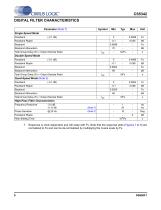
CS5342 DIGITAL FILTER CHARACTERISTICS Parameter (Note 7) Single-Speed Mode Passband Passband Ripple Stopband Stopband Attenuation Total Group Delay (Fs = Output Sample Rate) Double-Speed Mode Passband Passband Ripple Stopband Total Group Delay (Fs = Output Sample Rate) Stopband Attenuation Quad-Speed Mode (Note 2) Passband Passband Ripple Stopband Total Group Delay (Fs = Output Sample Rate) Stopband Attenuation High-Pass Filter Characteristics Frequency Response Phase Deviation Passband Ripple Filter Settling Time 7. Response is clock dependent and will scale with Fs. Note that the response plots...
Open the catalog to page 6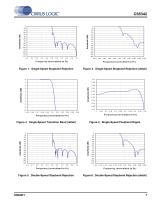
Figure 2. Single-Speed Stopband Rejection (detail) Figure 1. Single-Speed Stopband Rejection Figure 3. Single-Speed Transition Band (detail) Figure 5. Double-Speed Stopband Rejection Figure 4. Single-Speed Passband Ripple Figure 6. Double-Speed Stopband Rejection (detail)
Open the catalog to page 7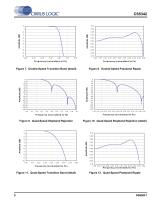
Figure 7. Double-Speed Transition Band (detail) Figure 8. Double-Speed Passband Ripple Figure 9. Quad-Speed Stopband Rejection Figure 10. Quad-Speed Stopband Rejection (detail) Figure 11. Quad-Speed Transition Band (detail) Figure 12. Quad-Speed Passband Ripple
Open the catalog to page 8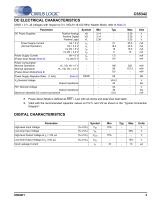
CS5342 DC ELECTRICAL CHARACTERISTICS (GND = 0 V, all voltages with respect to 0 V. MCLK=18.432 MHz; Master Mode; refer to Note 2) Parameter Positive Analog Positive Digital Positive Logic Power Supply Current (Power-down Mode) (Note 8) Power Consumption (Normal Operation) (Normal Operation) (Power-Down Mode)(Note 8) Output Impedance Output Impedance Maximum allowable DC current source/sink Power Supply Current (Normal Operation) Power Supply Rejection Ratio (1 kHz) VQ Nominal Voltage Filt+ Nominal Voltage 8. Power-Down Mode is defined as RST = Low with all clocks and data lines held static. 9....
Open the catalog to page 9
CS5342 SWITCHING CHARACTERISTICS - SERIAL AUDIO PORT (Logic "0" = GND = 0 V; Logic "1" = VL, CL = 20 pF) Parameter MCLK Specifications MCLK Period MCLK Pulse Duty Cycle Master Mode SCLK falling to LRCK SCLK falling to SDOUT valid SCLK Duty Cycle Single-Speed Double-Speed Quad-Speed Slave Mode Single-Speed (Note 10) LRCK Duty Cycle SCLK Period SCLK Duty Cycle SDOUT valid before SCLK rising SDOUT valid after SCLK rising SCLK falling to LRCK edge Double-Speed (Note 10) LRCK Duty Cycle SCLK Period (Note 11) SCLK Duty Cycle SDOUT valid before SCLK rising SDOUT valid after SCLK rising SCLK falling...
Open the catalog to page 10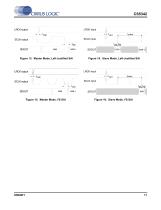
LRCK input LRCK output SCLK input SCLK output Figure 13. Master Mode, Left-Justified SAI Figure 14. Slave Mode, Left-Justified SAI LRCK input LRCK output SCLK input SCLK output Figure 15. Master Mode, I²S SAI Figure 16. Slave Mode, I²S SAI
Open the catalog to page 11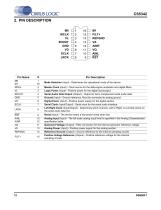
CS5342 2. PIN DESCRIPTION M0 MCLK VL SDOUT GND VD SCLK LRCK M0 M1 MCLK VL SDOUT GND VD SCLK RST AINL AINR VQ VA REFGND M1 FILT+ REFGND VA AINR VQ AINL RST Pin Description Mode Selection (Input) - Determines the operational mode of the device. Master Clock (Input) - Clock source for the delta-sigma modulator and digital filters. Logic Power (Input) - Positive power for the digital input/output. Serial Audio Data Output (Output) - Output for two’s complement serial audio data. Ground (Input) - Ground reference. Must be connected to analog ground. Digital Power (Input) - Positive power supply for...
Open the catalog to page 12All Cirrus Logic catalogs and technical brochures


Archived catalogs
 CS48DV2/6
2 Pages
 Mixed-Signal Audio Brochure
64 Pages






- Signal amplifying integrated circuit
- Power amplifying integrated circuit
- Compact converter
- Serial converter
- Industrial converter
- Measuring amplifier
- Voltage amplifier
- Serial receiver
- Power converter
- Digital amplifier
- Microcontroller
- Current amplifier
- Digital receiver
- Isolated converter
- Analog converter
- Audio amplifying integrated circuit
- Fast converter
- Video converter
- Programmable converter