


TPREG-R

TPREG-R
Catalog excerpts

TPREG R™ is a dry pre-impregnated reinforcement range with a thermoplastic THIS MATERIAL FEATURES: • The positive aspects of both thermoplastic materials (processing ease) and continuous glass fiber reinforcement (mechanical properties). • Optimizes the weight/performance ratio by using adapted yarn size. TPREG R™ + heat + pressure = consolidated composite • Sports & Leisure • Defence & Security • Building & Construction Reinforcement type Resin type
Open the catalog to page 1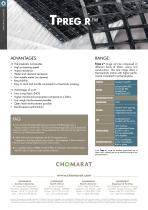
Thermoplastic Composites • High processing speed • Impact resistance • Water and chemical resistance • Few volatile matter (no styrene) • Easy to stock and handle compared to a thermodur prepreg • Higher mechanical propoerties compared to a fabric • Low weight reinforcement possible • Open mesh reinforcement possible • Reinforcement optimization 1. Can we reach the same performance as we have wiih thermoset resins ? Flexural modulus (NF EN ISO 14125) and tensile strength (ISO 527-4) have been tested and result in similar values. These properties are obtained with the right choice of matrix, yarn...
Open the catalog to page 2All Chomarat catalogs and technical brochures
 G-plyT
2 Pages
 G-WEAVE 320P
1 Page
 ROVIMAT™ 320P/300
1 Page
 G-WEAVE 75P 20 HAUT
1 Page
 G-WEAVE 60P 5PB
1 Page
 C-PLY ™
1 Page
 G-WEAVE
1 Page
 OFLEX? design
1 Page
 C-GRID: C50-2.36x4.0
1 Page
 C-GRID: C50-2.36x2.36
1 Page
 C-GRID: C50-Ox4.0
1 Page
 C-GRID: C25-Ox2.3
1 Page
 C-GRID: C12-1.5x1.5
1 Page
 Oskin-Soft
1 Page
 SINGLE SIDE ROVICORE
1 Page
 ROVIFLOW
2 Pages
 ROVICOREfireResistant
2 Pages
 ROVICORE-S-ASPECT
1 Page
 ROVICORE-line
2 Pages
 G-PLY
G-PLY2 Pages
 COREGLASS
2 Pages
 PIPE RELINING
4 Pages
 OFLEX? bio-based
1 Page
 SOLUTIONS FOR PULTRUSION
4 Pages
 Oskin-Silent
1 Page
 Oskin-Light
1 Page
 C-WEAVE
1 Page
 C-TAPE
1 Page
 CPLY
CPLY1 Page
 C-GRID: C50-Ox2.7
1 Page
 C-GRID: C50-3.54x4.0
1 Page
 C-GRID: C50-2.95x2.95
1 Page
 C-GRID: C50-1.8x1.6
1 Page
 Oskin-Even
1 Page
 Oskin-Compact
1 Page
 G-BOND
2 Pages


Archived catalogs


- Glass technical fabric
- Industrial technical fabric
- Reinforcement technical fabric
- Fabric fiber
- Reinforced technical fabric
- Coating technical fabric
- Polyester technical fabric
- Fiberglass technical fabric
- Maritime industry technical fabric
- Carbon technical fabric
- Composite technical fabric
- Glass fiber
- Rubber technical fabric
- Unidirectional technical fabric
- Aramid technical fabric
- Technical fabric for the construction industry
- Carbon fiber technical fabric
- Eco-friendly technical fabric
- Technical fabric for the textile industry