


- Products
- Catalogs
- News & Trends
- Exhibitions
SENSORS

SENSORS
Catalog excerpts

ZF Friedrichshafen AG Cherrystrasse 91275 Auerbach Germany Phone +49 9643 18-0 Fax +49 9643 18-1720 www.switches-sensors.zf.com Operating life ZF Electronic Systems Pleasant Prairie LLC 11200 88th Avenue Pleasant Prairie, Wisconsin USA 53158 Phone +1 262 942 6500 Fax +1 262 942 6566 Current sink interfacing As a solid-state device with no moving parts, the o perating life a ZF speed sensor is virtually unlimited. twitter.com/zf_konzern facebook.com/zffriedrichshafen youtube.com/zffriedrichshafenag 3-wire interface Sinking outputs are often used in negative logic appli cations, where a low signal is required for an active state. The measuring range depends on the sensor type and There, sinking outputs normally have current flowing the target, but maximum frequency is generally > 10 kHz. into the device output lead when the device is active. The target geometry must be noted when calculating Also called “open collector outputs”, sinking outputs are the frequency. With asymmetrical targets, for example, compatible with any logic family because they can be with narrow tooth widths as compared to the distances used for a wide range of supply and utput voltages. o between teeth, the time between the leading and trailing F urthermore, the supply voltage used to power the Hall edge of the tooth is the governing factor. ZF sensors have assembly may differ from the pull-up voltage to which maximum response times from approximately 10 μS it is connected. ZF Electronics Asia Limited 2 / F Technology Plaza 29–35 Sha Tsui Road Tsuen Wan, New Territories Hong Kong Phone +852 25 65 66 78 Fax +852 25 65 68 27 ZF Electronics TVS (India) Private Limited Madurai – Melur Road, Vellaripatti, Madurai – 625 122 India Phone +91 452 24 202 08 Fax +91 452 24 203 82 (MP series) to around 50 μS (GS series), due to the r esponse time of the Hall cell. If the required response The external pull-up resistor connected between time is very close to these limits, it can lead to unex the utput and supply voltage is required for proper o pected results, such as lost counts. Unlike passive speed sensors (VR or variable reluctance With the resistor connected as shown, the output will sensors), a GS sensor has an output amplitude that is be “pulled up” to the supply voltage (Vcc) level when off i ndependent of input frequency (speed). This means that and (approximately) to ground when on. the sensor does not require a minimum speed. However, it does require some initial movement of the target in o rder to locate the tooth edge. We therefore prefer to call it a “near-zero-speed” sensor. Recommended pull-up resistor values * Volts DC * Precise values supplied on request. Connection grid Sensor series Connector type 12 mm Round Wire lead Wire lead n / a n / a n / a n / a n / a n / a 12 mm Round Wire lead Delphi n / a n / a n / a n / a n / a n / a
Open the catalog to page 1
SENSORS FROM ZF deliver unmatched p erformance and reliability across a wide range of applications. They serve as economical solutions that are suitable for the most rigorous environments, including e xtreme temperatures, humidity, thermal shock, and vibrations. Choose a standard product or partner with ZF developers as they help you to create a custom solution. Customers in the automotive, appliance, and medical industries rely on ZF sensors for compact designs and durable products. Contents MP1 MAGNETIC PROXIMITY SENSORS, HALL MP2 MAGNETIC PROXIMITY SENSORS, REED GEARTOOTH SPEED SENSORS...
Open the catalog to page 2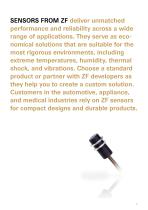
SENSORS FROM ZF deliver unmatched p erformance and reliability across a wide range of applications. They serve as economical solutions that are suitable for the most rigorous environments, including e xtreme temperatures, humidity, thermal shock, and vibrations. Choose a standard product or partner with ZF developers as they help you to create a custom solution. Customers in the automotive, appliance, and medical industries rely on ZF sensors for compact designs and durable products. Contents MP1 MAGNETIC PROXIMITY SENSORS, HALL MP2 MAGNETIC PROXIMITY SENSORS, REED GEARTOOTH SPEED SENSORS...
Open the catalog to page 3
MAGNETIC PROXIMITY SENSORS, HALL Integrated position sensors based on Hall technology respond to magnetic fields g enerated by permanent magnets. They provide a sinking current output. ∙∙Solid state reliability Magnetic proximity sensor in an adjustable Digital Hall-effect sensor in a low-profile, Digital Hall-effect sensor in a compact, ∙∙RoHs compliant cylinder housing flange-mount housing plastic, flange-mount housing ∙∙Stable output signal over the entire operating ∙∙Compatible with unregulated power supply ∙∙South pole sensitive ∙∙Flange-mount housing ∙∙South pole sensitive ∙∙North pole...
Open the catalog to page 4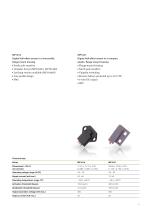
MAGNETIC PROXIMITY SENSORS, HALL Integrated position sensors based on Hall technology respond to magnetic fields g enerated by permanent magnets. They provide a sinking current output. ∙∙Solid state reliability Magnetic proximity sensor in an adjustable Digital Hall-effect sensor in a low-profile, Digital Hall-effect sensor in a compact, ∙∙RoHs compliant cylinder housing flange-mount housing plastic, flange-mount housing ∙∙Stable output signal over the entire operating ∙∙Compatible with unregulated power supply ∙∙South pole sensitive ∙∙Flange-mount housing ∙∙South pole sensitive ∙∙North pole...
Open the catalog to page 5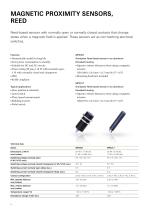
MAGNETIC PROXIMITY SENSORS, REED Reed-based sensors with normally open or normally closed contacts that change states when a magnetic field is applied. These sensors act as non-latching electrical switches. ∙∙Hermetically sealed for long life Omnipolar Reed-based sensor in an aluminum Omnipolar Reed-based sensor in a compact Omnipolar Reed-based sensor in in plastic housing ∙∙Zero power consumption in standby threaded housing plastic housing ∙∙Operate / release distances when using a magnetic ∙∙Operate / release distances when using a magnetic ∙∙Operate / release distances when using a magnetic...
Open the catalog to page 6All CHERRY catalogs and technical brochures
 SWITCHES, SENSORS & CONTROLS
32 Pages
 CHERRY SENSORS
1 Page
 MICROSWITCHES
74 Pages
 ROCKER SWITCH
24 Pages


Archived catalogs
 CHERRY - Automotive
4 Pages
- Single-pole switch
- Technology switch
- Multipole switch
- Electromechanical switch
- Rotary electric switch
- Micro-switch
- Single-pole micro-switch
- Lever micro-switch
- Mechanical switch
- LED switch
- IP40 switch
- Selector switch
- Multi-position switch
- Miniature proximity sensor
- Snap-action micro-switch
- Digital proximity sensor
- Electromechanical micro-switch
- Hall effect proximity sensor