

- Products
- Catalogs
- News & Trends
- Exhibitions
Chemitec Prooduct catalog
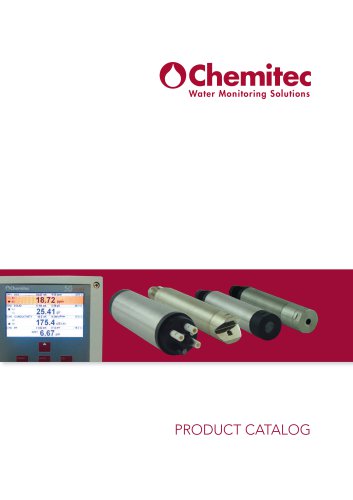
Chemitec Prooduct catalog
Chemitec, founded in 1984 in Florence, Italy, specializes in water treatment and liquid chemical analysis. With over 30 years of R&D experience, it operates in more than 80 countries and has a subsidiary in Shanghai, China. The company focuses on developing customized, user-friendly water monitoring solutions using high-quality components and innovative sensor technology.
Chemitec aims to be a global leader in online water and liquid analysis by focusing on customer needs, continuous improvement, and international presence. Their mission is to transform knowledge into innovative products.
Chemitec's products are used in various fields, including chemical processes, drinking and waste water, industrial water, cooling towers, swimming pools, and fish farming.
The company adheres to international quality standards such as CE, UL, CSA, and TR CU. Their quality management system is certified by DNV, and they comply with ISO14001 and OHSAS ISO18001 standards.
- Analyzers and Samplers: Includes sensors and controllers for parameters like pH, Redox, and conductivity.
- 50Series Controller: A flexible system for water treatment applications, supporting multiple measurements with automatic sensor recognition.
- 42Series Process Controller: Designed for industrial applications with proportional control and probe condition monitoring.
- Sensors: Models for measuring pH, Redox, conductivity, chlorine, turbidity, and more.
- Flow, Level, and Pressure Measurement: Includes flow meters, ultrasonic sensors, and pressure sensors.
- Remote Monitoring and Data Logging: Features like ChemitecWeb for remote setup and data transmission via GPRS.
The 50Series controller offers a user-friendly interface with a graphic TFT color LCD, internal data logger, programmable analog outputs, and digital output relays. It supports MODBUS RTU communication and can be expanded to traditional electrodes through digitizers.
The system features a programming keypad with five bubble-keys for calibration and configuration, including a GRAPH key for data display. It has a monochromatic display with graphic icons for status indication and data scrolling.
The intuitive programming menu allows easy control of the dosing system. It includes a data logger with a recording interval of 1 to 99 minutes, RS485 Serial Port for remote data acquisition, and a USB Port for data download. It supports analog and digital inputs for various functions and temperature compensation through PT100/PT1000 sensors.
The system measures parameters such as pH/ORP, dissolved oxygen, conductivity, turbidity, and various chemical concentrations like chlorine and ozone.
It includes programmable analog and digital outputs, set points for temperature control, and PID control capabilities. The power supply ranges from 100 to 240 Vac/dc, with optional 24 Vac/dc, and it has a power consumption of less than 7W.
The housing is made of ABS with IP66 protection, and the dimensions are 144 x 144 x 122.5 mm. It supports wall or panel mounting.
Various models are available for different applications, including high temperature and harsh chemical environments. They feature combined measurement and reference electrodes with different body materials and electrolytes.
The digital pH and ORP electrodes offer high accuracy and resistance to fouling, with features like solid reference electrolyte and IP68 protection.
These cells are designed for a wide range of applications, with different models for various conductivity ranges and operating conditions. They use materials like graphite and AISI 316 for electrodes.
These sensors offer advantages like reduced maintenance and high tolerance to coating phenomena. They are suitable for aggressive environments and have models for different mounting configurations.
The document outlines various sensors and probes used for measuring different parameters in water treatment and industrial applications. Key specifications include:
- Power supply: 12 ÷ 24Vdc, max. 2W power consumption.
- Signal interface: RS 485 Modbus RTU Protocol.
- Mechanical protection: IP68 Sensor + cable.
The sensors are applicable in various environments such as untreated water, drinking water, demineralization, reverse osmosis, ion exchangers, and more. Specific applications include swimming pools, waste water, process water, and biological treatment of waste water.
These sensors measure free chlorine, total chlorine, chlorine dioxide, ozone, peracetic acid, hydrogen peroxide, and chlorites. They feature:
- Measuring error: ±2% of the indicated value.
- Operating temperature: > 5 up to 45 °C.
- Maintenance interval: 2 weeks or more.
Utilizes Clark's cells for measuring oxygen content in liquids. Features include:
- Measuring range: 40 ppb ÷ 40 ppm.
- Operating temperature: 0 ÷ 60°C.
- Maximum pressure: 0 ÷ 4 bar.
Uses an optical method based on luminescence for measuring oxygen concentration. Key features:
- Measuring range: 0.00 to 20.00 mg/L.
- Operating temperature: -10 ÷ 60°C.
- Maximum pressure: 5 bar.
Measures turbidity using a 90° scattering method compliant with ISO 7027. Specifications include:
- Measuring ranges: 0 ÷ 100 ÷ 1000 NTU.
- Operating temperature: 0 ÷ 50°C.
- Maximum pressure: 2 bar.
Designed for high concentrations of suspended solids, these probes use infrared optical measurements. Features:
- Measuring range: 0 ÷ 50 gr/L.
- Operating temperature: 0 ÷ 50°C.
- Maximum pressure: 6 bar.
The document also describes the construction and materials used in the sensors, such as stainless steel, PVC, and special optical glasses, ensuring durability and reliability in various environmental conditions.
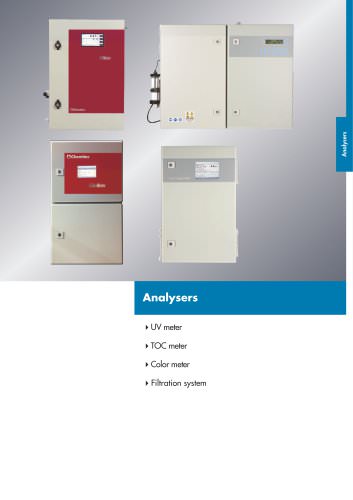
- UV Spectrophotometric Analyzers: These analyzers use UV absorption principles to measure concentrations of organic molecules, nitrates, and hydrocarbons in water. They feature automatic cleaning systems, low operating costs, and do not require reagents or consumables.
- COD and Nitrate Analyzers: Utilize UV absorption at specific wavelengths to determine concentrations. They compensate for turbidity and suspended solids using differential measurements.
- Hydrocarbon Analyzers: Employ UV fluorescence to detect low concentrations of aromatic hydrocarbons in various water types.
- TOC Analyzers: Measure total organic carbon using UV-Persulfate oxidation, suitable for continuous monitoring in industrial processes.
- SF-100 Filtration System: A self-cleaning device using compressed air for backwashing, maintaining the filter element clean and preventing rapid dirt accumulation.
- UF-TEC Filtration System: Designed for sample feeding in analyzers, it operates independently of sample conditions and includes a cleaning system controlled by the analyzer.
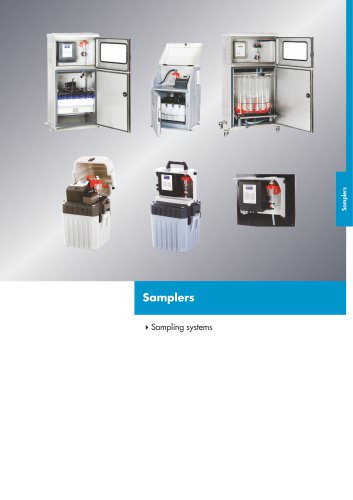
- MAXX Sampling Systems: Offer a range of models for fixed or portable use, featuring electronic control units, data logging, and remote connectivity options. They support various sampling modes and are equipped with vacuum or peristaltic pumps for accurate dosage.
- Automatic calibration and maintenance control.
- Integrated data logging and remote control capabilities.
- Compliance with international standards and minimal operating costs.
- Robust construction with stainless steel and high-grade materials for durability.
- SP5 B: A thermostat-controlled sampler housed in a plastic container with PE material insulation. It includes a control unit, dosing unit, and a distribution system for sample collection. Operating temperature ranges from -20°C to 40°C, with a power supply of 230V.
- SP5 S: Similar to SP5 B but housed in a stainless steel cabinet with two compartments. It offers enhanced durability and security with lockable doors.
- SP5 A: A self-draining version of the SP5 S, also in a stainless steel cabinet, designed for easy maintenance and inspection.
- P6: A compact unit available in two versions (P6 L and P6 Mini Maxx) with different dimensions and weights. It operates at ambient temperatures of 0°C to 45°C and includes various bottle configurations.
- TP5 W: A wall-mounted sampling head with an electronic control unit, suitable for integration into existing systems.
- TP5 C: A compact portable sampler with a PE/PC housing, offering flexibility in sample collection with its rechargeable battery and multiple bottle options.
- Ultrasonic Meters: Designed for open channels and pressurized piping, suitable for clean and dirty water. They offer high precision and are available with various connection types.
- Electromagnetic Meters: Used for conductive fluids, these meters are independent of fluid density and viscosity, making them ideal for industrial applications.
- Ultrasonic Level Measurement: Non-contact measurement suitable for liquids, featuring integrated temperature compensation and high resolution.
- Piezoresistive Transmitters: Offer high stability and accuracy for pressure measurement without separation liquid.
- Data logging capabilities with dual data loggers for instantaneous and totalized volume measurements.
- MODBUS RTU communication protocol for integration with other systems.
- Various housing materials and insulation options to suit different environmental conditions.
The document outlines various flow measurement systems and their specifications. It includes details on materials such as carbon steel and AISI 304, process temperatures ranging from -25°C to 200°C, and protection grades like IP68. Certifications such as ATEX II 2 GD EEx are mentioned.
The S101F and 200H systems use ultrasonic clamp-on or insertion transducers to measure flow rates based on the transit time of fluids in pipes. These systems are suitable for a wide range of liquids and pipe dimensions from 20 to 4000 mm. They feature DSP technology for low sensitivity to disturbances and have password-protected EEPROM for configuration values.
The DFM-5.1 and PDFM-5.1 meters use the Doppler effect to measure flow rates in liquids containing solids or air bubbles. They are non-invasive, easy to install, and suitable for various pipe materials. The meters offer features like easy programming, password protection, and data logging capabilities.
The AVFM 5.0 and STINGRAY systems measure fluid level and velocity to calculate flow rates in open channels or pipes. They use ultrasonic sensors and are designed for easy calibration and long-term data logging. The systems are suitable for various channel shapes and provide accurate measurements under specific conditions.
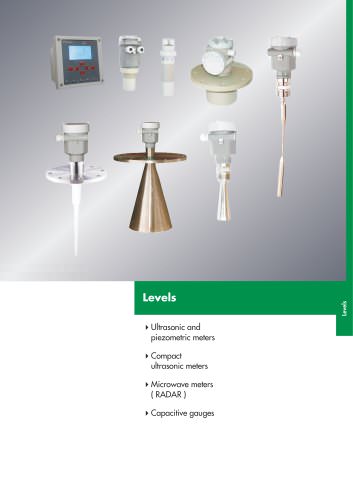
The document also describes level meters with ultrasonic or piezometric sensors, featuring automatic temperature compensation, programmable outputs, and relay outputs for pump control and alarms. Key settings include dead zone, distance, range, and level measurements.
- Ultrasonic Level Transmitters: Utilize ultrasonic pulses to measure distance and level. Key features include automatic temperature compensation, high resolution (1mm), and Modbus RTU protocol compatibility. Models like S425C offer different measuring ranges and are suitable for aggressive environments.
- Radar Level Transmitters: Use microwave technology for non-contact level measurement. They are unaffected by dust, vapors, and temperature variations. Models like RPL and RWL offer various configurations for different process conditions, with measuring ranges up to 70 meters.
- Piezoresistive Level Transmitters: Designed for hydrostatic level measurement, these transmitters offer high stability and accuracy. They feature "Dry-Pressure" technology and are suitable for harsh environments. Models like KPL and Series 36 X provide digital and analogue outputs.
- Programming of devices is facilitated through removable modules or digital communication protocols like HART and Modbus RTU.
- Initial setup includes calibration and configuration using guided menus and alphanumeric displays.
- Devices comply with various protection grades (IP66, IP67, IP68) and standards for electromagnetic interference (EMI/RFI).
- ATEX certification is available for certain models, ensuring safe operation in explosive environments.
- Ensure proper installation and calibration to achieve optimal performance and accuracy.
- Consider environmental conditions such as temperature and pressure when selecting a device model.
- Utilize digital communication options for enhanced data logging and remote monitoring capabilities.
- High precision and resolution in level measurement.
- Robust construction suitable for aggressive and demanding environments.
- Flexible installation options and easy integration with existing systems.
- Types: Absolute pressure (AA-36 X S) and relative pressure (PR-36 X S) transmitters are discussed, with specifications on pressure ranges, accuracy, and materials used.
- Specifications: The transmitters offer different pressure ranges, linearity, resolution, and stability. They are made from stainless steel and Viton, with protection grades up to IP68.
- Series 33 X and 35 X: These series provide high precision with options for digital and analogue outputs, suitable for various pressure ranges and overpressure conditions.
- ChemitecWeb: A web-based system for monitoring water quality parameters, offering remote control, data logging, and alert functionalities via SMS and email.
- SK2040 GSM Alarm: A system for monitoring and alerting through GSM, with capabilities for data logging, remote configuration, and alarm management.
- S145 Videographic Recorder: A device for recording and storing data with options for Ethernet connectivity and various input configurations.
- Communication: Devices support RS232/485 serial ports, Modbus protocols, and GPRS/Ethernet connectivity for data transmission.
- Data Management: Systems offer data storage, historical trend analysis, and real-time monitoring capabilities, with options for local and remote data access.
- Environmental Conditions: Operating and storage temperature ranges are specified for each device, ensuring functionality in various conditions.
Catalog excerpts

Water Monitoring Solutions PRODUCT CATALOG
Open the catalog to page 1
About us Founded in 1984, in Florence (Italy), Chemitec operates in more than 80 Countries and expand its international direct presence by opening a subsidiary in Shanghai (China) in 2015. Chemitec has a vast range of experience and expertise in Water Treatment and Liquid Chemical analysis. Chemitec designs, manufactures and distributes analyzers, probes, level and flowrate detection systems to industries worldwide. With a reputation for quality and service, we specialize in developing highly specific, customized and user friendly products to our discerning clients. Shanghai 2015 Our Mission to...
Open the catalog to page 2
Quality Assurance & Quality Control Chemitec is oriented to quality, by monitoring and evaluating systemically the different aspects of the design, planning (MRP), production (Kaizen) and aftersales support in order to guarantee customer satisfaction. Quality standards Chemitec develops its products according to the most demanding international quality standards (CE, UL, CSA, TR CU). The company’s quality management system UNI EN ISO 9001:2008 is certified by DNV (DET NORSKE VERITAS). Chemitec applies policies of the environmental quality and safety, making it an element of development and working...
Open the catalog to page 3
Index Sensors and Controllers
Open the catalog to page 4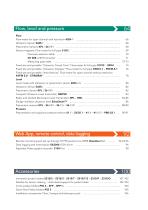
Web App, remote control, data logging
Open the catalog to page 5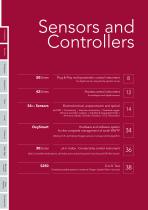
Controllers Sensors Plug & Play multi-parametric control instrument for digital sensor, plug & play system set up Process control instrument for analogue and digital sensors Electrochemical, amperometric and optical pH/ORP | Conductivity | Inductive conductivity | Dissolved oxygen Chlorine and other oxidants | Turbidity & Suspended Solids | Ammonia, Nitrate, Chloride, Potassium ( I.S.E. Electrodes ) OxySmart Pressure Hardware and software system for the complete management of small WWTP Utilizing I.S.E. and Optical Oxygen sensors in unique control algorithm pH / redox - Conductivity control instrument...
Open the catalog to page 6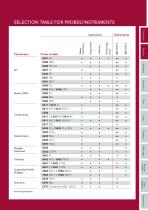
SELECTION TABLE FOR PROBES/INSTRUMENTS Suspended Solids through digitizer
Open the catalog to page 7
PLUG & PLAY MULTIPARAMETRIC INSTRUMENT Controllers Sensors Complete and flexible system for a wide range of applications in watertreatment with easy to use software and automatic recognition of sensors: available in two configurations, with up to two (2) and up to four (4) simultaneous measurements, freely selectable. Equipped with two RS485 serial ports: one (1) for sensors with RS485 digital interface and MODBUS RTU protocol and one (1) opto-isolated for the connection with the communication devices (Setup Computer, Remote Control Terminals etc.) of the local networks. Incorporates a Real Time...
Open the catalog to page 8
Communication protocol Upon request PROFIBUS DP ; CANopen; Ethernet; Devicenet; Modbus TCP ; Profinet MODBUS RTU (standard) for set-up, Real Time data communication or download of the stored data through C_NET dedicated software Analysers Samplers 50Serie 4 sensors configuration example Level J-Box Connection module Remote control Secondary Clarifier Data logging Accessories
Open the catalog to page 9
PLUG & PLAY MULTIPARAMETRIC INSTRUMENT Controllers Hardware features, software features and functions 50Series On analog or digital output Proportional range Integral and/or derivative 0:00 ÷ 5:00 min Analog Outputs Four (4) programmable ; 0/4 ÷ 20 mA ; Galvanic separation ; 1KV Optoisolator ; Maximum load 500 Ohm ; Output limits user programmable between measuring ranges Alarm output NAMUR ; 2.4 mA [with range 4 ÷ 20 mA ] Digital Outputs Six (6) ; Switching Relays usable as NO ; Maximum resistive load 3A at 230Vac Working range setting (Hysteresis/direction) ; pause/working time setting 000...
Open the catalog to page 10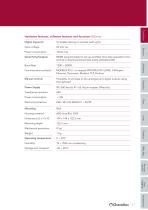
Hardware features, software features and functions 50Series To disable dosing or activate wash cycle 24 Vdc /ac 10mA max RS485 programmable for set-up and Real Time data acquisition from remote or download stored data (using dedicated SW) 1200 ÷ 38400 MODBUS RTU ; on request PROFIBUS DP SLAVE, CANopen, Ethernet, Devicenet, Modbus TCP, Profinet Possibility to simulate all the analogue and digital outputs using the keyboard Power Supply Transformer isolation Power consumption Electrical protection Housing material Mounting depth Mechanical protection Operating temperature Manual controls Communication...
Open the catalog to page 11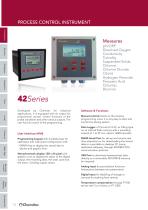
PROCESS CONTROL INSTRUMENT Controllers pH/ORP Dissolved Oxygen Conductivity Turbidity Suspended Solids Chlorine Chlorine Dioxide Ozone Hydrogen Peroxide Peracetic Acid Chlorites Bromine Analysers Samplers Flow Developed by Chemitec for industrial applications, it is equipped with an output for proportional control, control functions of the probe conditions and other various outputs. The user has full control of the programming. Software & Functions Manual controls thanks to the intuitive programming menu it is very easy to start and control the dosing system. Data Logger of Circular (F.I.F.O.)...
Open the catalog to page 12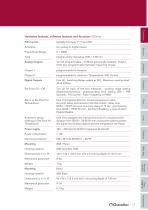
Hardware features, software features and functions 42Series Settable functions P ; PI and PID On analog or digital output 0 ÷ 500% Integral and/or derivative 0:00 ÷ 5:00 min Two (2) programmable ; 4÷20mA galvanically isolated ; Output limits user programmable between measuring ranges programmable for measure programmable for measure / Temperature / PID Control Four (4) ; Switching Relays usable as NO ; Maximum resistive load 3A at 230Vac Two (2) for each of the two measures ; working range setting (Hysteresis/direction) ; pause/working time setting 000 ÷ 999 Seconds ; PID Control ; Pulse Frequency...
Open the catalog to page 13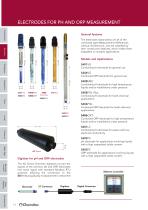
ELECTRODES FOR PH AND ORP MEASUREMENT Controllers General features The electrodes listed below are all of the combined type (Measurement+Reference), without maintenance, and are classified by their construction features, which makes them adaptable to multiple applications. Models and Applications S401VG Combined pH electrode for general use S406VG Combined ORP electrode for general use 120 mm S408MEC Combined pH electrode for high temperature liquids and/or installations under pressure Combined pH electrode for harsh chemical applications Combined ORP electrode for harsh chemical applications...
Open the catalog to page 14All CHEMITEC catalogs and technical brochures
 Chemitec 2017 product catalog
116 Pages
 Pressure
4 Pages
 Level
Level10 Pages
 Analizzatori
12 Pages
 Flow
Flow14 Pages
 Recording
3 Pages
 Remote Control
4 Pages
 Analysers
12 Pages
 Samplers
4 Pages
 4001 Photometry Series
3 Pages
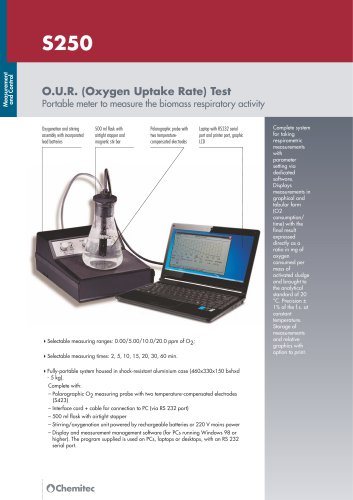 S230 O.U.R Test
2 Pages
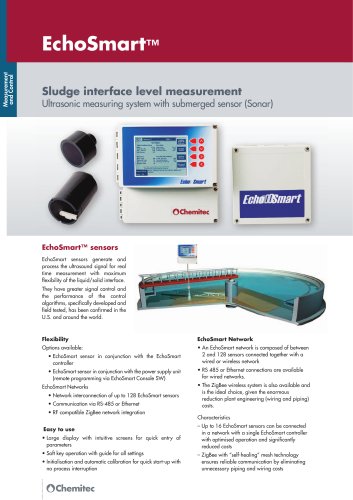 EchoSmart
2 Pages
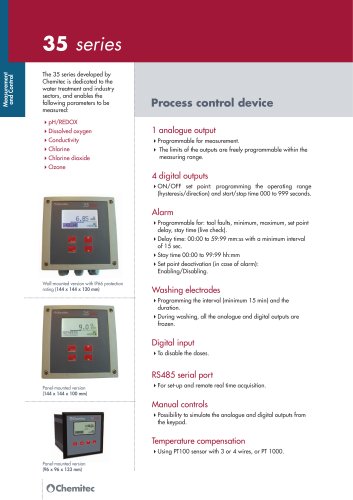 Serie 35 - Process Analysers
10 Pages
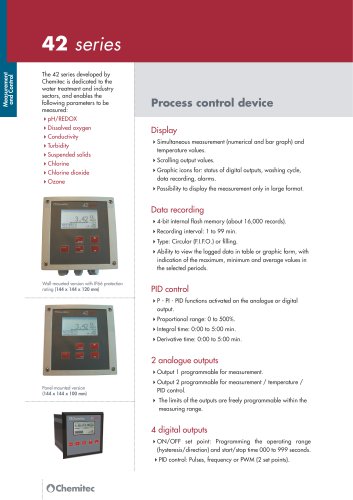 42 series - Process Analysers
16 Pages
- Volume flow monitor
- Liquid flow monitor
- Concentration analyzer
- Liquids analyzer
- Automatic analyser
- Analog pressure transmitter
- Waterproof flow meter
- Level probe
- Liquid level sensor
- Industrial flow monitor
- Portable analyzer
- Relative pressure transmitter
- In-line flow meter
- Water analyzer
- Integration analyzer
- Flow meter with display
- Compact analyzer