


CeramCool® Substrates

CeramCool® Substrates
Catalog excerpts
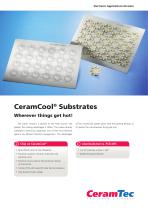
Electronic Applications Division CeramCool® Substrates Wherever things get hot! The closer ceramic is placed to the heat source, the greater the cooling advantages it offers. This makes directly of the CeramCool system grow with the packing density, so it’s perfect for use wherever things get hot! metalized CeramCool substrates one of the most efficient options for efficient thermal management. The advantages • Most efficient area of heat dissipation • Cut the substrate surface in half! • Electrical insulation, thermal conductivity and • Double the power density! electrical circuit • Electrical circuits without thermal barrier directly on CeramCool • Ceramic PCB with lowest Rtt total thermal resistance • High break-through voltage
Open the catalog to page 1
Forget about it Ceramic CeramCool substrates are electri- reduces the thermal resistance of the PCB by cally isolating, thermally conductive and can be about 50%. With Alunit the thermal resistance metalized directly. No thermal barrier blocks is negligible, so you can forget about it and en- optimal heat dissipation. This makes them per- fect for replacing a conventional PCB IMS (insulated metal substrate). Using Rubalit substrates Increase the power density Reduce the thermal resistance Alunit MC-PCB • Rubalit: Cuts thermal resistance in half • Alunit: Thermal resistance is negligible Alunit...
Open the catalog to page 2All CERAMTEC catalogs and technical brochures
 TOOLS FOR TURNING
188 Pages
 SYSTEM S3
56 Pages
 RAG
RAG37 Pages
 HARD TURNING
60 Pages
 CERAMIC INSERTS
96 Pages
 PERLUCOR® Transparent Ceramics
16 Pages
 Lasering of Ceramics
6 Pages


Archived catalogs
 Ceramic Materials
4 Pages
 SPK® PFK90-TN
132 Pages
 SPK Tools for hard materials
112 Pages
 Tools for Turning
188 Pages
 PcBn for cast iron Machining
24 Pages
 triduon thermo tames Temperature
16 Pages
 ALUTIT Aluminum Titanate
6 Pages
 ALOTEC
11 Pages
 Monolithic Multilayer Actuators
16 Pages
 New Milling Cutter Generation
36 Pages
 Materials for gas ignition
2 Pages
 SPK Tools for turning
340 Pages
 SPK Milling Tools
76 Pages


- Milling tool
- Solid milling cutter
- Steel milling cutter
- Milling tool with replaceable insert
- Clamping milling cutter
- Grade
- Face milling cutter
- Shell-end milling cutter
- Cutting milling cutter
- High-performance milling cutter
- Roughing milling cutter
- Shoulder milling cutter
- Turning grade
- Steel grade
- High-precision milling cutter
- Carbide grade
- CBN grade
- Milling cutter with negative insert
- Milling grade
- Cast iron grade